Showing posts with label Inconstant Traveler. Show all posts

Thursday, September 8, 2016

THANKS A MILLES

The Inconstant Traveler goes to Sweden!

The next time you're in Sweden visit Millesgarden, a fabulous home, art environment, terraced sculpture garden, and gallery space overlooking Stockhom Harbor.

It was created by and for sculptor Carl Milles (who studied with Rodin) and his wife, Austrian-born painter Olga Granner Milles, in the artistically simmering early decades of the last century.

This object to the left is a actually a (very thin) sponge, purchased in the gift shop, but I won't be mopping up spilled champagne with it anytime soon. I love the way its Wiener Werkstatte-inspired design and colors look on my aqua-green kitchen wall!

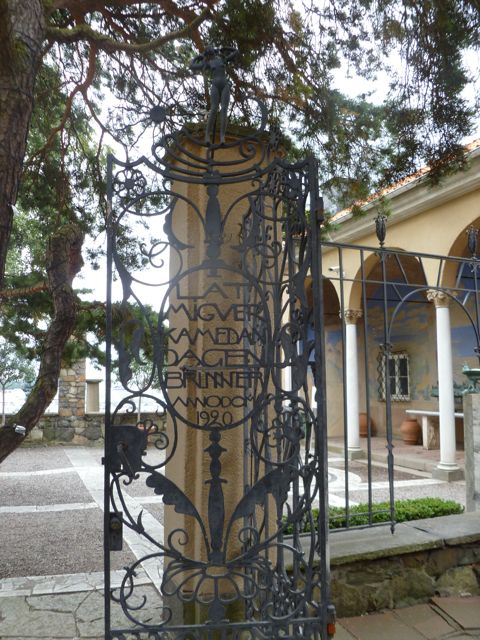
The graphic in the upper corner of the sponge replicates the design of this wrought-iron gate on the grounds. My Swedish is too rusty (okay; nonexistent) to translate the words, but I can read the date well enough: 1920.

This was right around the time the intricate, floral Art Nouveau aesthetic was starting to segue into the clean, machine-made design motifs of Art Deco.

Milles' bronze sculptures are monumental, mostly figures taken from Greek, Roman, and Christian mythology. On the grounds of Millesgarden, they are made even more imposing by their gravity-defying placement on tall, thin pedestals.

(For scale, see the tiny figures huddled at the low wall to the left, between the huge statue in the foreground, and the little spritz of water bubbling out of the fountain to its right? Those are actual people; that's how gigantic these sculptures are!)

Carl Milles' sculpture garden: monumental.
Each irregular paving stone in the terraces was placed by hand. Construction lasted for decades!

Austrian-born architect and textile designer, Josef Frank, who relocated to Sweden in the second half of his life, had a hand in some of the building on the Millesgarden grounds.

When we were there, the Millesgarden gallery was hosting an exhibition of Frank textiles, created by the Swedish design group,  Svenskt Tenn, with which Frank had a long association.

These are modern textiles based on Frank designs, shown alongside Franks' original watercolor sketches of each pattern. The colors are bold, the attitude playful, and the images abstract and amorphous, or wonderfully curvy, inspired by the fecund shapes of flowers, fruits, and leaves in nature.

Josef Frank: "Terrazzo."

Wall tapestries of Frank's designs were hung amid pieces of furniture  upholstered in these same patterns, ebulliently padded and poofy sofas, pillows, and chairs.

(Frank's dislike of hard, sharp corners is thought to have inspired Apple designer Jonathan Ive, a Frank fan, in his creation of the original blue iMac.)

I loved the designs for "Terrazzo," inspired by Italian mosaics. I also liked the starry, cloudlike silhouettes of "Zodiac," and a design based on images of historical sailing ships.

But for me, Best in Show was this whimsical riff on the classic bearskin rug (displayed only a couple of inches off the floor). The best thing about this life-sized accent piece is that it doesn't require the death of an actual animal to produce!

Oh, and the title of this piece? "Beast."


Sunday, May 31, 2015

NEW YORK STORIES

The Inconstant Traveler does NYC

Okay, I'm a beach girl. I don't know from the city. I'm not like my friend, Vivian, who used to panic if she couldn't feel concrete under her pumps. Just thinking about the fast pace of city life exhausts my brain.

Nevertheless. Although Old World cities like Paris, Prague, Vienna, and Bern might be more to my taste, the phenomenon that is New York City ought to be experienced at least once in a lifetime.

Art Boy and I had a chance to take a whirlwind 3 1/2-day trip to NYC earlier this month. Our good friend, Marta, grew up in the area and still visits several times a year; she decided she and her husband, John, should play tour guides and show us the sights. We secured a rental apartment on the Upper West Side, boarded the Jet Blue red-eye out of San Jose late on a Sunday night, and arrived at JFK around 7:30 in the morning, NY time.

I don't really sleep on planes. (Sitting upright for six hours with eyes squeezed shut is not the same thing.) Still, we knew we had to hit the ground running on such a short visit. And we had to be selective: we couldn't just wander around bug-eyed. We had to have a plan.
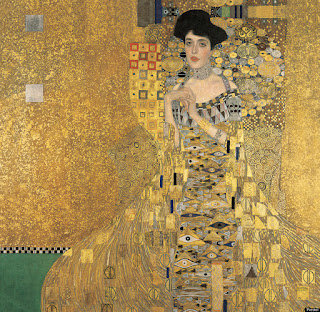
Glorious: The Woman In Gold
 The first order of business was the lengthy drive via car service into town—sadly, under a layer of fog that obscured the fabled NYC skyline. However, we discovered our apartment on W 52nd Street offered a spectacular view (see above), as soon as the fog cleared off.

Next, it was time to buy a good bottle of French champagne for my Francophile agent, to thank her for negotiating such a sweet deal for my upcoming Beast book. But my visit to her downtown office wasn't scheduled for a couple of days, and in the meantime, we had a city to explore!

Art museums were high on our list, and we'd done our homework online. So we knew Monday would be our only chance to visit the Neue Galerie, which has recently become famous as the permanent home of "The Woman In Gold (Adele Bloch-Bauer I)," masterwork of the great Gustav Klimt.

In honor of the recent movie The Woman In Gold, the Neue's current exhibit displays Adele as the jewel in a lovely setting that includes another four Klimt paintings, as well as furniture, graphics, silver, photographs, and objets d'art from Klimt's era, the glorious Viennese Secession movement.

The real Starry Night—better than a coffee mug!
But the centerpiece is "The Woman In Gold." And no matter how well you think you know a famous painting from books and print reproductions, there is nothing like seeing it in person. The complexity of Adele Bloch-Bauer's face and hair, the rich, intricate fantasia of Klimt's patterns, and all the gold leaf-on-gold detailing are simply amazing. (Up close, you can also see the variety of the initials "A" and "B" worked into those patterns.) She's worth a trip to NYC all by herself!

Adele is on permanent display, but the rest of The Woman In Gold show runs through September 7. If you're in the city between now and then, don't miss it. (And don't forget to stop by one of the two Viennese coffehouses in the building, Cafe Fledermaus or Cafe Sabarsky, for kaffe drinks and tortes—including the special Klimttorte, hazelnut cake and dark chocolate. Yum!)

The same sense of renewed awe I felt in the presence of Adele washed over me again the next say at the Museum of Modern Art when I saw Vincent Van Gogh's "The Starry Night." I don't care how many coffee mugs and tote bags you've seen with this image on them, seeing this painting for real is extraordinary. There is no substitute for standing three feet away and seeing the brush strokes and the fierceness with which they were applied, noticing how the work was evidently done in such a fury (of creativity? Hyperactivity? Possession?) that the paint doesn't even always stretch to the edge of the canvas. Talk about someone in the grip of his muse!

Bertold Loffler: oddly charming hybrid of styles
And speaking of painting in a fury, we saw a great show of outsider artists ("naive" art makers so compulsive, they are often only one step away, if not already in, an institution) at the American Folk Art Museum. This is a splendid little space on Lincoln Square that all art lovers should know about.

It has a terrific collection, hosts wonderful shows like the one we saw, When The Curtain Never Comes Down, and has a gift shop that offers not only the usual educational toys, books, postcards, and reproductions, but many pieces of genuine, original folk art, as well. Paintings, little boxes, wooden carvings, really cool stuff. Admission is free, although I encourage you to donate to the tip jar on the way in.

I had a lovely chat with my agent, the invincible Irene Goodman, first thing Wednesday morning. Her agency on the West Side is housed in a warren of small, cozy rooms with books literally stacked up everywhere—my kind of place!

Afterwards, Art Boy and I headed off for The Met (the art museum, not the opera house)—a plan only momentarily jeopardized when we flagged dow the only cabbie in NYC who doesn't know where The Met is! Fortunately for us, John and Marta (who were heading off elsewhere) were still standing curbside, so I rolled down the window and asked her to give our cabbie directions. (Hey, it's not like WE know the street address!)

Maurice Denis: weirdly evocative, even without faces
But we finally did arrive, grabbed a map and plotted our course, finding our way up to the 19th-Early 20th Century paintings exhibit. Besides the usual suspects—Picassso, Matisse, Gauguin, Renoir—we made some cool discoveries.

The decorative Vienna Secession-meets-the Pre-Raphaelites of Austrian artist Bertold Loffler's "Youth Playing the Pipes of Pan," 1912. Odilon Redon's pastel and mystical "Pandora." And the sketchy and dreamy "Springtime" by Maurice Denis, a French Symbolist artist neither of us have ever heard of.

We probably spent an hour or two wandering around, until our eyeballs couldn't absorb any more, and what we saw was maybe one twentieth—probably lots less—of the Met's exhibition space. It makes a person weep to look over the brochures, once back home again, 3000 miles away, to see all that we missed—from Greek pottery, Egyptian art, and medieval manuscripts to The Met's fabled Fashion Institute costume exhibits. *Sigh* But who had the time?


One thing we did have to make time for—Marta insisted we couldn't leave NYC without sampling them—were pastrami sandwiches from a New York deli. And they were great: paper-thin pastrami (and plenty of it!), soft rye bread, mustard and a whole pickle on the side. So NYC!

Back home in Santa Cruz, I can't really say I miss the Big City. It's nice to take life at a slower pace, to wake up to birdsong in the lemon tree outside our window instead of honking traffic, and to have cats and flowers around again. And stars! There are too many city lights to see the stars at night in NYC, which disappointed my inner Van Gogh.


On the other hand, the NYC skyline at night is its own dazzling light show. We don't get this view in Live Oak!

Monday, June 3, 2013

MYSTIC PORTALS

Here's a tip from the Inconstant Traveler. If you want to soak up the art, culture, and/or history of a place, forget the museums. Check out the doors!

I speak mainly of Europe, since I've rarely been anywhere else. (That's why my travels are inconstant!) But there is nothing so mysterious and beguiling as an Old World door you stumble across by sheer chance, on your way to someplace else.

Like this wonderful little Hobbit-like door tucked under a stone archway in the walled medieval town of Noyers-sur-Serein, in the Burgundy district of France. Art Boy and I fell in love with this door! Where does it lead? Who used it? What was its story?

That's the thing about the Old World; it's so much older than the New World! History is right there in front of you at every turn, begging to be discovered, and plumbed. If only we could find the password to get in.


Not all doors are small and atmospheric.

Some are inexplicably massive. I loved the gigantic carving (a man, a mermaid, and some sort of heraldic shield, is my best guess) above what is apparently a residential door in downtown Stockholm, Sweden.

The heavy wooden door is pretty cool too, once I get out of the way so you can see it; look at the size of that doorknob!


Another massive architectural carving decorates this arched double doorway in Leopoldstadt, Vienna, about a block away from the bridge over the Danube Canal into the Inner Stadt (downtown).

Judging from the little plaques, I think this building now houses offices—however grand a past it might have once had.

Here's another wildly carved doorway (although in a very different mood) from the Inner Stadt in Vienna.  My guess is this dates from the highly decorative 1910s or 1920s (although it could be much later).

 The figures look mythic, and from the star patterns that decorate them, I think they must represent constellations—Perseus, with the snake-haired Medusa head, on the upper left, and Andromeda, in chains, on the right.

The doors inside the alcove are impressive too; I love the contrast between the warm, brandy-colored wood and the cool grey concrete.

The buzzer placket suggests apartments or offices inside, but, sadly, unlike museums, doors you find on the street don't come with labels, so what the use or intent of this portal originally was is lost to the murky depths of Time.


Here we have another very arty door from wonderfully arty Prague.

This is half of a wrought iron gate that leads from a bustling little commercial street in Mala Strana (Little Town) into a quiet courtyard dotted with a couple of shops.

This castle-knight-ship design looks very modernist to me—possibly post-Communism—and as whimsical and charming as all of Prague.


 These ornate carved wooden double doors are attached to a small house that has stood empty for years in Mala Strana; we passed them every day when we were in Prague last summer.

Our traveling companion, Donna Mekis, poses here with Art Boy, as we all fantasize about moving in!

Sometimes it's not the door itself, but the decorations that get me.

 Look at these wonderful medieval-ish carving on a private door we passed in Prague one day in the vicinity of Nerudova Street!

They don't appear to be door knockers, but simply whimsical carvings for the sheer joy of it. The figures are not exact mirror images of each other, either, so your guess is as good as mine as to why one is upside down.

I thought they might be jesters with very stylized ass' ears, since the jester/fool is the official emblem of Prague (for a people who were as occupied and oppressed for so long as the Bohemians, what can you do but laugh?), although it's hard to tell. But the detail is amazing, especially the faces!

And finally, perhaps the most mysterious of all: this rather alarming, riveted iron door stood in an otherwise unremarkable wall of the tiny kitchen in our apartment in Vienna.

It was locked and bolted, of course, although without this pic as a reference point, I'd be tempted to remember it as being swathed with chains and padlocks—that's how forbidding it was!

It might have been a cellar door guarding dark family secrets (except it's on the fifth floor). It might have been built to keep out the Nazis during World War II.

But—like all the other mysterious doors of Europe—it's like a mystic portal into another world entirely.

Tuesday, May 21, 2013

MUCHO MUCHA

An Art Nouveau adventure in Prague with the Inconstant Traveler

From my previous posts about our adventures in Vienna and Prague last summer, readers might get the mistaken idea that all the art was in Vienna.

Not true: in addition to all its other charms, the magical city of Prague is alive with art. Centuries-old carvings, corniches and whimsically painted facades decorate just about every other building in the city.  An amble about the "New Town" section (which dates to around the turn of the last century, as opposed to the adjacent Old Town, which dates back to medieval times) is a feast of Art Nouveau architecture and decoration.

And then there's the Mucha Museum. Just off the main shopping boulevard, Na Prikope, in New Town, a couple of blocks down Panska Street, the museum is dedicated to the life and extraordinary work of Czech native son, Alfons Mucha, whose flowing, ornate style is among the most recognizable of all Art Nouveau artists.

And what a great museum it is! All on one floor, and beautifully laid out so you can follow and appreciate the chronology of Mucha's career.

An early popularizer of organic Nouveau forms, his first success was as a poster artist for Sarah Bernhardt in Fin de Siecle Paris. His revolutionary litho poster for her production of "Gismonda" (1894, above) was such a sensation, stealthy Parisian collectors crept out in the middle of the night to razor them off the kiosks!

During his Paris years, while becoming the premiere designer of advertising posters (for cigarettes, bicycles, tea, biscuits, and, of course, champagne), Mucha also produced illustrations, portraits, and decorative panels—the latter in four-part series, like "The Four Seasons," or "The Four Times of Day" (Matin, Jour, Soir, Nuit).

I love this Claire de Lune, from Mucha's four-part "The Moon and Stars" series. These pieces are not on display at the museum,  but I fell in love with the image on this bookmark in the gift shop and had to have it!

In 1910, Mucha rediscovered his roots, returned to Prague, and began creating posters and artwork celebrating Czech history and folklore, culminating in his 20-panel "Slav Epic" series of oil paintings.

These massive works are off-site, housed in the National Gallery's Veletrzni Palace, but the museum displays a large study for one of them, the haunting, enigmatic Star (or Winter Night), in which a Russian peasant woman embraces her fate on a snowy night.

Mucha's decorative lines and sinewy forms are exquisite, and it's fascinating to see some of his original drawings on display next to the printed poster versions.

Sketches and sketchbooks are also viewable in glass cases featuring the artist's designs for jewelry, furniture, and decorative motifs.

At the end of the exhibit, there's even an informative 15-minute biographical video—in English!


Stroll a few short blocks away and prepare to be dazzled by the Municipal House (Obceni Dum), begun in1906 and opened in 1912.

This block-long corner building situated on Namesti Republiky is an Art Nouveau masterpiece, from its gorgeous glass, and iron filigree, and painted and sculptural exteriors to its luscious tiled and stained glass interiors.

Among other things, the building houses three elegant restuarants and cafes—including the very cool Americky Bar in the basement—and the Smetana Concert Hall featuring Mucha-painted lintels and murals.

This is the principal venue for the Royal Prague Orchestra.

The day we visited New Town, we stopped in at Tesco (sort of the Czech Costco) on the way back to our apartment for more Bohemian Sekt ("sekt" being the all-purpose Eastern European word for champagne-like sparkling wine; we sampled sekt in Vienna as well).

Imagine our delight to find this bottle of Mucha Sekt!

The label is a lovely reproduction of a vintage Mucha champagne poster design.

Of course, we had to try it! And, of course, I had to bring the bottle home with me, in memory of our Mucha Day in Prague!

Monday, August 6, 2012

ON THE ROAD

Random travel tips from the Inconstant Traveler

Art Boy and I don't get out that much, Hobbit-like as we are in our affection for hearth and home, not to mention the kitties. (That's why I'm the Inconstant Traveler!) So on the rare occasions that we do venture out into the great world, we like to make every nanosecond count, because who knows when (or if) we'll ever be back?

After two fabulous weeks in Europe last June, one in Vienna and one in Prague, I've come up with a short checklist of ways to make the most of your precious travel time. Everybody tells me September and October are the best times to travel (better weather; fewer tourists), so if you're planning an adventure this fall, maybe these tips will be useful!

First things first: always wear slip-on shoes in airports. It's not such a big deal flying between European cities, but in US airports, you're going to have to put them in the bin at the security checkpoint, so the less time spent fooling with straps or laces, the better.

A sturdy, square-bottom tote bag, with scrunchable straps that can be folded over under the seat in front of you, is the best possible device for carrying  whatever you'll need on the plane. I used to use canvas, briefcase-shaped carry-on bags, but they tend to slump after 12 hours in the air (who doesn't?), and they're hard to get in and out of.

Once you've arrived, if you're going to be hiking around town, ladies, bring a minimal purse just big enough for cash, key, an iPhone-size camera and (if you're an obsessive note-taker like moi), a tiny note/sketch pad. (This can also double as an evening bag.) If, like me, you bring the same saddle bag you haul around back home, you'll feel like a pack mule.


If you're going to museums—which is what we spent most of our time doing, this trip—this is critical: pick up a brochure with a floor plan at the front desk and find out the exact location of what you want to see most. Then start there; otherwise, you could be wandering around dazedly for hours before you stumble across what you came to see—and by then you'll be too exhausted to appreciate it.

(Another good museum tip: bring a bottle of water in a backpack and check it in the coat room. It can get hot in museums, and they rarely have drinking fountains—especially if they're located in a former palace or monastery.)

And finally—try NOT to travel in June! Global warming is real, folks; Vienna is about the same latitude as Seattle, Prague even farther north, yet we had hot, steamy days in the uppers 80s, with 80-90% humidity, almost the entire trip. (Even when it was raining, as it was the day we walked to the Hundertwasser Museum in Vienna.)

 If you must go in June, prepare to strip down to a tank top. On the upside: despite generous helpings of strudel, Viennese sausage, Prague ham, and Bohemian Sekt (Czech sparkling wine), this is one vacation where we actually lost weight!

(Above: at the Gare de Lyon, Paris (sigh).)

Tuesday, July 10, 2012

DESPERATELY SEEKING GUSTAV

Searching for Klimt in Vienna with The Inconstant Traveler


This week (July 14, 2012, to be exact) is the 150th anniversary of the birth of hometown boy Gustav Klimt, and the museums in Vienna are hosting special Klimt events all year. I love Klimt, leader of the Secession Movement at the turn of the last century that broke away from traditional, conservative classicism to pioneer a new sensual, decorative, and expressionistic painting style.  We couldn't wait to get to Vienna last month to see the Klimts.

But like the waters in Casablanca, I found I was misinformed. It's not that there aren't any Klimts in Vienna, I just didn't always know the right places to look.

The Leopold Museum, in the Museum Quartier (a modern courtyard just south of the Innere Stadt on the edge of the surrounding Ringstrasse) has the most comprehensive exhibit: an entire floor devoted to Klimt's paintings (including this masterful Tod und Leben (Death and Life)), sketches and landscapes. There are partial recreations of lost work and a series of display boxes snaking throughout the entire exhibit space containing Klimt's lifelong correspondence with friend and patron Emilie Floge. (The Klimt exhibit runs through August 27.)

Another entire floor is devoted to the permanent exhibit, Vienna, 1900, featuring the art, graphics, furniture and objects of the Wiener Werkstatte (Vienna Workshop),  the Viennese version of the Arts and Crafts Movement that looks as stunningly modern today as ever. And yet another floor is filled with a special exhibit on Rudolf Kalvach and the next generation of graphic artists inspired by Klimt and the Wiener Werkstatte style. And as if all this wasn't enough, the Leopold also houses the largest collection of Egon Schiele's dark hypnotic, expressionist paintings in the world (and yes, that's another floor).

We all loved the Leopold, but we didn't get there until 2 pm and it closes at 6. If you go, get there early and plan to spend the whole day.

The Kunsthistorisches (Art History) Museum, just across the Ringstrasse from the MQ, heavily promotes its participation in the Klimt festivities. The museum has erected a pedestrian bridge over the staircase in the main rotunda from which to view a series of paintings between columns and over archways executed by the young Klimt as part of the interiors designed by Klimt's colleague Franz Matsch.

These depict the female spirits of Greek and Egyptian Arts in their wonderfully decorated alcoves (gazing out with their impassive, insouciant turn-of-the-century faces), a meditative Dante regarding a wistful angel in a gorgeously patterned gown, and a few other vignettes. They are fabulous, but, sadly, they are the only Klimts in the entire museum.

We were similarly—well, I wouldn't say disappointed, exactly, but surprised—by the Secession Museum, in the Opera district. Designed in 1898 to exhibit the new wave of art, the temple-like building itself is magnificent under its "onion dome" of gilded wrought iron leaves. But our mistaken expectations were disappointed in that we went in expecting the Secession museum to house art of the Secessionists.

Not so. Except for Klimt's marvelous Beethoven Frieze in the basement, the Secession remains stubbornly true to its original design as a showcase for the new and avant-garde—which in this day and age, means mostly (yawn) video installations and the like. History repeats itself; now we Klimt-lovers are the Philistines, longing for the painterly values represented by the (now old-school) Secession artists.


However, the Beethoven Frieze is well worth the price of admission. Painted in 1902 to adorn the walls high above a Secession exhibit devoted to the composer, the piece was never intended to outlive the original exhibition. But some canny collector bought and preserved it, and today the entire restored fresco is on permanent display in the climate-controlled Secession basement—where another handy bridge boosts viewers up to eye-level with Klimt's extraordinary work.
 Detail from the Stoclet House frieze

Inspired by Beethoven's Ninth Symphony (which includes the "Ode To Joy"), the frieze depicts humankind's search for happiness and meaning through arts and poetry. The journey includes an allegorical questing knight all in gold (who bears a not coincidental resemblance to Beethoven himself), who acts as guide through the various sins and horrors that plague humankind, leading at last to a chorus of inspirational angels—all culminating in a "kiss" of connection to the universe and the natural world.

(Here's a look at the Frieze in situ from the Secession website.)

(I saw a very similar allegory in an ancient, peeling 15th Century fresco painted on a wall inside St. Michael's Church a few winding side-streets away in Vienna. Only in that image, it was the Angel Michael leading humble humanity away from the Devil toward the Madonna and Christ Child. Exactly the same allegory; only the savior and the nature of salvation had evolved.)

The kiss is important to Klimt. It's the subject and title of his most famous painting, and embracing couples also figure prominently in the Beethoven Frieze and in  another larger-than-life-size mosaic frieze Klimt designed for the dining room at Stoclet House in Brussels, the private home of a wealthy patron. The enormous full-color sketch "cartoons" of this project are on view at another Vienna museum, the MAK (Museum of Applied Arts), and they're pretty spectacular. They're on the top floor, and it gets a bit stuffy in the MAK, so make sure you start there and work your way down. (And don't miss the Wiener Werkstatte artifacts in the adjoining room.)


Back home again, I found out that five of Klimt's major paintings—including The Kiss—are on view at the Belvedere, a garden palace-turned-museum far to the southeast of the Innere Stadt, and it kills me that I missed them.  My advice is, if you go to Vienna to see the Klimts, start with the Belvedere. Give yourself a whole day to soak them in. Then devote the rest of your time to the museums around the Ringstrasse—the Leopold (plan to spend the entire day!), the MAK, the Kunsthistoriches, the Wien (for the famous Portrait of Emilie Floge, which I also missed) and the Secession.

If anything, I guess I was slightly disappointed that it wasn't still 1900 in Vienna, with Klimt swanning around in his blue robe, his women/models posing in their radical, unstructured "reform" gowns, and Secession art and objets in every storefront gallery. But until they invent time travel, the Klimt anniversary celebrations in Vienna are the next best thing.

(This museum pass will get you in at a discounted rate at every Klimt exhibit in Vienna—if you can find them.)


Tuesday, July 3, 2012

WALTZING THROUGH VIENNA

More adventures with The Inconstant Traveler


Since we were going to be as close as Prague, Art Boy also wanted to visit Vienna. His main objective was to make a pilgrimage to Kunst Haus Wien, the museum devoted to 20th Century artist/designer/architect Friedensreich Hundertwasser.


This was a man who abhored the straight line. His museum (along with the residential apartment building he designed a few blocks away) is a riot of opposing colors, organic shapes, patterned tiles and mosaics, sloping floors, mismatched windows, and sudden bursts of greenery (including trees and shrubbery planted on the roof).


In the gallery rooms upstairs (walls painted deep blue, hunter green, cinnamon, steel grey, anything but boring "gallery white"),  we saw the incredibly subtle to vivid coloration and craftsmanship of Hundertwasser's "mixed media" originals (watercolor, pen, ink, gouache, gold and silver leaf, and who knows what else). Ideas and images cascade, execution is playful and passionate, and we were simply staggered by the power of the work in real life.

Art Boy in Heaven: Kunst Haus Wien


We strolled for about half an hour in a light drizzle along the south bank of the Danube Canal to get to the Hundertwasser museum, which is located a few blocks east of Vienna's central Innere Stadt (Inner City) section. (You could probably get there by tram in about ten minutes). But it was so worth it!


We also had a light lunch at the museum cafe and goggled at the extravagantly tiled bathrooms. At the end, we visited the gift shop, although all I bought was the postcard above. This wasn't about collecting souvenirs from Hundertwasser-Land. It was about diving into the experience and coming away awed!

Friday, June 29, 2012

The INCONSTANT TRAVELER: AGOG IN PRAGUE

Just back from two weeks in the Old World, and I have something to declare: I am in love with Prague!

If you ever get the chance to visit this magical place, just drop everything and go.

Prague's downtown section, Old Town, is a well-preserved, never-bombed medieval city whose ancient buildings (often grafted together from different eras) feature gargoyles, outdoor frescoes and stencil paintings, unexpected statues tucked into odd spaces, and exuberant carvings like this fanciful mermaid, floating serenely above a cobbled side-street.

We traveled with our friend, Donna Mekis, who had spent a lot of time in the city with her husband, Morton Marcus, a trip we had all hoped to take together some day. Donna and Art Boy and I made this pilgrimage in his honor; we visited Mort's favorite haunts, followed his route to Charles University (where he taught a month-long summer course one year), and ate in some of Mort's favorite cafes, toasting him all the way.

With Prague Castle and St. Vitus Cathedral on the hill overlooking the town, and dozens of green patina domes, spires and medieval towers in all directions, Prague has a dreamy fairy tale look—especially when everything is lit up at night.


 Czech history, of course, has been anything but a fairy tale—which may account for Prague's thriving puppet culture. Here are some very cool hand-carved wooden specimens I found in the shop Marionety, in Nerudova Street. (Here's a link to their online shop, although you may have to run it through Google Translator, unless your Czech is better than mine.)

The best, like these, are carved by artisans from families who have been making puppets for generations. You can find plenty of shops and vendors hawking the cheap, molded plaster variety to tourists to take home to the kiddies, but it's not really kid-stuff.

Back in the various eras of repression (in the 20th Century alone, the Czech people were occupied by the Austro-Hungarian Empire, the Nazis, the Soviets and the Communists), it was humble marionette shows traveling through rural towns and villages that lampooned the powerful and spread the audacity of hope among the people in allegorical terms only the natives would understand.

No wonder the Czech national symbol is the wily jester, as one puppet-seller told us, and jesters—benign, arch, or downright scary—appear in every puppet shop. Of course these days, along with the usual kings, princesses, clowns, Pinnocchios, devils, and puppets in traditional Czech costumes, you also find Harry Potter marionettes, Captain Jack Sparrows, a smattering of Obamas, and—freakiest of all—Michael Jacksons.


For centuries before the Czechs had their own Republic, Prague was the capitol of old Bohemia, from which we get the notion of "bohemians" as arty iconoclasts. Prague is still a hotbed of spontaneous, interactive street art.

The John Lennon wall near Kampa Island (a couple of blocks from where we were staying in Malá Strana, the Little Quarter) started going up as soon as the Communists rolled out; graffiti artists and passers-by have been layering on political slogans, peace signs, Beatles lyrics, Lennon portraits, and who-knows-what-all ever since.

I decided to go native and leave my own mark on the wall with a handy Magic Marker some previous tenant left in our rented apartment. Two days later, my endeavor was almost completely covered up by another guerrilla artist wielding pink day-glo paint. Ah, the transitory nature of art!

Here's art with a little more permanence: the Love Lock Bridge over the Certovka  (The Devil's Stream), a narrow canal that separates Kampa Island from the rest of the Little Quarter. Nobody knows who started this one, but for about eight years,  couples have thronged to this bridge to declare their love by locking padlocks around the railing.


By now, the bars and cross beam of the railing are so thick with locks, lovers have started padlocking other bridges nearby. But the ever intrepid Art Boy found a space on the original bridge for our lock, which he painted red, and which I decorated with our names and dates.


It was tricky, but he managed to secure it, then he threw the key into the canal. So I'll always feel we left a part of ourselves in Prague—and vice versa!


Monday, June 27, 2011

THE INCONSTANT TRAVELER


Notorious homebodies that we are, Art Boy and I don't travel all that much. The sun is out (yay!), the fruit trees are ripening, the succulents are blooming, the kitties are frolicking: why would we leave? But when we do—like our recent trip to the wilds of Spooner, WI, for a family reunion—we try to minimize the trauma as much as possible. It's hectic enough charting and booking the flight, reserving airport parking, and arranging for a cat-sitter. (Thank you, Marta!) Who has the time or energy to obsess over what to wear?


Well, that would be me. How I long to be one of those people who can just toss four items into a satchel (jeans, top, dress, wrap) and be ready for any adventure, from a trek through a tropical rain forest to dinner at Maxim's. (Well, neither is likely to occur in Spooner, WI, but you get my drift.) But no, I'm a Virgo; I tend to overthink the entire process, packing a little bit of everything, just in case, and ending up with three times as much stuff crammed into my suitcase as I could ever possibly wear.


Or I did, until I hit upon the Doodle Solution. A few weeks before take-off, I start doodling the options from my so-called wardrobe in my sketchbook. I start with the essentials, then do some mental spelunking into the musty depths of my closet and dresser drawers, sketching in additional items that might plausibly be coordinated. (For me, this is a much less laborious method than actually trying everything on; besides, my clothes look better when I'm not in them.) Neutrals are best for travel; in a pinch, all the pieces match (sort of). And if you focus on one color to jazz things up (for this trip, the operative color was green), you can cut way back on the amount of jewelry, shoes, and accessories you might be tempted to pack with a wider variety of costume changes.


Once I had everything drawn out, I ex-ed out a few items that seemed redundant, then drew connecting arrows between other items that might be coerced into outfits. Affter separating out what I would wear on the plane, packing the rest according to this "key" made the whole process seem less random and scary. (Although I was obviously still too discombobulated to remember what year it is when I scribbled in the date at the top. D'oh!)


Of course, the one element you can't control in even the best laid travel plans is the weather. Having Googled various weather reports for days, which yielded forecasts of 90 degrees, or rain, or both, I was expecting a typically muggy Midwestern summer, and so packed a few too many tank tops. Only at the last minute did I throw in a long-sleeved T-shirt and a sweater—which I wore just about every day in Spooner, when the weather turned cold, grey and drizzly.


Still, but for three superfluous tops, I wore everything else on this chart at least once, and was prepared for anything, from a hike through the lakeside underbrush to teatime with Grandma. The best thing is, I could have packed the entire lot in one small piece of carry-on luggage. Which we will certainly do, one carry-on apiece, next time we travel (IF we ever travel again, as Art Boy always says as soon as we get home to Santa Cruz), now that the airlines charge $25 to check the one large piece of luggage we usually share. Whatever happened to the friendly skies?


Speaking of travel to exotic places, our niece, Helena, and her boyfriend, Per, are visiting us from Sweden this week, and having a blast bombing around Santa Cruz. (This is her fourth visit, and his second.) If you have out-of-town visitors this summer, Per and Helena recommend Verve coffeehouse in Pleasure Point, the Swift Street Courtyard (especially the Bonny Doon tasting room), the Live Oak Farmers Market, and the Penny Ice Creamery downtown. (The Cardamom Pistachio Chocolate Chip gets an enthusiastic thumbs up!)