Showing posts with label Twelfth Night. Show all posts

Friday, February 14, 2020

SEA CHANGE


Heads up, Shakespeare fans! Our own Santa Cruz Shakespeare has announced its lineup for this year's summer festival season — and since it revolves around two of my favorite Shakespeare plays, I could not be more excited!

As in recent summers past, the season opener will be a non-Shakespearean offering, in this case A Flea In Her Ear, the classic French farce by Georges Feydeau, from the turn of the last century. This story of marital mistrust, miscommunication, mistaken identities and reconciliation gets a spanking new adaptation by David Ives (whose adaptation of Moliere's The Liar, back in 2015, was one of the funniest productions in the company's history).

Next up will be Twelfth Night, Shakespeare's lively comedy of romantic complications when a young woman shipwrecked on a foreign shore disguises herself as a young man to seek employment. Full of swift banter, unrequited passion, even a little swordplay, it's an adroit comedy of love, gender, and identity that never goes out of style.
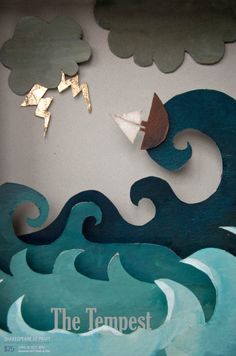

Cut-out poster, Pratt Institute, 2012
But I may be most excited about The Tempest, Shakespeare's last play, and the grand finale of his career, a gorgeous feast of magic and redemption. Duke Prospero, the sorcerer, is usurped by his conniving brother and exiled with his daughter to an uncharted island. With help of his spirit familiars, he causes a shipwreck that delivers his enemies into his power for a day of retribution, romance, and — ultimately — reconciliation.

The Tempest is categorized as a romance (what we might call in modern parlance magic realism), depending on magic, spells, and sorcery to advance the plot. With its scheming royals, drunken clowns, young lovers, antic, otherworldly spirits, disappearing banquets, and exuberant pageantry (as well as its undercurrent of slavery vs. freedom), its effects can be as subtle or spectacular as the playmakers can dream up. 

One previous production of the play (in the company's former incarnation as Shakespeare Santa Cruz) used Balinese shadow puppets and masks to convey the magical elements. In another, director Danny Scheie riffed on Gilligan's Island, with uneven results, but also included a magnificent Ariel, Prospero's chief magical minion, soaring above the action on a trapeze.


The Tempest a la Balinese
A more recent production, set in the Art Noveau era, emphasized the story's humanism, the burgeoning cult of Nature, and the merging of spiritualism with the supernatural.

This will be the company's fourth production of The Tempest, and its first-ever helmed by Artistic Director Mike Ryan, making his debut in the director's chair. I can't wait! Especially since my next novel (under construction as we speak) imagines the further adventures of Prospero's daughter!

The recurring themes of shipwreck and redemption in this year's playlist prompts Ryan to adopt Sea Change as this season's unofficial title. As he explains it, “All of our 2020 plays center around someone (or someones) who are shipwrecked, sometimes physically, sometimes emotionally, and sometimes in both ways. These stories ask questions about how we find our way past disaster, impotence, and emotional stagnancy to find fertile ground in renewed joy, love, and hope.”

Finding our way past disaster through love and hope could not be more timely, in our current cultural climate. But, here, I'll let Mike tell you all about it himself!

Meanwhile — full steam ahead!

Saturday, April 16, 2016

SHAKES @ 400

Pop those corks! William Shakespeare's 400th anniversary is almost upon us!

Okay, the quadricentennial of his birth was celebrated back in 1964. But next week, April 23, is the 400th anniversary of his death (which was also his 52nd birthday, back in 1616), and why wait another 48 years to throw a party?

And there is much to celebrate in a low-born scribe (his father was a glove-maker), with an unremarkable education, whose plays are still being performed with gusto four centuries later—and still strike an emotional chord in audiences worldwide.

As my character Jack Dance, actor-turned-pirate-turned actor, says, in one of my unpublished novels:

"There’s no censure in Shakespeare, and every facet of life is represented— bawds and kings and villains and fools. Everything you could ever think or feel or want, Shakespeare has already written about it. And everything that happens in your own life affects how you to respond to him, so his words always seem new and fresh, however often you play them."

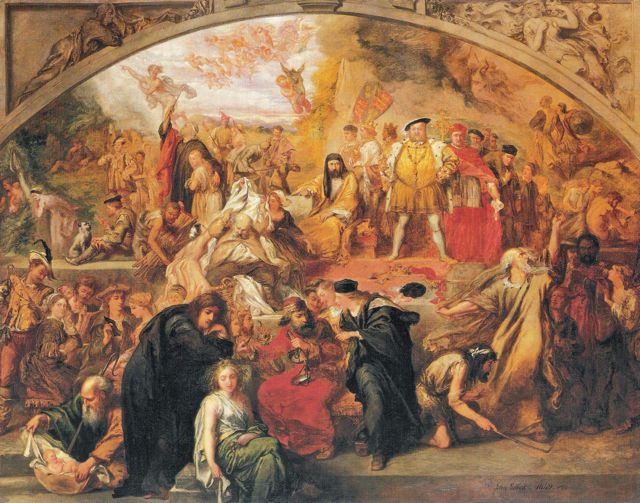
John Gilbert, The Plays of William Shakespeare, 1849.
Not surprisingly, I totally agree! But Jack is only 28 when he says this, so from the vantage point of my own great age, I would add this: as we grow in years and experience, Shakespeare's words become ever more relevant, as we continually view them from our own ever-expanding perspective.

Shakespeare is timeless, in the same way that mythology, folklore, and fairy tales endure. And their timelessness inspires succeeding generations of bards and storytellers to reinvent the stories for their own devices—or eras.

I remember the first time I ever read a review of the Tom Stoppard play, Rosencrantz and Guildenstern Are Dead. I remember thinking,  What? Another writer can just appropriate a couple of Shakespeare's characters and make up his own story about them?

What a concept!

Recycled Shakespeare, like retold fairy tales, has become a genre unto itself, and one that I personally love! I've already flailed away on this blog about the fabulous Fool books of Christopher Moore  (which turn several Shakespearean tragedies into fodder for hilarity via King Lear's savvy Fool) and Alan Gordon's Fools Guild mysteries (reimagining Twelfth Night fool, Feste, as a Renaissance secret agent).

Ditto, Elizabeth Bear's gorgeous Ink and Steel duology, which takes Will Shakespeare and Kit Marlowe as its central characters. And we all know West Side Story, the classic stage musical riff on Romeo and Juliet.

But here are five more clever reinterpretations, examples of just how adaptable Shakespeare continues to be:

CALIBAN'S HOUR  In Tad Williams' beguiling revision, the much abused "monster," Caliban from The Tempest makes his way back to Naples one fateful night to confront Miranda, daughter of his tormentor and enslaver, Prospero. Now a fading beauty approaching middle age, with a teenage daughter of her own, Miranda is compelled to hear Caliban's side of the story—and reconsider who he is (and what has been done to him).

QUEEN MAB  Kate Danley dares to imagine a secret life for Romeo's witty, charismatic pal, Mercutio—one of the most lamented murder victims in all of Shakespeare—as well as a delicious afterlife as lover to the Fairy Queen, Mab.

INDIGO From mythologist and fairy tale scholar Marina Warner comes this decidedly rich and strange riff on The Tempest. It's a dark, simmering exploration into conquest, colonialism, and slavery, and their aftermath, not only for those conquered, but for generations of European conquerors as well.

A MIDSUMMER NIGHT'S DREAM  Okay, no points for originality in the title department, but otherwise, this splendid episode from Neil Gaiman's long-running Sandman graphic novel series is a completely fresh delight. It imagines a very special performance of the Dream by Will Shakespeare and his company of players on Midsummer Eve before the king and queen of the fairies and all their impish court.

THE LION KING Don't laugh! A murdered king (who later appears as a ghost), a treacherous uncle, a young prince trembling on the brink of maturity, uncertain how to test his power—sound familiar? True, there's not a lot of singing or dancing in Hamlet, but at least the folks at Disney steal from the best!

Celebrations will be global throughout the year. Happy Birthday, Will!


Wednesday, August 1, 2012

TOUR de FARCE

Raucous comedy highlights SSC's lively 'Twelfth Night'

Shakespeare Santa Cruz continues to brighten up our foggy coastal summers with imaginative and exciting live theater. The company launches its 31st season with a new production of Twelfth Night, one of Shakespeare's most enjoyable and accessible romantic comedies. Directed by SSC Artistic Director Marco Barricelli, this lively production floods the stage with knockabout farce, yet leaves enough breathing room for moments of poignant reflection on the many ways romantic love can be found—and lost.

Shipwreck survivor Viola (a winsome Lenne Klingaman) lands on the coast of Illyria. Believing her twin brother drowned, she dresses in male clothing for protection and finds employment with the nobleman, Duke Orsino (Tom Gough). Distracted by his unrequited love for the noble lady, Olivia (vivacious Rayme Cornell), Orsino sends Viola, now called "Cesario," to woo the lady on his behalf. Olivia remains unmoved by the Duke's message, but she falls for the messenger, "Cesario." Viola, meanwhile, trapped within her male disguise, has fallen in love with the Duke.

But the highlight here is its boisterous comedy. Vincent Paul O'Connor is hilarious as Olivia's debauched uncle, Sir Toby Belch, canoodling with saucy maid Maria (Shannon Warrick), or consuming a raw egg and tabasco cocktail onstage. William Elsman is absolutely terrific as his foppish cohort, Sir Andrew Aguecheek, commanding every inch of his stage space with his big, yet precise comic gestures and powerful voice. And special kudos to Mark Christine as Feste (above), who handles the clown's witty repartee, and sings and plays guitar with wistful sweetness. (Read more)