Thursday, October 27, 2016

FOR LOVE OF BOOKS

Break out the champagne!

This year, Bookshop Santa Cruz turns 50!

Celebrations have been going on all year, as befits such a momentous occasion. To thank the community, BSC has commissioned and installed three "Artful Reading Benches" in parks and playgrounds around the county. Poured by concrete meister Tom Ralston, each bench is designed and painted by a local artist. The store has also been celebrating all year with monthly giveaways and raffles.

Santa Cruz's own Wallace Baine has just hit the bookshelves with A Light In the Midst of Darkness, a history of BSC in our community. Published by Steve Kettner, founder of the Wellstone Center in the Redwoods, it's a non-fiction memoir as told to Wallace by the people at the epicenter of BSC history — former owner Neal Coonerty, his daughter Casey Coonerty Protti, current owner of the store, and dozens of local lights and ex-employees, working with and for the Coonertys, who helped shape BSC into the cultural hub it is today.

Wallace, Neal and Candy appeared before an SRO crowd of well-wishers at a book launch at the store last week, to tell their stories. It was more of a love-fest than a traditional book-signing. Wallace read some entertaining passages from the book, and Casey spoke about growing up in a world of books.

Neal and Wallace: Boyz n the Hub
Neal's talk was mostly a heartfelt tribute to his late wife, and original business partner, Candy Issenman Coonerty: how they met at a Yeats festival in Ireland, married, moved to Santa Cruz, and decided to pursue their love of books by opening a bookstore. Little did they suspect the impact their decision would have on the Santa Cruz cultural scene.

Long ago, in a galaxy far, far away (okay, it was 1966, on Pacific Avenue), on November 6, the first incarnation of Bookshop Santa Cruz opened at 1520 Pacific Avenue — more or less where it now stands — on the site of an old post-beatnik, pre-hippie hangout called The Hip Pocket Bookstore.

In 1969, the store moved across the street and down the block to 1547, Pacific Avenue, where it stood for the next 20 years. In 1973, Neal and Candy bought the business from owners Ron and Sharon Lau.

Sharon continued to work at the store for years. Ron could often be found outside, on the deck of the first incarnation of Caffe Pergolessi (built in the courtyard behind BSC in 1974), holding forth on a variety of inflammatory topics.

Bookshop basement: way, way back in the day
The Coonerty family weathered the quake of 1989 — and were blown away by the subsequent show of community support when 400 volunteers showed up to move boxes of books out of the rubble to help the business relocate to a tent. The store faced down challenges from mighty chains like Crown Books, and Borders — and prevailed! But you can read all about it in Wallace's book!

Me, I've always had a soft spot in my heart for BSC. I worked in the textbook room, in the basement, from 1974 to 1976. (It was sheer nepotism; my brother, Steve, was the manager.) It was my second job out of college, after a 6-month stint selling popcorn at the former UA Cinemas (now the Riverfront) on Front Street.

Books and movies: two obsessions I never got over!

Artful Reading Bench by Terra Dawson, San Lorenzo Park

I loved it! There was no dress code — I got to wear my embroidered overalls and Monty Python T-shirt to work. (Hey, it was the '70s!) And we got to borrow books.

As long as we weren't too grubby, and left the pristine dust jackets in the safety of the storeroom, we could take books home to read! (Well, I don't know if we "could," but we did!) It was all good!

BSC will be throwing its own birthday bash in the store on Friday, November 4, starting at 8 pm. And you're invited! Music, cake, raffle prizes, and a proclamation from the mayor are on the program, and who knows what other surprises?

If you've ever bought a book, browsed through a magazine, or attended an event at Bookshop Santa Cruz — or you just want to say "Thank You!" — come join the celebration.

Wednesday, October 19, 2016

THE BEAST GOES ON

Look out, folks! Here comes another installment in the saga of getting Beast: A Tale of Love and Revenge into print!

Due to publisher Candlewick reshuffling its release schedule, and some last-minute editorial decisions, my poor Beast has fallen off the Spring, 2017 publication schedule.

But fear not: as of this moment, he's set to come roaring back — bigger, bolder, and stronger than ever — on the Fall, 2017 list. Expected pub date is now September 12.

Stay tuned . . .

In the meantime, treat your orbs to this lovely Beauty and the Beast painting by Jynette Tigner, over at Deviant Art, which I just discovered and posted to my Pinterest page.

I love everything about this image — the romantic mood, the impressive Beast, and the woman smart enough to appreciate him as he is. (Did I mention that Beast, himself, not the "handsome prince," is the hero of my story?)

This is definitely my favorite Beast image of the month!

Find more of Jynette Tigner's fairy tale-inspired work here!

Sunday, October 16, 2016

THE TOXIC AVENGER

Okay, friends, under normal circumstances, I prefer to blog about movies, book news, occasional travels, and other fun stuff. But these circumstances are so not normal.

The clown show that is the Donald Trump presidential campaign is so surreal, so much like a bad movie, it just screams for commentary. Who am I to resist?

I'll leave the jokes for the pros. (Besides, this campaign is such a joke already, it defies the job of satire to make it seem even more ridiculous.) I'm more interested in how we've come to this truly bizarro point in our collective public life.

Um, I have an idea.

For about the last 30 years, and certainly the  last eight or ten — in an effort to defeat Obama (unsuccessful), and control Congress (successful) — the GOP has not only admitted, but actively courted every nutsquad out there with a grudge: Tea Party loonies, birthers, homophobes, xenophobes, anti-abortion terrorists, racists, religious right fanatics, climate change deniers, neo-Nazis — you name it.

There are plenty of people who are mad as hell and not going to take it any more. They're sure somebody is to blame for whatever's wrong in their lives, but they don't know who. All they need a target for their rage, and if there's one thing Trump actually does know how to do, it's incite unfocused minds to rage.

("What are you rebelling against?" biker Marlon Brando is asked in The Wild One. "Whattya got?" Brando drawls back. Trump is a master at serving up a bogeyman-du-jour from one speech to the next.)


 Add this bag of mixed nuts to the traditional, conservative GOP power elite of Wall Street, Big Pharma, predatory lenders, real estate scammers, and corporate America — that is, most of the folks responsible for their problems in the first place — and you get an unholy alliance of epic proportions.

Trump is like the Toxic Avenger, the goo that rises up out of this muck to overwhelm the mad scientist (or party) that created him. And now that he's finally beginning to self-destruct under the weight of his own bloated arrogance, Republican leaders are scrambling to save what's left of their party.

But it's too late for that. The damage is so done.

As soon as the GOP grudgingly named Trump to top their ticket, they've been willing to overlook his complete lack of policies, his woeful ignorance of foreign affairs, his inability to prep for a debate, his refusal to release his damning tax returns, and the outright lies and other random things that come out of his mouth on the stump.

He'll tell his cheering fans anything. He'll bring US business back from China (but that's where he sends all his own manufacturing). He'll get Americans to work again — he just won't pay them. (Look at his own record of stiffing contractors and other employees who worked for him.)

It's taken the almost daily allegations of repulsive sexual conduct in these last couple of weeks to alert even the most comatose of GOP stalwarts that something might be just a little off about their so-called candidate. (Not because they actually think there's anything wrong with his "locker-room banter," so much as the dim realization that over half the voting population is, you know, female. Trump's response? Repeal the 19th Amendment.)

This is not Reality TV; this is supposed to be Presidential politics.Those thundering hoofbeats you hear is the stampede of party leaders trying to distance themselves from the Trump debacle while they still can.

It's not news that their candidate is an unrepentant sleazebag, an "octopus" (albeit small-handed) who drools all over pretty women like Kujo. Why are party leaders and supporters surprised? Why didn't the GOP quit him months ago?

Because they kept hoping to sway his nutball "base" back to their own agenda. Ha! As if Trump cared about anyone's agenda but his own. He wants to promote himself as a rich "celebrity," because then he can "get away with" groping unwilling women and paying off debts with lawsuits. All he wants to do is win this horse race, a goal that grows more laughable every hour.

The GOP is the horse he rode in on. The disastrous Trump campaign is going down in flames, and now it threatens to take the whole party with it. And it couldn't happen to a more deserving bunch of folks.


Saturday, September 24, 2016

SEE 'THE LIGHT'


You guys!


Okay, I was too late to review The Light Between Oceans (I was out of town when it opened) but you should still run out and see it. Like, now!


I never read the M. L. Stedman novel, but I was completely entranced by the sophisticated storytelling of Derek Cianfrance's film adaptation. Cianfrance takes his time to tell the story with all the depth of feeling he needs to make an impact.


Michael Fassbender is terrific as Tom, a stoic WWI vet with no family ties who takes a job as lighthouse keeper on a lonely rock off the Australian coast where two oceans meet. After the horrors of war, he's looking forward to the solitude.

Fassbender and Vikander: back to life.

The remarkable Alicia Vikander is Isabel, the spirited daughter of Tom's new boss, head of the Commonwealth that employs him. She eases past Tom's defenses and changes his plans; they marry, and she moves into his cottage on the island.


Gradually, we see all the ways that loving her brings Tom back to life.


And the always excellent Rachel Weisz co-stars as Hannah, a woman of the town with sorrows of her own to contend with, whose life and destiny becomes inexorably knotted up with Tom and Isabel's.

Fassbender and Vikander: to the lighthouse.
Any further detailing of the plot might make it sound schmaltzy. But trust me, it's not. This emotional story is told without an ounce of sentimentality.

It all revolves around what Art Boy and I call "the film noir moment," when characters make that one regrettable choice that will have wrenching repercussions throughout the rest of the movie, and their lives.

And the pivotal moment here when that choice is made is utterly persuasive. Even as the viewer thinks, "No, no! Don't do it!," we can see exactly what it means to the character advocating so desperately for it, and exactly why the co-conspirator is powerless to say no.

This is movie-making for grown-ups, thoughtfully conceived and beautifully shot.

Why are you still sitting there?


Monday, September 19, 2016

BURIED TREASURE

A vintage fairy tale book can be as enchanting as the ageless stories that inspire it. Imagine our deight to find this one squirreled away in our stuff!

First, some backstory: Once upon a time, Art Boy used to go to the flea market every Sunday to buy old books.

Most were fantasy/sci-fi paperbacks, picked up for a dime to re-sell in his comic shop (preferably with gorgeous covers by Frazetta or Boris)— an outgrowth of his previous business selling books to collectors through the mail.

Untold cartons of these old books had been taking up space in the rafters of our garage for eons. But last year, when he decided to start recycling them back into circulation, we discovered two things.

One: eBay and its ilk have taken a huge bite out of the collectible book biz; you can get anything you want online. So there's not the same thrill Art Boy used to get from finding that one weird book he knew was on some collector's wish-list.

And two: a dwindling sector of people consider books worth collecting at all. People read on the run, on devices (like they do everything else), or listen to audiotapes. Who wants to clutter up their busy lives with actual, physical books?

Oh, but look what you miss out on!

While preparing a box of old hardcovers for Logos, Art Boy found this lovely volume: Wonder Tales Retold, a collection of folk and fary tales from around the world.

It was written and illustrated by Katharine Pyle (1863-1938), sister of legendary artist Howard Pyle.

Although she is lesser-known today, Katharine Pyle was a prolific and a successful illustrator in her own right.  Besides poems and magazine stories, she wrote, illustrated, compiled, edited, and/or adapted more than 50 books for children.


Wonder Tales Retold features stories from the French, German, Russian, Norse, and English, to Bohemian, French Creole, Persian, "Hindoo," Korean, and American Indian. Some are familiar, like Baba Yaga, or Tam Lin (here called "Tamlane"), but most were new to me.

The minute we flipped open the book, I knew we had to keep it!

It may not the most elaborate fairy tale book ever, by modern standards. But even though it's only a four-color printing process, look how lovely and sinuous these illustrations are! They were done in the Golden Age of Illustration, that decorative era right around the turn of the last century that I love so much.

A lot more women have made their living as artists or illustrators than history records, especially around this era of artistic and social ferment. I'm always thrilled to discover a new one!

What else is serendipitous about finding this buried treasure of a book? It was published in September, 1916 — making it 100 years old this month!

Sunday, September 11, 2016

ALL ABOARD

Jewel Theatre Company on-track with season opener 'Streetcar Named Desire'

These days, Tennessee Williams' groundbreaking drama, A Streetcar Named Desire could seem as quaint and mannered as the fading, delusional Southern belle at its center.

But the old girl holds up surprisingly well in the smart new production of Streetcar that launches the twelfth season of Jewel Theatre Company.

First produced onstage in 1947, the play was controversial for daring to whisper (obliquely) about taboo subjects like homosexuality, sexual promiscuity, and rape. It examines the erosion of Southern gentility, in the hothouse flower that is Blanche DuBois, exposed in the merciless glare of the postwar modern world represented by her rough-hewn working-class brother-in-law, Stanley Kowalski.

But Williams knew that the perceived elegance of the Old South — built on generations of slavery and repression — was as much an illusion as Blanche's fragile image of herself as a genteel lady.

Schindele and James: culture clash
These are no longer considered scandalous, or particularly new ideas. But director Susan Myer Silton sets them up vividly in her JTC production. The story is set in the French quarter of New Orleans, and one of Silton's coolest innovations is to place a three-man jazz combo on a wrought-iron balcony overlooking the stage; they play the actors in and out of scenes, subtly punctuating the action, but never overwhelming it.

Stanley Kowalski is played by Brent Schindele, previously seen in a dinner jacket, tinkling the ivories as the lounge pianist in JTC's delightful film noir musical, Gunmetal Blues. His performance here is a pretty nifty about-face. Erika Schindele (she and Brent are married in real life) plays his wife, Stella, with strength and compassion. The Kowalskis  enjoy a strong physical, if sometimes volatile, relationship.

Stanley and Stella: volatile
But their marriage is strained when Stella's older sister, Blanche (Julie James), arrives. A spinsterish onetime high school English teacher, Blanche spins a tale of woe about how the family home (a Mississippi plantation called Belle Reve), has been "lost," as the elder generation died out.

Alternately reproaching Stella for "abandoning" the family that Blanche had to care for, and buttering her up as her "precious baby sister," Blanche has nowhere to go, and her travel plans are indefinite.

Blanche deplores what she considers the Kowalski's miserable living conditions in their two-room apartment, and finds Stanley crude and common. Stanley suspects her of cheating Stella out of the family inheritance; he loathes her superior attitude, her interference in his marriage, and her pretense to gentility, which he considers a phony act.

And the clash of wills between them only intensifies. (Read more)

All photos ©2016 Steve DiBartolomeo-Westside Studio Images

Thursday, September 8, 2016

THANKS A MILLES

The Inconstant Traveler goes to Sweden!

The next time you're in Sweden visit Millesgarden, a fabulous home, art environment, terraced sculpture garden, and gallery space overlooking Stockhom Harbor.

It was created by and for sculptor Carl Milles (who studied with Rodin) and his wife, Austrian-born painter Olga Granner Milles, in the artistically simmering early decades of the last century.

This object to the left is a actually a (very thin) sponge, purchased in the gift shop, but I won't be mopping up spilled champagne with it anytime soon. I love the way its Wiener Werkstatte-inspired design and colors look on my aqua-green kitchen wall!

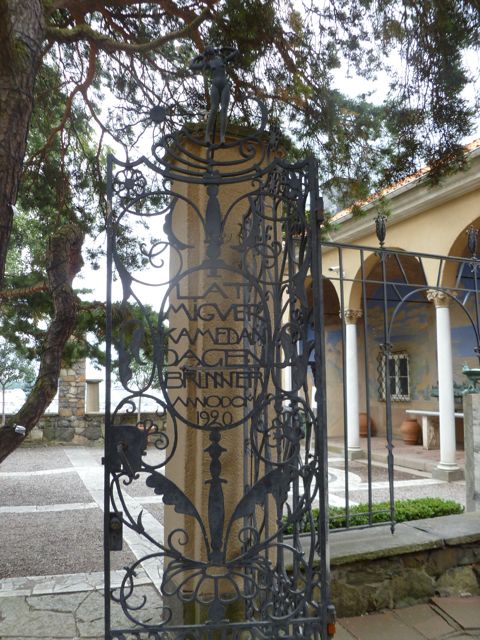
The graphic in the upper corner of the sponge replicates the design of this wrought-iron gate on the grounds. My Swedish is too rusty (okay; nonexistent) to translate the words, but I can read the date well enough: 1920.

This was right around the time the intricate, floral Art Nouveau aesthetic was starting to segue into the clean, machine-made design motifs of Art Deco.

Milles' bronze sculptures are monumental, mostly figures taken from Greek, Roman, and Christian mythology. On the grounds of Millesgarden, they are made even more imposing by their gravity-defying placement on tall, thin pedestals.

(For scale, see the tiny figures huddled at the low wall to the left, between the huge statue in the foreground, and the little spritz of water bubbling out of the fountain to its right? Those are actual people; that's how gigantic these sculptures are!)

Carl Milles' sculpture garden: monumental.
Each irregular paving stone in the terraces was placed by hand. Construction lasted for decades!

Austrian-born architect and textile designer, Josef Frank, who relocated to Sweden in the second half of his life, had a hand in some of the building on the Millesgarden grounds.

When we were there, the Millesgarden gallery was hosting an exhibition of Frank textiles, created by the Swedish design group,  Svenskt Tenn, with which Frank had a long association.

These are modern textiles based on Frank designs, shown alongside Franks' original watercolor sketches of each pattern. The colors are bold, the attitude playful, and the images abstract and amorphous, or wonderfully curvy, inspired by the fecund shapes of flowers, fruits, and leaves in nature.

Josef Frank: "Terrazzo."

Wall tapestries of Frank's designs were hung amid pieces of furniture  upholstered in these same patterns, ebulliently padded and poofy sofas, pillows, and chairs.

(Frank's dislike of hard, sharp corners is thought to have inspired Apple designer Jonathan Ive, a Frank fan, in his creation of the original blue iMac.)

I loved the designs for "Terrazzo," inspired by Italian mosaics. I also liked the starry, cloudlike silhouettes of "Zodiac," and a design based on images of historical sailing ships.

But for me, Best in Show was this whimsical riff on the classic bearskin rug (displayed only a couple of inches off the floor). The best thing about this life-sized accent piece is that it doesn't require the death of an actual animal to produce!

Oh, and the title of this piece? "Beast."


Saturday, August 20, 2016

AFTERGLOW

Okay, my opinion is not exactly impartial. But even I didn't expect to have so much fun at the premiere of Alias Hook last night at Louden Nelson Center!

I wasn't sure how I'd feel about Santa Cruz Parks & Rec Teen Theatre leaders Sara Jo Czarnecki and Darwin Garrett fooling around with my grown-up story for a cast of 12-17-year-olds.

But I was very impressed with the way they managed to telescope the book's action and themes in an early draft of the script they showed me.

And last night onstage, it came together with much more pizzazz than I could ever have hoped for!

There's a real thrill in seeing my characters brought to life before my eyes, not to mention hearing my jokes get laughs from the audience!  (Although, some of the biggest laughs were for funny lines that Sara and Darwin added.)

Sure, compromises were made. There's no flying, and no underwater merfolk community. The sexy Fairy Revels are replaced by a crew of cute flapper fairies doing the Charleston.

The racier aspects of James and Stella's relationship are eliminated (no doubt to the cheers of my readers over at the Republic of Goodreads, who are often shocked to find this is an adult fantasy, not written for kids). But Stella still indulges her fondness for wine!

And while James Hook's backstory is mostly cut out, the character of Proserpina, the voudon priestess who cursed him to eternal life in the Neverland, weaves in and out of the action, haunting him with his lifetime of mistakes.

There were other clever additions. I especially liked the moment when James, no longer able to play his beloved piano one-handed, rises from the bench, hand and hook moving over imaginary keys in the air, while the music playing in his head fills the auditorium.

Proud author with Aidan Brekka as Hook!
Most importantly, the heart of the story comes through intact — James Hook learning to give up the endless war games with Pan and extricate himself from the Neverland by finally growing up.

Much credit for this goes to Aidan Brekka for his brisk, commanding performance as James. He strikes just the right notes of sarcasm and despair. Sophia Alexander-Sidhom is poised and funny as Stella.

In the role of Pan (ironically played by a girl), Seyla Manzo is just as brash and bratty as she should be. And kudos to every single cast member, playing various pirates, fairies, Lost Boys and Indians, for making this show such a success.

After the show, Sara and Darwin presented me with this copy of the production's poster, signed by everyone in the cast! That was very, very cool, and I was also thrilled to meet a lot of the young actors down in front, afterwards. I said they were all great, and I meant it.

"Thank you for writing us!" They responded.

Seriously, I couldn't have had more fun!

Friday, August 19, 2016

WORLD PREMIERE!


Hey, Santa Cruzans, tonight's the night!

Alias Hook will have it's World Premiere, live, onstage, at Louden Nelson, courtesy of the spirited folks at Santa Cruz Parks and Rec Teen Theatre. These kids have been working for 12 weeks to get my book up on the boards, and tonight, we lucky local get to see the result!

Check out some of these rehearsal stills. Looks like fun!

The unsinkable Sara Jo Czarnecki, godmother of the program, has been (among other accomplishments) assistant fight choreographer with Santa Cruz Shakespeare.

So expect plenty of crossed swords, one damsel (occasionally in distress, but mostly not), plenty of pirates, fairies, and Lost Boys, and one voodoo priestess.

And, of course — the (dreaded) Pan!

Showtime is 7 pm tonight (Friday) and Saturday night, plus a 2pm Saturday matinee. Talk about an exclusive engagement!

If you've ever longed for Captain James Hook to have a chance to be the hero, this is the show for you!

Visit SCP&RTT's Facebook page for more details.

Tuesday, August 2, 2016

PUTTIN' ON THE GLITZ

Dreamy vision of Old Hollywood dished up in Cafe Society

If Blue Jasmine was Woody Allen's homage to A Streetcar Named Desire, his latest, Cafe Society, evokes Casablanca, in tone and romanticism. True, Allen's film is set in the 1930s, not the '40s; it takes place in Hollywood and New York City, not Paris, and there are no Nazis lurking about.

But otherwise, this plays like a spiritual prequel to the classic Bogart movie, the kind of bittersweet story of young love that might come back to haunt the participants years later, after they've moved on. (It even ends up where Casablanca begins — in a nightclub.)

Beautifully shot by veteran Vittorio Storaro, at Old Hollywood locations all over Los Angeles (including the Chinese and Los Feliz Theatres, and several vintage Bel Air mansions), Cafe Society revolves around Bobby Dorfman (Jesse Eisenberg).

An innocent nebbish from one of Allen's typically large, boisterous Jewish families from the Bronx, Bobby wants more out of life than working in his father's factory. So his mother, Rose (Jeannie Berlin), ships him off to her brother, Phil Stern (Steve Carrell), a hotshot Hollywood agent.


Stewart and Eisenberg: they'll take romance.

Phil assigns his personal assistant, Vonnie (Kristen Stewart), to drive Bobby around and show him the town. Beautiful, level-headed Vonnie isn't interested in the glitz and glamour of showbiz; she'd rather live at the beach and eat tacos in a cozy Mexican joint. Bobby is completely smitten with her, even though she tells him she has a boyfriend.

Allen presents a romanticized vision of a 1930s that never was — except in the movies. (The same way Casablanca romanticized the wartime era, Nazis and all.) And as a confection celebrating old-time Hollywood glamour, Cafe Society is pretty irresistible.

Still, as fresh and youthful as the central love story is, this is the work of a mature sensibility, a wistful meditation on choices made that invites us to ponder what might have been. (Read more in this week's Good Times.)

Sunday, July 31, 2016

THE DANISH GIRL

SCS reinvents Hamlet in solid new production


It's not like a woman has never played Hamlet before.

Sarah Bernhardt famously played the great Dane onstage in 1899, captured for posterity in this poster by Alphonse Mucha.

Classical Danish actress Asta Nielsen essayed the role in a 1921 silent film.

(Although, it seems like Shakespeare without spoken words is sort of missing the point).

What's wild about Nielsen's version is that this Hamlet was supposedly born female, but her parents brought her up disguised as a boy to preserve the lineage.

That this Hamlet has lived all her life in male drag complicates relationships in the drama: she sort of jollies along old Polonius' attempts to match her up with his daughter, Ophelia, but she secretly pines for friend and schoolfellow, Horatio.

Here's a highlight reel of the film via You Tube, with includes a link to the entire two-hour film.

What's fresh about the new Santa Cruz Shakespeare interpretation is that Kate Eastwood Norris plays the character of Hamlet as a woman.

Nothing is changed in the script, except references to "son" are switched to "daughter," and the prevailing form of address becomes "my Lady," instead of "my Lord."

The rest of the play is still intact, including Hamlet's love affair with Ophelia.

Everyone knows they've always been drawn to each other; when Hamlet feigns madness, in hopes of sussing out the truth of her father's untimely demise, everyone assumes she's out of her mind with love for Ophelia.

Dueling Hamlets: Eastwood Norris
And here's the deal: nobody thinks anything of it. Casting Hamlet as a woman doesn't turn it into a "lesbian love story." The Hamlet-Ophelia subplot is about young love, in all its recklessness, passion, and confusion — just as it always has been.

Meanwhile, the rest of Shakespeare's tragedy marches on in this bare-bones, yet powerful production. The metal monkey-bar towers from Midsummer are wrapped in bunting to stand in for interior castle columns.

And without atmospheric sets, it's up to the writing and the acting to deliver the goods. Happily, both Shakespeare, and this excellent cast, are up to the task.

Norris doesn't miss a note of the character's complexity; her Hamlet is dashing, introspective, and witty, by turns. Torn as she is between inaction and confident resolution, she also makes the most of every wry aside — especially concerning the marriage of her mother, the queen, to her uncle, after the sudden demise of her father, the king.


Dueling Hamlets: Bernhardt

When she cries,, "Frailty, thy name is woman!" this female Hamlet sounds both astonished and self-deprecating.

Bernard K. Addison (so boisterously funny as Bottom in Midsummer) is both fierce and stately as the Ghost of Hamlet's murdered father, as well as his own murderous brother, Claudius, Hamlet's uncle, all too speedily wed to her mother, Queen Gertrude (Carol Halstead).

In this version, Patty Gallagher plays a female Polonius as a sort of dotty matchmaker, egging on her daughter, Ophelia (Mia Ellis), to encourage and comply with the increasingly distracted Hamlet in hopes of arranging a royal union.

Mike Ryan makes a stalwart Horatio. And Larry Paulsen is absolutely terrific in voice and manner as the Player King.

This is where this season's costume budget went, with B. Modern designing a fabulous lace-covered gown for Queen Gertrude, and a magnificent, ivory-hued robe for the Ghost — who makes an eerie circuit around the back of the seating area before joining the action onstage.

(However, the backpacks and plaid skirts for the female Rosencrantz and Guildenstern make them seem more like Catholic schoolgirls than university students. But it's a nice touch that Hamlet wears her skirt rakishly over pants, and her vest unbuttoned.)

The play is definitely the thing in this streamlined, highly effective production.

Addison, Norris, Halstead: that's Princess of Denmark.

Wednesday, July 27, 2016

UNMATCHED

Robust: Adam Campbell as Tevye
Soaring performances, production, fuel Cabrillo Stage's 'Fiddler on the Roof'

Back in 2012, the Cabrillo Stage summer musical series mounted one of its most successful productions, Anything Goes. It was a frothy 1930s period piece built around vintage Cole Porter songs, and featuring what may be the single most electrifying production number in CS history, a massive syncopated tap extravaganza to the title tune, in which everyone but the orchestra was onstage dancing.

That show was directed and choreographed by Kikau Alvaro, making his CS debut. And now Alvaro is back in the same capacity for the second production of the company's current season, Fiddler On the Roof.

True, there are few opportunities for ensemble tap dancing in this enduring tale about the denizens of a poor Jewish shtetl in a remote area of Russia toward the end of Tsarist rule. But Alvaro still delivers a wonderful production of this classic musical, vividly imagined in the design and dance departments, and blessed by a knockout centerpiece performance by Adam Campbell in the central role of Tevye, the dairyman.

The original 1964 production was directed and choreographed by the great dance maestro, Jerome Robbins (whose choreography Alvaro reproduces here, according to the credits). And while the dancing is terrific, this is not a show that depends on dancing; rather, it's a moving tale of life, love, family, and, of course, tradition, in an era of changing values.

Tevye is the engine that makes this show go. Campbell's great singing voice can be big and expressive, or soft and sweet, and his wry demeanor is irresistible, whether conversing with God, or in his robust rendition of Tevye's signature song, "If I Were a Rich Man."

Upholding "Tradition"
 A poor dairyman whose assets amount to one milk cow and a lame horse, Teyve and his wife, Golde (Marianne Thompson, another fine singer) have five daughters to see settled, with the help of village matchmaker, Yente (Alice Hughes). A staunch upholder of "Tradition" (as laid out in the rousing opening number), Tevye's worldview is challenged as, one by one, his three eldest daughters choose their own husbands for love, rather than submitting to arranged matches.

In terms of production and performance, this Fiddler is rich indeed. (Read more)

Monday, July 25, 2016

FAB TECHNICIANS

Dysfunctional duo ages disgracefully in 'Absolutely Fabulous: The Movie'

The new Absolutely Fabulous: The Movie is not for the uninitiated. If you're not already a fan of the cultish '90s TV series, chances are you'll have no clue what's supposed to be funny about two clownish women of a certain age in ridiculous clothing attempting to stave off the ravages of time with gallons of champagne, while clinging desperately by their ferociously manicured claws to the ragged fringes of trendy pop culture.

But those who already have a soft spot in their hearts for the ribald and outrageous TV series will find much to chuckle at in the big screen adventures of sad-sack Edina (Jennifer Saunders) and coolly caustic Patsy (Joanna Lumley).

Scripted by series creator Saunders for director Mandie Fletcher (veteran of many of the TV episodes), the movie falls prey to the usual pitfalls of TV-to-film adaptations: it's tough to maintain a coherent storyline and keep delivering the laughs over 90 minutes (instead of 30).

Still, despite the slower passages, the brio with which Eddie and Pats pursue their absurd agenda, in the face of common sense, common decency, and reality, remains oddly cheer-worthy.

La Dolce Vita: In their dreams.

And beneath the frantic facade lurks a sharp satire of our celebrity-obsessed society, along with, at times, a surprisingly poignant look at how women who have the bad judgment to age are treated by the popular culture that finds them so instantly disposable. (Read more in this week's Good Times)

Tuesday, July 19, 2016

DREAM LOGIC

Stage trees vs. the real thing
Stark, but fun Dream launches new SCS space

It's fitting that Santa Cruz Shakespeare chooses A Midsummer Night's Dream as the inaugural production for its spanking new venue at DeLaveaga Park. That they even got the stage erected in time for opening day is no less a feat of magic than anything devised by Puck and his fleet of fairies.

The set and costumes may be minimalist, but a wonderful cast performing Shakespeare's beloved comedy, and a sense of adventure on both sides of the stage, keep patrons engaged.

First the facts: the Festival Glen at UCSC is no more, at least as a performance space for this company. Ousted by the university (which retained the original name, Shakespeare Santa Cruz), the company has risen phoenix-like, rebranded itself as Santa Cruz Shakespeare, and found a new home in DeLaveaga Park.

City Council approval to build the new space was granted in February of this year, meaning SCS has had a scant five months to complete construction.

Addison + Ellis: love potion goes awry
The stage nestles in a grove of pine and eucalyptus, with an open space for picnicking in front of tiered rows of permanent benches and chairs. Sightlines are good, and the box office, restrooms, and parking lot are all immediately adjacent to the performance space (so you no longer need hiking boots and GPS to navigate to the stage area). Named in honor of the company's intrepid co-founder, and tireless supporter, the space is called Audrey Stanley Grove.

Director Terri McMahon's production begins with youthful fairies in baby blue dragging pillows onstage and falling asleep, as the four plots kick in. An extravagant wedding ceremony is about to be held for Duke Theseus of Athens (Cody Nickell) and the Amazon Queen Hippolyta (Mia Ellis).

But first, a noblewoman complains to the Duke that her daughter, Hermia (Katherine Ko — appropriately little and fierce, also funny), refuses to marry the suitor her mom has picked out for her, Demetrius (Brian Smolin, so hilarious in last season's The Liar), Demetrius was formerly engaged to Helena (Mary Cavett), who still pines for him.

But Hermia loves Lysander (Kyle Hester), so that night, they run away—followed by Demetrius, who is followed by Helena. All are soon lost in the forest, where Oberon and Titania, the King and Queen of the fairies, (also played by the commanding Nickell, and the warm, regal Ellis) are having a tiff.

Meanwhile, some tradesmen of the town, are rehearsing a play to perform for the Duke's nuptials. Most enthusiastic of her crew is Nick Bottom, all too eager to take on every part in their show, played with endearing comic bombast by Bernard K. Addison. When a fairy love potion goes awry, the fairy queen falls in love with Bottom, who has acquired the head (and other characteristics) of an ass.

All's well that ends well: lovers correctly matched at last
Christina Dinkel's costumes are simple and effective. (It's funny that she dresses Obron's fairy sidekick Puck (Larry Paulsen) like Smee in Peter Pan, with piratical striped stockings and headscarf.)

Collette Pollard's smart, stark forest set features towers of metal bars, through which we see the actual trees beyond, while the random chairs they sprout are used as fairy perches, or piled up to make thrones.

It may not be as ornate as some versions of Dream, but the  cleverness of this minimalist production makes us eager to see what SCS does next. (Read more)

Friday, July 15, 2016

BLOODY BOOK


What a great way to start off a foggy Friday!

Found this today on my Alias Hook page, over at the Republic of Goodreads. James Hook's voyage of conquest continues!

Saturday, July 9, 2016

MORE BEASTLY NEWS

It's Happy Dance time!

Yesterday, I received the email that every author longs to hear from her editor:

"Lisa!!! I think this is perfection! Truly! I have no further tweaks to suggest."

This came after one week (not counting the 3-day holiday) of wrangling between Editor Kaylan, from Candlewick, and moi over the Author's Note, to go in the back of the Beast book. 

We went five rounds in four days, cutting, pasting, snipping, and shaping. But it's good that we're both so detail-oriented, because the result is — well, perfection!

So, yay! We're done!

The final ms has been copyedited, accepted, and approved. The Author's Note and jacket copy are finalized, and the cover design is almost done. Oh, and we now have a new title:

How I spent my July 4 weekend.
Beast: A Tale of Love and Revenge

This title, and the scrupulously-edited Author's Note, are meant to signify to readers that my book is NOT the Disney version of the tale — no more than Alias Hook was the Disney version of Peter Pan.

But you all knew that, right?

(Speaking of which, the live-action adaptation of Disney's Beauty and the Beast is coming to a movie theatre near you in March, 2017, right around the time my Beast is hitting the bookshelves. Looks like it's going to be a Beastly spring!)

Anyway, my rough Beast's hour has come round at last, as he slouches now toward Candlewick to be born!

Stay tuned!

Sunday, July 3, 2016

TRAVELING MUSIC

Beguiling doc 'Music of Strangers' celebrates diversity, humanity

Some people talk about building a wall. (Okay, one fool in particular.) The perfect antidote to that mentality is The Music of Strangers: Yo-Yo Ma and the Silk Road Ensemble.

This beguiling and bittersweet documentary chronicles the efforts of the renowned cellist to found a performing group of international musicians from Europe, Asia, and the Middle East, whose entire existence is dedicated to both cultural diversity, and common humanity.

Filmmaker Morgan Neville won an Oscar for the fabulous 20 Feet From Stardom, giving backup singers — the unsung heroines of rock 'n' roll — their well-deserved moment in the spotlight.

He knows a great music doc needs to feature not only wonderful music, but dynamic personalities to perform it, and The Music of Strangers is incredibly rich in both.

Kayhan Kalhor, Yo-Yo Ma: soulful

In 2000, Yo-Yo Ma got the idea to search the world for masters of traditional instruments for a workshop and performance he wanted to stage at the prestigious Tanglewood Music Festival in Massachusetts.

Born in Paris of Chinese parents, and raised in the US, Yo-Yo embodies the spirit of internationalism.

His idea was to follow the ancient "Silk Road" trade route, from Venice to China, scouring the world for master musicians.

Cristina Pato: rock star

And what an ensemble he came up with: Kinan Azmeh, is a clarinetist from Damascus.

Wu Man survived Mao's Cultural Revolution in China by her skill on the lute-like pipa.

Iranian Kayhan Kalhor is soulful master of another stringed instrument, the Kurdish kamancheh.

Spaniard Cristina Pato plays Galician bagpipes like a born rock star.

The musicians (and the other dozen or so Ensemble members) are fascinating in the ways their various instruments, and their playing, as well as their diverse personalities, mesh.

And the music is often thrilling.
(Read more in this week's Good Times)

Sunday, June 26, 2016

EDITOR REX

Fabled editor vs. star author in fascinating Genius

Maybe it's because my high school mounted a stage production of Look Homeward Angel when I was a senior, and I had a big crush on the guy who played the lead. But I've always had a soft spot for Thomas Wolfe's coming-of-age novel, and the mystique of its author.

Both figure prominently in Michael Grandage's literary biopic Genius, which delves into the relationship between Wolfe and his editor at Charles Scribner's Sons, the legendary Maxwell Perkins.

By the time he met Wolfe, Perkins was already famed as the editor who shepherded both and Ernest Hemingway and F. Scott Fitzgerald to publication in the 1920s.

Based on a biography of Perkins, Max Perkins: Editor of Genius, by A. Scott Berg, the movie depicts Wolfe as a larger-than-life persona, eager to swallow life whole, and blast it out again in torrents of gorgeous prose.

Firth as Max: choosing words with care
Of course, I'll concede it's a view of the author that perhaps you can only appreciate if you fell in love with Wolfe's great, sprawling verbiage at age seventeen.

Jude Law is way over the top in the role, with his frenzied eyes and Southern-fried drawl, but his performance conveys the essence of a man utterly, passionately besotted by words.

In contrast, the movie gives us stoic, thoughtful, dependable Colin Firth as editor Perkins.

When the movie begins, in 1929, Perkins is a happily married father of five daughters, who takes the commuter train into New York City, usually with a manuscript he's reading in hand.

The real Max Perkins at work.
 Having wrangled with the likes of Fitzgerald and Hemingway, he chooses his words with great care, for maximum impact. Firth plays Max as a man so button-down, he never takes off his fedora, even listening to the radio at night by his own fireside.

Genius is a lit geek's delight, and its backstage look at the business of publishing, as Max and Tom tussle over every line and page, is as fascinating as it is mind-boggling.

Granted, Wolfe was an extreme case; in the movie, he delivers the manuscript for his second novel, Of Time And the River, in multiple crates, totaling five-thousand hand-written pages. (And he keeps adding more.)
The real Tom Wolfe: crates of verbiage.

It takes a fleet of Scribner's typists months to pound it into typed pages before the editing can even begin.

The movie is as in love with words and their power as Tom is. The filmmakers acknowledge Max's point, that a book's primary function is to tell a story, and if excessive verbiage — no matter how gloriously written — gets in the way, out it goes.

But it also sympathizes with Tom's lust for words for their own sake. When Max explains to Tom why one achingly beautiful passage has to go, first he gets to read it out loud, so we can all enjoy it.

Some may argue that editing books isn't a spectator sport, and watching the process is not exactly thrilling (unless you're Tom, fighting for every word, or Max, desperate to streamline the work into something publishable, yet still true to the author's vision).

Okay, I get that. But as a writer who has agonized over ever cut phrase in my own novels, and an editor who has done plenty of cutting on other writers' work, I feel the pain of both of them!
(Read more)

Firth and Law: editing as a spectator sport.