She had me at “Fitz fixes feist’s fits. Fat suffices.”
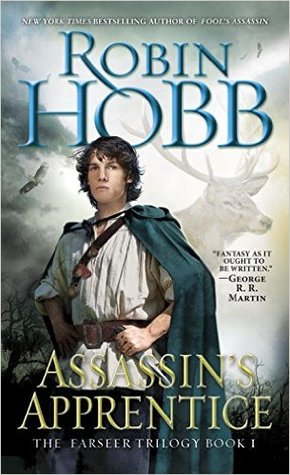
It seems like whenever I visit a fantasy site, I find euphoric readers rhapsodizing about Fitz and Fool. And since I just finished Robin Hobb’s Liveship Traders Trilogy and loved it so much, I felt the time was ripe to plunge into this, Hobb’s first book, Volume One of her Farseer Trilogy, in which the mismatched duo is introduced — and whose unlikely bond begins with that cryptic bit of doggerel mentioned above.
This is more Fitz’s story, FitzChivalry Farseer, that is, bastard son of an elder royal prince. Young Fitz is taken into the castle keep as a 6-year-old stable boy, and basically raised with the hounds, to protect him from becoming a pawn in the subtle but dangerous game of royal succession.
Adept at caring for hawks, hounds, and horses while struggling to learn courtly manners, he’s trained in secret in the delicate art of poisons by the court assassin, and discovers within himself the Farseer ability to link minds with animals, and, at times, other people.
Fool (kept to amuse Fitz’s grandfather, the king) is more of a supporting character here. But his natterings often contain the seeds of truth, as well as prophecy — if Fitz can decode them. More importantly, as the child Fitz matures into a robust youth, he and the mysterious, pale, “colorless” Fool become friends — which both will need as the series and the courtly intrigues continue, I have no doubt!
Imagine the luxury of developing a storyline through three volumes! (Says I, the writer whose first manuscript ran to 900 pages — typed! Sternly edited before publication of course, when cooler heads prevailed!)
Hobb is able to take her own sweet time developing characters, setting, culture, and the intricacies of her plots. Each of her massive trilogies takes place in a separate region of the world she has built (and continues to build). Yet four-and-a-half volumes into her ouvre, I'm only just beginning to realize all the clever ways her separate stories and regions overlap and influence each other.
Talk about a Big Picture! That's why her books, while technically stand-alone (telling one complete story) never seem to end, exactly; they simply reach a plateau so the reader can draw breath before plunging into the next adventure!
Adventures in writing with Lisa Jensen, Author, Columnist and Film Critic
Friday, August 16, 2019
Thursday, August 15, 2019
WINTER IN SUMMER
Santa Cruz Shakespeare takes a chance with its third repertoire production of the summer, The Winter’s Tale.
It may be one of Shakespeare’s lesser-known works, but the SCS production values are typically impeccable, the players act up a storm, and costumes by Ulises Alcala segue from the glamorous ’40s into the early ’60s over the play’s 16-year time span.
(Further proof that the ’60s are all the rage this summer, from Beehive to Yesterday. And, yes, it’s weird when your childhood inspires nostalgia for the distant past!)
But it’s easy to see why The Winter’s Tale is sometimes considered one of Shakespeare’s “problem plays.” Written late in his career, it’s neither comedy nor tragedy, exactly, dabbling in a kind of tentative magic realism that will only reach full bloom in the fantastical enchantments of his masterful final play, The Tempest.
The main problem in the more somber first act is the raging suspicion of King Leontes (Ian Michael Peakes) of Sicilia that his pregnant wife, Hermione (Karen Peakes) has been unfaithful with his best friend, King Polixenes (Lindsay Smiling), visiting from his kingdom of Bohemia.
Even though Hermione is innocent, Leontes is at full boil from almost he very first scene — it’s as if the entire plot of Othello has already happened offstage, plunging us into the conflict with no backstory whatsoever.
And this time there’s no malignant Iago pouring poison into the king’s ear for political gain. Leontes’ delusion of his wife’s infidelity is entirely self-inflicted. The seething, choking fury of Peakes’ Leontes is electrifying, but the audience remains flummoxed.
Chavez Ravine smolders with outrage as court lady, Paulina, the only one with the backbone to stand up to the king’s madness.
Fortunately, the action shifts to Bohemia for the more lighthearted Act II, where the SCS production unleashes its secret weapon: Allen Gilmore.
As the rogue, Autolycus, peddler, thief and mischief-maker, Gilmore comes onstage lustily singing the vintage honky-tonk ditty, “Snatch And Grab It,” in addition to the introductory song that Shakespeare actually wrote for him. The parallel songs mesh deliciously in Gilmore’s adroitly funky delivery.
In Bohemia, we find the comic banter of a humble Shepherd (the always-reliable TommyGomez) and his wide-eyed son, Clown (Adrian Zamora). We also get the romance of winsome foundling, Perdita (Allie Pratt), raised by the shepherds, and stalwart young Florizel (an appealing Uche Elueze), the son of Polixenes.
A gentle fantasy element comes into play as the play’s two halves are resolved in the name of love and redemption.
Director Raelle Myrick-Hodges makes inventive use of the character, Time. Traditionally, the character functions as a chorus at the beginning of Act II to explain the passage of 16 years.
But here, as personified by Patty Gallagher in full Elizabethan dress, she flits in and out of the action throughout the play, in (mostly) silent observation — except at the very end of Act I.
When the action revolves around a newborn infant in a basket, Gallagher is onstage to provide the most impressive range of cooing, crying, gurgling baby noises you will ever hear outside of an actual baby!
(The Winter's Tale plays through September 1 at the Audrey Stanley Grove in Delaveage Park.)
It may be one of Shakespeare’s lesser-known works, but the SCS production values are typically impeccable, the players act up a storm, and costumes by Ulises Alcala segue from the glamorous ’40s into the early ’60s over the play’s 16-year time span.
(Further proof that the ’60s are all the rage this summer, from Beehive to Yesterday. And, yes, it’s weird when your childhood inspires nostalgia for the distant past!)
But it’s easy to see why The Winter’s Tale is sometimes considered one of Shakespeare’s “problem plays.” Written late in his career, it’s neither comedy nor tragedy, exactly, dabbling in a kind of tentative magic realism that will only reach full bloom in the fantastical enchantments of his masterful final play, The Tempest.
The main problem in the more somber first act is the raging suspicion of King Leontes (Ian Michael Peakes) of Sicilia that his pregnant wife, Hermione (Karen Peakes) has been unfaithful with his best friend, King Polixenes (Lindsay Smiling), visiting from his kingdom of Bohemia.
Even though Hermione is innocent, Leontes is at full boil from almost he very first scene — it’s as if the entire plot of Othello has already happened offstage, plunging us into the conflict with no backstory whatsoever.
And this time there’s no malignant Iago pouring poison into the king’s ear for political gain. Leontes’ delusion of his wife’s infidelity is entirely self-inflicted. The seething, choking fury of Peakes’ Leontes is electrifying, but the audience remains flummoxed.
Chavez Ravine smolders with outrage as court lady, Paulina, the only one with the backbone to stand up to the king’s madness.
Fortunately, the action shifts to Bohemia for the more lighthearted Act II, where the SCS production unleashes its secret weapon: Allen Gilmore.
As the rogue, Autolycus, peddler, thief and mischief-maker, Gilmore comes onstage lustily singing the vintage honky-tonk ditty, “Snatch And Grab It,” in addition to the introductory song that Shakespeare actually wrote for him. The parallel songs mesh deliciously in Gilmore’s adroitly funky delivery.
In Bohemia, we find the comic banter of a humble Shepherd (the always-reliable TommyGomez) and his wide-eyed son, Clown (Adrian Zamora). We also get the romance of winsome foundling, Perdita (Allie Pratt), raised by the shepherds, and stalwart young Florizel (an appealing Uche Elueze), the son of Polixenes.
A gentle fantasy element comes into play as the play’s two halves are resolved in the name of love and redemption.
Director Raelle Myrick-Hodges makes inventive use of the character, Time. Traditionally, the character functions as a chorus at the beginning of Act II to explain the passage of 16 years.
But here, as personified by Patty Gallagher in full Elizabethan dress, she flits in and out of the action throughout the play, in (mostly) silent observation — except at the very end of Act I.
When the action revolves around a newborn infant in a basket, Gallagher is onstage to provide the most impressive range of cooing, crying, gurgling baby noises you will ever hear outside of an actual baby!
(The Winter's Tale plays through September 1 at the Audrey Stanley Grove in Delaveage Park.)
Tuesday, August 6, 2019
SOUTHERN DISCOMFORT
Although he's not especially political, he has reason to be very afraid when he's thrust into the dark heart of extreme Southern yahoo culture in Lynn Shelton's very funny comedy Sword Of Trust.
Mel is played by Marc Maron, better known as a stand-up comedy performer and podcaster.
Filmmaker Shelton conceived the part of Mel as a showcase for Maron's dry wit and scruffy sarcasm beneath a facade of rational cool — all on full display here, since so much of the movie's dialogue was improvised.
When a Civil War-era sword is brought into the shop one day, Mel and his cohorts are drawn into an entire subculture of "provers." Convinced that the truth about the South actually winning the war has been "buried by the Deep State," these folks are dedicated to collecting evidence that "proves" otherwise — and ready to pay big bucks for it.
![]() |
| Into the woods: Will irony be enough? |
A fellow called Hog Jaws escorts Mel and his uneasy cohorts out to meet “the boss.” On a long journey into the woods, shut up in a van without windows, but an entirely carpeted interior, they realize they're entering into "the brain" of redneck craziness. "Apparently, it's carpeted."
Irony won't be much of a weapon if things get dire, but it's all they've got.
The twisty little surprises of the plot are delicious to discover along the way, and the sharp, funny conversations had me laughing out loud. It's a well-crafted movie of many small pleasures that add up to big fun.
Thursday, August 1, 2019
WISH FULFILLMENT
Don't believe in fairy tales? You may change your mind when you see Into The Woods, the second production of the summer season at Cabrillo Stage.
While the show itself takes a somewhat sardonic view of the flip side of "happily ever after," and cautions us to be careful what we wish for, the Cabrillo production is so teeming with the magic of live theater, it'll make a believer out of anyone.
The blockbuster musical from Stephen Sondheim and James Lapine is a fairy tale mashup that examines the tropes of the genre — true love, quests of honor, virtue rewarded — before and after the tales' traditional happily-ever-after conclusions.
It's a gift of a show, but also a challenge, from Sondheim's fiendishly clever and intricate (but often tongue-twisting) lyrics to creating the necessary magical mood by means of stagecraft alone. Fortunately, director and choreographer Janie Scott and her intrepid team are up to the task in this beautifully sung, wonderfully atmospheric production.
"Once upon a time . . . ." intones the onstage Narrator to start things off. Andrew Ceglio is a formidable presence throughout in the role, observing the action with cool aplomb — until he's sucked into it much later. (He also plays the Mysterious Man running loose in the woods with unhinged glee.)
Against a gorgeous, eerie, cleverly functional forest backdrop from scenic designer Skip Epperson, the principal characters are introduced.
Young Jack (played with eager innocence by Jackson Brivic) lives with his exasperated mother (Alice Christine Hughes) and his best friend, their cow, Milky White.
(Okay, it's a guy in a cow suit, but Isai Centeno brings humor and a touch of genuine pathos to the pantomime role.) They wish they weren't so poor they have to sell the cow.
Cinderella (Ashley Rae Little) rakes ashes out of the grate for her mean, social-climbing stepmother (Melanie Olivia Camras) and vain, twittery step-sisters (the fractious comedy duet of Kassandra Escamilla and Ryann Liljenstolpe) and wishes she could go to the Prince's festival.
Little captures Cinderella's feisty fortitude, and possesses perhaps the loveliest, most ethereal voice in a cast of strong singers.
The hard-working village Baker (Ian Leonard) and the loyal Baker's Wife (Melissa Harrison) wish more than anything for a child. But they can't produce one, because the Witch next door (Kristen Hermosillo) once visited a curse on the Baker's long-gone father.
This salt-of-the-earth couple grounds the more fantastical elements in the show, with Harrison an especially strong presence in what may be the most demanding and pivotal role.
But the curse may be lifted if they obtain for the conniving Witch some magical objects, which quest sets the rest of the plot in motion. Into their orbit skips gluttonous, reckless Red (a very funny Brittney Mignano) with her basket of goodies for Granny. Rapunzel (Amy Young) is imprisoned in her tower by the doting Witch, who longs to be her surrogate mother.
The Prince who discovers her (Michael Stahl), and the smitten Prince who doggedly pursues Cinderella after the festival (David Jackson) turn out to be brothers, equally fickle in their romantic attachments. ("I was raised to be charming, not sincere," explains Cinderella's Prince.)
The Princes' ironic duet, "Agony," is a highlight of the show.
So is the dueling wordplay of Cinderella's Prince and the Baker's Wife in "Any Moment," deep in the woods.
Jackson is also great fun as the slinky wolf with designs on Red.
Maria Crush's costumes are storybook-perfect. Kyle Grant's lighting design is effective throughout, from the way the treetops overhanging the stage are lit to create depth, to the sudden blackout inside Granny's cottage when things get too gruesome.
Scott has imaginative staging solutions for tricky elements, like the arrival of a Giant (well, part of her), or a carriage full of revelers, complete with prancing horse.
When it's time for Cinderella to ride off with her Prince, they glide offstage together on an ornate carousel pony.
Scott conjures a winsome, witty production out of this tale of bittersweet enchantment. It's everything an audience could wish for.
Just for fun, I thought I'd post this image I found this on the Cabrillo Stage Instagram account. It's a photo of the working 3-D model for Epperson's set design. Pretty cool, huh? Just add color and volume to grow it into a stage full of theatre magic!
While the show itself takes a somewhat sardonic view of the flip side of "happily ever after," and cautions us to be careful what we wish for, the Cabrillo production is so teeming with the magic of live theater, it'll make a believer out of anyone.
The blockbuster musical from Stephen Sondheim and James Lapine is a fairy tale mashup that examines the tropes of the genre — true love, quests of honor, virtue rewarded — before and after the tales' traditional happily-ever-after conclusions.
It's a gift of a show, but also a challenge, from Sondheim's fiendishly clever and intricate (but often tongue-twisting) lyrics to creating the necessary magical mood by means of stagecraft alone. Fortunately, director and choreographer Janie Scott and her intrepid team are up to the task in this beautifully sung, wonderfully atmospheric production.
"Once upon a time . . . ." intones the onstage Narrator to start things off. Andrew Ceglio is a formidable presence throughout in the role, observing the action with cool aplomb — until he's sucked into it much later. (He also plays the Mysterious Man running loose in the woods with unhinged glee.)
Against a gorgeous, eerie, cleverly functional forest backdrop from scenic designer Skip Epperson, the principal characters are introduced.
Young Jack (played with eager innocence by Jackson Brivic) lives with his exasperated mother (Alice Christine Hughes) and his best friend, their cow, Milky White.
(Okay, it's a guy in a cow suit, but Isai Centeno brings humor and a touch of genuine pathos to the pantomime role.) They wish they weren't so poor they have to sell the cow.
Cinderella (Ashley Rae Little) rakes ashes out of the grate for her mean, social-climbing stepmother (Melanie Olivia Camras) and vain, twittery step-sisters (the fractious comedy duet of Kassandra Escamilla and Ryann Liljenstolpe) and wishes she could go to the Prince's festival.
Little captures Cinderella's feisty fortitude, and possesses perhaps the loveliest, most ethereal voice in a cast of strong singers.
The hard-working village Baker (Ian Leonard) and the loyal Baker's Wife (Melissa Harrison) wish more than anything for a child. But they can't produce one, because the Witch next door (Kristen Hermosillo) once visited a curse on the Baker's long-gone father.
This salt-of-the-earth couple grounds the more fantastical elements in the show, with Harrison an especially strong presence in what may be the most demanding and pivotal role.
But the curse may be lifted if they obtain for the conniving Witch some magical objects, which quest sets the rest of the plot in motion. Into their orbit skips gluttonous, reckless Red (a very funny Brittney Mignano) with her basket of goodies for Granny. Rapunzel (Amy Young) is imprisoned in her tower by the doting Witch, who longs to be her surrogate mother.
The Prince who discovers her (Michael Stahl), and the smitten Prince who doggedly pursues Cinderella after the festival (David Jackson) turn out to be brothers, equally fickle in their romantic attachments. ("I was raised to be charming, not sincere," explains Cinderella's Prince.)
The Princes' ironic duet, "Agony," is a highlight of the show.
So is the dueling wordplay of Cinderella's Prince and the Baker's Wife in "Any Moment," deep in the woods.
Jackson is also great fun as the slinky wolf with designs on Red.
Maria Crush's costumes are storybook-perfect. Kyle Grant's lighting design is effective throughout, from the way the treetops overhanging the stage are lit to create depth, to the sudden blackout inside Granny's cottage when things get too gruesome.
Scott has imaginative staging solutions for tricky elements, like the arrival of a Giant (well, part of her), or a carriage full of revelers, complete with prancing horse.
When it's time for Cinderella to ride off with her Prince, they glide offstage together on an ornate carousel pony.
Scott conjures a winsome, witty production out of this tale of bittersweet enchantment. It's everything an audience could wish for.
Just for fun, I thought I'd post this image I found this on the Cabrillo Stage Instagram account. It's a photo of the working 3-D model for Epperson's set design. Pretty cool, huh? Just add color and volume to grow it into a stage full of theatre magic!
Wednesday, July 17, 2019
AUSTEN POWERS
Shakespeare meets Austen in Santa Cruz Shakespeare buoyant season opener, Pride And Prejudice
The 2019 Santa Cruz Shakespeare season arrived this week with bells on — literally. The bell-ringing motif (as in for whom the bell tolls) recurs throughout the season-opening production of Pride and Prejudice, in which a man and woman who should be perfectly matched find their twin aversions to marriage and each other challenged when the bells of attraction begin to toll for them.
Astute playgoers will notice that Pride and Prejudice was not actually written by Will Shakespeare. But contemporary playwright Kate Hamill's 2017 stage adaptation of the beloved Jane Austen novel is the perfect vehicle for launching the company's summer season on a note of crowd-pleasing goodwill — everybody knows the story, there's none of that pesky Elizabethan dialogue to contend with, and a mood of buoyant fun persists throughout.
In Hamill's version, there are only four Bennett sisters, only three of them anatomically correct. (The show's running gag has the eight-person cast scurrying around to cover all 14 roles, whether or not the genders match up — which fits right in with the SCS commitment to non-traditional casting.)
The eldest, prettiest, and most compliant sister is Jane (Karen Peakes). Lizzy (the excellent Allie Pratt), the surrogate for author Austen's more trenchant social commentary, is the clever observer who pokes fun at human folly, especially the matrimonial maneuverings of the girls' dizzy mother, Mrs. Bennett (Carol Halstead), who is determined to pair up her daughters with suitably wealthy husbands. While Mama relentlessly herds her daughters into the paths of incoming bachelors, Lizzy declares that matrimony is a game she doesn't want to win.
Lizzy's ally in common sense is her patient, irascible father, Mr. Bennett (the always wonderful Allen Gilmore), who tries to steer clear of his wife's schemes. Gilmore also manages a neat about-face as Charlotte, Lizzy's cheerfully gossipy, yet practical-minded best friend.
Lydia, the youngest and most wayward sister, is played with bratty exuberance by Madison Pulllins, who switches gears later to play imperious dowager Lady Catherine de Bourgh. (With Peakes hilariously incomprehensible as her veiled spinster daughter.)
As the bookish sister, Mary, who's not so integral to the plot, Landon Hawkins isn't asked to do much but look surly and elicit cries (or shrieks) of alarm every time anyone else in the cast turns to face him. But he's perfectly cast as the male ingenue, fresh-faced Mr. Bingley, who comes courting Jane.
With his tremendous presence and noble bearing, Lindsay Smiling is terrific in the pivotal role of Mr. Darcy, Bingley's friend. A serious, honorable man with absolutely no gift for small talk or silliness, we can see his discomfort whenever he's beset by social butterflies — like the Bennett females — which Lizzy mistakes for arrogance.
Of course, they're a perfect match for each other in wit and ironic temperament, if only they could figure it out. Smiling makes the war between Darcy's head and heart so palpable, and Pratt's Lizzy is so wryly caustic beneath her chipper demeanor that we wish playwright Hamill had written an extra scene or two for just the two of them, prowling around each other in their lively, eccentric mating dance.
The show's most tireless chameleon is Ian Merrill Peakes, who plays Mr. Bingley's snobbish, tippling sister, as well as the dashing officer and scoundrel, Wickham. But it's in his supporting role as the deliciously gauche and creaky pastor, Mr. Collins, that Peakes steals the show, with his twisted, laborious gait and riotously funny vocal inflections.
Director Paul Mullins, who made such a frantic, hilarious, knockabout farce out of The 39 Steps a couple of seasons ago, works in a more subtle hue here, although the laughs are set up and delivered with the same precision. Dipu Gupta's uncluttered set grouping vintage chairs around a piano, with a suggestion of Doric columns, and B. Modern's simple yet versatile gowns and tweedy gentlemen's outfits beautifully evoke Austen's late-Georgian era.
(Pride And Prejudice plays in repertory with upcoming Santa Cruz Shakespeare productions of A Comedy Of Errors and The Winter's Tale through August 31 in the Audrey Stanley Grove at Delaveaga Park.)
The 2019 Santa Cruz Shakespeare season arrived this week with bells on — literally. The bell-ringing motif (as in for whom the bell tolls) recurs throughout the season-opening production of Pride and Prejudice, in which a man and woman who should be perfectly matched find their twin aversions to marriage and each other challenged when the bells of attraction begin to toll for them.
Astute playgoers will notice that Pride and Prejudice was not actually written by Will Shakespeare. But contemporary playwright Kate Hamill's 2017 stage adaptation of the beloved Jane Austen novel is the perfect vehicle for launching the company's summer season on a note of crowd-pleasing goodwill — everybody knows the story, there's none of that pesky Elizabethan dialogue to contend with, and a mood of buoyant fun persists throughout.
![]() |
| Three Sisters: Pullins, Peakes, and Pratt |
The eldest, prettiest, and most compliant sister is Jane (Karen Peakes). Lizzy (the excellent Allie Pratt), the surrogate for author Austen's more trenchant social commentary, is the clever observer who pokes fun at human folly, especially the matrimonial maneuverings of the girls' dizzy mother, Mrs. Bennett (Carol Halstead), who is determined to pair up her daughters with suitably wealthy husbands. While Mama relentlessly herds her daughters into the paths of incoming bachelors, Lizzy declares that matrimony is a game she doesn't want to win.
Lizzy's ally in common sense is her patient, irascible father, Mr. Bennett (the always wonderful Allen Gilmore), who tries to steer clear of his wife's schemes. Gilmore also manages a neat about-face as Charlotte, Lizzy's cheerfully gossipy, yet practical-minded best friend.
![]() |
| Gilmore, Pratt and Smiling: No social butterflies |
As the bookish sister, Mary, who's not so integral to the plot, Landon Hawkins isn't asked to do much but look surly and elicit cries (or shrieks) of alarm every time anyone else in the cast turns to face him. But he's perfectly cast as the male ingenue, fresh-faced Mr. Bingley, who comes courting Jane.
With his tremendous presence and noble bearing, Lindsay Smiling is terrific in the pivotal role of Mr. Darcy, Bingley's friend. A serious, honorable man with absolutely no gift for small talk or silliness, we can see his discomfort whenever he's beset by social butterflies — like the Bennett females — which Lizzy mistakes for arrogance.
![]() |
| Ian Merrill Peakes: Deliciously gauche and creaky |
The show's most tireless chameleon is Ian Merrill Peakes, who plays Mr. Bingley's snobbish, tippling sister, as well as the dashing officer and scoundrel, Wickham. But it's in his supporting role as the deliciously gauche and creaky pastor, Mr. Collins, that Peakes steals the show, with his twisted, laborious gait and riotously funny vocal inflections.
Director Paul Mullins, who made such a frantic, hilarious, knockabout farce out of The 39 Steps a couple of seasons ago, works in a more subtle hue here, although the laughs are set up and delivered with the same precision. Dipu Gupta's uncluttered set grouping vintage chairs around a piano, with a suggestion of Doric columns, and B. Modern's simple yet versatile gowns and tweedy gentlemen's outfits beautifully evoke Austen's late-Georgian era.
(Pride And Prejudice plays in repertory with upcoming Santa Cruz Shakespeare productions of A Comedy Of Errors and The Winter's Tale through August 31 in the Audrey Stanley Grove at Delaveaga Park.)
Tuesday, July 16, 2019
MISSING JAMES
![]() |
| Winds of Change, by James Aschbacher |
How do I not?
You pop up in the strangest, most mundane places. There you lurk every time I grab the red tube of Chapstick in the bathroom cabinet. Every Christmas morning, one of the little packages wrapped up in a scrap of old holiday paper and tucked into my stocking held 3 or 4 tubes of Chapstick, Scotch-taped together. Enough to last me all year!
Now, I have to buy my own, not to mention that Santa doesn’t come to fill my stocking anymore. (Ditto the Easter Bunny, the Valentine’s Day Bunny, or the Birthday Bunny, who used to pile up an assortment of Ferrell’s Doughnuts on my breakfast plate!)
Vitamin time. You used to set out my daily dosage on the counter above the kitchen sink at breakfast time — in a little aluminum dish that once held a tea light. The empty dish sits there still, neglected, because by the time I remember to take the vitamins, I just pour them out of the bottle into my hand and gulp them down. Another domestic ceremony lost. Another little nick out of my quality of life.
The quiet. When I come downstairs mid-morning, there’s no longer the clinking of your paint brush’s metal collar against the water glass, the distinctive sound of my Art Boy so industriously painting away. “Pee time?” you’d ask, as I came galumphing down on my usual routine. “Or tea time?”
(Not that I have time for a second cup of tea, most days. I’m too busy dragging myself off to the store, to the movies, to yoga, or texting for rides for all of the above — all things I so blithely used to let you do for me, without even thinking about it.)
Plum season. Lucky enough to have bought a house on a property full of fruit trees, we often had to give away excess pears, figs and limes by the basket if we couldn’t eat them fast enough. But not plums. Sweet, juicy, wine-red Santa Rosa plums were your favorite fruit!
It was an event every summer when you found the first ripe one that had fallen to the grass; after that. you haunted the tree like Marley’s Ghost every morning, picking the ripest ones for breakfast. And you never wanted me to “waste” them in a tart, which is where most of the extra pears ended up. Plums went directly into your face!
The 25th of every month: it only reminds me that another 30 days have passed in the ever-widening gap that now separates us.
Friday, July 5, 2019
HIVE MIND
Women of '60s rock celebrated in Cabrillo Stage's Beehive
The '60s are having a moment right now, at least, the music of the '60. Besides the just-opened, Beatles-themed movie Yesterday and the ironic use of some choice '60s anthems on the soundtrack of The Last Black Man In San Francisco, along comes the Cabrillo Stage season opener, Beehive.
Subtitled "The 60s Musical," the name suggests an homage to the girl groups of that era, which is certainly a major part of the show, especially in its first half. But Beehive also aspires to celebrate a diverse slate of women rockers, from Connie Francis to the Supremes to Aretha to Janis Joplin.
The show was created in 1985 by Larry Gallagher as a nightclub revue, which explains why it's a bit short on book. When the performers talk onstage, it's usually in brief snippets of narration setting up the context in which the playlist unspools.
More than 30 tunes are performed with gusto by the six-woman cast: Kiana Hamzehi, Jennifer Taylor Daniels, Lindsey Chester, Jessica Pierini, Sadie Rose, and Catarina Contini.
Director Gary John La Rosa also did the choreography — from demure girl-group syncopation to the butt-shaking gymnastics of Tina Turner. Skip Epperson's single, functional set consists of vinyl-inspired discs in all colors hanging down from the rafters, and a large, round record-shaped portal draped in shiny fringe through which the performers enter and exit.
A six-piece combo appears on a balcony upstage, led by Musical Director Jon Nordgren. The effect is like a giant, sparkly juke box with live performers providing your hit parade — no quarters necessary.
At times, the costumes and wigs don’t correctly match the era of the song being performed. (The opening number references girl groups of the early ’60s, but the women are dressed in Swinging London outfits from mid-decade.)
But all these performers can sing up a storm. Should you feel compelled to join in (and believe me, you will), audience participation is strongly encouraged!
(Read more)
Photos by Jana Marcus
The '60s are having a moment right now, at least, the music of the '60. Besides the just-opened, Beatles-themed movie Yesterday and the ironic use of some choice '60s anthems on the soundtrack of The Last Black Man In San Francisco, along comes the Cabrillo Stage season opener, Beehive.
Subtitled "The 60s Musical," the name suggests an homage to the girl groups of that era, which is certainly a major part of the show, especially in its first half. But Beehive also aspires to celebrate a diverse slate of women rockers, from Connie Francis to the Supremes to Aretha to Janis Joplin.
The show was created in 1985 by Larry Gallagher as a nightclub revue, which explains why it's a bit short on book. When the performers talk onstage, it's usually in brief snippets of narration setting up the context in which the playlist unspools.
More than 30 tunes are performed with gusto by the six-woman cast: Kiana Hamzehi, Jennifer Taylor Daniels, Lindsey Chester, Jessica Pierini, Sadie Rose, and Catarina Contini.
![]() |
| Lindsey Chester delivers a knockout set of Janis Joplin tunes |
A six-piece combo appears on a balcony upstage, led by Musical Director Jon Nordgren. The effect is like a giant, sparkly juke box with live performers providing your hit parade — no quarters necessary.
At times, the costumes and wigs don’t correctly match the era of the song being performed. (The opening number references girl groups of the early ’60s, but the women are dressed in Swinging London outfits from mid-decade.)
But all these performers can sing up a storm. Should you feel compelled to join in (and believe me, you will), audience participation is strongly encouraged!
(Read more)
Photos by Jana Marcus
Thursday, July 4, 2019
DELETE THE BEATLES
Band erased from history in sly, audacious Yesterday
Imagine if The Beatles had never existed. It was devastating enough for me as a teenager when the band broke up. How could life as we know it go on? If there had never been any Beatles, I rationalized grimly, at least we wouldn't know what we'd missed.
In his antic and audacious new movie, Yesterday, director Danny Boyle poses an even gnarlier idea: suppose The Beatles had existed, and enjoyed their incredible nine yeas of productivity together — but then suddenly disappeared from the collective memory of basically everyone on Earth?
Everyone but one guy.
Imagine the potential for comedy (not to mention plunder and exploitation) if that guy were a struggling singer-songwriter who could take his pick from the entire song catalog of the Fab Four, certain that no one in the audience had ever heard of John, Paul, George, or Ringo.
Scripted by veteran Richard Curtis (Four Weddings And A Funeral; Love Actually), for the ever genre-bouncing Boyle, Yesterday is a sly, persuasive morality play about the wages and nature of success dressed up as a pop-cultural comedy.
It's also as entertaining as hell, especially for those of us who do remember The Beatles, thank you very much, and will appreciate every in-joke, downbeat, and visual and audio cue Boyle employs with such shameless glee throughout his tall tale.
(Read more)
Imagine if The Beatles had never existed. It was devastating enough for me as a teenager when the band broke up. How could life as we know it go on? If there had never been any Beatles, I rationalized grimly, at least we wouldn't know what we'd missed.
In his antic and audacious new movie, Yesterday, director Danny Boyle poses an even gnarlier idea: suppose The Beatles had existed, and enjoyed their incredible nine yeas of productivity together — but then suddenly disappeared from the collective memory of basically everyone on Earth?
Everyone but one guy.
Imagine the potential for comedy (not to mention plunder and exploitation) if that guy were a struggling singer-songwriter who could take his pick from the entire song catalog of the Fab Four, certain that no one in the audience had ever heard of John, Paul, George, or Ringo.
Scripted by veteran Richard Curtis (Four Weddings And A Funeral; Love Actually), for the ever genre-bouncing Boyle, Yesterday is a sly, persuasive morality play about the wages and nature of success dressed up as a pop-cultural comedy.
(Read more)
Wednesday, June 26, 2019
OUT AT HOME
Displacement fuels poignant, dreamy Last Black Man In San Francisco
The vintage hippie anthem, "San Francisco (Be Sure To Wear Flowers In Your Hair)," keeps popping up on the soundtrack of The Last Black Man In San Francisco. Its use is ironic, referencing the mythology of the city's fabled past while its characters — two young black men born and raised in the city — reckon with the uncertainty of its present.
The most apropos lyric from the song, however, is never actually sung in the movie: the recurring refrain, "People in motion."
Everyone is on the move here —the protagonist on his skateboard, navigating the city's steep hills and ramshackle neighborhoods; passers-by in the streets — techies, joggers, homeless scavengers; chattering Muni bus passengers; platoons of sanitation workers in neon vests marching out to clean up the toxic waterfront.
And yet, despite all the activity around them, the protagonists seem rooted in place, unable to move forward as time marches on, struggling to imagine viable new lives for themselves in the rapidly evolving city they love.
This is the first feature from rookie director Joe Talbot, who wrote the script with Rob Richert, based on a story Talbot concocted with his longtime friend and fellow San Francisco native, Jimmie Fails — who stars as a semi-autobiographical version of himself.
Jimmie's passion is the stately, Victorian-style home in the Fillmore district that his grandfather built in the 1940s, after entire communities of Japanese-Americans had been removed to internment camps. It’s long since fallen out of his family’s possession. But when the current owners move out, Jimmie and his best bud Montgomery (the excellent Jonathan Majors) stealthily move in.
It’s a bit thin, plot-wise, but the storytelling is everything in this splendidly atmospheric mood piece. Themes of displacement, gentrification, and cultural identity are there to be pondered in every dreamy, thoughtfully composed shot, every passing image, without Talbot beating us over the head with them.
(Read more)
Trivia alert: Director Joe Talbot is the grandson of longtime Hollywood veteran Lyle Talbot. Leading man material at Warner Bros in the 1930s and ’40s, Lyle Talbot became a fixture in B-movies of the ’50s (including the notorious Plan 9 From Outer Space), and segued smoothly into TV for a couple of decades after that.
Joe Talbot is also the nephew of Stephen Talbot, a Bay Area TV journalist (long associated with PBS) and documentary producer. Stephen Talbot was also a child actor who had a recurring role on Leave It To Beaver.
Talk about family history!
The vintage hippie anthem, "San Francisco (Be Sure To Wear Flowers In Your Hair)," keeps popping up on the soundtrack of The Last Black Man In San Francisco. Its use is ironic, referencing the mythology of the city's fabled past while its characters — two young black men born and raised in the city — reckon with the uncertainty of its present.
The most apropos lyric from the song, however, is never actually sung in the movie: the recurring refrain, "People in motion."
Everyone is on the move here —the protagonist on his skateboard, navigating the city's steep hills and ramshackle neighborhoods; passers-by in the streets — techies, joggers, homeless scavengers; chattering Muni bus passengers; platoons of sanitation workers in neon vests marching out to clean up the toxic waterfront.
![]() |
| Majors, Fails: Stealthy |
This is the first feature from rookie director Joe Talbot, who wrote the script with Rob Richert, based on a story Talbot concocted with his longtime friend and fellow San Francisco native, Jimmie Fails — who stars as a semi-autobiographical version of himself.
Jimmie's passion is the stately, Victorian-style home in the Fillmore district that his grandfather built in the 1940s, after entire communities of Japanese-Americans had been removed to internment camps. It’s long since fallen out of his family’s possession. But when the current owners move out, Jimmie and his best bud Montgomery (the excellent Jonathan Majors) stealthily move in.
It’s a bit thin, plot-wise, but the storytelling is everything in this splendidly atmospheric mood piece. Themes of displacement, gentrification, and cultural identity are there to be pondered in every dreamy, thoughtfully composed shot, every passing image, without Talbot beating us over the head with them.
(Read more)
Trivia alert: Director Joe Talbot is the grandson of longtime Hollywood veteran Lyle Talbot. Leading man material at Warner Bros in the 1930s and ’40s, Lyle Talbot became a fixture in B-movies of the ’50s (including the notorious Plan 9 From Outer Space), and segued smoothly into TV for a couple of decades after that.
Joe Talbot is also the nephew of Stephen Talbot, a Bay Area TV journalist (long associated with PBS) and documentary producer. Stephen Talbot was also a child actor who had a recurring role on Leave It To Beaver.
Talk about family history!
Sunday, June 16, 2019
DEAD ZONE
![]() |
| Look at that cast: what could go wrong? |
In some circles, the words "Jim Jarmusch zombie comedy" would be all the PR you'd need to sell a movie. It's irresistible: the hipster auteur of Stranger Than Paradise, Coffee And Cigarettes, Ghost Dog, and Only Lovers Left Alive making a meal of the flesh-eating dead horror apocalypse genre.
Especially when you learn the cast includes such longtime Jarmush stock company stalwarts as Bill Murray, Adam Driver, Steve Buscemi, Tilda Swinton, Iggy Pop, Carol Kane, and Tom Waits.
But while it looks so promising on paper, the onscreen result needs a little more meat on its bones.
It would be shameless punning to employ words like "stilted" and "catatonic" to describe a movie about reanimated dead people. (That's the point, right?) Certainly, everybody involved seems to be having a swell time, from actors playing both the living and the dead (often getting to segue from one to the other), and Jarmusch himself, so tickled that he lingers over every shot; you can almost hear him chuckling off-camera.
![]() |
| Murray and Driver: deadpan |
But be prepared to endure long, long stretches of ennui between unsubtle moments that drive home the message, and name-that-zombie celebrity-spotting.
The oft-repeated explanation is that "polar fracking" by stupid humans has knocked the Earth out of whack and opened the floodgates for the zombie apocalypse — one way for Mother Nature to get even.
Point taken. But a bit more honed outrage (or at least funnier satire) might have served better.
(Read more in this week's Good Times)
Sunday, June 9, 2019
POP FICTION
Aging Shakespeare vs self-delusion in tender, wistful All Is True
With summer (finally, almost) here, regional Shakespeare festivals, including our own Santa Cruz Shakespeare, are ramping up for their summer seasons. What better time to launch a movie about Shakespeare himself, reflecting on art, love, family, and reputation, at the end of his life?
That movie would be All Is True. The sardonic title refers to the act of adapting historical fact into fiction (we're told it was the original title of the playwright's Henry VIII), as well as to the little equivocations and outright falsehoods we cling to in the act of getting through our daily lives.
Written by Ben Elton (longtime scriptwriter on the Black Adder TV series), All Is True is produced and directed by Kenneth Branagh, who also stars as Will Shakespeare. These guys know their Bard, and they've come up with a wonderful homage — witty, atmospheric, at times heartbreaking — to both the towering genius of myth and the oh-so-fallible man within, trying to separate fact from fiction in the story of his own life.
When his Globe Theatre burns down in London, Will Shakespeare (Branagh) returns to Stratford-on-Avon, and the family he's scarcely seen in twenty years. His homecoming is not exactly triumphant. Obedient, but long-neglected wife, Anne (the ever-formidable Judi Dench), puts him in the guest bedroom. Lively daughter, Susannah (Lydia Wilson), is happy to see him, but unhappily wed to a theatre-hating Puritan.
Touchier still is Will's relationship to his spinster daughter, Judith (Kathryn Wilder), twin sister to the couple's only son, Hamnet, who died years earlier at the age of 11.
The themes are a bit darker than you might expect from the lighthearted trailer, although the story is handled with plenty of dry humor.
Then into the midst of it all rides dear old Ian McKellan as the visiting Earl of Southampton, patron of Will's theatre company (and reputed to have once been the object of the poet's romantic sonnets).
In a private fireside chat with Will, where they discuss past glories and future legacies, both Branagh and McKellan have a go at the "Fortune and men's' eyes" sonnet. Each man’s delivery of the lines is completely different from the other, and yet equally captivating and powerful.
In an act of extreme generosity, director Branagh shoots in close-up on McKellan's expressive face, the all-terrain roadmap of McKellan's eyes; the tart and wistful working of his mouth. If they gave Judi Dench and Oscar for ten minutes of screen time in Shakespeare In Love, McKellan deserves at least knighthood — wait, he's already a knight; sainthood, maybe? — for this one delicious scene.
(Read more)
With summer (finally, almost) here, regional Shakespeare festivals, including our own Santa Cruz Shakespeare, are ramping up for their summer seasons. What better time to launch a movie about Shakespeare himself, reflecting on art, love, family, and reputation, at the end of his life?
That movie would be All Is True. The sardonic title refers to the act of adapting historical fact into fiction (we're told it was the original title of the playwright's Henry VIII), as well as to the little equivocations and outright falsehoods we cling to in the act of getting through our daily lives.
Written by Ben Elton (longtime scriptwriter on the Black Adder TV series), All Is True is produced and directed by Kenneth Branagh, who also stars as Will Shakespeare. These guys know their Bard, and they've come up with a wonderful homage — witty, atmospheric, at times heartbreaking — to both the towering genius of myth and the oh-so-fallible man within, trying to separate fact from fiction in the story of his own life.
![]() |
| Branagh, Dench: well-met by candlelight |
Touchier still is Will's relationship to his spinster daughter, Judith (Kathryn Wilder), twin sister to the couple's only son, Hamnet, who died years earlier at the age of 11.
The themes are a bit darker than you might expect from the lighthearted trailer, although the story is handled with plenty of dry humor.
![]() |
| McKellan in close-up: All-terrain |
In a private fireside chat with Will, where they discuss past glories and future legacies, both Branagh and McKellan have a go at the "Fortune and men's' eyes" sonnet. Each man’s delivery of the lines is completely different from the other, and yet equally captivating and powerful.
In an act of extreme generosity, director Branagh shoots in close-up on McKellan's expressive face, the all-terrain roadmap of McKellan's eyes; the tart and wistful working of his mouth. If they gave Judi Dench and Oscar for ten minutes of screen time in Shakespeare In Love, McKellan deserves at least knighthood — wait, he's already a knight; sainthood, maybe? — for this one delicious scene.
(Read more)
Tuesday, June 4, 2019
HIS THINGS/HIS STUFF
![]() |
| Castle Moving Day — but where to? |
Understand, his things are not to be confused with his stuff, of which there is an inexhaustible (and exhausting) supply around the place: entire rooms full of meticulously organized art stuff (paints and brushes, card stock, hooks, spools of wire, tacks, posters, spray cans, sketches and cutouts, files on all of his commissions, slides and/or photos of every single one of his images), as well as his vast collection of art books; a small but judiciously curated collection of his beloved '50s sci-fi monster movie posters; boxes of his Famous Monsters magazine collection; monster models, robot toys, Cootie, Slinky, and all the other pop-culture paraphernalia that he loved so much.
And let's not even venture into the video closet!
No, I'm talking about his personal things.
His glasses on the bedroom dresser that he didn't have time to put on that last morning he was here.
His toothbrush and razor, still waiting in the medicine cabinet. His hairbrush in the bathroom drawer that he brought with him all the way from Illinois.
| What lurks within the (dreaded) video closet? |
His slippers, parked in the bottom cubbyhole of the bedroom dresser he designed, with a vertical row of shelves alongside the drawers, waiting for him to waltz in, kick off his "hard" outside shoes, and slip them on to go work at his art table.
If only.
I've moved out the extra pairs of athletic shoes in various stages of decrepitude, the still-relatively-decent ones for walking in the harbor, and the extra-grody ones to wear while wielding his spray paint cans. But I find myself unable to dislodge his slippers. They are too personal to be brushed aside They belong where they are.
All of his things belong where they are. I still don't have the heart to move any of them. I joke to myself, it's because, you know, DNA. Just in case cloning ever becomes a thing.
(Not that a clone of James could ever be as good. He might have the same crooked smile and the same devilish twinkle in his eyes. The same springy hair, the same slight swayback. But unless he's lived every second of the life James led, especially the last 40 years with me, not even the most exact replica could ever be my Art Boy!)
Meanwhile, his stuff stands by, silently rebuking my inability to deal with it. It’s not the objects themselves that are the problem. It’s the way I see them. Right now I still view it all as an archive to be preserved, like the re-created Gustav Klimt studio we saw behind glass somewhere in Vienna during the Klimt 150th anniversary celebration.
I am loath to move a single brush or box of hooks for fear of messing up the historical integrity of his workspace.
When my friend Donna Mekis lost her husband, poet Morton Marcus, she was able to ritualize the process of saying goodbye in preparing and cataloguing his effects to go into Special Collections at UCSC.
But so far, no one has offered to build an Aschbacher Museum to preserve all of James’ stuff. And if there were ever to be such a place, it probably shouldn’t be in my house. That is the very definition of living in the past, the surest way to become a museum-piece myself.
It's up to me to find another way of looking at his stuff, some way that I can let go of it without feeling like I’m betraying him, or trampling on his legacy.
If only I could figure out how.
Sunday, June 2, 2019
MESSY & DARK
Googling around the web, I came across this page of instgram/bookstagram pics featuring Beast: A Tale of Love and Revenge!
It is, I agree, insanely photogenic. I can say that in all modesty, since I had nothing at all to do with this glorious cover design. I wish I could take the credit! Chalk it up to those creative elves in the art department at Candlewick.
Opinions on the text inside the dust jacket continue to be radically mixed.
But, boy, everyone loves that cover!
Here’s my favorite of all the images. It’s from Malin Karlsson, who operates the book review website Grimmsnaught. Very atmospheric; I like how she used the silver candelabra, the slightly decaying winter rose, and the rich, blood-red drape.
If you click the link to her site, you’ll also find one of my favorite one-sentence reviews of my Beast:
“I like this book for the simple reason that it is complicated, messy and dark.”
Thank you, Grimmsnaught!
It is, I agree, insanely photogenic. I can say that in all modesty, since I had nothing at all to do with this glorious cover design. I wish I could take the credit! Chalk it up to those creative elves in the art department at Candlewick.
Opinions on the text inside the dust jacket continue to be radically mixed.
But, boy, everyone loves that cover!
Here’s my favorite of all the images. It’s from Malin Karlsson, who operates the book review website Grimmsnaught. Very atmospheric; I like how she used the silver candelabra, the slightly decaying winter rose, and the rich, blood-red drape.
If you click the link to her site, you’ll also find one of my favorite one-sentence reviews of my Beast:
“I like this book for the simple reason that it is complicated, messy and dark.”
Thank you, Grimmsnaught!
Sunday, May 26, 2019
MAD LOVE
Going through extreme Game of Thrones withdrawal? Looking for a new series to staunch your post-partum misery?
How about a dip — better yet, a dive — into the robust and complex fantasy books of Robin Hobb?
I read the first book in Hobb's Liveship Traders trilogy way back in 2013. I loved the craftsmanship with which she created her fantasy world of seafaring Trader families and their sentient "liveships," her intricate plotting, and her richly developed characters. Her world is less brutal, but no less epic than those of George R. R. Martin, her colleague in the fantasy trade.
These formidable books are long, however, and while the stories were unresolved at the end of the first book, I could never commit the time required to start in on the next book.
But even though I've read (and written!) many other books in the intervening years, Hobb's characters and their stories have really stuck with me. Especially my favorite character from the first book, Ship Of Magic, the liveship Paragon.
Long beached and abandoned on the shores of the commercial center of Bingtown, he provided shelter and occasional wry companionship for the few human characters bold enough to befriend him. He'd been forsaken by his Trader family and nicknamed "Pariah" after he inexplicably turned rogue on one voyage and was responsible for the death of his crew.
A supporting, almost a peripheral character in the first book, Paragon is central to the plot of Mad Ship, the second installment, which I finally picked up earlier this year. The title, of course, refers to him.
Matriarch Ronica Vestrit and her Trader family face ruin when the family liveship, Vivacia (through the incompetent stewardship of her greedy, tyrannical son-in-law), falls into the hands of the notorious pirate, Kennit, who begins to bond with the impressionable young ship in alarming ways.
The Vestrit clan launches a desperate rescue mission aboard the Paragon, with seafaring heroine Althea Vestrit as second mate to the captain, Brashen Trell, disgraced and disowned son of another prominent Trader family, and a disreputable crew of Bingtown wharf rats.
Althea (to whom Vivacia had been promised until her brother-in-law took over), Brashen, and, of course, Paragon, all have something to prove.
Most intriguing in this installment is how the origin of the liveships is gradually and masterfully revealed, where their consciousness comes from, and what effect this revelation will have on the various plot threads — and especially on Paragon, becoming more attuned than anyone else to the potent collective memory of the liveships, so long submerged.
I'm not rooting for the pirate in this one — surprise! Kennit seemed too much like the standard, comic-opera pirate villain in the first book, although his actions are now integral to the larger plot. But all the various story arcs are interesting. (Even spoiled, insufferable Malta Vestrit, a character I cheerfully loathed in the first book, may prove to be redeemable.)
I'm so glad I finally made the time to catch up with this installment. The plots are still unresolved, but yes, I have the third book, Ship Of Destiny on order as we speak!
(Did I mention there are dragons? But we don't find out about them until Book 2, so keep reading!)
How about a dip — better yet, a dive — into the robust and complex fantasy books of Robin Hobb?
I read the first book in Hobb's Liveship Traders trilogy way back in 2013. I loved the craftsmanship with which she created her fantasy world of seafaring Trader families and their sentient "liveships," her intricate plotting, and her richly developed characters. Her world is less brutal, but no less epic than those of George R. R. Martin, her colleague in the fantasy trade.
These formidable books are long, however, and while the stories were unresolved at the end of the first book, I could never commit the time required to start in on the next book.
But even though I've read (and written!) many other books in the intervening years, Hobb's characters and their stories have really stuck with me. Especially my favorite character from the first book, Ship Of Magic, the liveship Paragon.
Long beached and abandoned on the shores of the commercial center of Bingtown, he provided shelter and occasional wry companionship for the few human characters bold enough to befriend him. He'd been forsaken by his Trader family and nicknamed "Pariah" after he inexplicably turned rogue on one voyage and was responsible for the death of his crew.
A supporting, almost a peripheral character in the first book, Paragon is central to the plot of Mad Ship, the second installment, which I finally picked up earlier this year. The title, of course, refers to him.
Matriarch Ronica Vestrit and her Trader family face ruin when the family liveship, Vivacia (through the incompetent stewardship of her greedy, tyrannical son-in-law), falls into the hands of the notorious pirate, Kennit, who begins to bond with the impressionable young ship in alarming ways.
The Vestrit clan launches a desperate rescue mission aboard the Paragon, with seafaring heroine Althea Vestrit as second mate to the captain, Brashen Trell, disgraced and disowned son of another prominent Trader family, and a disreputable crew of Bingtown wharf rats.
Althea (to whom Vivacia had been promised until her brother-in-law took over), Brashen, and, of course, Paragon, all have something to prove.
![]() |
| At a book event in 2014: Adventurers in the fantasy trade |
I'm not rooting for the pirate in this one — surprise! Kennit seemed too much like the standard, comic-opera pirate villain in the first book, although his actions are now integral to the larger plot. But all the various story arcs are interesting. (Even spoiled, insufferable Malta Vestrit, a character I cheerfully loathed in the first book, may prove to be redeemable.)
I'm so glad I finally made the time to catch up with this installment. The plots are still unresolved, but yes, I have the third book, Ship Of Destiny on order as we speak!
(Did I mention there are dragons? But we don't find out about them until Book 2, so keep reading!)
Monday, May 13, 2019
CROWD PLEASING
Okay, here's the thing about Game of Thrones: George R. R. Martin has not even finished writing the sixth and last book of the series yet.Everything that's happened on the TV adaptation for the last season and a half has been cobbled together by the showrunners and their scriptwriters.
Granted, Martin is their chief consultant and guru on the show. We assume he is shaping the narrative to some degree as the show thunders toward its grand finale next week, giving his team the general idea of where the story is headed.
But how closely does it have to hew to the book Martin is actually writing?
Think about it: If Martin is like most writers with a publication date looming, he's still tinkering with plot details and narrative choices. He may think he knows where he's going, but still deciding the best way to get there.
![]() |
| Martin's ouvre has taken on a life of its own. |
What's an author to do?
You know what they say about pleasing all of the people all of the time. So, for the sake of sanity, most authors try to write for the only audience that matters — themselves. (Or a least their inner editors.)
But with an audience as massive as Martin's now is, ready to scrutinize every semi-colon, he's got to be feeling the pressure. Meanwhile, the TV series gallops along at it's own breakneck pace.
But it could work to Martin's advantage. He now has a worldwide supply of beta-readers (okay, beta-watchers) eager to point their thumbs up or down over each new revelation that flickers across their screens. Social media explodes like dragon fire the minute after each new episode is aired.
![]() |
| George R. R. Martin: who's writing this thing anyway? |
Not that he will necessarily adapt his novel-in-progress according to what plays on social media — nor should he. Anyone who cheerfully kills off his nominal hero at the end of the first book in a six-book series doesn't exactly fall into the crowd-pleaser category.
But with public outcry (not to say outrage) reaching fever pitch at each new plot twist revealed on the show, he now he faces the kind of integrity test that has so often challenged his characters over the last eight seasons.
Will he do the right thing, according to his own perverse instincts? Or will he strive — for once — to give the people what they demand?
Stay tuned . . .
Sunday, May 12, 2019
RING MASTER
Fantasy author's formative years, obsessions, explored in Tolkien
When movies are made about real people — especially creative artists — it's always interesting to see what aspect of a life the filmmakers choose to spotlight. Will the focus be on a singular event in the subject's life to build a story around? Or will the movie try to suggest in dramatic terms what inspired the subject's work?
In the atmospheric Tolkien, a movie about the celebrated fantasy author who gave us The Hobbit, and The Lord Of the Rings, these two approaches are the same thing. The movie begins in the horrific trenches of The Somme, in France, during World War I, a setting to which it keeps returning throughout the film.
The devastation of warfare was certainly the most singular event in J. R. R. Tolkien's life as a young man, but it also inspired him to create the epic battle between good and evil that occupies the Rings trilogy.
Directed by Dome Karukoski, from a script by David Gleeson and Stephen Beresford, Tolkien tries hard to elide the author's experiences as a schoolboy, an Oxford student, and a soldier into the larger themes of quests, courage and fellowship that would dominate his later work. The filmmakers are largely successful at this; their workmanlike approach doesn't always create a lot of deep resonance, but it's a satisfying look at the gestation of the creative process.
This is not a portrait of the artist writing in a fever of inspiration. Instead, Tolkien (played as an adult by Nichols Hoult) is depicted as a man of very methodical, intersecting obsessions, writing stories, and developing complex language systems for his own amusement. He also sketches almost constantly: fantasy landscapes, menacing figures emerging out of the shadows, dragons. (Tolkien himself provided watercolor paintings for the dust jackets and endpapers of many early editions of his work.)
The director's thoughtful approach may drag a little in the midsection, but his themes line up with Tolkien's stated purpose to explore "the journeys we take to prove ourselves."
(Read more)
When movies are made about real people — especially creative artists — it's always interesting to see what aspect of a life the filmmakers choose to spotlight. Will the focus be on a singular event in the subject's life to build a story around? Or will the movie try to suggest in dramatic terms what inspired the subject's work?
In the atmospheric Tolkien, a movie about the celebrated fantasy author who gave us The Hobbit, and The Lord Of the Rings, these two approaches are the same thing. The movie begins in the horrific trenches of The Somme, in France, during World War I, a setting to which it keeps returning throughout the film.
The devastation of warfare was certainly the most singular event in J. R. R. Tolkien's life as a young man, but it also inspired him to create the epic battle between good and evil that occupies the Rings trilogy.
Directed by Dome Karukoski, from a script by David Gleeson and Stephen Beresford, Tolkien tries hard to elide the author's experiences as a schoolboy, an Oxford student, and a soldier into the larger themes of quests, courage and fellowship that would dominate his later work. The filmmakers are largely successful at this; their workmanlike approach doesn't always create a lot of deep resonance, but it's a satisfying look at the gestation of the creative process.
![]() |
| J. R. R. Tolkien's dust jacket design for The Hobbit, 1937 |
The director's thoughtful approach may drag a little in the midsection, but his themes line up with Tolkien's stated purpose to explore "the journeys we take to prove ourselves."
(Read more)
Tuesday, April 30, 2019
HOLDING CLOSE / LETTING GO
I wouldn’t exactly call it an anniversary; that suggests something to be celebrated. But I passed a milestone this last week — one year to the day since I lost my Sweetie.
Lost. Passed away. Joined the Heavenly Choir. Shuffled off this mortal coil. Whatever euphemism you like, as long as it doesn’t involve the ‘D’ word.
Funny, a year ago, I thought (in those fleeting moments back then when I was capable of thinking) that I’d have it all figured out by now. I would miraculously know what to do with the car I can no longer drive, this house, still so crammed with his stuff (not to mention my stuff!), this life with him no longer in it.
But so far that miracle hasn’t happened. I find myself just as overwhelmed as ever, paralyzed by the prospect of going on without him. I understand the necessity of plunging forward — instead of crab-crawling sideways like I’ve been doing. But the question is, when is it all right for those left behind to survive?
James is already physically gone, an impossible reality I grapple with every minute of every day. I desperately want to hoard his memory, like I’m holding on to his stuff, afraid that if I change anything, I might inadvertently slip one of the tethers still holding his spirit in place here with me. So I cling by my claws like Sylvester the Cat to every item that was so much a part of him, and every insistent memory of the life we shared together.
But no matter how ferociously I try to hold on, I can feel part of him beginning to slip away from me. Whether I like it or not, my life is slowly beginning to regroup around his loss, the way tidewater patiently diverts itself around, but ultimately engulfs an obstacle in the sand.
The tide will keep coming in and going out again. I can’t stay in one place, just surviving from one crisis to the next. Somehow, I have to dig in and take a stand, or the tide of life will erode me.
Of course, some stubborn part of me doesn’t want to make any new memories without him. That would feel like a betrayal. But as horrible, as hideous a thought as it is, I need to go forward, or be stuck here in this precarious limbo forever.
I have to let him go.
But how?
Then I remembered a scene in my first novel, The Witch From the Sea. My heroine, Tory, the daughter of a Native American mother, learns that her friend and fellow pirate, Jack, has suffered a terrible loss in the past. She tries to comfort him with a Mohawk prayer for the dead — and the survivors.
“They say to the dead: We release you on your journey. Let nothing of this world hinder you, let no friends or relations trouble you. Forget the sadness of this world and go in peace.
They say to the survivors: The journey of the dead will be yours one day. If you love them let them go in peace. Do not trouble them with your sadness. Do not be idle with grief. Do not lose hope.”
The next step, she tells him, is to abstain from wickedness for a year, although Jack points out, it’s a little late for that in his case. “If you can’t be good for a year for the sake of ceremony,” says Tory, “you must take the time to mourn out of respect.”
I’ve had a year to mourn, a process that’s not going to end anytime soon. But it’s time to get out from under the yoke of grief, to stop using my sorrow as an excuse not to take responsibility for the rest of my life. And, somehow, I have to re-commit to hope.
In this at least I have an ally in James, the most positive person on the planet; he never lost hope about anything, no matter how daunting, and his enthusiasm for life was unbridled.
That’s the part of his spirit I must never let go of. Never, ever.
(Top: Cosmic Connection, by James Aschbacher)
(Above: New Release Party, by James Aschbacher)
Lost. Passed away. Joined the Heavenly Choir. Shuffled off this mortal coil. Whatever euphemism you like, as long as it doesn’t involve the ‘D’ word.
Funny, a year ago, I thought (in those fleeting moments back then when I was capable of thinking) that I’d have it all figured out by now. I would miraculously know what to do with the car I can no longer drive, this house, still so crammed with his stuff (not to mention my stuff!), this life with him no longer in it.
But so far that miracle hasn’t happened. I find myself just as overwhelmed as ever, paralyzed by the prospect of going on without him. I understand the necessity of plunging forward — instead of crab-crawling sideways like I’ve been doing. But the question is, when is it all right for those left behind to survive?
James is already physically gone, an impossible reality I grapple with every minute of every day. I desperately want to hoard his memory, like I’m holding on to his stuff, afraid that if I change anything, I might inadvertently slip one of the tethers still holding his spirit in place here with me. So I cling by my claws like Sylvester the Cat to every item that was so much a part of him, and every insistent memory of the life we shared together.
But no matter how ferociously I try to hold on, I can feel part of him beginning to slip away from me. Whether I like it or not, my life is slowly beginning to regroup around his loss, the way tidewater patiently diverts itself around, but ultimately engulfs an obstacle in the sand.The tide will keep coming in and going out again. I can’t stay in one place, just surviving from one crisis to the next. Somehow, I have to dig in and take a stand, or the tide of life will erode me.
Of course, some stubborn part of me doesn’t want to make any new memories without him. That would feel like a betrayal. But as horrible, as hideous a thought as it is, I need to go forward, or be stuck here in this precarious limbo forever.
I have to let him go.
But how?
Then I remembered a scene in my first novel, The Witch From the Sea. My heroine, Tory, the daughter of a Native American mother, learns that her friend and fellow pirate, Jack, has suffered a terrible loss in the past. She tries to comfort him with a Mohawk prayer for the dead — and the survivors.
They say to the survivors: The journey of the dead will be yours one day. If you love them let them go in peace. Do not trouble them with your sadness. Do not be idle with grief. Do not lose hope.”
The next step, she tells him, is to abstain from wickedness for a year, although Jack points out, it’s a little late for that in his case. “If you can’t be good for a year for the sake of ceremony,” says Tory, “you must take the time to mourn out of respect.”
I’ve had a year to mourn, a process that’s not going to end anytime soon. But it’s time to get out from under the yoke of grief, to stop using my sorrow as an excuse not to take responsibility for the rest of my life. And, somehow, I have to re-commit to hope.
In this at least I have an ally in James, the most positive person on the planet; he never lost hope about anything, no matter how daunting, and his enthusiasm for life was unbridled.
That’s the part of his spirit I must never let go of. Never, ever.
(Top: Cosmic Connection, by James Aschbacher)
(Above: New Release Party, by James Aschbacher)
Monday, April 22, 2019
GLAD TIDINGS
Happy Spring Rebirth to all, whether you celebrate Easter, Passover, or the pagan fertility goddess Eostara!
This is how James Aschbacher and I spent every Easter Sunday for the 10 years he was painting murals with the 4th and 5th-graders at elementary schools across the county.
While they were off home for the holiday weekend, hunting for eggs and going into sugar shock, we were in the schoolyard, prepping the wall and transferring the kids’ designs to be ready for them to start painting as soon as they came back.
This was his very first school mural, Bay View Elementary, at Bay and Mission, in the Spring of 2005.
Here’s how it worked. First, he visited the classrooms and got each student to make a drawing in keeping with the theme (in this case, the ocean).
Then he stretched a long roll of paper across our floor at home and arranged their drawings into a composition. Over the holiday weekend, armed with carbon paper and markers, he and I would trace those images onto the school wall he had prepped with his spray-painted background.
Then, over the next two or three weeks, the kids came out of class, two at a time, to paint their images.
James centered this particular mural with his image of dolphins circling the sun. But all other creatures in the mural were dreamed up and painted by the kids themselves — and James always loved to see what they came up with!
They got to choose their own colors to paint with, too, and in the pic of the finished mural (with my Art Boy standing proudly beside it), you can see they mostly favored bright, neon hues. Which really makes the mural stand out at that busy intersection!
The kids also got to "sign" their work. See those hand prints all around the border? Instead of the usual runic glyphs James carved around the borders of his smaller paintings, he let every participating student slather the color of their choice across their palms and slap their hand print up on the wall!
This not only created a festive border, it allowed the kids to, literally, leave their mark on the school. It was their favorite part of the process!
So no baskets of chocolate bunnies for us, all those years. But, boy, was it worth it!
Subscribe to:
Posts (Atom)