Showing posts with label Charles Dickens. Show all posts

Tuesday, December 2, 2025

COMFORT and JOY


SC Shakespeare's
A Christmas Carol delivers the holiday spirit

For a joyous dose of holiday cheer, treat yourself to Santa Cruz Shakespeare's A Christmas Carol, now playing at the Veterans Memorial Hall in downtown Santa Cruz. Now in its second year, this seasonal revival of Charles Dickens' beloved Christmas chestnut is recalibrated for the stage by SCS Artistic Director Charles Pasternak, who also co-directs, with Alicia Gibson.


The festivities begin as soon as you enter the hall, with sweet treats, warm drinks, and popcorn (merrily popping away in a vintage popper) for sale on the way into the theater, which is festooned with green garlands and red bows on all sides.


Even with a streamlined cast of only five adults and two children, and a single, functional set, this production manages to evoke the majority of Dickens' vast array of eccentric characters, its time-traveling adventures, and all of the story's large-hearted humanity.


Much of this is achieved by the actors slipping in and out of character to trade narration duties, enhancing scenes with snippets of Dickens' observational prose from the original novella. All the actors take part in this round-robin of narration that keeps the story moving briskly along, except for Mike Ryan, as protagonist Ebenezer Scrooge. Onstage throughout as the "grasping, greedy, covetous old sinner," Ryan's job is to sneer and glower at everyone else in the first half, cower before the supernatural spirits, and ultimately embrace his redemption with wholehearted glee, and he delivers with his usual panache.


 Julie James, Artistic Director of the late, lamented Jewel Theatre Company, pops up in several key roles. She's Marley's Ghost — dragging his chains and shrieking his despair over his misspent life, in a scene so shrouded in stage fog and bleached of color, it looks like a black-and-white movie — (kudos to Lighting Designer Stephen Migdal) — and also the ebullient Ghost of Christmas Present, in her holly wreath crown and lavish fur robes. Most fun is her cackling Mrs. Dilber, the housekeeper looking to sell Scrooge's meagre effects to the rag-and-bone man after his lonely demise.

As Old Joe, the rag-and-bone man, Eddie Lopez is just as funny, in a boisterous departure from his main role as poor, but warm-hearted Bob Cratchit, Scrooge's much put-upon clerk. Among other roles, he also plays Scrooge as a young man in flashback, in love with stalwart and loyal Belle (Charlotte Boyce Munson), whose love he squanders in his single-minded pursuit of wealth and power. Munson also does a nifty about-face as Scrooge's nephew, Fred, infused with a lusty holiday spirit he's determined to impose on his sour old uncle, whether he likes it or not. Andrea Sweeney Blanco essays a pair of devoted wives, plucky Mrs. Cratchit, and nephew Fred's cheery bride. She also brings a tender and graceful gravitas to the role of the Ghost of Christmas Past, shepherding the reluctant Scrooge through the youthful dreams and wretched mistakes of his past.


On opening night, Joseph Pratt Lukefahr was effective as both the lonely boy Scrooge, and cheerful Tiny Tim, as well as the sassy street urchin Scrooge sends to buy a turkey for the Cratchits. Sigrid Breidenthal did a lovely job as child Scrooge's sister, Fan, and the Cratchit's number two daughter, Belinda.


Christmas Past's angelic white satin gown and glittering snowy halo, along with Christmas Present's elaborate robes, are the standouts among B Modern's gorgeous costume design. But every article of clothing is rich in period and thematic detail, from the ladies' Victorian gowns and the suits, waistcoats and toppers of the gentlemen, down to the decaying rags of Marley's Ghost.

Scenic Designer Bennett Seymour's rotating, two-story spiral staircase morphs into everything from Scrooge's counting house to the floating plateau from which Scrooge and the Ghosts view the mortal world, to the cozy Cratchit family hearth.


As a self-confessed Christmas Carol nerd (as I've expressed many times in these digital pages), I've devoured dozens and dozens of versions, on stage and screen — big and small —  ­and I'm always interested in new takes on the material. I admire the economy of Pasternak's pared down production, which feels consistently rich in spirit. Although I do miss the joyful sight of the Old Fezziwig and Mrs. Fezziwig dancing at their Christmas party (even though Dickens' prose in the narration brings the scene vividly to life). And it seems like the Cratchit family is short a couple of kids.


A particularly festive touch in this production is the liberal use of traditional Christmas carols strategically inserted throughout to reflect upon, and enhance the story. (Orchestrated to an incredible offstage mix tape by Music Director Luke Shepherd that sounds as if there's a live combo secreted somewhere within the folds of the curtain.) All of the cast members sing beautifully, and their harmonies are  especially lovely. The show begins with the robustly caroling cast members carrying lit candles through the darkness as they parade down the aisle to the stage, and it ends with the entire company onstage (and the audience on its feet) joining in on a rousing "We Wish You A Merry Christmas" to sing us all out into the night, infused with a renewed holiday spirit.


(Santa Cruz Shakespeare's A Christmas Carol plays through Wednesday, December 24, at the Veterans Memorial Hall in downtown Santa Cruz.)

 (Photos by Kevin Lohman (Top, 3, 4) and Shmuel Thaler (2))

Sunday, September 13, 2020

DICKENSIAN RHAPSODY


Diverse cast, soaring spirit, fuel joyous
'Personal History of David Copperfield'


Anglo-Indian actor Dev Patel may not be the most obvious choice to play David Copperfield, one of Charles Dickens' most beloved and most autobiographical heroes. But casting the popular Patel is but one of many inspired and audacious choices made by Armando Iannucci in his smart and highly entertaining adaptation, The Personal History of David Copperfield.


Director Iannucci and his co-scenarist and frequent writing partner, Simon Blackwell, are best known for sly political satires The Death of Stalin, and TV's Veep, created by Iannucci. In their hands, Dickens' classic coming-of-age tale gets and energizing makeover that is absolutely true to this spirit of the novel. While unapologetically diverse in its casting, it never feels unduly PC, and is often brilliant in the originality of its storytelling.


Patel as Copperfield: Noteworthy
 The movie is framed as a theatrical recitation by acclaimed author Copperfield. (A nod to the kinds of public readings Dickens himself staged for his rapt admirers throughout his career.) As he narrates his life story, beginning with his birth, it unfolds onscreen, with the adult David popping up in the shot with commentary— one of the movie's many charmingly surreal touches.


David's idyllic childhood with his loving young widowed mother ends abruptly when she marries grim Murdstone, who arrives with his equally sour sister (an unrecognizable Gwendoline Christie). The spirited child David (Jairaj Varsani) is banished to London to work in a grimy factory. He's a teenager (now played by Patel) when he learns his mother has died, and walks all the way to Dover to throw himself on the mercy of his only relative, the formidable Aunt Betsey Trotwood (a delightful Tilda Swinton.)


Swinton, Patel, Laurie, Eleazar: al fresco
 Peter Capaldi is droll and wistfully philosophical as the impecunious Micawber, and Hugh Laurie is wonderful as the mostly befuddled but sometimes gently insightful Mr. Dick, Aunt Betsey's distant relation. He and David share a love of writing things down (David obsessively records his life in notes and sketches), giving the filmmakers ample opportunity to weave Dickens' delicious prose into the fabric of the movie. Ben Whishaw is unctuously oozy as conniving Uriah Heep, although there's not enough time to convey the full menace of his crimes. Aneurin Barnard is impressively grand as Steerforth, David's elitist schoolfellow, but he seems more of a poseur than genuinely charismatic; David's attachment to him never quite feels earned.


Meanwhile, the narrative strides boldly forward through Dickens' busy plot, hitting most of its emotional  high notes, yet boisterously funny throughout. Quick and clever editing keeps the pictures moving with smooth dissolves and ingenious expositions. When David falls instantly in love with porcelain, childlike Dora (Morfydd Clark), daughter of the lawyer who employs him, he sees her face painted on a pub sign in the street, and her blonde curls adorning a passing cart driver. To keep the narrative moving, the filmmakers even have the nerve to write out a key character, at her request. ("I really don't fit in.") I doubt if Dickens would approve, but it's a smart way to keep the movie's tone consistent and focused.


The movie looks terrific, from teeming London streets to the fresh, open countryside to the seaside. Motherly Peggotty (Daisy May Cooper), David's former nurse, lives with her family under the upturned hull of a boat on the beach at Yarmouth. (A magical place vividly realized by production designer Cristina Casali.) In addition to the Micawbers, Aunt Betsey and Mr. Dick, David's surrogate family includes his aunt's tippling but well-meaning solicitor, Whitfield (Benedict Wong), and his daughter, Agnes (played with good-humored warmth by Rosalind Eleazar). 


Patel plays David with the right balance of open-hearted exuberance and dawning maturity. The non-traditional casting also highlights the story's core question of identity. David earns many nicknames on his journey through life — Davy, Trot, Daisy, Doady — which are more expressions of who others need him to be than who he actually is. It's a nifty little victory when this David finally discards his nicknames to proclaim himself simply David Copperfield— the hero (at last) of his own life.


Wednesday, December 13, 2017

DECONSTRUCTED DICKENS

Jeff Garrett: Scrooge defiant
Condensed Carol delivers holiday spirit in lively, solo Scrooge

No matter how many versions of A Christmas Carol you've seen — and I've seen plenty —the new Jewel Theatre Company production, Scrooge: The Haunting of Ebenezer, is something completely different.

It's adapted and performed as a one-man-show by Jeff Garrett, in which the dauntless Garrett enacts 31 characters out of the beloved Charles Dickens classic.

Garrett delivers a Herculean solo performance playing all the parts — from Scrooge, Marley's Ghost, Mrs. Fezziwig, Tiny Tim — in a show that's as much a celebration of the acting craft as it is about the Yuletide season.

This is also the first ever holiday show to be mounted by JTC, now in its 13th season, and embarking on its third year in the Colligan Theater at The Tannery. With only nine scheduled performances over a seven-day period, it's a brisk injection of holiday spirit right when we need it the most.
Garrett: Scrooge redeemed

In addition to playing all the characters, Garrett also takes the role of narrator, telling us Dickens' famous Christmas Eve tale in the author's own words.

 (Well, not all of them; Garrett cherry-picks his scenes, characters, and incidents, streamlining and condensing the material into a fleet 80 minutes.)

But this isn't Dickens Lite; the emotional heart of the story is laser-focused throughout.

What I love about the novel is the economy of its storytelling, well-served in this unadorned, yet effective production. It only plays through next Sunday, so catch it quick, before it disappears like the foam off a glass of hot bishop. (Read more)

Tuesday, November 28, 2017

DICKENSIAN FEAST

Here's the thing: I'm a Charles Dickens geek. A Christmas Carol is probably my favorite novel, for both the economy of its storytelling, and the scope of its story. I have an insatiable appetite for the Carol, and I've seen every version, good, bad, and ugly — from Alistair Sim and Bill Murray to Mr. Magoo and The Muppets.

Still, glutton that I am for this Dickensian feast, you have to wonder how anyone could possibly find anything new to bring to the story.
   
The answer is The Man Who Invented Christmas, a delightful fantasia on the writing of A Christmas Carol at a pivotal moment in the life of its author. It's based on Les Standiford's non-fiction book on how Dickens, beset by financial and family worries, set out to write and publish a Christmas book in only six weeks.

But dry facts are transformed into delicious fiction by scriptwriter Susan Coyne, who combines Dickens' real life with the volatility of his active imagination — whose impudent characters keep overflowing into every other aspect of his life.

Dickens vs Scrooge: who's in charge of this story?
Directed by Bharat Nalluri, the movie begins in 1842, where Dickens (Dan Stevens) is treated like a rock star on a speaking tour of America. A year later, after three poor-selling "flops," he promises his anxious publishers he'll produce a Christmas story in time for the approaching holiday — although he hasn't an idea in his head.

With a new house to furnish and an ever-burgeoning family, Dickens roams the London streets in search of inspiration — an elderly waiter at the Garrick Club; beggars in the street.

But it's not until he overhears the young Irish nanny, Tara (winsome Anna Murphy), telling a spooky story to his children, that Dickens gets the idea for a ghost story set on Christmas Eve — as experienced by a greedy, covetous old sinner named Scrooge (Christopher Plummer), who calls the season "Humbug!"

Marly may be dead as a doornail, but he keeps popping up.
As the story takes shape in his head, Dickens' characters come alive onscreen, haunting him like Scrooge's ghosts, occupying his study to egg him on, or criticize his story.

(They're like actors backstage, clamoring for their script.)

Meanwhile, in the real world, his publishers reject the first stave of his story; Dickens angrily returns their check, and pays to publish the installments and hire illustrator, Leech (Simon Callow), out of his own pocket — while desperately trying to finish the book.

The arrival of his perpetually impecunious father (Jonathan Pryce), the role-model for Mr. Micawber, further complicates things.   

Coyne is the ideal translator of this material, well-versed in acting, writing, and theater. (She created the hilarious, cult Canadian TV series Slings and Arrows, about the tension between art and commerce in a modern Shakespearean theater company.)

Coyne as Anna, Slings and Arrows: harried
(She also co-starred as harried, but unfailingly efficient receptionist, Anna.)

Her scenes of Dickens at work ring especially true. Every writer has experienced that moment: the idea has come, you're just starting to commune with your characters, and boom! Somebody knocks on the door. The phone rings.

Your story dissolves and you're back in the real world.

Stevens is a master of the eye-rolling slow burn as Dickens, reacting to every interruption with teeth-gritting cordiality.

He's great as the physical embodiment of the writing process (which is generally not a spectator sport), stalking around his study, having animated conversations with characters only he (and we) can see.


But what's most interesting about Coyne's interpretation — and it sneaks up on you amid the fun and frivolity — is the way Dickens himself is shown to have a dark side that also informs his work.

Beneath his unfailingly polite and jovial exterior, he too has begun to forge a chain; it's not yet as long as Scrooge's, but redemption must be sought before he can move on.

You don't have to be an expert on the Carol, or Dickens' ouvre, to appreciate the sly gusto with which Coyne and company weave references to Dickens' world and his work into the fabric of their film.

Yet this is a highly original work of holiday cheer: witty, bracingly unsentimental (yet honestly moving), and hugely entertaining.

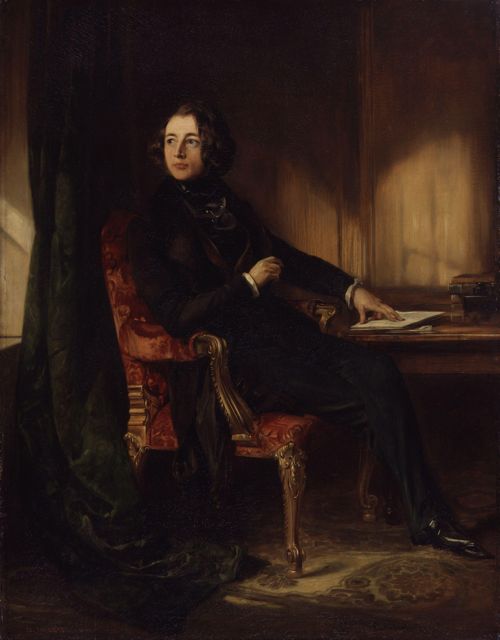
(Charles Dickens, painted by Daniel Maclise, 1839 (age 27). He was 31 when the events of this movie take place!)

Sunday, November 12, 2017

PRE-HOLIDAY CHEER

Who's ready for a little pre-holiday spirit?

If your answer was a resounding "Gah!" stop reading right now. Otherwise, stick around.

Okay, full disclosure: I'm kind of a Charles Dickens geek.

His unparalleled view of Victorian-era England (London, especially) — upstairs and downstairs, comic and tragic, darkness and light, good, bad, ugly, and everything in between — is endlessly fascinating to me. I eat it up like a Christmas pudding.

So imagine my delight when this trailer appeared before the feature over at the Nick a couple of days ago. Coming this Thanksgiving weekend: The Man Who Invented Christmas. It stars Dan Stevens as you-know-who, caught in the act of creating one of his most beloved works, A Christmas Carol.

Whenever I'm asked to name my favorite book of all time, this is it. It's astonishing at how polished this simple-seeming tale is: it obeys the so-called "classical unities" of time, place, and action, occurring in the space of a single night, and yet it encompasses one man's entire lifetime, while painting an indelible portrait of an age and culture at its most human, and inhumane extremes.

All wrapped up in an eerie Gothic ghost story.

Really, it's a master class in how to write fiction!

As the screen went dark on the Dickens trailer, Art Boy whispered to me, "I know you're going to want to see that one!" And how. I wanted to stay sitting right there for the next two weeks until the movie itself came onscreen. He practically had to chisel me out of the seat!

This movie might well be silly. It might be trash. But my appetite is inexhaustible! Opening day is November 22, Thanksgiving Eve, at the Nick. We'll see you there!

Sunday, July 12, 2015

A FOND FAREWELL

Very sad to hear of the passing of Roger Rees, beloved (and inexhaustible) star of the Royal Shakespeare Company's epic 8-hour production of The Life and Adventures of Nicholas Nickleby.

When Nicholas Nickleby was first broadcast on TV in the States in 1983, Rees' performance gave the whole sprawling enterprise its emotional center. His Nicholas navigated the massive plot with a quicksilver adrenalin-rush of moral courage that seemed to surprise even him.

I'm sure neither my husband nor his will mind me saying I've been in love with him ever since.

Still in the Dickensian mode, he had a featured role in the Georg C. Scott TV version of A Christmas Carol (Rees played nephew Fred), and a TV adaptation of John Fowles' The Ebony Tower. He went on to play recurring roles in Cheers (zillionaire Robin Colcord) and The West Wing (Lord John Marbury).
My poster from the RSC. It's still in my office .

I also enjoyed seeing him pop up in the odd movie over the years—Star 80, Mountains of the Moon, Frida, The Prestige. (Some of the damned odd; who could forget his energetic villainy as the nasty Sheriff of Rottingham in Mel Brooks' Robin Hood: Men In Tights?)

But his first love was always the stage. He played many leading Shakespearean roles, from A Comedy of Errors to Hamlet, with the RSC in England. He collaborated with playwright Tom Stoppard in original stage productions of The Real Thing and Hapgood. I raced like the wind down south for the chance to see him live, onstage, when Hapgood played in LA.

But (to my eternal regret) I missed his one-man stage show on playing Shakespeare, What You Will, when it played in San Francisco in 2008. And how I would've loved to see him play the divine Gomez Addams in The Addams Family musical on Broadway in 2011!

PR pic from Rees' solo show What You Will, 2008
More recently, Rees won an off-Broadway Obie in 2011, and was nominated for another Tony in 2012, for co-directing the Peter Pan prequel, Peter and the Starcatcher. (If only I'd gotten a grip and finished Alias Hook when he was still in his Forties, Rees would have been perfect for my James Hook!)

Earlier this year, he opened in the new musical, The Visit, opposite Chita Rivera, but had to withdraw in May for health reasons.

Rees' Nickleby had such a profound effect on me, I started binge-reading Dickens. I plowed through Nicholas Nickleby, Bleak House, and Our Mutual Friend (the best of the lot, with its splendid, propulsive river imagery) before I came up for air. For better or worse, I started seriously writing my own fiction soon after.

By all accounts, Roger Rees was as charming and gracious in real life as he was compelling and entertaining onstage.

Flights of angels sing thee to thy rest, Mr. Rees. You will be missed.

Update: I've just read that the lights of Broadway will be dimmed for one minute, at 7:45 pm, July 15, in honor of Roger Rees. A fitting tribute to a gifted player who loved the stage so much!

Friday, January 31, 2014

HE'S SO FIENNES

The Invisible Woman a splendid tribute to Dickens and his era

If Ken Russell had ever made one of his notorious creative-genius biopics about Charles Dickens, and the famous, middle-aged Victorian novelist's secret love affair with teenage actress Nelly Ternan, one can only imagine the bombastic sturm und drang that would ensue.

Fortunately, Ralph Fiennes—in addition to being a marvelously subtle actor—is a filmmaker of much different mettle than Russell. In his second outing as a director, The Invisible Woman, in which he also stars as the charismatic Dickens, Fiennes does not give us the expected hothouse tale of illicit passion.

Instead, his film is a shrewdly observed portrait not only of the relationship between Dickens and Ternan, but between the artist and his public, and the larger milieu in which their story plays out.

Fiennes plays Dickens as a man of almost maniacal energy and bubbling bonhommie. At the height of his considerable artistic powers, he's an indefatigable actor in a play of his friend and colleague, Wilkie Collins (an irascible Tom Hollander, right, with Fiennes), as well as a popular orator whose readings of dramatic scenes from his own novels leaves audiences spellbound.

He's also a devoted family man who delights in his ten children. Yet he's increasingly unhappy in his longtime marriage to Catherine (Joanna Scanlan), a well-meaning but conventional woman who, he feels, can never be his equal in energy, intellect or sensibilities.

Ellen (Nelly) Ternan (Felicity Jones) is a dewy 18-year-old who, along with her mother, Frances (Kristin Scott Thomas), and two sisters, are engaged for roles in the Collins play. The Ternan women are a family of actresses, but Frances realizes that Nelly's "talent lies elsewhere."
Felicity Jones and Kristin Scott Thomas

Nelly is a great fan of Dickens' novels, and converses with him avidly about them. When Frances notes that the novelist is, in turn, attracted to her youngest daughter, she encourages an attachment that might provide a better living for her daughter than the stage.

Thanks to a savvy script by Abi Morgan (The Iron Lady), based on the non-fiction book by Claire Tomalin, the story proceeds from the viewpoint of Ternan, it's protagonist, heroine, and occasional victim.

While Fiennes' Dickens lights up the screen with his warmth and creative pizzazz, it's Nelly's story that touches us as she (and we) face the ever-narrowing circle of options open to a single woman of that era with but a precarious means of earning a living and without male financial and social protection.

Meanwhile, director Fiennes pays loving hommage to the era that spawned Dickens and his work. Besides the Collins melodrama, staged with all the panache of a Vincent Crummels production, there's an eerie night ramble through the streets of London teeming with the impoverished and outcast, as well as a Fezziwig-worthy party of dancing, music, and magic tricks.
As in so many of Dickens' novels, the characters in The Invisible Woman are highly flawed, yet compelling in their unvarnished humanity. The film is a lovely gift to Dickens and his fans on the occasion (next week, February 7) of his 202nd birthday.

Monday, February 6, 2012

A TOAST TO MR. DICKENS


(Dickens' Dream, unfinished watercolor by Robert William Buss, 1875.)

Let's all raise a glass of something festive to my favorite author, Charles Dickens, on the occasion of his 200th birthday (Tuesday, Feb 7). Funny, he doesn't look a day over 58, the age he was at his untimely death—a tad younger than I am now. I feel like SUCH a slacker!

Check out this website, Dickens 2012, devoted to the year-long celebrations being held in his honor, not only in London and Portsmouth (his birthplace), but all over the world. Not bad for the son of an impecunious Naval Office clerk who spent time in debtor's prison while 12-year-old Charles was taken out of school to work in a draconian blacking (shoe polish) factory—a bitter experience that informed his novels and his sense of justice for the rest of his life.

This acute sense of moral outrage, coupled with his first-hand experience of the vast gulf between the 1% and the other 99 makes his work as relevant today as it ever was. And yet, some modern pundits question whether Dickens is "too hard" to be read at all in the texting and twittering age. (Dickens can't even complete a chapter heading in 144 characters.) To these people, I say: get over yourselves and plunge in. The sheer richness of his alien world is the whole point; getting lost in one of his humongous, vital, character-driven, immensely humane, heartbreaking, savage and hilarious novels is the reason God invented reading.

I can't claim to have read all of Dickens' work; not even close. But certain of his books have been the highlights of my reading life. A Christmas Carol remains my ideal of the perfect book, a simple but ingenious construction that confines the story to a single night, yet expands to include an entire lifetime, indeed, an entire historical era of experience—all with a nifty Gothic ghost story element that's the forerunner of what we now call magic realism. In a word: bravo!

I devoured David Copperfield at age 18 (working for minimum wage at a summer job that was my own "blacking factory," a commercial pottery factory in Manhattan Beach, whose owner bore the Scrooge-like initials "ES"), and the other great coming-of-age saga, Great Expectations. Funny, the books I "had" to read in school—A Tale Of Two Cities; Hard Times—I remember with somewhat less affection than those I discovered on my own. After watching The Royal Shakespeare Company's intense, nine-hour stage production of The Life And Adventures of Nicholas Nickleby on TV, I went on a Dickens binge, polishing off Nickleby, Bleak House, and the sensational Our Mutual Friend (with its  brilliant recurring motif of the sinister, powerful, indifferent, and yet lifegiving River Thames) in short order. Okay, it took me a few months, but it was time well spent.

Certainly not as an alternative to actually reading Dickens, but because so many of my own forays into literature have been prompted by seeing a screen adaptation, I offer my Top 5 Favorite Dickens productions:

A CHRISTMAS CAROL (1951) Accept no substitutes! The incomparable Alistair Sim is the Scroogiest possible Scrooge in this spare, spooky, and foreboding British classic. (Note: It was called Scrooge in its initial theatrical release, but don't mistake it for the 1970 Albert Finney musical version.)

THE LIFE AND ADVENTURES OF NICHOLAS NICKLEBY (1982) This immense video capture of The Royal Shakespeare Company's epic stage event overflows with good and evil, high life, lowlife, and every variety of life in between. By turns eloquent and riotously funny, it also offers a pre-Carol take on the Scrooge character in cold, miserly Ralph Nickleby (John Woodvine) doing his utmost to crush the spirit of his resilient nephew, Nicholas (the inexhaustible Roger Rees). A knockout!

DAVID COPPERFIELD (1935) This classic Hollywood Golden Age production unleashed the entire arsenal of MGM stars on one of Dickens' most venerable and popular novels—led by the inimitable W. C. Fields as the lovable, but impoverished Micawber (based on Dickens' own father). Edna May Oliver is a delicious Aunt Betsey, Basil Rathbone oozes evil as the hateful Murdstone, and Freddie Bartholomew plays the young David. (I never saw the more recent TV version with little Danielle Radcliffe as young David; maybe I'll catch up with it some day!)

OLIVER TWIST (1948) Another eerie black-and-white mood piece, this British production is an early film by the great David Lean. Alec Guinness is a sly, larcenous father-figure Fagin, shepherding his team of child pickpockets through the teeming streets of London. A teenage Anthony Newley is the Artful Dodger, and look out for Robert Newton as the murderous, dangerous Bill Sykes (he would play Long John Silver in Treasure Island two years later).

MR. MAGOO'S CHRISTMAS CAROL (1962) Sorry, but I first saw this at an impressionable age and I still adore it! If you must apply songs to a Dickens story, get Jule Styne and Bob Merrill to write them. I've rhapsodized about this one before in this blog; here's what I love about it.

And speaking of Dickens, take a peek at this fabulous art project by Cardiff School of Art and Design student Rachel Walsh, called "Explaining the Kindle to Charles Dickens." It's great to know that books continue to inspire creative thought, one way or another!

(Above, right: Scrooge confronts the restless, moaning phantoms, unable to rest in peace. Arthur Rackham illustration for A Christmas Carol, 1915.)

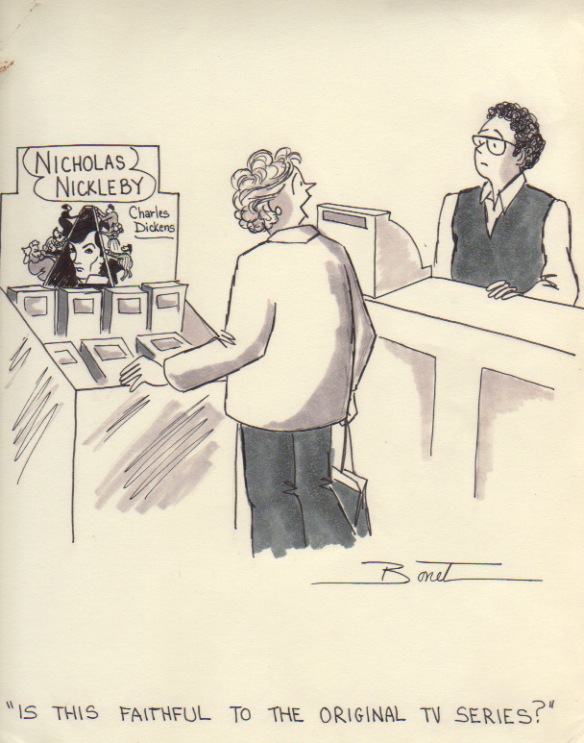
(Above, left: I drew this cartoon to illustrate my review of the TV production of Nicholas Nickleby for the fanzine Movie Collector's World. "Bonet" was the joint nom de plume under which Art Boy and I perpetrated a cartooning career years ago.)

Friday, December 17, 2010

CHRISTMAS CHESTNUTS


I don't know about you, but I have an inexhaustible appetite for A Christmas Carol. For one thing, Charles Dickens is probably my favorite author, and I consider Carol to be the perfect story. It's humorous, dramatically punchy, and fiercely moral, ghostly and Gothic, innovative in its use of magic realism, and brilliant in the simplicity of its concept. It even obeys the classical unities of time, place and action. So I was overjoyed last year when Cabrillo Stage inaugurated a winter season with an annual holiday production of "Scrooge."

Dickens' modest little Christmas ghost story has spawned hundreds of versions on stage, film, video, and TV, over the centuries, and I've lapped 'em up like a steaming bowl of punch. There’s hardly anything even a faintly competent adaptation can do to ruin it — except sing.

It's not that I don't love musicals. But "Scrooge" (which opens again tonight for a two-week run) is a stage version of the old 70s movie musical starring Albert Finney, with indifferent songs by Leslie Bricusse. Last year, the stout-hearted Cabrillo players, dancers and chorus poured their hearts into it; Joseph Ribeiro was an excellent Scrooge, and Benjamin Holck a robust and irresistible Ghost of Christmas Present. But there are some properties that simply do not benefit from the addition of show tunes. At least not these tunes, remarkable in how undistinguished they are. Sample titles: "I Hate People." "I Love Life." "I'll Begin Again." Yawn...

If they MUST do the Carol as a musical, why doesn’t some enterprising person adapt the book from "Mr. Magoo's Christmas Carol," the musical cartoon version that used to run on TV every Christmas? Sure, you'd probably have to cut out the bracketing story featuring Magoo himself, but the Carol-within-the-cartoon is perfectly viable in its own right. Yes, the vintage-1962 TV animation is cheap and tacky, but THOSE were songs! The Jule Styne/Bob Merrill numbers include the lyrical "Winter Was Warm," (sung by young Scrooge's heartbroken cast-off fiancee;) the hilarious "We're Despicable," sung by a trio of grotesques—the charwoman, the laundress, and the rag-and-bone man—cackling over the late Scrooge's effects (a pivotal scene that isn't even in the Bricusse version); and the haunting "All Alone in the World" sung by the boy Scrooge, left behind after all the other schoolboys go home for the holiday. (I'm in tears just thinking about it. But don't take my word for it: see for yourself.)

These songs really enhance the action, rather than stopping it dead in its tracks.

Cabrillo's "Scrooge" is better than no Carol at all. Last year, I especially liked the festive touch of old-fashioned sweets for sale out in the courtyard and strolling carolers in Victorian dress to sing us inside. But now's the time to start sniffing out the rights to the Magoo version for 2011…

Of course, the godfather of all Christmas Carol adaptations is the 1951 British version starring the incomparable Alistair Sim as the scroogiest possible Scrooge. Shot in brooding black-and-white, it's both an unsettlingly spooky and foreboding ghost story and a dazzling celebration of Dickensian Yuletide revelry. Stream it, TiVo it, or put it in your queue, but don't miss it; Christmas just isn't as merry without it.

Speaking of durable Christmas chestnuts, the good folks over at the Aptos Cinema Weekend Classics series are getting into the spirit with special daily holiday schedules and programming. Starting this weekend, matinees will play every day through New Year's Eve. And after the fabulous Philadelphia Story (Sat-Mon), things get seasonal. Starting Tuesday, it's Miracle on 34th Street. Liberate Santa from the small screen and see him in all his plus-size glory in this 1947 family classic. Jolly old elf Edmund Gwenn stars as a Macy's department store Santa out to convince disbelieving child Natalie Wood (and her disenchanted single working mom, Maureen O'Hara) that he's the real deal. Matinees play through Friday, Dec 24, 11 a.m.


Starting Christmas Day, the venerable White Christmas takes over for a special three-day run. Bing Crosby (crooning you-know-what), Danny Kaye, Rosemary Clooney and Vera-Ellen star. Yeah, yeah, we've all seen it six dozen times on TV, but hands up, everyone who's ever seen it on a big screen. I thought not! Trust me, 1954-vintage Technicolor makes those velvet reds and spruce greens pop on a giant screen. And that first snowfall in Vermont is truly magical in wide-screen VistaVision —especially for little California kids in the audience who may have never experienced the real thing. Plays Saturday-Monday, Dec 25 through 27, 11 a.m.

Finishing up the series is a less traditional Yuletide story, The Apartment. Jack Lemmon wants to get ahead in business during the holiday season by loaning out his apartment to boss Fred MacMurray for his adulterous trysts with a wistful Shirley MacLaine in Billy Wilder's incisive, Oscar-winning 1960 comedy. It's in from Tuesday, Dec 28 to Friday, Dec 31, 11 a.m.

In the meantime, gather up the little ones and check out an encore holiday performance of Toy Story 3D, this Saturday (Dec 18) at the Del Mar, 10 a.m., a benefit for the Second Harvest Food Bank. I'm not the world's biggest cheerleader for 3D, as you know if you read my recent column, but you might as well experience it as God intended, in the 1936 Art Deco splendor of the Del Mar's Grand Auditorium with its spanking new state-of-the-art 3D equipment. And what better vehicle than the latest Toy Story, where the lovable toy heroes from Andy's room come back as fresh, funny, and irresistible as ever. And here's the best part: admission is FREE with donation of a non-perishable food item. Talk about the holiday spirit!