Found this interesting link by prolific science-fiction author, historian, and translator Brian Stableford on Mme. de Villeneuve, the French author who first set down the Beauty and the Beast story in print in 1740. Stableford celebrates Villeneuve (Gabrielle-Suzanne Barbot) as a pioneer of sci-fi/fantasy, citing her La Belle et la Bete as " the eighteenth-century work that most closely resembles modern generic fantasy novels."
However, it's the heavily abridged and altered rewrite of the tale published in 1756 by Jeanne-Marie Leprince de Beaumont that has become the standard version of the tale — even though Stableford calls it "a conscious and corrupt plagiarism of a far more innovative and interesting original." He praises the largely forgotten Villeneuve as "a far more complicated and more sophisticated writer than a superficial reading of the Beauty/Beast motif implies," and cites "the nature and intensity of her imagination."
I was aware of these dueling versions of the tale (but not in so much interesting detail!) when I wove both authors' names into Beast: A Tale of Love and Revenge. In my book, the Beaumonts have more or less eclipsed the power and prestige of their Villeneuve cousins, claiming the Villeneuve reputation, like Beast's disputed chateau, for their own — as Mme. Beaumont claimed the Beauty/Beast story for her own, all but eclipsing the stalwart efforts of Mme. Villeneuve.
Obviously, Mme. Le Prince de Beaumont had a much more deft hand at self-promotion, judging by this fanciful portrait by contemporary illustrator Binette Schroeder for a 1986 edition of the tale! Did La Beaumont really keep a cheetah on a leash? Or is it all just metaphor?
Adventures in writing with Lisa Jensen, Author, Columnist and Film Critic
Showing posts with label Fairy Tales. Show all posts
Saturday, January 26, 2019
Thursday, March 23, 2017
FURRY TALE
How does Disney's new Beauty and the Beast shape up?
So, I went to see Disney's new Beauty and the Beast movie. Full disclosure: Disney's 1991 cartoon version, along with the dreamy 1946 Jean Cocteau black-and-white La Belle et la Bete, inspired me to write my own alternative take on the tale.
(Beast: A Tale of Love and Revenge, due out March 6, 2018. But you knew that!)
When it was first announced that Disney was doing a live-action remake, my first reaction was: why? They'd gotten everything so right the first time.
The obvious answer is the studio wants to wrest another megazillion bucks in profits out of tried-and-true properties to which the studio already owns the rights. (See other recent live-action remakes like Cinderella and Maleficent.)
But, the more pertinent question is: have they built a better Beast?
Lavish, enormously-budgeted, gorgeously-produced, and directed by Bill Condon as a color-saturated movie musical extravaganza, the new version is much longer than the cartoon.
Additions have been made to the original script by Linda Woolverton (who does not get a credit this time around) by screenwriters Stephen Chbosky and Evan Spiliotopoulos.
There's some new backstory about the "Beauty" character, Belle (Emma Watson), her clockmaker father (Kevin Kline), and her absent mother. The pivotal moment when an insulted enchantress casts a spell to turn the spoiled, frivolous young prince into the fearsome Beast (Dan Stevens) is acted out as a prologue. And three new songs have been added to the Oscar-winning musical score by Alan Menken and the late Howard Ashman (new lyrics written by Tim Rice).
Otherwise, the story hews pretty closely to the (Disney) original. Belle is considered "odd" in her French country village because she reads books, dreams of adventure, and is in no hurry to get married — especially not to Gaston (Luke Evans), the narcissistic lout who means to make her his wife because "she's as pretty as me."
When her father is taken prisoner by a horrible Beast in a castle hidden in the woods, Belle demands to take her father's place. She doesn't know the fearsome Beast is a prince under a witch's curse. All his servants have been turned into household objects who befriend Belle, knowing that only a girl who falls in love with Beast and earns his love in return can break the curse on them all.
But there's a ticking clock: an enchanted rose preserved under a (ahem) bell jar. If Beast hasn't found love by the time the last petal drops, he and his people will be trapped in the curse for the rest of their lives.
Fractious with each other at first, Belle and Beast start to bond — especially when he invites her to visit his vast library. Meanwhile, the hateful Gaston makes plans to storm the castle, kill the beast, and "rescue" the girl.
There are many charming and funny interactions between Belle and the enchanted objects. I loved the staging of the song, "Be Our Guest," led by the irrepressible master-of-ceremonies, Lumiere, the candelabra (voice and motion-capture movements by Ewan McGregor), a show-stopping production number with its homages to Busby Berkeley-style overhead shots, and clever lyrics. ("No one's gloomy or complaining/When the flatware's entertaining").
I also found it rather touching toward the end when the enchanted objects gradually begin to lose the power to move and speak — ie: their human qualities —the more petals the rose drops.
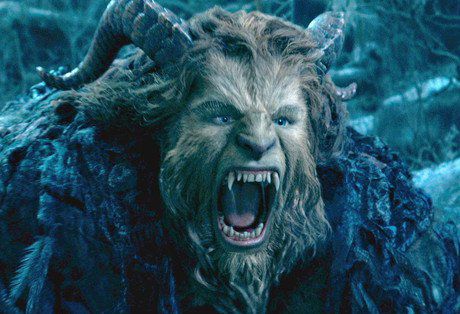
And this is a great-looking Beast, with his impressively long and upswept horns. (Although his mane looks a bit overly-groomed for my taste.) He's at his beastly best when he comes roaring out of the castle to fight off a pack of ravening wolves who attack Belle in the woods.
But it's hard to tell how much Stevens (late of Downton Abbey and currently on Legion) was able to contribute to the role. I experienced technical difficulties in some of his scenes with Belle. Long and medium shots, when the actors share the same physical space (Stevens in costume), are convincing enough. But at other times, Stevens doesn't get to use his own face to express the character's emotions because a decision was made to do Beast's face as a CGI effect.
Granted, it's a pretty amazing effect. But there are moments when Beast's expressions don't look as natural as Belle's when they are in close-up together. We sense a thin layer of physical and emotional disconnect between them — a problem when their relationship is meant to be the heart of the movie — so their romance never quite swept me up in its luscious grip, as it should have.
Another problem is that way to much of the story is devoted to the preening Gaston and his evil machinations. Don't get me wrong; I've loved Luke Evans ever since Tamara Drewe. But Gaston is a one-note character who sucks up too much precious screen time away from Belle and Beast — who could really use it to establish more rapport.
The showdown with Gaston in the finale is also a bit disappointing, with Beast leaping about like Spiderman from one castle spire to the next. Since when did his transformation into a beast come with web-slinging capabilities?
Still this is a sumptuous rendering of the classic fairy tale. But the essential question of why someone who falls in love with the noble Beast would be pleased when he suddenly turns into the standard-issue "handsome prince" in the end remains unresolved. What's so happily-ever-after about that?
This is the one thing that's always bugged me about this fairy tale. And it's an issue I'll be grappling with in my book!
So, I went to see Disney's new Beauty and the Beast movie. Full disclosure: Disney's 1991 cartoon version, along with the dreamy 1946 Jean Cocteau black-and-white La Belle et la Bete, inspired me to write my own alternative take on the tale.
(Beast: A Tale of Love and Revenge, due out March 6, 2018. But you knew that!)
When it was first announced that Disney was doing a live-action remake, my first reaction was: why? They'd gotten everything so right the first time.
The obvious answer is the studio wants to wrest another megazillion bucks in profits out of tried-and-true properties to which the studio already owns the rights. (See other recent live-action remakes like Cinderella and Maleficent.)
But, the more pertinent question is: have they built a better Beast?
![]() |
| Belle and Gaston: no way, lout |
Additions have been made to the original script by Linda Woolverton (who does not get a credit this time around) by screenwriters Stephen Chbosky and Evan Spiliotopoulos.
There's some new backstory about the "Beauty" character, Belle (Emma Watson), her clockmaker father (Kevin Kline), and her absent mother. The pivotal moment when an insulted enchantress casts a spell to turn the spoiled, frivolous young prince into the fearsome Beast (Dan Stevens) is acted out as a prologue. And three new songs have been added to the Oscar-winning musical score by Alan Menken and the late Howard Ashman (new lyrics written by Tim Rice).
Otherwise, the story hews pretty closely to the (Disney) original. Belle is considered "odd" in her French country village because she reads books, dreams of adventure, and is in no hurry to get married — especially not to Gaston (Luke Evans), the narcissistic lout who means to make her his wife because "she's as pretty as me."
![]() |
| Beast and Belle: the way to a girl's heart |
But there's a ticking clock: an enchanted rose preserved under a (ahem) bell jar. If Beast hasn't found love by the time the last petal drops, he and his people will be trapped in the curse for the rest of their lives.
![]() |
| Lumiere: candle power |
Fractious with each other at first, Belle and Beast start to bond — especially when he invites her to visit his vast library. Meanwhile, the hateful Gaston makes plans to storm the castle, kill the beast, and "rescue" the girl.
There are many charming and funny interactions between Belle and the enchanted objects. I loved the staging of the song, "Be Our Guest," led by the irrepressible master-of-ceremonies, Lumiere, the candelabra (voice and motion-capture movements by Ewan McGregor), a show-stopping production number with its homages to Busby Berkeley-style overhead shots, and clever lyrics. ("No one's gloomy or complaining/When the flatware's entertaining").
I also found it rather touching toward the end when the enchanted objects gradually begin to lose the power to move and speak — ie: their human qualities —the more petals the rose drops.
![]() |
| Stevens aroar: don't mess with this Beast! |
But it's hard to tell how much Stevens (late of Downton Abbey and currently on Legion) was able to contribute to the role. I experienced technical difficulties in some of his scenes with Belle. Long and medium shots, when the actors share the same physical space (Stevens in costume), are convincing enough. But at other times, Stevens doesn't get to use his own face to express the character's emotions because a decision was made to do Beast's face as a CGI effect.
![]() |
| Beast and Belle in the ballroom: sumptuous |
Another problem is that way to much of the story is devoted to the preening Gaston and his evil machinations. Don't get me wrong; I've loved Luke Evans ever since Tamara Drewe. But Gaston is a one-note character who sucks up too much precious screen time away from Belle and Beast — who could really use it to establish more rapport.
The showdown with Gaston in the finale is also a bit disappointing, with Beast leaping about like Spiderman from one castle spire to the next. Since when did his transformation into a beast come with web-slinging capabilities?
Still this is a sumptuous rendering of the classic fairy tale. But the essential question of why someone who falls in love with the noble Beast would be pleased when he suddenly turns into the standard-issue "handsome prince" in the end remains unresolved. What's so happily-ever-after about that?
This is the one thing that's always bugged me about this fairy tale. And it's an issue I'll be grappling with in my book!
Wednesday, October 19, 2016
THE BEAST GOES ON
Look out, folks! Here comes another installment in the saga of getting Beast: A Tale of Love and Revenge into print!
Due to publisher Candlewick reshuffling its release schedule, and some last-minute editorial decisions, my poor Beast has fallen off the Spring, 2017 publication schedule.
But fear not: as of this moment, he's set to come roaring back — bigger, bolder, and stronger than ever — on the Fall, 2017 list. Expected pub date is now September 12.
Stay tuned . . .
In the meantime, treat your orbs to this lovely Beauty and the Beast painting by Jynette Tigner, over at Deviant Art, which I just discovered and posted to my Pinterest page.
I love everything about this image — the romantic mood, the impressive Beast, and the woman smart enough to appreciate him as he is. (Did I mention that Beast, himself, not the "handsome prince," is the hero of my story?)
This is definitely my favorite Beast image of the month!
Find more of Jynette Tigner's fairy tale-inspired work here!
Due to publisher Candlewick reshuffling its release schedule, and some last-minute editorial decisions, my poor Beast has fallen off the Spring, 2017 publication schedule.
But fear not: as of this moment, he's set to come roaring back — bigger, bolder, and stronger than ever — on the Fall, 2017 list. Expected pub date is now September 12.
Stay tuned . . .
In the meantime, treat your orbs to this lovely Beauty and the Beast painting by Jynette Tigner, over at Deviant Art, which I just discovered and posted to my Pinterest page.
I love everything about this image — the romantic mood, the impressive Beast, and the woman smart enough to appreciate him as he is. (Did I mention that Beast, himself, not the "handsome prince," is the hero of my story?)
This is definitely my favorite Beast image of the month!
Find more of Jynette Tigner's fairy tale-inspired work here!
Monday, September 19, 2016
BURIED TREASURE
A vintage fairy tale book can be as enchanting as the ageless stories that inspire it. Imagine our deight to find this one squirreled away in our stuff!
First, some backstory: Once upon a time, Art Boy used to go to the flea market every Sunday to buy old books.
Most were fantasy/sci-fi paperbacks, picked up for a dime to re-sell in his comic shop (preferably with gorgeous covers by Frazetta or Boris)— an outgrowth of his previous business selling books to collectors through the mail.
Untold cartons of these old books had been taking up space in the rafters of our garage for eons. But last year, when he decided to start recycling them back into circulation, we discovered two things.
One: eBay and its ilk have taken a huge bite out of the collectible book biz; you can get anything you want online. So there's not the same thrill Art Boy used to get from finding that one weird book he knew was on some collector's wish-list.
And two: a dwindling sector of people consider books worth collecting at all. People read on the run, on devices (like they do everything else), or listen to audiotapes. Who wants to clutter up their busy lives with actual, physical books?
Oh, but look what you miss out on!
While preparing a box of old hardcovers for Logos, Art Boy found this lovely volume: Wonder Tales Retold, a collection of folk and fary tales from around the world.
It was written and illustrated by Katharine Pyle (1863-1938), sister of legendary artist Howard Pyle.
Although she is lesser-known today, Katharine Pyle was a prolific and a successful illustrator in her own right. Besides poems and magazine stories, she wrote, illustrated, compiled, edited, and/or adapted more than 50 books for children.
Wonder Tales Retold features stories from the French, German, Russian, Norse, and English, to Bohemian, French Creole, Persian, "Hindoo," Korean, and American Indian. Some are familiar, like Baba Yaga, or Tam Lin (here called "Tamlane"), but most were new to me.
The minute we flipped open the book, I knew we had to keep it!
It may not the most elaborate fairy tale book ever, by modern standards. But even though it's only a four-color printing process, look how lovely and sinuous these illustrations are! They were done in the Golden Age of Illustration, that decorative era right around the turn of the last century that I love so much.
A lot more women have made their living as artists or illustrators than history records, especially around this era of artistic and social ferment. I'm always thrilled to discover a new one!
What else is serendipitous about finding this buried treasure of a book? It was published in September, 1916 — making it 100 years old this month!
First, some backstory: Once upon a time, Art Boy used to go to the flea market every Sunday to buy old books.
Most were fantasy/sci-fi paperbacks, picked up for a dime to re-sell in his comic shop (preferably with gorgeous covers by Frazetta or Boris)— an outgrowth of his previous business selling books to collectors through the mail.
Untold cartons of these old books had been taking up space in the rafters of our garage for eons. But last year, when he decided to start recycling them back into circulation, we discovered two things.
One: eBay and its ilk have taken a huge bite out of the collectible book biz; you can get anything you want online. So there's not the same thrill Art Boy used to get from finding that one weird book he knew was on some collector's wish-list.
And two: a dwindling sector of people consider books worth collecting at all. People read on the run, on devices (like they do everything else), or listen to audiotapes. Who wants to clutter up their busy lives with actual, physical books?
Oh, but look what you miss out on!
While preparing a box of old hardcovers for Logos, Art Boy found this lovely volume: Wonder Tales Retold, a collection of folk and fary tales from around the world.
It was written and illustrated by Katharine Pyle (1863-1938), sister of legendary artist Howard Pyle.
Although she is lesser-known today, Katharine Pyle was a prolific and a successful illustrator in her own right. Besides poems and magazine stories, she wrote, illustrated, compiled, edited, and/or adapted more than 50 books for children.
Wonder Tales Retold features stories from the French, German, Russian, Norse, and English, to Bohemian, French Creole, Persian, "Hindoo," Korean, and American Indian. Some are familiar, like Baba Yaga, or Tam Lin (here called "Tamlane"), but most were new to me.The minute we flipped open the book, I knew we had to keep it!
It may not the most elaborate fairy tale book ever, by modern standards. But even though it's only a four-color printing process, look how lovely and sinuous these illustrations are! They were done in the Golden Age of Illustration, that decorative era right around the turn of the last century that I love so much.
A lot more women have made their living as artists or illustrators than history records, especially around this era of artistic and social ferment. I'm always thrilled to discover a new one!
What else is serendipitous about finding this buried treasure of a book? It was published in September, 1916 — making it 100 years old this month!
Saturday, April 2, 2016
FASHIONABLE FAIRY TALES
![]() |
| Dom's look: Don't call her 'Tink.' |
Once again, it was all about fairy tales Thursday night on Project Runway All Stars.
It was only last September when the regular Project Runway (as opposed to the
various Lite and Unleaded versions they now show pretty continuously between
seasons) featured a challenge inspired by the hit musical Finding Neverland—a challenge won by a designer riffing on CaptainHook!
So, Thursday night, the challenge for each designer was to
take a "literary heroine" and design something modern and fashionable
inspired by that character's persona and backstory.
Character names were drawn
out of a bag, with one given to each designer. And it quickly became apparent
that all these literary characters were all fairy-tale protagonists.
Which is fine with me; I've been adulterating fairy tales
for years! And I applaud any pop culture institution that keeps these eternal
tales in the limelight.
![]() |
| Kini's Alice: party in the back. |
But it was also just as apparent that all these characters
were specifically the Disney version of fairy-tale heroines. How do I know? One
of them was "Belle," which was never used as a proper name for the
heroine in Beauty and the Beast until
the Disney version.
(French versions called La
Belle et la Bete, like the Jean Cocteau movie, don't count, since
"belle" simply means "beauty" in French.)
As usual, designers responded to the challenge with varying
degrees of success. My favorite was Dom Streater, who was given Tinker Bell,
described as a punky, impish girl hanging out with a bunch of London street
boys. Dom nailed it with patterns and attitude (above).
I wouldn't wear it, but she
totally got the challenge.
I also liked Kini Zamora's riff on Alice in Wonderland—decorous in front, with that demure white
collar (wait, isn't that what's usually called a "Peter Pan collar?"),
but a crazy touch of Wonderland absurdity in the back with that outrageous,
pink-lined ruffle. (One judge called it a "dress mullet.")
What I really love about it is the white ankle socks in
black heels—so perfect for Alice! (A too literal rendition of the classic
Tenniel illustrations with white stockings and black flats just wouldn't have
had the same panache.)
Neither of these won, of course; I remain undefeated in my
inability to think like a PR judge. The winner was Asha Daniel's take on
Rapunzel. Not a bad design of itself, but she didn't glom onto the potential of
the challenge with the same verve as the other two.
![]() |
| Asha's look: Towering. |
(Although her outfit's
columnar shape does sort of look like the tower itself, especially from the
back, with Rapunzels long blonde braid hanging down.)
Btw, the dress for Belle didn't really work; nor did
designer Layana Aguilar's explanation that she designed it so Belle could wear it when she was whisked off to
Argentina to watch a polo match.
In embroidering this scenario, Layana
once referred to Belle's "husband" taking her off on this jaunt. But
I think (and I'd have to watch the replay to be sure) that the second time, Layana
called him "Beast."
And if "Belle" and Beast (not the Prince he turns
into, but Beast himself) jet-setting off to Argentina together as a couple is
an acceptable concept, I may be onto something in my own upcoming novel—where Beast gets to be the hero in
his own tale!
Saturday, September 26, 2015
VOYAGE OF CONQUEST
What does Alias Hook have in common with the books of Sarah J. Maas, Marissa Meyer and Neil Gaiman? They're all featured this week in an article in the glossy showbiz mag, Entertainment Weekly!
Yes, Captain Hook's voyage of conquest through pop culture continues. The occasion for the EW story is the return of the insanely popular TV series, Once Upon A Time, this Sunday night, for its fifth season.
To celebrate this event, EW writer Megan Lewis selected eight books, contemporary novels in the retold classic fairy tale genre, that should appeal to fans of various characters on the show. And since Guess Who is the most popular character on the show, Alias Hook ranks numero uno on the list!
I could not be more thrilled to share these column inches with so many other talented scribes. Not to mention being linked up with such a popular show.
Okay, I've had my issues with OUAT over the years. But I have to give the show credit for helping to redeem Hook from the ranks of pure villainy. According to readers on my Goodreads pages, lots of people picked up Alias Hook because they were envisioning Colin O'Donoghue in the role!
Anyway, my Amazon numbers spiked overnight!
Read the whole article here.
Yes, Captain Hook's voyage of conquest through pop culture continues. The occasion for the EW story is the return of the insanely popular TV series, Once Upon A Time, this Sunday night, for its fifth season.
To celebrate this event, EW writer Megan Lewis selected eight books, contemporary novels in the retold classic fairy tale genre, that should appeal to fans of various characters on the show. And since Guess Who is the most popular character on the show, Alias Hook ranks numero uno on the list!
I could not be more thrilled to share these column inches with so many other talented scribes. Not to mention being linked up with such a popular show.
Okay, I've had my issues with OUAT over the years. But I have to give the show credit for helping to redeem Hook from the ranks of pure villainy. According to readers on my Goodreads pages, lots of people picked up Alias Hook because they were envisioning Colin O'Donoghue in the role!
Anyway, my Amazon numbers spiked overnight!
Read the whole article here.
Thursday, September 24, 2015
WILD AT HEART
Last year, Australian author Kate Forsyth's splendid adult novel, Bitter Greens, retold the tale of Rapunzel from three fascinating female viewpoints—Rapunzel herself, the beautiful sorceress who imprisons her in the tower, and Charlotte-Rose de Caumont de la Force, a real-life writer at the court of Louis XIV who set down one of the earliest versions of the Rapunzel tale.
This year brings us The Wild Girl, which is actually Forsyth's first adult novel (written before Bitter Greens), but the second to be published in the US. In the new book, Forsyth builds her narrative around the very act of retelling, collecting, and preserving the old tales.
Its heroine, Dortchen Wild, is another real-life figure, a girl who grew up next door to the Grimm family in the small German kingdom of Hesse-Cassel during the tumultuous early years of the 19th Century.
It's Dortchen who's credited with telling Wilhelm Grimm, and his brother, Jakob, many of the enduring folktales collected in their now-famous fairy tale book, Children's and Household Tales (first published in 1812).
Forsyth also builds her narrative around the growing romance of spirited, stout-hearted Dortchen, fifth of six daughters of a severe, upper middle-class apothecary and his frail wife, and Wilhelm, second of five sons of an impoverished widow.

As we all know, the ancient tales so painstakingly recorded by the Grimms are nothing like the Disney versions. Forsyth is interested in the way these symbolic, magic-infused tales reflect the real-life human dilemmas of the people who pass them along over the generations.
She skillfully weaves many of the most extreme cautionary tales of violence, mutilation, and treachery into the equally harrowing real-life events of war (as Hesse-Cassel is occupied by the French and then the Russians), oppression, poverty, drunkenness, abuse, and thwarted love.
In particular, the relationship Forsyth imagines for Dortchen and her cruel father (determined to tame his "wild girl" into obedience) looms over the novel like a black thundercloud, providing some of its most grueling scenes.
Yet the humor and lyricism of the story snippets themselves, along with Forsyth's strong character-building (especially Dortchen and her lively sisters), help to offset the story's darker moments.
The pacing falters a bit in the last suite of chapters. The author seems to be delaying events in the speculative part of her story to coincide with historical dates, and these scenes feel somewhat unfocused and meandering after the smooth tension-building of the rest of the book.
Still, The Wild Girl is an impressive debut. It's not as gorgeous nor as intricately put together as Bitter Greens, but does provide an insightful look at the enduring stories we tell, and how, and why we tell them.
This year brings us The Wild Girl, which is actually Forsyth's first adult novel (written before Bitter Greens), but the second to be published in the US. In the new book, Forsyth builds her narrative around the very act of retelling, collecting, and preserving the old tales.
Its heroine, Dortchen Wild, is another real-life figure, a girl who grew up next door to the Grimm family in the small German kingdom of Hesse-Cassel during the tumultuous early years of the 19th Century.
![]() |
| Dortchen Wild, 1815 |
It's Dortchen who's credited with telling Wilhelm Grimm, and his brother, Jakob, many of the enduring folktales collected in their now-famous fairy tale book, Children's and Household Tales (first published in 1812).
Forsyth also builds her narrative around the growing romance of spirited, stout-hearted Dortchen, fifth of six daughters of a severe, upper middle-class apothecary and his frail wife, and Wilhelm, second of five sons of an impoverished widow.

As we all know, the ancient tales so painstakingly recorded by the Grimms are nothing like the Disney versions. Forsyth is interested in the way these symbolic, magic-infused tales reflect the real-life human dilemmas of the people who pass them along over the generations.
She skillfully weaves many of the most extreme cautionary tales of violence, mutilation, and treachery into the equally harrowing real-life events of war (as Hesse-Cassel is occupied by the French and then the Russians), oppression, poverty, drunkenness, abuse, and thwarted love.
In particular, the relationship Forsyth imagines for Dortchen and her cruel father (determined to tame his "wild girl" into obedience) looms over the novel like a black thundercloud, providing some of its most grueling scenes.
![]() |
| Later edition of the Grimms' book, 1865 |
Yet the humor and lyricism of the story snippets themselves, along with Forsyth's strong character-building (especially Dortchen and her lively sisters), help to offset the story's darker moments.
The pacing falters a bit in the last suite of chapters. The author seems to be delaying events in the speculative part of her story to coincide with historical dates, and these scenes feel somewhat unfocused and meandering after the smooth tension-building of the rest of the book.
Still, The Wild Girl is an impressive debut. It's not as gorgeous nor as intricately put together as Bitter Greens, but does provide an insightful look at the enduring stories we tell, and how, and why we tell them.
Wednesday, September 23, 2015
LE MOT JUSTE
Did'ja miss me?
No, I did not fall off the edge of the world in a leaky pirate vessel, nor vanish in an untimely explosion of fairy dust.
I've been right here, hunkered down over the keyboard, hammering out my latest revision of Beast: A Love Story. And as much as I love this book, and as mind-expandingly fabulous my editor Kaylan Adair's suggestions have been for tweaking it into even better shape, let's hope this really in the last revision!
I don't want to dither around too much longer; I want to launch Beast in all his glory out into the world. But I also want him to be as buff as possible—and really, really ready for his close-up. And so I cobble away, word by word, sentence by sentence, scene by scene...well, you get the idea.
Fortunately, I love to edit. By this time in the process, you have a complete draft to work on, so you know where the plot is going, and more or less how it's getting there. (Let's hope so, anyway. Expect delays if you're still monkeying around with story structure at this late date.)
So now it's time for the more detailed wordsmithing—reorganizing sentences, phrase by phrase, and finding exactly le mot juste (as they say in France—which happens to be where Beast takes place, and where the best-known Beauty and the Beast tales originated). Picking the right word—this is the fun part for me!
But editing also involves pruning, and you have to buck up and be ready to kill your darlings. (Wait, that sentence was perfect! Except, that plot point has now been discarded. Oh, the humanity!) In the best-case scenario, you have the luxury of time (as I've had, this month) to approach this process with a scalpel, not a broadsword.
Instead of the wholesale slaughter of entire paragraphs (although I've done plenty of that too), you have to select the most important ideas in that great slog of verbiage and find somewhere else to slot them in. In the sneakiest manner possible, of course, so it will look seamless, as if each sentence had never been anywhere else.
Not to be too anal about it, but every word counts. And as I race (okay, crawl) toward the finish line, I want to get as much juice as I can from every single one!
(Above: Illuminated manuscript, pre-1492, found here)
No, I did not fall off the edge of the world in a leaky pirate vessel, nor vanish in an untimely explosion of fairy dust.
I've been right here, hunkered down over the keyboard, hammering out my latest revision of Beast: A Love Story. And as much as I love this book, and as mind-expandingly fabulous my editor Kaylan Adair's suggestions have been for tweaking it into even better shape, let's hope this really in the last revision!
I don't want to dither around too much longer; I want to launch Beast in all his glory out into the world. But I also want him to be as buff as possible—and really, really ready for his close-up. And so I cobble away, word by word, sentence by sentence, scene by scene...well, you get the idea.
Fortunately, I love to edit. By this time in the process, you have a complete draft to work on, so you know where the plot is going, and more or less how it's getting there. (Let's hope so, anyway. Expect delays if you're still monkeying around with story structure at this late date.)
![]() |
| Be ready to kill, or at least cut your darlings |
So now it's time for the more detailed wordsmithing—reorganizing sentences, phrase by phrase, and finding exactly le mot juste (as they say in France—which happens to be where Beast takes place, and where the best-known Beauty and the Beast tales originated). Picking the right word—this is the fun part for me!
But editing also involves pruning, and you have to buck up and be ready to kill your darlings. (Wait, that sentence was perfect! Except, that plot point has now been discarded. Oh, the humanity!) In the best-case scenario, you have the luxury of time (as I've had, this month) to approach this process with a scalpel, not a broadsword.
Instead of the wholesale slaughter of entire paragraphs (although I've done plenty of that too), you have to select the most important ideas in that great slog of verbiage and find somewhere else to slot them in. In the sneakiest manner possible, of course, so it will look seamless, as if each sentence had never been anywhere else.
Not to be too anal about it, but every word counts. And as I race (okay, crawl) toward the finish line, I want to get as much juice as I can from every single one!
(Above: Illuminated manuscript, pre-1492, found here)
Thursday, April 16, 2015
BECOMING BEAST
![]() |
| Posted to my Goodreads page this week! |
Sounds like the fat lady is singing at last!
Previously, here on the blog, I was trembling on the brink of a new direction in my writing career.
Now, it's my pleasure to announce that a very generous offer has been made for my novel, Beast: A Love Story, by the good people at Candlewick Press. I spoke to my new editor-to-be, the esteemed Kaylan Adair, last week, and I know this is the beginning of a productive relationship.
![]() |
| Soulful Beast or handsome Prince. Which would you choose? |
How do I know? For one thing she loves my book! 'Nuff said. For another, you can Google her until your keyboard turns blue and not find one single iota of snark directed at her by anyone she has ever worked with. Her authors and colleagues all adore her, and I consider myself incredibly lucky to join their ranks!
Set in Renaissance France, Beast is an origin story from which future Beauty and the Beast tales might have evolved. In my story, "happily ever after" depends on perspective as Beast struggles to conquer his treacherous inner prince and emerge as the true hero of his own tale.
Publication is set for Spring, 2017, which gives you an idea of the time, care, and attention Candlewick lavishes on its books. And you can be sure I'll keep you posted as the process unfolds!
In the meantime, if you'd like to visit Beast's world, please do hie thee off to my Beast page on Pinterest!
Monday, March 16, 2015
TWICE UPON A TIME
Charming cast, lush production, but no surprises in Cinderella
With Once Upon A Time still knocking 'em dead on TV, the folks at Disney now realize what profits can be made from repackaging their old cartoon fairy tale classics into new live-action formats. Last year, they tested the cinematic waters with Maleficent, which was bold enough to re-tell the story of Sleeping Beauty from the viewpoint of its "evil" fairy villainess.
Flawed it may have been, but it was such a radical retelling of the familiar story that it earned its own place in the Disney canon.
The latest Disney live-action reboot, Cinderella, sticks much closer to the original story (the Disney version, anyway), and so doesn't feel quite as fresh. Yes, the production values are absolutely luscious, and Kenneth Branagh's skilled direction imbues the story with humor, tension, and emotional complexity.
He's even mindful enough to populate his canvas with many visible people of color, although mostly as extras (except for the always impressive Nonso Anozie as the captain of the Royal Guard).
But the difference is in the writing. Scriptwriter Linda Woolverton, who wrote Maleficent (also Disney's Beauty and the Beast and Alice in Wonderland) comes from a generation of women who grew up chafing against the passivity of Disney cartoon heroines.
Chris Weitz, who wrote Cinderella, does his best to provide more of a personality for both his heroine, and her Prince, than they had in the cartoon version, and he succeeds pretty well.
But he doesn't have the same feminist fire. He's content to stick to the same bare bones of the plot—complete with friendly, live-action mice (although at least in this version, they don't actually talk)—and tell the same old story in much the same old way.
Still, what the story lacks in innovation, the film makes up for in sheer loveliness, performed by a thoroughly engaging cast. It's great to see Ben Chaplin back on the big screen in the prologue as little Ella's charming merchant father.
He and his beloved wife (a blonde Hayley Atwell, TV's Agent Carter) raise their daughter in an idyllic country cottage surrounded by animals, beauty, and love. Her mother teaches Ella to "Have courage and be kind," advice she clings to when her beloved mother dies.
Years later, when Ella is a young woman (now played by Lily James, Lady Rose from Downton Abbey), her father remarries. No sooner does Ella's new Stepmother (a ferociously red-haired Cate Blanchett) move in with her two petulant grown daughters (Holliday Grainger and Sophie McShera), than Ella's father also dies, leaving her at the mercy of her cruel, resentful new step-family. She becomes their kitchen drudge, her quarters removed to the drafty attic, her only friends those sympathetic mice.
Why does she put up with it? Weitz invents a promise made to her parents to look after the house where they were all so happy once. Well, okay...
He's more successful with a scene in the woods where Ella meets a handsome young stranger calling himself Kit (Richard Madden, Robb Stark from Game of Thrones) whom she doesn't realize is the Prince.
It's because Kit is so beguiled by the girl's beauty and kindness (she talks him and his hunting party out of pursuing a deer, which must be some kind of Disney penance for Bambi), that he orchestrates the whole royal ball ploy, open to all the marriageable ladies in the kingdom, just to find her again.
Some sections are a bit slow: Ella bravely facing oppression from her step-family, or the overly-lengthy ball sequence. Yes, it establishes Ella and Kit's connection, but that first dance goes on forever. With her blonde hair and dark brows, James so resembles Daenerys Targaryen, the dragon girl in Game of Thrones, you might find yourself wishing for a flying dragon to come along and jolt things back to life.
But Helena Bonham Carter is loopy fun as the fairy godmother. The first transformation scene is well done, and the gold filigree coach conjured from a pumpkin is outstanding! But Branagh's piece de resistance is the coach's mad dash away from the palace as the clock strikes midnight, footmen morphing back into lizards, the driver becoming a goose again, snow-white steeds sprouting mouse ears and devolving down into rodent form, all while on the run.
It's a brilliant sequence that makes up for the unadventurous familiarity of the story.
Due next year: a live-action Beauty and the Beast, written by Woolverton. Stay tuned.
With Once Upon A Time still knocking 'em dead on TV, the folks at Disney now realize what profits can be made from repackaging their old cartoon fairy tale classics into new live-action formats. Last year, they tested the cinematic waters with Maleficent, which was bold enough to re-tell the story of Sleeping Beauty from the viewpoint of its "evil" fairy villainess.
Flawed it may have been, but it was such a radical retelling of the familiar story that it earned its own place in the Disney canon.
The latest Disney live-action reboot, Cinderella, sticks much closer to the original story (the Disney version, anyway), and so doesn't feel quite as fresh. Yes, the production values are absolutely luscious, and Kenneth Branagh's skilled direction imbues the story with humor, tension, and emotional complexity.
![]() |
| Diversity in the realm, just not in the starring roles |
He's even mindful enough to populate his canvas with many visible people of color, although mostly as extras (except for the always impressive Nonso Anozie as the captain of the Royal Guard).
But the difference is in the writing. Scriptwriter Linda Woolverton, who wrote Maleficent (also Disney's Beauty and the Beast and Alice in Wonderland) comes from a generation of women who grew up chafing against the passivity of Disney cartoon heroines.
Chris Weitz, who wrote Cinderella, does his best to provide more of a personality for both his heroine, and her Prince, than they had in the cartoon version, and he succeeds pretty well.
But he doesn't have the same feminist fire. He's content to stick to the same bare bones of the plot—complete with friendly, live-action mice (although at least in this version, they don't actually talk)—and tell the same old story in much the same old way.
![]() |
| Irredeemable: Stepmom, sisters don't get much sympathy |
Still, what the story lacks in innovation, the film makes up for in sheer loveliness, performed by a thoroughly engaging cast. It's great to see Ben Chaplin back on the big screen in the prologue as little Ella's charming merchant father.
He and his beloved wife (a blonde Hayley Atwell, TV's Agent Carter) raise their daughter in an idyllic country cottage surrounded by animals, beauty, and love. Her mother teaches Ella to "Have courage and be kind," advice she clings to when her beloved mother dies.
Years later, when Ella is a young woman (now played by Lily James, Lady Rose from Downton Abbey), her father remarries. No sooner does Ella's new Stepmother (a ferociously red-haired Cate Blanchett) move in with her two petulant grown daughters (Holliday Grainger and Sophie McShera), than Ella's father also dies, leaving her at the mercy of her cruel, resentful new step-family. She becomes their kitchen drudge, her quarters removed to the drafty attic, her only friends those sympathetic mice.
![]() |
| Madden, James: hope they're not planning a red wedding |
Why does she put up with it? Weitz invents a promise made to her parents to look after the house where they were all so happy once. Well, okay...
He's more successful with a scene in the woods where Ella meets a handsome young stranger calling himself Kit (Richard Madden, Robb Stark from Game of Thrones) whom she doesn't realize is the Prince.
It's because Kit is so beguiled by the girl's beauty and kindness (she talks him and his hunting party out of pursuing a deer, which must be some kind of Disney penance for Bambi), that he orchestrates the whole royal ball ploy, open to all the marriageable ladies in the kingdom, just to find her again.
![]() |
| A coach to flip your gourd for |
But Helena Bonham Carter is loopy fun as the fairy godmother. The first transformation scene is well done, and the gold filigree coach conjured from a pumpkin is outstanding! But Branagh's piece de resistance is the coach's mad dash away from the palace as the clock strikes midnight, footmen morphing back into lizards, the driver becoming a goose again, snow-white steeds sprouting mouse ears and devolving down into rodent form, all while on the run.
It's a brilliant sequence that makes up for the unadventurous familiarity of the story.
![]() |
| Identity theft: mouse-eared steeds devolve before our eyes |
Monday, December 1, 2014
MORE DUELING HOOKS
Hey kids, what time is it? Ten points to Gryffindor if you said it's time for Captain Hook!
Sure, James M Barrie's enduring pirate captain may be 110 years old (or more, if you subscribe to my version of the character in Alias Hook, where he's been frozen in time—at age 43—since 1724). But the time has never been more right for the witty, sardonic old rogue, who's enjoying something of a mini-Renaissance right this minute.
Over on TV's Once Upon A Time, we have the handsome young leather-clad incarnation of the character played for a couple of seasons now by Colin O'Donoghue. It seems like this Captain Hook (aka Killian Jones) was brought in at the beginning of the second season chiefly as a villainous adversary to Robert Carlyle's Rumplestiltskin/Mr. Gold character.
But viewer response to the sexy Irishman was so positive, this Hook has since been promoted to the role of principal love interest to the show's nominal heroine, Emma Swan. But Emma's love interests have an unfortunate way of ending up dead—remember the handsome sheriff who had his traitor's heart squished (literally) by the evil queen? Remember Pinocchio?—which may be why Emma's been so standoffish.
Still, last night, with calamity looming (calamity is always looming in this show), Killian/Hook got another chance to plant a big smooch on Emma. That gurgling sound you may have heard was millions of women all over America melting over their remotes.
Meanwhile, Hook is coming back to the big screen in a big way in next summer's Pan. The movie won't be out for seven more months, but official studio portraits of the main characters were released this week.
No doubt inspired by the popularity of the OUaT character, the producers went with a younger vibe for their Hook, as played by Garrett Hedlund. In what purports to be an origin story of Peter Pan, the boy Peter is whisked off to the Neverland, where he falls in with the notorious pirate, Blackbeard—one of whose crewmembers is the youthful James Hook. Apparently, the two of them team up to save Neverland from their lunatic boss. (Played by Hugh Jackman, from whom I'm expecting plenty of scenery-chomping brio!)
I'm not sure what time period—if any—the movie is meant to be set in. That flintlock Hedlund is grasping looks appropriate to the Blackbeard era, although not so his clothing or his haircut. Doesn't he seem a tad neatly coifed for a pirate?
As I mentioned in a previous post, J. M. Barrie says in his novel, Peter And Wendy, that James Hook once sailed with Blackbeard, so I suppose the storyline isn't all that far-fetched. It's Hook becoming allies with that infernal boy I may not be able to swallow; but I suppose it's all in the telling.
And then, this Thursday (Dec 4), batten down the hatches for Peter Pan Live, an in-studio production of the venerable stage musical to be broadcast live to a TV screen near you. And speaking of venerable, the intrepid Christopher Walken—iconoclast that he is—is going against the youth-vibe trend to bring seasoned menace to the role of Captain Hook.
A veteran hoofer from way back (remember him tap-dancing on the bar in Pennies From Heaven?), Walken also promises to bring a bit of the ol' soft-shoe to the deck of Hook's ship. (It's a musical, remember?)
I can't say that any of these gentlemen are exactly my vision of James Hook. But I'll be cheering them all on, thrilled that the good captain continues to, er, carve out a place for himself in popular culture!
Sure, James M Barrie's enduring pirate captain may be 110 years old (or more, if you subscribe to my version of the character in Alias Hook, where he's been frozen in time—at age 43—since 1724). But the time has never been more right for the witty, sardonic old rogue, who's enjoying something of a mini-Renaissance right this minute.
Over on TV's Once Upon A Time, we have the handsome young leather-clad incarnation of the character played for a couple of seasons now by Colin O'Donoghue. It seems like this Captain Hook (aka Killian Jones) was brought in at the beginning of the second season chiefly as a villainous adversary to Robert Carlyle's Rumplestiltskin/Mr. Gold character.
But viewer response to the sexy Irishman was so positive, this Hook has since been promoted to the role of principal love interest to the show's nominal heroine, Emma Swan. But Emma's love interests have an unfortunate way of ending up dead—remember the handsome sheriff who had his traitor's heart squished (literally) by the evil queen? Remember Pinocchio?—which may be why Emma's been so standoffish.
Still, last night, with calamity looming (calamity is always looming in this show), Killian/Hook got another chance to plant a big smooch on Emma. That gurgling sound you may have heard was millions of women all over America melting over their remotes.
Meanwhile, Hook is coming back to the big screen in a big way in next summer's Pan. The movie won't be out for seven more months, but official studio portraits of the main characters were released this week.
No doubt inspired by the popularity of the OUaT character, the producers went with a younger vibe for their Hook, as played by Garrett Hedlund. In what purports to be an origin story of Peter Pan, the boy Peter is whisked off to the Neverland, where he falls in with the notorious pirate, Blackbeard—one of whose crewmembers is the youthful James Hook. Apparently, the two of them team up to save Neverland from their lunatic boss. (Played by Hugh Jackman, from whom I'm expecting plenty of scenery-chomping brio!)
I'm not sure what time period—if any—the movie is meant to be set in. That flintlock Hedlund is grasping looks appropriate to the Blackbeard era, although not so his clothing or his haircut. Doesn't he seem a tad neatly coifed for a pirate?
As I mentioned in a previous post, J. M. Barrie says in his novel, Peter And Wendy, that James Hook once sailed with Blackbeard, so I suppose the storyline isn't all that far-fetched. It's Hook becoming allies with that infernal boy I may not be able to swallow; but I suppose it's all in the telling.
And then, this Thursday (Dec 4), batten down the hatches for Peter Pan Live, an in-studio production of the venerable stage musical to be broadcast live to a TV screen near you. And speaking of venerable, the intrepid Christopher Walken—iconoclast that he is—is going against the youth-vibe trend to bring seasoned menace to the role of Captain Hook.
A veteran hoofer from way back (remember him tap-dancing on the bar in Pennies From Heaven?), Walken also promises to bring a bit of the ol' soft-shoe to the deck of Hook's ship. (It's a musical, remember?)
I can't say that any of these gentlemen are exactly my vision of James Hook. But I'll be cheering them all on, thrilled that the good captain continues to, er, carve out a place for himself in popular culture!
Sunday, November 30, 2014
WOODS AND WOLVES
If any further proof were needed that fairy tales are taking over our popular culture, consider this—a new trailer for the movie version of Into the Woods!
While this musical fairy tale mashup from composer Stephen Sondheim and scriptwriter James Lapine wowed Broadway in 1987, it's taken almost 30 years for the show to make it to the big screen. But now, at last, the timing seems to be right.
For one thing, Disney's live-action Once Upon a Time TV series (or, as we like to call it around my house, the mosh pit where old Disney characters go to die) continues to be a big hit.
Yes, I despair of them ever giving their Captain Hook character anything to do besides trail around in Emma's wake, pining for her.
Still, I hear from many readers of Alias Hook how much they adore Colin O'Donoghue in the role, so I'm grateful to him and the show for helping to make the character sympathetic to the mass audience.
Anyway, it's no coincidence that the Disney company is also responsible for getting Into the Woods up on the big screen. (There must be a Faustian bargain inked in blood somewhere that no fairy tale spinoff can ever again be produced without Disney participation.)
And it's interesting that the director is Rob Marshall, famed for his film adaptation of Chicago. More recently Marshall directed the fourth Pirates of the Caribbean movie, On Stranger Tides, which no doubt accounts for Woods securing Johnny Depp in the featured role of The Wolf.
I understand there's some distress in the blogosphere over this casting, that some fans were hoping for a wolfier, perhaps CGI version of this character in all his scary beastliness. (Although I do think it would sort of break the illusion when he bursts into song.
But wolves exist in fairy tales to symbolize the dangers of the outside (read: grown-up) world to supposedly innocent children like Red Riding Hood. And what more dangerous predator is there than Man?
Besides, look how cool Depp looks in his Zoot Suit and big, furry ears! I can't help but think of the slick, anthropomorphic wolves in the old Warner Brothers cartoons drawn by Tex Avery.
The rest of the cast is not exactly chopped liver either: Meryl Streep as the Witch, James Corden and Emily Blunt as the pivotal Baker and his Wife, Anna Kendrick as Cinderella, and Chris Pine (newly discovered—by me—as an entertaining comic actor) as Cinderella's Prince, to name but a few.
Onstage, Into the Woods was a sardonic meditation on what happens after Happily Ever After, and a wistful cautionary tale to be careful what you wish for.
If you've never seen the stage production do what I did: nip off to the library and borrow the original Broadway cast production on DVD.
So when the film version opens Christmas Day, you'll be all set to marvel at how enduring, alluring, and open to endless interpretations fairy tales continue to be.
While this musical fairy tale mashup from composer Stephen Sondheim and scriptwriter James Lapine wowed Broadway in 1987, it's taken almost 30 years for the show to make it to the big screen. But now, at last, the timing seems to be right.
For one thing, Disney's live-action Once Upon a Time TV series (or, as we like to call it around my house, the mosh pit where old Disney characters go to die) continues to be a big hit.
Yes, I despair of them ever giving their Captain Hook character anything to do besides trail around in Emma's wake, pining for her.
Still, I hear from many readers of Alias Hook how much they adore Colin O'Donoghue in the role, so I'm grateful to him and the show for helping to make the character sympathetic to the mass audience.
Anyway, it's no coincidence that the Disney company is also responsible for getting Into the Woods up on the big screen. (There must be a Faustian bargain inked in blood somewhere that no fairy tale spinoff can ever again be produced without Disney participation.)
And it's interesting that the director is Rob Marshall, famed for his film adaptation of Chicago. More recently Marshall directed the fourth Pirates of the Caribbean movie, On Stranger Tides, which no doubt accounts for Woods securing Johnny Depp in the featured role of The Wolf.
I understand there's some distress in the blogosphere over this casting, that some fans were hoping for a wolfier, perhaps CGI version of this character in all his scary beastliness. (Although I do think it would sort of break the illusion when he bursts into song.
But wolves exist in fairy tales to symbolize the dangers of the outside (read: grown-up) world to supposedly innocent children like Red Riding Hood. And what more dangerous predator is there than Man?
Besides, look how cool Depp looks in his Zoot Suit and big, furry ears! I can't help but think of the slick, anthropomorphic wolves in the old Warner Brothers cartoons drawn by Tex Avery.
The rest of the cast is not exactly chopped liver either: Meryl Streep as the Witch, James Corden and Emily Blunt as the pivotal Baker and his Wife, Anna Kendrick as Cinderella, and Chris Pine (newly discovered—by me—as an entertaining comic actor) as Cinderella's Prince, to name but a few.
Onstage, Into the Woods was a sardonic meditation on what happens after Happily Ever After, and a wistful cautionary tale to be careful what you wish for.
If you've never seen the stage production do what I did: nip off to the library and borrow the original Broadway cast production on DVD.
So when the film version opens Christmas Day, you'll be all set to marvel at how enduring, alluring, and open to endless interpretations fairy tales continue to be.
Wednesday, November 12, 2014
SPLENDOR and MAGIC
Kate Forsyth is serious about fairy tales.
The author of several series of magic-infused children's books, she's also in the midst of earning a doctorate in fairy tale retellings. But there is nothing academic or plodding about her marvelous adult historical fantasy, Bitter Greens.
To call it a mere retelling of Rapunzel does not even begin to do justice to this ambitious, absorbing, and imaginative novel.
When I was writing Alias Hook, I didn't realize that the retold fairy tale had become a genre unto itself. I just became so obsessed with the character of James Hook, notorious villain of the Neverland, that I knew I had to tell his story in his own voice.
It seems that Forsyth's book had a similar genesis—her fascination with formidable Frenchwoman Charlotte-Rose de Caumont de la Force, a real-life writer at the court of Louis XIV who set down one of the earliest versions of the Rapunzel tale in 1697.
Indeed, Charlotte-Rose is a lively and irresistible protagonist, as imagined by Forsyth. But hers is only one of three distinct stories of three dynamic women that span two hundred years of European history in the course of the novel.
Their stories are braided together as intricately as the strands in Rapunzel's rope of red-gold hair.
One protagonist is Margherita, daughter of a mask-maker in Renaissance Venice. At age 12, she's stolen from her parents and imprisoned alone in an impregnable tower by the hundred-year-old witch, La Strega, who uses the girl's virginal blood in black magic rituals to preserve her eternal beauty.
Another protagonist is, of course, Charlotte-Rose herself, who will ultimately write the story in French as Persinette.
(This title, meaning "Little Parsley," refers to the Faustian bargain by which the girl's parents are lured by the witch into staking their daughter's future on a handful of bitter greens.)
Charlotte-Rose's fierce wit and scandalous romances make for compelling reading; the minute she is banished from court and incarcerated in a nunnery in the first chapter, divested of her fancy clothes, her hair, and—quelle horreur!—her writing implements, I was completely hooked!

And, perhaps most unexpectedly, Forsyth's third protagonist is La Strega herself, Selena Leonelli. Daughter of a prostitute mother brutally assaulted before her eyes, apprenticed to a witch, ageless courtesan and dangerous sorceress, she's determined to make the world pay for the injustices done to her.
While none of these women qualifies as the popular modern cliché of the "kick-ass heroine," each is wily, independent, and courageous in her own way. And each of them is worthy of redemption.
Indeed, how the tale of Persinette is revealed to Charlotte-Rose is one of the most satisfying strands in Forsyth's grand design.
Forsyth's prose is gorgeous, her storytelling layered and complex in this splendid, magical feast of a book.
* * *
The cool thing about fairy tales is how open they are to interpretations, by diverse artists as well as writers. Look at these visions of Rapunzel I found! The Arts and Crafts-era illustration (top right) was done by Heinrich Lefler, ca. 1905. Lower right is a lovely painting from a book of Grimms Fairy Tales by F. W. Darlington, ca. 1930s or 40s.
The author of several series of magic-infused children's books, she's also in the midst of earning a doctorate in fairy tale retellings. But there is nothing academic or plodding about her marvelous adult historical fantasy, Bitter Greens.
To call it a mere retelling of Rapunzel does not even begin to do justice to this ambitious, absorbing, and imaginative novel.
When I was writing Alias Hook, I didn't realize that the retold fairy tale had become a genre unto itself. I just became so obsessed with the character of James Hook, notorious villain of the Neverland, that I knew I had to tell his story in his own voice.
It seems that Forsyth's book had a similar genesis—her fascination with formidable Frenchwoman Charlotte-Rose de Caumont de la Force, a real-life writer at the court of Louis XIV who set down one of the earliest versions of the Rapunzel tale in 1697.
Indeed, Charlotte-Rose is a lively and irresistible protagonist, as imagined by Forsyth. But hers is only one of three distinct stories of three dynamic women that span two hundred years of European history in the course of the novel.
Their stories are braided together as intricately as the strands in Rapunzel's rope of red-gold hair.
One protagonist is Margherita, daughter of a mask-maker in Renaissance Venice. At age 12, she's stolen from her parents and imprisoned alone in an impregnable tower by the hundred-year-old witch, La Strega, who uses the girl's virginal blood in black magic rituals to preserve her eternal beauty.
Another protagonist is, of course, Charlotte-Rose herself, who will ultimately write the story in French as Persinette.
| A portrait of Charlotte-Rose—I hope! |
(This title, meaning "Little Parsley," refers to the Faustian bargain by which the girl's parents are lured by the witch into staking their daughter's future on a handful of bitter greens.)
Charlotte-Rose's fierce wit and scandalous romances make for compelling reading; the minute she is banished from court and incarcerated in a nunnery in the first chapter, divested of her fancy clothes, her hair, and—quelle horreur!—her writing implements, I was completely hooked!

And, perhaps most unexpectedly, Forsyth's third protagonist is La Strega herself, Selena Leonelli. Daughter of a prostitute mother brutally assaulted before her eyes, apprenticed to a witch, ageless courtesan and dangerous sorceress, she's determined to make the world pay for the injustices done to her.
While none of these women qualifies as the popular modern cliché of the "kick-ass heroine," each is wily, independent, and courageous in her own way. And each of them is worthy of redemption.
Indeed, how the tale of Persinette is revealed to Charlotte-Rose is one of the most satisfying strands in Forsyth's grand design.
Forsyth's prose is gorgeous, her storytelling layered and complex in this splendid, magical feast of a book.
* * *
The cool thing about fairy tales is how open they are to interpretations, by diverse artists as well as writers. Look at these visions of Rapunzel I found! The Arts and Crafts-era illustration (top right) was done by Heinrich Lefler, ca. 1905. Lower right is a lovely painting from a book of Grimms Fairy Tales by F. W. Darlington, ca. 1930s or 40s.
Friday, June 27, 2014
BLOGS R US
Good Grief, I seem to be all over the blogosphere this week, ranting on about villains, villainy, fairy tales, and Alias Hook.
The Hugo Award-winning sci-fi blogsite, SF Signal, invited me to weigh in on its "Mind Meld" feature of the week. And forget about redemption; this time the topic is Villains We Love to Hate!
A selection of genre authors contribute their ideas on Worst. Villain(s). Ever. Me, I tried to steer clear of the heavy hitters—your Voldemort, your Sauron.
Because in books, as is so often the case in real life, the worst, most egregious villainy is often perpetrated not by the designated evildoers, but by more or less ordinary folks behaving very badly. That's the kind of life-sized villainy that gets me steamed.
Then, just another click away—look, Ma, I'm on Huff Post! Here's a piece I wrote on the fashion for rewriting fairy tales, listing some of my favorites in the genre.
Why do these ancient tales (in which I also include mythology, folklore, even Shakespeare) endure? Because each new generation of bards and storytellers reinvents those tales to keep them vital and current. Times change. Tastes change. One woman's Beast is another woman's Prince.
In this piece, I salute some writers who have dared to retell an old tale from the villain's side of the story. Like Tad Williams' Caliban's Hour. In one fleet, revisionist tale, Williams creates one of the most soulful of modern Beast-heroes!
The Hugo Award-winning sci-fi blogsite, SF Signal, invited me to weigh in on its "Mind Meld" feature of the week. And forget about redemption; this time the topic is Villains We Love to Hate!
A selection of genre authors contribute their ideas on Worst. Villain(s). Ever. Me, I tried to steer clear of the heavy hitters—your Voldemort, your Sauron.
Because in books, as is so often the case in real life, the worst, most egregious villainy is often perpetrated not by the designated evildoers, but by more or less ordinary folks behaving very badly. That's the kind of life-sized villainy that gets me steamed.
Then, just another click away—look, Ma, I'm on Huff Post! Here's a piece I wrote on the fashion for rewriting fairy tales, listing some of my favorites in the genre.
Why do these ancient tales (in which I also include mythology, folklore, even Shakespeare) endure? Because each new generation of bards and storytellers reinvents those tales to keep them vital and current. Times change. Tastes change. One woman's Beast is another woman's Prince.
In this piece, I salute some writers who have dared to retell an old tale from the villain's side of the story. Like Tad Williams' Caliban's Hour. In one fleet, revisionist tale, Williams creates one of the most soulful of modern Beast-heroes!
Saturday, December 14, 2013
BRAVE NEW GIRLS
What Disney Princess movies say about gender, culture, and romance
What would the holidays be without a new Disney feature cartoon? With Frozen, the studio is in full "Disney Princess" mode—the line of femme-centric fairy tale movies designed to market Mattel dolls, outfits and accessories to little girls. (Especially now, as the holiday buying season ramps up.) A marketing ploy made all the more obvious when the movie is animated via CGI, and all the characters already look like plastic dolls, with their smooth, unlined skin and dimensional shading.
Let's take a moment to consider the history of the brand. At least since the revisionist '70s, we've all been yammering on about the evolution, or lack thereof, of Disney's fairy tale cartoon heroines, but I think it's interesting to see how they've reflected their times.
Snow White was sort of a neutered '30s chorus girl (Betty Boop, without sex), with her bobbed hair and baby-doll voice, pining for her prince to come. Cinderella was the obedient drudge, ca. 1950, sublimating her own desires. A decade later, Sleeping Beauty could let her hair down, but she was still the poster girl for passivity; her most dynamic action was to fall asleep for 100 years.
But since the resurgence of fairy tale princess movies that began in 1989 with Ariel in The Little Mermaid, Disney heroines have become more resourceful, spunky (and, oh please, don't make me write "pro-active"), in taking charge of their lives. And more ethnically diverse—grudgingly—if you count Chinese warrior princess Mulan, and Jasmine, from Aladdin, although it took 72 years for the first black Disney cartoon heroine, Tiana, from The Princess and the Frog in 2009.
Very loosely inspired by Danish storyteller Hans Christian Andersen's classic tale, The Snow Queen (although it has only the vaguest nodding acquaintance with the source material), Frozen is one of the whitest of all Disney Princess movies. Not only is it set in a Scandinavian island kingdom perched on a fjord and full of Nordic blondes, but there's the whole snow thing—a princess with uncontrollable magical powers whose touch turns everything to ice.
After Princess Elsa accidentally freezes the kingdom in perpetual winter, she flees up into the mountains and magicks herself a crystal ice palace. The rest of the movie follows her sister, Princess Anna, on a trek across the snowy mountains to find her sister and save the realm. Her unlikely guide is humble woodworker and ice delivery man, Kristoff, while she leaves the kingdom under the protection of neighbor Prince Hans.
For those of you keeping score at home, that's two Disney princesses, one handsome prince, and one roguish commoner.
Which brings us to another topic: the evolution of the Disney cartoon hero. Seriously, does anyone even remember the bland, boring, cookie-cutter "Prince Charmings" of those earlier films? The first one to distinguish himself from the pack was Beauty's splendid Beast in 1991, and even he morphed back into a (yawn) prince at the end.
But finally, the folks at Disney are starting to perceive that their new breed of heroine deserves better, maybe a male counterpart with, you know, a personality.
Frog Prince Naveen was a charming wastrel with a line of corny, yet good-natured patter; unfortunately, he spent most of the movie as a green amphibian.
Flynn Rider in Disney's 2010 Rapunzel movie, Tangled, wasn't even a prince, but a thief and a rogue, on the lam from the palace guard. Sure, the rascal hero is as old a cliché as the bland prince, and if wisecracking Flynn were a live-action hero, he'd be pretty obnoxious, but as a new Disney hero, he had his points. And in the landmark Brave in 2012, there was no romantic hero at all; bow-and-arrow sharpshooter Princess Merida was too busy finding herself.
The excess of heroes in Frozen might suggest a regressive step back to the old days, except for the surprisingly clever, even subversive way the love stories play out. And it's interesting to watch the Disney tale-spinners create more evenly-matched romantic figures, characters who grow and endure trials together, and end up together because they deserve each other, not just because they're the only prince and/or princess in the movie.
But wouldn't it be refreshing if a Disney heroine wasn't a princess at all, but an ordinary girl? Now that would be brave.
What would the holidays be without a new Disney feature cartoon? With Frozen, the studio is in full "Disney Princess" mode—the line of femme-centric fairy tale movies designed to market Mattel dolls, outfits and accessories to little girls. (Especially now, as the holiday buying season ramps up.) A marketing ploy made all the more obvious when the movie is animated via CGI, and all the characters already look like plastic dolls, with their smooth, unlined skin and dimensional shading.
Let's take a moment to consider the history of the brand. At least since the revisionist '70s, we've all been yammering on about the evolution, or lack thereof, of Disney's fairy tale cartoon heroines, but I think it's interesting to see how they've reflected their times.
Snow White was sort of a neutered '30s chorus girl (Betty Boop, without sex), with her bobbed hair and baby-doll voice, pining for her prince to come. Cinderella was the obedient drudge, ca. 1950, sublimating her own desires. A decade later, Sleeping Beauty could let her hair down, but she was still the poster girl for passivity; her most dynamic action was to fall asleep for 100 years.
But since the resurgence of fairy tale princess movies that began in 1989 with Ariel in The Little Mermaid, Disney heroines have become more resourceful, spunky (and, oh please, don't make me write "pro-active"), in taking charge of their lives. And more ethnically diverse—grudgingly—if you count Chinese warrior princess Mulan, and Jasmine, from Aladdin, although it took 72 years for the first black Disney cartoon heroine, Tiana, from The Princess and the Frog in 2009.
Very loosely inspired by Danish storyteller Hans Christian Andersen's classic tale, The Snow Queen (although it has only the vaguest nodding acquaintance with the source material), Frozen is one of the whitest of all Disney Princess movies. Not only is it set in a Scandinavian island kingdom perched on a fjord and full of Nordic blondes, but there's the whole snow thing—a princess with uncontrollable magical powers whose touch turns everything to ice.
After Princess Elsa accidentally freezes the kingdom in perpetual winter, she flees up into the mountains and magicks herself a crystal ice palace. The rest of the movie follows her sister, Princess Anna, on a trek across the snowy mountains to find her sister and save the realm. Her unlikely guide is humble woodworker and ice delivery man, Kristoff, while she leaves the kingdom under the protection of neighbor Prince Hans.
For those of you keeping score at home, that's two Disney princesses, one handsome prince, and one roguish commoner.
Which brings us to another topic: the evolution of the Disney cartoon hero. Seriously, does anyone even remember the bland, boring, cookie-cutter "Prince Charmings" of those earlier films? The first one to distinguish himself from the pack was Beauty's splendid Beast in 1991, and even he morphed back into a (yawn) prince at the end.
But finally, the folks at Disney are starting to perceive that their new breed of heroine deserves better, maybe a male counterpart with, you know, a personality.
Frog Prince Naveen was a charming wastrel with a line of corny, yet good-natured patter; unfortunately, he spent most of the movie as a green amphibian.
Flynn Rider in Disney's 2010 Rapunzel movie, Tangled, wasn't even a prince, but a thief and a rogue, on the lam from the palace guard. Sure, the rascal hero is as old a cliché as the bland prince, and if wisecracking Flynn were a live-action hero, he'd be pretty obnoxious, but as a new Disney hero, he had his points. And in the landmark Brave in 2012, there was no romantic hero at all; bow-and-arrow sharpshooter Princess Merida was too busy finding herself.
The excess of heroes in Frozen might suggest a regressive step back to the old days, except for the surprisingly clever, even subversive way the love stories play out. And it's interesting to watch the Disney tale-spinners create more evenly-matched romantic figures, characters who grow and endure trials together, and end up together because they deserve each other, not just because they're the only prince and/or princess in the movie.
But wouldn't it be refreshing if a Disney heroine wasn't a princess at all, but an ordinary girl? Now that would be brave.
Thursday, May 30, 2013
KISS of LIFE
If you love fairy tales, in all their infinite variety, don't miss Blancanieves, Pablo Berger's flavorful retelling of Snow White with a decidedly Spanish twist. That it's a silent film (no spoken dialogue, but a vivid musical soundtrack), shot in luminous black-and-white, only adds to its distinction. By making the story so uniquely his own, Berger proves just how universal the enduring and endlessly adaptable fairy tale format can be.
Snow White was the "It" girl of the moment last year with two separate Hollywood productions vying to bestow the kiss of life on the old tale. But Mirror Mirror and Snow White and the Huntsman failed (the one being too giddy, the other trying to graft on too much epic fantasy action) by attempting to recreate some kind of familiar, if nebulous, fairy tale realm.
Berger shows how to do it correctly by setting his version of the tale in a very specific era and culture—Seville, Spain, ca, 1920. It's a heady milieu rife with flamenco music, bullfighting, and women's emancipation.
The story begins with the heroine's parents. Her father is a famous matador, Antonio Villalta (the elegant Daniel Giménez Cacho); her mother, Carmen (Inma Questa), is a beautiful flamenco dancer. On the day Antonio suffers a paralyzing accident in the ring, Carmen goes into labor early and dies giving birth to their daughter, called Carmencita.
Antonio can't bear to look at the baby, who is whisked off by her grandmother (Angela Molina) to be raised. Meanwhile, the scheming nurse, Encarna (Maribel Verdu), worms her way into the household of wealthy but now helpless Antonio, and drags him into marriage.
Years later, on Carmencita's Communion day, her loving abuela dies, and the young girl (the winsome, vivacious Sofia Oria) is sent to live in her father's household.
Here, filmmaker Berger borrows a page from Cinderella as her stepmother, Encarna, shuts up Carmencita in the cellar, cuts her hair, and puts her to work as the household drudge. Her only friend is a chicken—until the day she accidentally wanders into her father's room. Smitten with the girl who now reminds him so much of her mother, Antonio rouses himself out of his emotional doldrums; he reads her fairy tales and teaches the eager girl the art of bullfighting.
Of course, Encarna finds a way to permanently squelch their growing bond, and the now young adult Carmencita (Macarena Garcia) finds herself cast out into the world. She's revived from an attempted drowning by a troupe of dwarves with a traveling torero act; they stage mini bullfights with horned calves.
She can't remember who she is (they call her Blancanieves, i.e.: Snow White), but she joins the act when she proves she knows her way around the ring. (Animal lover alert: no bulls are killed in this movie; it's all about the artistry of the cape.)
Soon, the young lady matadora is the toast of Seville—famous enough to once again attract the notice of the jealous and powerful Encarna.
Verdu is great nasty fun as Encarna, swanning around in her chic clothes with matched pair of greyhounds, seeking advice from her mirror image in a reflecting pond. As Blancanieves, both little Oria and fresh, poised Garcia are spirited and appealing, but never sticky-sweet. This girl isn't sitting around, waiting for her prince to come; she's, er, grabbing life by the horns!
Berger has an eye for striking images (time passes as a full moon dissolves into the Communion wafer on the tip of Carmencita's tongue), and an ear for evocative music—his score includes flamenco guitar, propulsive hand-clapping, and the occasional haunting strains of a Theremin.
And these are definitely not your Uncle Walt's dwarfs, from the cheerfully cross-dressing Josefa (Alberto Martinez) and pompous, embittered Jesusin (Emilio Gavira), to soulful Juanin (Jinson Añazco)—who is far more substantial than any typical storybook prince.
Berger's ending will be controversial. It seemed to me to occur about five minutes short of actually resolving the story that Berger sets up with such an inventive flourish. (Although it does work as a sly, cautionary warning to artists to never, ever sign a contract for life with a diabolical agent, as Blancanieves does here.) But at least the open-ended finale adds another layer of intrigue to a truly enchanting film.
Snow White was the "It" girl of the moment last year with two separate Hollywood productions vying to bestow the kiss of life on the old tale. But Mirror Mirror and Snow White and the Huntsman failed (the one being too giddy, the other trying to graft on too much epic fantasy action) by attempting to recreate some kind of familiar, if nebulous, fairy tale realm.
Berger shows how to do it correctly by setting his version of the tale in a very specific era and culture—Seville, Spain, ca, 1920. It's a heady milieu rife with flamenco music, bullfighting, and women's emancipation.
The story begins with the heroine's parents. Her father is a famous matador, Antonio Villalta (the elegant Daniel Giménez Cacho); her mother, Carmen (Inma Questa), is a beautiful flamenco dancer. On the day Antonio suffers a paralyzing accident in the ring, Carmen goes into labor early and dies giving birth to their daughter, called Carmencita.
Antonio can't bear to look at the baby, who is whisked off by her grandmother (Angela Molina) to be raised. Meanwhile, the scheming nurse, Encarna (Maribel Verdu), worms her way into the household of wealthy but now helpless Antonio, and drags him into marriage.
Years later, on Carmencita's Communion day, her loving abuela dies, and the young girl (the winsome, vivacious Sofia Oria) is sent to live in her father's household.
Here, filmmaker Berger borrows a page from Cinderella as her stepmother, Encarna, shuts up Carmencita in the cellar, cuts her hair, and puts her to work as the household drudge. Her only friend is a chicken—until the day she accidentally wanders into her father's room. Smitten with the girl who now reminds him so much of her mother, Antonio rouses himself out of his emotional doldrums; he reads her fairy tales and teaches the eager girl the art of bullfighting.
Of course, Encarna finds a way to permanently squelch their growing bond, and the now young adult Carmencita (Macarena Garcia) finds herself cast out into the world. She's revived from an attempted drowning by a troupe of dwarves with a traveling torero act; they stage mini bullfights with horned calves.
She can't remember who she is (they call her Blancanieves, i.e.: Snow White), but she joins the act when she proves she knows her way around the ring. (Animal lover alert: no bulls are killed in this movie; it's all about the artistry of the cape.)
Soon, the young lady matadora is the toast of Seville—famous enough to once again attract the notice of the jealous and powerful Encarna.
Verdu is great nasty fun as Encarna, swanning around in her chic clothes with matched pair of greyhounds, seeking advice from her mirror image in a reflecting pond. As Blancanieves, both little Oria and fresh, poised Garcia are spirited and appealing, but never sticky-sweet. This girl isn't sitting around, waiting for her prince to come; she's, er, grabbing life by the horns!
Berger has an eye for striking images (time passes as a full moon dissolves into the Communion wafer on the tip of Carmencita's tongue), and an ear for evocative music—his score includes flamenco guitar, propulsive hand-clapping, and the occasional haunting strains of a Theremin.
And these are definitely not your Uncle Walt's dwarfs, from the cheerfully cross-dressing Josefa (Alberto Martinez) and pompous, embittered Jesusin (Emilio Gavira), to soulful Juanin (Jinson Añazco)—who is far more substantial than any typical storybook prince.
Berger's ending will be controversial. It seemed to me to occur about five minutes short of actually resolving the story that Berger sets up with such an inventive flourish. (Although it does work as a sly, cautionary warning to artists to never, ever sign a contract for life with a diabolical agent, as Blancanieves does here.) But at least the open-ended finale adds another layer of intrigue to a truly enchanting film.
Subscribe to:
Posts (Atom)