Showing posts with label Robin Hobb. Show all posts

Sunday, February 23, 2020

TRIPLE TREAT

My love affair with Robin Hobb continues!

All three volumes in each of her trilogies are so closely linked with each other, I decided to stop reviewing the individual books, and wait until I finished all three. Reviewing one book at a time would be like writing a film review after only seeing one third of the movie!

So now, looking back with hindsight, I can say there are major changes for Fitz as the first book in the Tawny Man Trilogy, Fool’s Errand, begins, 15 years after the end of the Farseer Trilogy. At 35, Fitz is in retirement on a little plot of land, out of the limelight of Buckkeep, raising Hap, an orphan boy brought to him by itinerant minstrel and occasional bedmate, Starling. (I've never entirely trusted Starling!)

Soon enough, both former mentor, Chade, and the Fool, orbit back into his life, dragging Fitz into more courtly intrigue around the disappearance of Prince Dutiful — not Fitz's son, not exactly, but child of his body. (It's complicated.) Meanwhile, back in the realm, the entire Liveship Traders Trilogy has occurred in the intervening years, which will begin to impact the story of Fitz and Fool as this trilogy progresses.

Also of note, Fool is the tawny man in question, now passing himself off as the idle aristocrat Lord Golden, his coloring deepening, book by book, as his adventures are imprinted on his physical self and his ever-evolving psyche. Salted into the quest/adventure story arc is the wry comedy of Fitz (now calling himself Tom Badgerlock) passing himself off as Lord Golden's manservant as they surreptitiously search for Dutiful.

For all the political intrigue between the outcast Witted and the elite Skilled, and the lovely, heartbreaking exit of one of the series' most adored characters, it remains the evolution of Fitz's relationship with Fool that powers this endlessly compelling series.

Golden Fool is very much the second act in the Tawny Man Trilogy — all the plots are still simmering! And smack in the middle of it, a swirling eddy of characters and backstory from the Liveship Traders Trilogy begins to well up and seep into the story of Fitz and Fool. I was so excited! One suspicion confirmed, some questions answered, and even more intriguing questions raised. The dynamic between Fitz and Fool just keeps getting more intense —irresistibly so!

I read the Liveship books out of order, before I even started the first Fitz/Fool trilogy (Farseer), which I don't think was particularly detrimental to my enjoyment of either series. I was able to piece together a few key elements of the larger story as I went along.

But I am so glad I read the Liveship books before I started the Tawny Man Trilogy! It not only enriches the experience of reading each individual book, it sweeps the reader up in the thrilling scope of Hobb's imagination. Bit by tasty bit, the enormity of her Big Picture begins to take shape.

Okay, maybe Fool’s Fate, the third book in the Tawny Man Trilogy, is not the best book to read on a cold winter night, with our heroes slogging through impeccably rendered snow and ice across a glacier. Brrr . . .

 But in the last two paragraphs of Chapter 29, you will find my favorite single scene of the whole series so far. I dare not provide any context, leaving it for intrepid readers to discover on their own.

Suffice it to say that from the depths of insurmountable despair, the reluctant Changer engineers the Best. Change. Ever. Damn the Prophecy. Damn Fate. Damn whatever may come next.

This is what love looks like. They are so pack!

Sunday, October 13, 2019

FITZ OF FURY


FitzChivalry Farseer is fighting mad. Bastard grandson to the old king, and apprenticed in his youth to the court assassin, he now finds himself separated by his dangerous trade from the woman he loves and the child he will never know. His mentor, Verity, the King-in-Waiting (and uncle by blood) is possibly dead on a desperate quest of his own, and Fitz, can only watch as their kingdom is ravaged by ferocious Sea Raiders after being abandoned by the usurper king, Prince Regal.

In Assassin’s Quest, the final installment of Robin Hobb’s Farseer Trilogy, Fitz has only one goal left in his shattered life — to find and kill the contemptible Regal, who has destroyed Fitz's own life, before Regal's negligence and conniving can destroy the entire realm.

From the opening sequence of Fitz reluctantly detaching himself from the freedom and relative simplicity of life as a wolf, courtesy of his link to his bond animal, Nighteyes, to the arduous journey through the mountains, always trying to stay one step ahead of Regal's thugs (not always successfully) in search of Verity, who calls irresistibly to Fitz through telepathy called The Skill, this page-turner sucks you in like the vortex of a tornado.

Fitz and Nighteyes' companions include an ancient woman who seems to know a lot about The Skill, an often troublesome minstrel who tags along determined to fashion a heroic ballad from Fitz's adventures that will make her fortune, and Verity's intrepid bride, Queen Kettricken of the mountain kingdom. Diverse as they are, they strive to work together as a unit. Or as Nighteyes exults, "We are pack!"

Also along for the ride is the latest iteration of the oft-evolving Fool; not quite as "colorless" as before, but just as sharp-tongued, enigmatic, insightful and compassionate. Referred to by some as a White Prophet, the Fool was the first to nickname Fitz as "Catalyst" (to Fitz's great annoyance), while Nighteyes sometimes calls him "Changer."

One of Fitz's few pleasures (but just one of many for the reader) is the immediate and easygoing alliance that develops between his two closest friends, Fool and Nighteyes. The wolf calls Fool "the Scentless One."

This only highlights intriguing questions hinted at about the Fool's age, origin, species (perhaps not exactly human) and gender. Which, having already read the next trilogy in Hobb's ouevre, The Liveship Traders, opens up to me a whole new raft of possibilities around one of the principal characters in those books.

Hobb is an Equal Opportunity storyteller: Guards, warriors, Skillmasters, armorers, artisans, all are as likely to be female as male. Hobb herself is a master weaver, embroidering rich details into her massive and complex tapestry — each trilogy from a different point of reference and a different region, but all part of the same engrossing world.
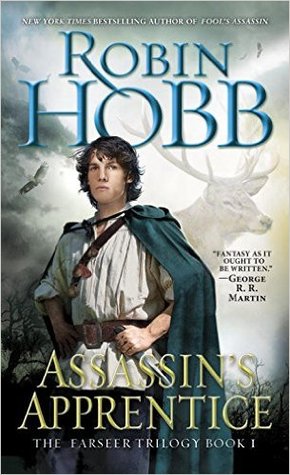
Hobb Fan Alert:  25 years after the release of Assassin's Apprentice, all three books in the Farseer Trilogy have just come out in matching hardcover editions — illustrated, yet! Launch date was October 1st. In stores as we speak!

These are the three Anniversary Edition covers. Pretty cool huh? Click here to see what Hobb has to say about it!

Friday, September 27, 2019

SATURATED FITZ

Coming of age finds FitzChivalry Farseer increasingly drenched in two glamorous and dangerous forms of magic.

As the trajectory of his story continues in Royal Assassin, Robin Hobb's second installment of the Farseer Trilogy (after Assassin's Apprentice), Fitz, bastard son of the old king, must learn to manage the gifts he's inherited (legitimately, or not) from his royal Farseer bloodline.

Through The Wit, publicly condemned as "Beast magic," he is so attuned to animals, he can share their thoughts, feelings, pain, and adventures.

Far more sophisticated, and potentially more treacherous is The Skill, a sort of Vulcan mind meld (but no physical contact required) by which a Skillmaster can enter the minds of friends and foes alike, flinging powerful support to allies in danger, or confusing the minds and distorting the actions of enemies.

Having failed Skill training as a youth, Fitz's powers are random and unpredictable — but increasingly potent.

The character of the mysterious Fool grows more intriguing here, as his friendship with Fitz deepens — and his cryptic prophecies become more pointed.

But the key relationship in this book is Fitz's bond with Nighteyes, a wild wolf pup he rescues from the cage of an unsavory animal vendor.

The perils of The Wit — that the human soul might be tempted to untether itself and be literally carried away by its wild bond animal — is explored from every possible angle and leads to a gripping, literally death-defying finale that will have you racing for the finish line — even as your inner reader screams that she doesn't want the book to end yet!

Like any junkie, the minute I finished this book, I groped immediately for the next injection — oops, installment — to find out what happens next. It does not disappoint.

Btw, just because I'm coming so late to this series doesn't mean that zillions of others have not already fully embraced Hobb's fabulous books. Here is one of the more interesting alternative covers I found online.

I don't know where it comes from; there was no attribution, and my knowledge of the Slavic-seeming title (Polish? Czech?) is, well, nonexistent. Anybody recognize it? But one thing seems certain: Hobb's  popularity is global!


Friday, August 16, 2019

FINDING FITZ

She had me at “Fitz fixes feist’s fits. Fat suffices.”

It seems like whenever I visit a fantasy site, I find euphoric readers rhapsodizing about Fitz and Fool. And since I just finished Robin Hobb’s Liveship Traders Trilogy and loved it so much, I felt the time was ripe to plunge into this, Hobb’s first book, Volume One of her Farseer Trilogy, in which the mismatched duo is introduced — and whose unlikely bond begins with that cryptic bit of doggerel mentioned above.

This is more Fitz’s story, FitzChivalry Farseer, that is, bastard son of an elder royal prince. Young Fitz is taken into the castle keep as a 6-year-old stable boy, and basically raised with the hounds, to protect him from becoming a pawn in the subtle but dangerous game of royal succession.

Adept at caring for hawks, hounds, and horses while struggling to learn courtly manners, he’s trained in secret in the delicate art of poisons by the court assassin, and discovers within himself the Farseer ability to link minds with animals, and, at times, other people.

Fool (kept to amuse Fitz’s grandfather, the king) is more of a supporting character here. But his natterings often contain the seeds of truth, as well as prophecy — if Fitz can decode them. More importantly, as the child Fitz matures into a robust youth, he and the mysterious, pale, “colorless” Fool become friends — which both will need as the series and the courtly intrigues continue, I have no doubt!

Imagine the luxury of developing a storyline through three volumes! (Says I, the writer whose first manuscript ran to 900 pages — typed! Sternly edited before publication of course, when cooler heads prevailed!)

Hobb is able to take her own sweet time developing characters, setting, culture, and the intricacies of her plots. Each of her massive trilogies takes place in a separate region of the world she has built (and continues to build). Yet four-and-a-half volumes into her ouvre, I'm only just beginning to realize all the clever ways her separate stories and regions overlap and influence each other.

Talk about a Big Picture! That's why her books, while technically stand-alone (telling one complete story) never seem to end, exactly; they simply reach a plateau so the reader can draw breath before plunging into the next adventure!

Sunday, May 26, 2019

MAD LOVE

Going through extreme Game of Thrones withdrawal? Looking for a new series to staunch your post-partum misery?

How about a dip — better yet, a dive — into the robust and complex fantasy books of Robin Hobb?

I read the first book in Hobb's Liveship Traders trilogy way back in 2013. I loved the craftsmanship with which she created her fantasy world of seafaring Trader families and their sentient "liveships," her intricate plotting, and her richly developed characters. Her world is less brutal, but no less epic than those of George R. R. Martin, her colleague in the fantasy trade.

These formidable books are long, however, and while the stories were unresolved at the end of the first book, I could never commit the time required to start in on the next book.

But even though I've read (and written!) many other books in the intervening years, Hobb's characters and their stories have really stuck with me. Especially my favorite character from the first book,  Ship Of Magic, the liveship Paragon.

Long beached and abandoned on the shores of the commercial center of Bingtown, he provided shelter and occasional wry companionship for the few human characters bold enough to befriend him. He'd been forsaken by his Trader family and nicknamed "Pariah" after he inexplicably turned rogue on one voyage and was responsible for the death of his crew.

A supporting, almost a peripheral character in the first book, Paragon is central to the plot of Mad Ship, the second installment, which I finally picked up earlier this year. The title, of course, refers to him.

Matriarch Ronica Vestrit and her Trader family face ruin when the family liveship, Vivacia (through the incompetent stewardship of her greedy, tyrannical son-in-law), falls into the hands of the notorious pirate, Kennit, who begins to bond with the impressionable young ship in alarming ways.

The Vestrit clan launches a desperate rescue mission aboard the Paragon, with seafaring heroine Althea Vestrit as second mate to the captain, Brashen Trell, disgraced and disowned son of another prominent Trader family, and a disreputable crew of Bingtown wharf rats.

Althea (to whom Vivacia had been promised until her brother-in-law took over), Brashen, and, of course, Paragon, all have something to prove.

At a book event in 2014: Adventurers in the fantasy trade
Most intriguing in this installment is how the origin of the liveships is gradually and masterfully revealed, where their consciousness comes from, and what effect this revelation will have on the various plot threads — and especially on Paragon, becoming more attuned than anyone else to the potent collective memory of the liveships, so long submerged.

I'm not rooting for the pirate in this one — surprise! Kennit seemed too much like the standard, comic-opera pirate villain in the first book, although his actions are now integral to the larger plot. But all the various story arcs are interesting. (Even spoiled, insufferable Malta Vestrit, a character I cheerfully loathed in the first book, may prove to be redeemable.)

I'm so glad I finally made the time to catch up with this installment. The plots are still unresolved, but yes, I have the third book, Ship Of Destiny on order as we speak!

(Did I mention there are dragons? But we don't find out about them until Book 2, so keep reading!)