Showing posts with label Kate Danley. Show all posts

Saturday, April 16, 2016

SHAKES @ 400

Pop those corks! William Shakespeare's 400th anniversary is almost upon us!

Okay, the quadricentennial of his birth was celebrated back in 1964. But next week, April 23, is the 400th anniversary of his death (which was also his 52nd birthday, back in 1616), and why wait another 48 years to throw a party?

And there is much to celebrate in a low-born scribe (his father was a glove-maker), with an unremarkable education, whose plays are still being performed with gusto four centuries later—and still strike an emotional chord in audiences worldwide.

As my character Jack Dance, actor-turned-pirate-turned actor, says, in one of my unpublished novels:

"There’s no censure in Shakespeare, and every facet of life is represented— bawds and kings and villains and fools. Everything you could ever think or feel or want, Shakespeare has already written about it. And everything that happens in your own life affects how you to respond to him, so his words always seem new and fresh, however often you play them."
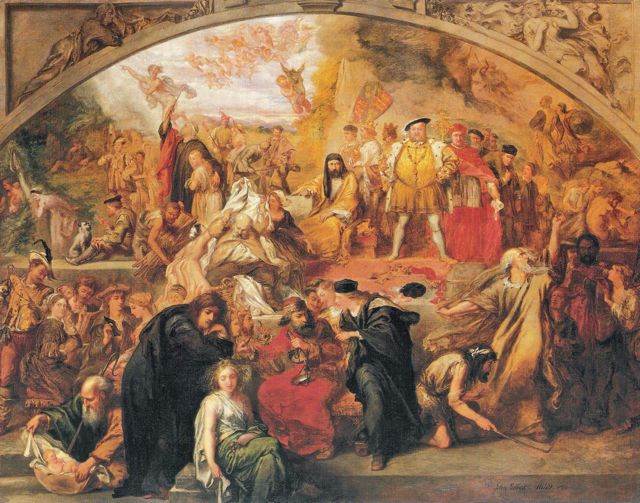
John Gilbert, The Plays of William Shakespeare, 1849.
Not surprisingly, I totally agree! But Jack is only 28 when he says this, so from the vantage point of my own great age, I would add this: as we grow in years and experience, Shakespeare's words become ever more relevant, as we continually view them from our own ever-expanding perspective.

Shakespeare is timeless, in the same way that mythology, folklore, and fairy tales endure. And their timelessness inspires succeeding generations of bards and storytellers to reinvent the stories for their own devices—or eras.

I remember the first time I ever read a review of the Tom Stoppard play, Rosencrantz and Guildenstern Are Dead. I remember thinking,  What? Another writer can just appropriate a couple of Shakespeare's characters and make up his own story about them?

What a concept!

Recycled Shakespeare, like retold fairy tales, has become a genre unto itself, and one that I personally love! I've already flailed away on this blog about the fabulous Fool books of Christopher Moore  (which turn several Shakespearean tragedies into fodder for hilarity via King Lear's savvy Fool) and Alan Gordon's Fools Guild mysteries (reimagining Twelfth Night fool, Feste, as a Renaissance secret agent).

Ditto, Elizabeth Bear's gorgeous Ink and Steel duology, which takes Will Shakespeare and Kit Marlowe as its central characters. And we all know West Side Story, the classic stage musical riff on Romeo and Juliet.

But here are five more clever reinterpretations, examples of just how adaptable Shakespeare continues to be:

CALIBAN'S HOUR  In Tad Williams' beguiling revision, the much abused "monster," Caliban from The Tempest makes his way back to Naples one fateful night to confront Miranda, daughter of his tormentor and enslaver, Prospero. Now a fading beauty approaching middle age, with a teenage daughter of her own, Miranda is compelled to hear Caliban's side of the story—and reconsider who he is (and what has been done to him).

QUEEN MAB  Kate Danley dares to imagine a secret life for Romeo's witty, charismatic pal, Mercutio—one of the most lamented murder victims in all of Shakespeare—as well as a delicious afterlife as lover to the Fairy Queen, Mab.

INDIGO From mythologist and fairy tale scholar Marina Warner comes this decidedly rich and strange riff on The Tempest. It's a dark, simmering exploration into conquest, colonialism, and slavery, and their aftermath, not only for those conquered, but for generations of European conquerors as well.

A MIDSUMMER NIGHT'S DREAM  Okay, no points for originality in the title department, but otherwise, this splendid episode from Neil Gaiman's long-running Sandman graphic novel series is a completely fresh delight. It imagines a very special performance of the Dream by Will Shakespeare and his company of players on Midsummer Eve before the king and queen of the fairies and all their impish court.

THE LION KING Don't laugh! A murdered king (who later appears as a ghost), a treacherous uncle, a young prince trembling on the brink of maturity, uncertain how to test his power—sound familiar? True, there's not a lot of singing or dancing in Hamlet, but at least the folks at Disney steal from the best!

Celebrations will be global throughout the year. Happy Birthday, Will!


Monday, March 30, 2015

PERCHANCE to DREAM

I'm bingeing on Bard-related books this month. First, I finished The Serpent of Venice, Christopher Moore's fabulous follow-up to Fool (pardon me while I alliterate), which gleefully mashes up plots and characters from King Lear, Othello and The Merchant Of Venice.

And now I've segued into Kate Danley's Queen Mab, a fairy fantasy woven in and out of Romeo and Juliet. Danley had me at the first hint of turning Mercutio—one of the most lamented of all the Bard's untimely deaths—into the hero of her story.

In tales of the Fae, death need never be final if an author has the chutzpah and imagination to rewrite a story we think we already know. Fortunately, Danley has both.

Queen Mab is a figure from ancient Celtic folklore, the Fairy Queen known as the Bringer of Dreams. In Danley's story, three generations after the Roman demi-god, Faunus, tricks beautiful Mab and breaks her heart, the two immortals enter into a wager for sport—a chess game in which two mighty houses of Verona are pitted against each other: the Capulets and the Montagues.
Mab brings dreams to sleeping mortals.

But the game has scarcely begun when Mab finds herself bewitched by Mercutio. A witty, compassionate mortal man allied with neither house, he sees beyond Mab's magical aspect to the complex and beautiful soul beneath. She and Mercutio become lovers, but the stakes of the game rise fearfully as Faunus secretly plots to steal Mab's power and banish her from the world.

In Danley's view, all the events in Shakepeare's play—sudden brawls, reversals of fortune, changes of heart—are chalked up to fairy interference. This allows Danley to use large sections of dialogue from the play (not scary: written as prose) in the unfolding of her story.

In one clever invention, Mercutio's show-stopping "Queen Mab speech" becomes his desperate attempt to hold onto her memory, fading like a dream, after she charms him into forgetting her for his own safety.
An untimely end, but only in the Bard's version

Using so much of Shakespeare's text might feel like cheating. But the original material that Danley's weaves in—the love story of Mab and Mercutio, appearances by Faunus, and the Old Gods—is such a great idea, and so well-integrated into the plot of the play, that it draws us in. (Mab and Mercutio even get their own balcony scene!)

The formatting of this self-published book can be a bit wonky from page to page, with the expected typos sprinkled in here and there. Of more concern to me was overuse of the word "upon"—sometimes twice in the same sentence—when "on" would serve just as well.

But this is a pet peeve of mine; so many authors seem to believe that "upon" makes their prose sound more historical.

It also feels as if the book were written very fast. A little more time spent on building resonance, particularly in the closing chapters, to appreciate the plot twists, would have been nice. But Queen Mab is also a fast read (due in part to its enormous print), and the sheer audacity of Danley's premise kept me happily engaged.
Another guest appearance by Mab.

Rewriting the fates of classic literary characters has become its own sub-genre in recent fiction. (Hey, I did it in Alias Hook!) Moore and Danley cheerfully rewrite Shakespearean plays the way we wish they had all turned out. Still, one of my favorites of the bunch reimagines the lives of the playwrights themselves, not the plays.

In Elizabeth Bear's outstanding Ink and Steel, Christopher Marlowe (Kit Marly) is resurrected in the Court of the Fairy Queen after that unfortunate incident at Deptford. There, he becomes the innamorato of several important fairies while helping to train his successor, Will Shakespeare, in the art of weaving magical fairy spells into the gorgeous texts of his plays to protect the mortal realm of Elizabeth.

Every idea on every page of this two-book tale (including the sequel, Hell and Earth) is rich, complex, and literally beguiling.

Gee, I think I'll go read it again...

(Above: Queen Mab by Gustav Dore.)
(Above: The Death of Mercutio by Edwin Austin Abbey)