Wednesday, October 19, 2011

BOT-ITUDE


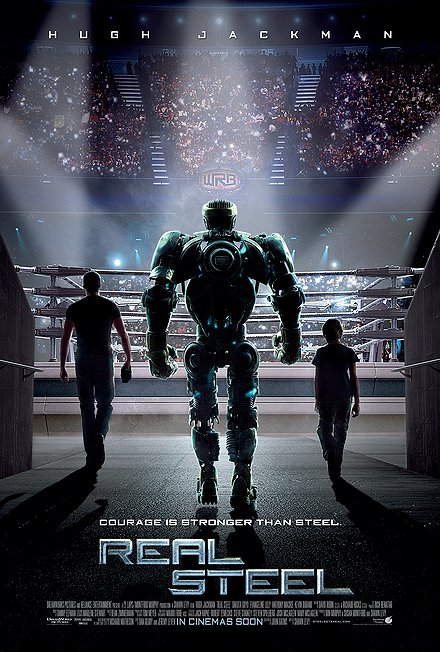
Here's the thing about Hugh Jackman. (Well, there are several things, but I'm trying to focus, here.) I'm still waiting for him to get a movie role as charming, exuberant, and versatile as he is himself, as an interview subject (on Inside the Actor's Studio, for instance) and as an awards show host. In the meantime, we get Real Steel, a workmanlike saga of tarnished dreams and redemption from director Shawn Levy. It's by-the-numbers in every possible way, plot-wise, but it coasts along on the considerable appeal of Jackman, playing both tough and tender as Charlie Kenton, a broken-down fight promoter who gets one last chance to turn his life around.


The story is set in the very near future when fighting robots have replaced humans in the boxing ring. Charlie was a contender once, until the bots took over; now he lives a gypsy life on the road, trucking around an old robot called Ambush on the county fair circuit while trying to stay one step ahead of his numerous creditors. (In the film's ugliest scene, Ambush fights a live rodeo bull at a cheesy fair. Art Boy, my charming moviegoing companion, suggested the bot should have been fighting a mechanical bull, which would have been a much more clever idea, and less icky to watch.)


Anyway, just when Charlie hits bottom, with no bot, no cash, and no prospects, he gets word that a former girlfriend has died in an accident—leaving behind their 11-year-old son, whom Charlie has never known. Intending to sell his custody rights to the boy's wealthy aunt, Charlie instead gains temporary guardianship of young Max (Dakota Goyo) for the summer. Their relationship is adversarial in every way until Max, a videogame junkie, gets a load of his first life-sized fighting bot.


When another of Charlie's fighters is pummeled to scrap metal in the ring, and they raid a recycling center (ie: junkyard) for spare parts, Max discovers Atom under a pile of debris. A small, early-model "sparring bot," Atom is made to take a lot of punishment. His vintage circuitry is out of date, and his control box is funky, but there's something soulful about him, and as Charlie and Max start refurbishing their little underdog and winning bouts with him, father and son, of course, begin to bond as well. Thus, Charlie begins to reclaim himself, and salvage his relationship with Bailey (Evangeline Lilly), the plucky daughter of his former trainer who still run's her father's crumbling old gym.


Every crisis, every bad guy, and every triumph plays out exactly as you expect, but I still found the movie almost ridiculously entertaining. I liked the just-a-few-weeks-from-now milieu: the bots themselves are well articulated and distinctive, and all the tech toys are a little more streamlined, sleek and glowing, but clothing and vehicles & weathered old buildings in the low-rent districts still pretty much look the same. (A nice touch is all the green-power windmills in the distant landscape.)


I especially liked all the different levels of Purgatory suggested by the various fighting arenas: the bleak, tawdry fair, the renegade "zoo," where bikers, punks & lowlifes build their own DIY junker bots to fight for peanuts, the sleazy "Crash Palace," where has-been pro bots go for their melancholy last hurrah (with its great, industrial Metropolis-like posters out front), and the way more upscale first pro League Fight. And at last, the Valhalla (maybe I should say Olympus) of the superdome where Atom fights champion mega-bot Zeus.


Jackman is fun to watch. (Although for his Charlie, "broken-down" is meant to be taken spiritually, not literally; Bailey's misty rhapsody on how, in his fighting prime, Charlie was "lean" and "beautiful," would have more impact if Jackman wasn't standing right there in such ferociously good shape.) And the CGI is well-integrated into the visuals; it always looks like the human and robot characters are side-by-side in the same spatial plane.


What it all boils down to is a tale about a little bot with heart managed by a fighter vs big, hulking, hi-tech muscle machines controlled by geeks with joysticks. In Real Steel's universe, heart wins out. Who could argue with that?

Thursday, October 13, 2011

PAINTER OF LIFE


Enter a teeming Bruegel painting in audacious, exciting 'The Mill and the Cross'


I don't know much about Polish filmmaker Lech Majewski, but he's made one wild, weird-ass movie about art and the artmaking process in The Mill and the Cross. It's a fairly awful title for such a grand, edgy cinematic experiment. Yes, a mill and a cross figure prominently in the painting under construction in the movie, but this title not only makes the film sound dull and plodding, it suggests none of the originality and sheer visual audacity that makes this movie so exciting.

In general, it's about the 16th Century Flemish painter Pieter Bruegel the Elder, caught in the act of creating his vast masterwork, "The Way To Calvary," in 1564. Majewski's film is inspired by a non-fiction book on the subject by art historian Michael Francis Gibson, but Majewski's approach is completely unconventional. We never see the artist actually painting; instead, Majewski creates an onscreen landscape that already looks like a Bruegel painting, especially the background, with its sky full of roiling clouds and the distant hills.


The foreground is occupied by the local peasants that Bruegel always painted with such gusto going about their daily business. Bruegel himself (played by the iconic Rutger Hauer) trudges about in the extreme foreground, deciding how he will marshal these people for allegorical purposes within his composition. He shares these ideas with the audience, sometimes in private voice-over contemplation, at other times in conversation with his wealthy patron, Nicolaes Jonghelinck (Michael York). Now and then, the busy activity onscreen stops dead in its tracks while Bruegel and Jonghelinck prowl around on the outskirts, discussing the various images and what they mean.


But this is in no way a dry history lesson or art critique. And forget about narrative: Majewski isn't interested in telling a linear story. Instead, life sprawls across his cinematic canvas, in all its messy, teeming, tragi-comic, absurd humanity. A weathered miller looks down on it all from his millhouse perched high on a craggy hill, as his windmill blades slowly churn, and the massive gears grind away.


Bruegel explains that the miller, high on his hill, represents God in his painting, "the Great Miller of Life." In Majewski's view, the painter himself (and by extension, the filmmaker) is also a godlike figure, grinding the raw grain of life and human activity into art. Those enormous wooden gears and cogs grinding away inside the millhouse are like the artist's imagination, set to work by the full sails of inspiration. (Read more)


You won't believe how amazing this movie looks. But don't take my word for it; here's the trailer.


Whatever you do, don't miss seeing this wonderful, questing, radical art film on a big screen, where it belongs! Why are you still sitting there?

WHAT'S UP, DOC?


Real-life stories take center stage in 23rd Annual Pacific Rim Film Festival


Truth may not be stranger than fiction, but reality is every bit as compelling in this year's edition of the Pacific Rim Film Festival. Now in its 23rd year, Santa Cruz's favorite free film festival unspools October 14-19, at three locations: The Del Mar Theatre, the Rio Theatre, and Cabrillo College Watsonville Center. As usual, the festival presents films from all around the Pacific Rim, from China, Japan, the Philippines, India, South Korea, New Zealand and Australia to Mexico, Hawaii and the U. S. mainland.


And of the 19 films served up in this year's festival, nine are documentaries, including the opening night kickoff event and the closing night benefit. Three other films in the lineup are fact-based stories, lightly fictionalized accounts of real people and real-life events.


What sort of real-life stories are we talking about here? Hot doc topics include music, in many variations, Japanese-American soldiers in WWII, a Korean mother reuniting with her American son, murder in the Himalayas, and circumnavigating the entire Hawaiian Islands via outrigger canoe. In particular, the opening night film (Last Paradise) and closing night film (Patagonia Rising) concern extreme sports, eco-activism (and exteme eco-activism). (Read more)


And speaking off offbeat movies, here are two words you might not expect to see in the same sentence: Norwegian comedy. But that's Happy, Happy, a tart, acerbic domestic satire about two modern couples who don't know what they want and don't want what they have. A big winner at Sundance, and Norway's official entry to the 2012 Academy Awards, it's not exactly a laff riot, but rookie director Anne Sewitsky trades in a laugh-to-keep-from-crying sort of worldview.


City couple Elisabeth (Maibritt Saerens), a lawyer, and Sigve (Henrik Rafaelsen), along with their adopted young African son, rent a small guest house from warm, ebullient schoolteacher Katja (Agnes Kittelsen) and her sullen hubby, Erik (Joachim Rafaelsen) for a winter vacation. The cool Elisabeth thinks "Katja is desperate to be my friend," but it's Sigve and Katja who bond; both are lonely in the same way. Elisabeth was cheating on Sigve back in the city, and Katja is emotionally battered by Erik—who has demons of his own.


Director Sewitsky punches up these dark themes with ironic appearances by a quartet of white, Nordic males, singing a capella American gospel. (After a montage of illicit sex, the chorus comes back with a deadpan, yet somehow salacious "Good Religion.") In this way, Sewitsky develops her larger themes. When Erik and Katja's son, Theodor, starts playing "slave" games with the African child (including faux flogging with a towel), Sewitsky and screenwriter Ragnhild Tronvoll introduce the idea iof a bad marriage as a kind of enslavement for couples unhappily shackled together. This is alluded to again in a concert scene by the community chorus that the characters all join, where the oppressed Katja is chosen as a soloist on "Amazing Grace"—a hymn originally penned to support the anti-slavery movement in 19th Century Britain.


The narrative strays into some weird, off-putting moments as these characters attempt to find "tenderness and joy." And they can be alarmingly clueless. (Katja yearns to have more children, but if the results are more demon spawn like Theodor, we're glad she's been thwarted.) But Kittelsen delivers a mostly endearing performance as Katja; the viewer becomes invested in her emotional journey. And Sewitsky displays a droll sensibility (ironic, if not strictly comic) that keeps her feature debut interesting, however strange it may get. Catch up with it at the Nick before it disappears.

Thursday, October 6, 2011

EVERY PICTURE TELLS A STORY


It was all about narrative when Art Boy and I headed out to tour some Open Studios last Sunday. Maybe it's the writer in me, but I like artwork that tells some sort of story, and draws the viewer into some intriguing alternate world.


That's certainly true of Anna Oneglia, prolific painter, printmaker, and draughtswoman. Her live/work space in the Tannery was our first stop; we got there just a few minutes after 11, to avoid the inevitable crowd, later.


Anna has been traveling a lot in India over the last couple of years, and her new work (like "Ganesha On a Bike," left) reflects not only her interest in Indian culture, but how smitten she is with the bicycle. Ask her why, and she'll praise the bicycle as the most democratic and ecological mode of transportation.Yet, the bike is more and more often seen as the symbol of poverty in India; anyone with any pretensions at all to upward mobility invests in a scooter. Anna thinks this is a shame. In her world, the Hindu gods reject snobbery and celebrate the fun and functionality of the lowly bike.


Anna's bold, colorful paintings in acrylics and oils line the hallway leading to her studio. Inside surfaces are covered with stacks of irresistible small studies done in vibrant colors on sheets of brown paper. But if you ever get a chance, page through her wonderful sketchbooks, a compulsive recording of everything—people, plants, animals, clothing food—encountered on her travels to places like France, Hawaii and India, over the years. Prepare to be charmed!


While at the Tannery, we checked out the brand new studio spaces, adjacent to the live/work apartments. (The building isn't technically finished yet, but designated OS artists were let in Friday to set up for the weekend show.)


Some painters and mixed media artists were ensconced between the empty spaces soon to house a dance studio and a cafe. Over in the Clay wing, I liked Carol Eddy's fanciful, hand-built amphora vases with their graphic sgraffito surfaces. But I have to admit, my favorite thing that I saw was a history of the Tannery and other local industries running along the corridors between studios, from a great blown-up map of Santa Cruz, ca 1877, through log and limestone exhibits and on to the rebirth of the Tannery as an Arts Center.


Back across the highway, we stopped in to see what was new with fiber sculptor Susan Else. This year, several of her pieces are being exhibited at the National Quilt Museum in Paducah, Kentucky, but there's still plenty to see in her home/work space on Escalona Drive—like this amazing chess set, titled "Your Move." The largest pieces are about 8 inches tall; the "pawns" about 4 inches tall, and, yes, the pieces are separate from the board so in theory you could play a game with them, if you could stop being dazzled long enough to pay attention.


Susan says she didn't know how she was going to interpret the Bishop pieces, not being particularly inspired by traditional bishop figures. But when she found out the French name for this chess piece is fou, fool or jester, everything fell into place; on her board, her kings and queens are flanked by a tumbler, a juggler, and a clown. I especially love the mime in the black bowler hat and striped fabric on the blue side.


She also has a new piece on display. With my typical crackerjack reporter's instincts, I've already forgotten the clever title, but in the work, a lone figure is struggling heroically to row a huge, listing rowboat weighted down with family members and all the implied metaphorical baggage that suggests. Now that's a great story!


Of course, no Open Studios weekend would be complete without a visit to Beth Gripenstraw. A longtime ceramicist of distinctively fun tableware, a jewelerymaker, and an accomplished watercolor painter, Beth doesn't just open her studio/home: she creates entire interactive environments that transport visitors into her alternative reality. And, boy, is it a fun place to be!


Last year, she and her daughter, Allison, collaborated on a multi-media extravaganza inspired by the whimsy of Alice in Wonderland. This year, Beth decided to conduct visitors on an African safari—complete with a tent set up outside next to a jeep, an incredibly detailed "Dr. Livingston's Study" set up in her sunroom inside, and a "Botswana Trading Company" room devoted to her wares. Along the way, the walls were decked with large watercolors depicting Beth and her dog, Benny, on (imaginary) safari in the wilds of Africa.


As if all this wasn't enough, she decorated her grounds with life-sized wildlife—papier maché cheetahs, towering giraffes, and this herd of zebras, who generously allowed Beth and me to join them around the old watering hole.


Beth is a one-woman explosion of creative energy. And talk about narrative! She invents a new scenario every year, and the lucky public gets to come along for the ride. But she only does OS for one weekend, so mark your calendars now to go see her next year. Who knows where she'll take us next?


We had a bunch of other artists to visit, but an unfortunate tire malfunction on the ArtBoyMobile put the kibosh on our plans before we got to the Westside to see Glenn Carter, Peggy Snider, and a few others. It's too bad, since this was our only chance to see other artists; we'll be home here in Live Oak hosting Art Boy's own Open Studios the next two weekends. Oh, well, wait'll next year...


In the meantime, Open Studios runs for the next two weekends, so plot your course, rotate your tires, and go!

Monday, October 3, 2011

BASIC BLACK (AND WHITE)


I thought there was something wrong with the color on my monitor the other day when I logged onto IMDb and got a load of these posters for upcoming movies. Looks like black-and-white is the new black in movie poster chic—at least for this fall.

What's Hollywood trying to tell us, here? The message seems to be: okay, kids, summer is over, so wipe those goony grins off your faces, sit up straight, and pay attention. Forget about those bubble-gum-colored superheroes of summer. These movies are serious business!


But, wait: gigantic boxing robots? An outer space alien who crash lands in Antarctica? Okay, maybe not SO serious. Only the Geoge Clooney film, Ides of March, a political drama, has any pretensions to grown-up subject matter. But this is always the time of year when Clooney appears in his Oscar-contending movies. Check out the similarly color-challenged posters for Syriana, Up In the Air, and Good Night and Good Luck. (At least the latter was actually shot in gorgeous black-and-white, so the poster is more appropriate.)


Anyway, at least half of the movies coming out between now and Christmas go in for stark black-and-white sobriety in their posters. Chalk it up to another sign of the changing seasons, like longer nights and rain washing away our Indian Summer.


Btw, this new version of The Thing bills itself as a prequel to John Carpenter's 1982 "classic." I say, classic, schmassic. Carpenter's horror thriller had it's moments, but it was basically a more graphic reboot of an older property for the post-Alien age.


The original The Thing, directed by Howard Hawks in 1951, is the genuine classic, and not just in the genre; it's one of my all-time favorite movies! Sure, it sounds silly: a pre-Marshall Dillon James Arness resembles a giant carrot from outer space who menaces a team of Arctic researchers and military personnel.


But the movie is not only relentlessly scary (building acute tension out of shadows and dread, instead of gore), it features spirited camaraderie and snappy dialogue that would be right at home in any other Hawks movie, like His Girl Friday, or The Big Sleep. (It also features a great performance by my favorite unknown character actor, Douglas Spencer, as a wisecracking reporter on the base.) Trust me, Hawks' version is the real Thing.


And speaking of media messaging, did you see The Emmys a couple of weeks ago? Here are some interesting stats:


Number of times an image of James Durbin flashed onscreen during the Reality TV montage: 3.


Number of times an image of putative "winner" Scotty McCreery flashed onscreen: 0.


I'm just sayin' ...

Thursday, September 29, 2011

ART AND ABOUT


Get ready to hit the road for Open Studios 2011


Don't forget, the Open Studios Art Tour starts this weekend! A whopping 295 local artists—painters, collagists, ceramacists, sculptors, printmakers, photographers, jewelery-makers, fabric artists, you name it—will open the mystic portals to their work spaces to YOU, the art-loving public, over the next three weekends.


North County artists step up to the plate first this year. 139 studios will be open from north of the Santa Cruz Yacht Harbor through downtown and the Westside all the way to Davenport. While you're out there, don't miss Doug Ross (312 Poplar Ave, SC), one of my favorite OS artists. His clean, colorful silk screen prints often depict seals and other marine life, but don't you just love this fanciful little hummingbird?


Sure, there's a staggering number of artists to see, but remember, this is not an endurance test. Nobody is expected to visit EVERY studio; you just have to pace yourself. And the best way to do this is to visit one of the OS Preview Exhibits in advance, to get a feel for the actual art pieces, up close and personal.


As usual, the Art League is now hosting a show featuring one work by every single participating artist. New this year is a companion exhibit at the R. Blitzer Gallery, on the Westside, featuring work by North County artists from Davenport, Bonny Doon, San Lorenzo Valley, and Scotts Valley. Both exhibits will be up through the last day of OS, October 16. (A public reception will be held for the Blitzer show on Friday, October 7, 5-9 pm.)


Many local favorites are participating in OS again this year. That's ceramic sculptor Peggy Snider's Preview Exhibition piece at the Art League on the left. I'm pretty sure the title is "Being My Muse," but I might have gotten it wrong, what with 6.2 gazillion people crammed into the exhibit space at last Sunday's opening reception. Anyway, I just love that inquisitive little face! (Peggy shows this weekend at 680 Meder Street, SC.)


There are plenty of newcomers to the event this year, as well. I was very intrigued by the little woven piece by fabric artist Doug Masury at the Art League. It's a small, square, framed piece with tight rows of hand-dyed yarn in an abstract, archaeological/landscape design. (Doug is open this weekend at 128 Mason Strert, SC.) I forgot to take note of the title, but if you're headed down there, check it out.


And speaking of fabric art, Susan Else (126 Escalona Drive) is back this year with her beautifully crafted fabric sculptures of whimsical figures in unexpected landscapes. This piece is called "On the Rocks," and yes, it's ALL stuffed and quilted fabric—even that perfectly rendered abalone shell in the foreground!


Open Studios is a free event, but potential art tourists are strongly advised (by me!) to pick up the official OS Calendar and Artist Guide. ($20 online or at outlets countywide.) Not only does the Calendar provide addresses and maps to help you locate even the most remote studios, it also features thumbnail images of the work of every single participating artist, in a useful 16-month calendar format.


The OS Art Tour continues next weekend, October 8 & 9, with South County artists opening their studios from south of the Yacht Harbor through Live Oak, Soquel, Aptos, and down to Watsonville. The following weekend, October 15 & 16, is Encore Weekend, when both North and South County artists can opt for opening their studios. (Check the OS Calendar for information on which artists will be open Encore Weekend.) So plot your course, grab an art buddy and hit the road!

Wednesday, September 14, 2011

PLEASURE CRUISE


Acclaimed Corralitos mystery writer Laurie R. King has shepherded her husband-and-wife detective team through some dark, sobering themes in her last couple of books—religious fanaticism, moral corruption, even human sacrifice. Her latest novel, Pirate King, takes another tack entirely. For this eleventh outing in her popular mystery series, King places her intrepid heroine, Mary Russell, and her equally redoubtable husband, Sherlock Holmes, smack in the middle of a witty, lighthearted romp of an adventure involving the early days of the silent film industry, Gilbert and Sullivan operettas, and, of course, pirates.


King combines the usual scholarship, travelogue, feminism and skullduggery readers have come to expect from her Russell-Holmes mysteries with swashbuckling on the high seas and a healthy dose of absurdist hilarity—along with the ever-deepening affection and camaraderie between Russell and her much older, yet still vigorous spouse. The combination is just about irresistible. Fans can get a taste of this tall tale when King reads from her new novel next Tuesday, September 20, at Bookshop Santa Cruz.


Pirate King
begins with Russell craving nothing more than a few weeks of leisure among the books and bees at the Sussex cottage she and Holmes share. Instead, she is invited by Inspector Lestrade of Scotland Yard to insinuate herself into the employment of a London motion picture company that appears to be leaving a trail of mayhem in its wake. Maddeningly encouraged by Holmes, and fearing the imminent arrival of Holmes' alarming brother, Mycroft, for an extended visit, she reluctantly takes the assignment. (Read more)


(Laurie King will read from and sign copies of Pirate King Tuesday, September 20, at Bookshop Santa Cruz, 7:30 pm.)

Tuesday, September 13, 2011

THE GIRLS CAN HELP IT


A few days ago, Art Boy and I decided to be the last kids on our block to go see The Help. Now into its second month on local screens, it's had longer legs than any other summer "blockbuster," except for the last Harry Potter movie.


And I can see why. For one thing, it appeals strongly to women, in a movie season traditionally written off for teens and fanboys only. Based on Kathryn Stockett's bestselling novel, it depicts a femme-o-centric universe where men scarcely exist at all (onscreen, anyway), and delivers a female-empowering story in which a handful of women stand together to change the status quo in their community—in this case, racial inequality in the deep south, ca. 1960, on the cusp of the Civil Rights movement.


It also has that Mad Men, '60s-era fashion show thing going on, which doesn't hurt. And it provides lots of juicy roles for a variety of actresses—Hollywood's most neglected commodity—of all ages and varieties: starlets Emma Stone, Bryce Dallas Howard, and Jessica Chastain as the young white belles, the divine Viola Davis, sassy Octavia Spencer, and the legendary Cicely Tyson as neighborhood maids, Allison Janney as somebody's mother, even Sissy Spacek as a tippling granny.


It took a long time for this movie to work on me. The fashions seemed too Barbie Doll-perfect, the bitchy Junior League girls too over-the-top brittle, the dialogue too forced and hokey, the emotional situations too scripted and obvious. But I liked the pert Stone as tomboyish protagonist "Skeeter," whose friendship with the black women sets the plot in motion, (although I didn't buy for a second that she couldn't get a date because her hair was too kinky). And I loved Chastain as the sweet, "trampy" outcast. (This year's It Girl, the versatile Chastain changes her persona with each different onscreen hair color: ethereal redheaded mother in The Tree of Life, serious brunette undercover op in The Debt, and her blonde, Monroe-ish waif, here.) And as usual, Davis brought grace and emotional resonance to the proceedings.


(Emma Stone, Octavia Spencer, and Viola Davis in The Help.)


Here's what I hated: the way this story reduces the entire complex issue of civil rights—generations of racism, himiliation, murder, and courage in the face of all of the above— down to something that can easily be resoved by putting a few token white snooty bigots in their place. And the comeuppances doled ot to the film's designated villainess, bitchy Hilly (Howard) are both idiotic and pointless. (Seriously, how do two dozen old, broken toilets delivered to her front lawn strike a blow for racial equality?)


But here's the thing: in the ladies' room afterwards, a woman I don't know started telling me a story. When she lived in North Carolina from 1962-66, she told me, all the women had grown up on tobacco plantations and they all smoked—but never in public (as depicted in the film). Otherwise, she thought the setting was pretty accurate. At which point, another woman came out of a stall and chimed in that when she, a Northerner, went to the South for the first time at about this era, she was shocked to find "Whites only" bathrooms.


And that's when I realized how this movie is working on its audiences. Whether or not they've ever actually lived in the South (but especially if they have), women are finding reflections of their own life experiences in this broad canvas of issues filtered through the female perspective—not only race and politics, but motherhood, marriage, social status, work, friendship, injustice and loss. The Help not only speaks to, but validates the experiences of this vast, untapped audience of women. With a steady $137 million racked up at the box office to date, you'd think this would be an audience worth cultivating, if only Hollywood would get a clue.

Saturday, September 10, 2011

COMING SOON...


When sharks, apes, Barbarians, and (yawn) teens in peril dominate local screens, we know we're stuck in the post-Labor Day movie doldrums. But fear not: the fresh breezes of fall are on the way, bringing with them a batch of eclectic and interesting new films. Here are a select few of the most promising (we hope):


DRIVE Onetime Oscar nominee Ryan Gosling steps out of his perceived comfort zone with a vengeance in this majorly buzzed action thriller, based on the James Sallis novel.


THE THREE MUSKETEERS It would be tough to top Richard Lester's fresh, rollicking two-part production of the early '70s, so why am I so intrigued by this new film version? The cast, for one thing, starting with Christoph Walz as the scheming Cardinal Richelieu.


ANONYMOUS Okay, I get a little peeved at these conspiracy theories that anyone other than the artist historically known as William Shakespeare wrote the canon of plays attributed to him. This film purports to argue in favor of Edward De Vere, Earl of Oxford. But the movie stills look lush and expensive, and with Vanessa Redgrave and real-life daughter Joely Richardson on board as Good Queen Bess (in youth and age), I'm there.


THE RUM DIARY Johnny Depp returns to Fear-and-Loathing mode in this adaptation of the Hunter S. Thompson novel (begun in 1959, but not published until the late '90s), a lightly fictionalized account of the author's early stint as a reporter for a run-down newspaper in San Juan, Puerto Rico.


MY WEEK WITH MARILYN Worlds collided in 1957 when glamorous Hollywood movie star Marilyn Monroe, and acclaimed British thespian Laurence Olivier made a movie together. A memoir about that film shoot inspires this film, starring the ever-gutsy Michelle Williams. (Read complete article)


(Above: Joely Richardson and Jamie Campbell Bower dance around the question of who wrote Shakespeare's plays in Anonymous.)

Wednesday, September 7, 2011

INTO THE WOOD


Hot on the heels of its excellent Big Creek Pottery retrospective exhibit last spring, the Santa Cruz Museum of Art and History continues its commitment to local art and artisans with its current show, Studio Made: Santa Cruz Woodworkers. The show is already into its second month, but I just caught up with it at First Friday last week, and what exciting work it is. If you just love woodwork, that most soulful medium, or if you're a fan of expert hand crafting in general, you need to run out and see this show, like, now.


10 members of the SC Woodworkers collective are featured in the exhibit. You may have noticed some of their pieces decorating the storefront windows of the cavernous Rittenhouse Building downtown, but there's nothing like seeing this work up close, brightly lit, and in detail, to appreciate all the nuances.


Work ranges from massive cabinetry and media centers in vibrant, contrasting wood grains by Om Anand, to an absolutely amazing collection of teeny tiny vessels of wood, palm nuts, and seed pods by Joshua Salesin. (Turned on antique lathes, Salesin's incredibly intricate and diverse pieces, ranging from fingernail-size to about and inch or two high, may be the most breathtaking objects in the show.)


In between, feast your eyes on the dashing, organic lines of Roger Heitzman's chairs, the glorious unfolding wood burl sculptures of Gary Stevens (above), and the lovely inlay work of Matthew Werner, on a variety of pieces.


I was especially knocked out by this three-legged corner jewelry cabinet by Michael Singer. It's a deceptively simple, even demure piece, until you open the doors and discover the layers upon layers of tiered, swing-out drawers and irresistible cubbyholes within. Functional and gorgeous; I loved it!


Singer's glass-topped Fandance Coffee Table is pretty impressive too, with its sweeping, fan-shaped bamboo base.


I'm also a huge fan of Ronald Cook, whose lovely, hand-crafted replications of antique instruments like dulcimers and rebecs (decorated with his signature tiny carved faces) have been thrilling Santa Cruzans for years. An assortment of these are on view at the MAH show, but so are some completely unexpected delights. Like this hand-carved chess set (look at the character in all those faces!), along with the chessboard, the formidable gaming table on which it sets, a pair of medieval-style trestle stools, and the wooden chandelier that hangs down over the entire ensemble!


And these are just a few highlights of a fascinating and inspiring exhibit. (While you're there, don't miss the companion exhibit, Furniture Design, up on the third floor. I liked the strong, rakishly asymmetrical Black Mamba chairs by Fred Hunnicut, and John Baer's ingenious Jet Cone cocktail table and wine bucket made of found metal objects.)


Also, big kudos to Nina Simon for continuing to open the MAH not only to local artists, but the community as well (especially kids). The interactive play stations she's set up throughout the museum are an interesting way to conquer visitors' fear of art and get them to engage with and enjoy the exhibits.


(The Santa Cruz Woodworkers show is up at the MAH through Novembr 13.)

Tuesday, September 6, 2011

WHEN RUSSELL MET HOLMES


Oh, the audacity of Laurie King.


In only her second novel, The Beekeeper's Apprentice (1994), she had the nerve to tinker with one of the greatest legends in all of mystery fiction. The beekeeper in question was Sherlock Holmes, a greying, but no less acute and acerbic man in his mid-fifties retired to a country cottage on the Sussex Downs ca. 1915 to raise bees, under the watchful eye of his faithful housekeeper, Mrs. Hudson.


His apprentice-to-be was a 15-year-old orphan from a neighboring cottage who was about to enter Oxford University. This precocious youth was independent, analytical, fiercely intelligent—and female. Her name was Mary Russell. Holmes, along with King's soon-to-be-legion of readers were pleased, if astonished, to recognize an intellect as fine, prickly, and impatient as Holmes' own, and the young woman was glad to rise to the challenge of his tutelage.


Over the course of King's popular mystery series, Russell and Holmes (as they always refer to each other, comrade-style) have become not only best friends and partners in wit and detection, they are plausibly married as well. That Russell embodies the generation of "new" women rising phoenix-like out of the ashes of the war-ravaged Old World adds another subtle layering to the delicate balance of their relationship as they strive for common ground and equal footing.


Many of their adventures have been dark, indeed. But in her new novel, Pirate King, the eleventh outing in the series, King combines the usual scholarship, travelogue, feminism and skullduggery readers have come to expect with swashbuckling on the high seas and a healthy dose of absurdist hilarity. The combination is just about irresistible! Fans can get a sneak preview when Laurie reads from her new novel this Thursday (September 8) at Capitola Book Cafe, 7:30 pm.


(Above: UK paperback cover for The Beekeeper's Apprentice, looking very Erte!.)

Friday, September 2, 2011

LET THE TREASURE HUNT BEGIN!


Listen: that whooshing sound you hear is Time's Wingéd Chariot, hurtling us into the Santa Cruz Fall arts season.


And, believe it or not, Open Studios is just around the corner. The official catalogue for the Open Studios Art Tour 2011 goes on sale today, and how cool is that green art glass vase by Jim and Connie Grant on the cover? Just the thing to get your juices flowing for another round of OS treasure hunting. This $20 catalogue also functions as a 16-month calender featuring artwork by all 300+ OS artists. You can order online, as we speak, or click here to find a catalogue-selling outlet near you.


Btw, Jim and Connie are South County OS artists whose marvelous one-of-a-kind glassworks combine clean lines and echoes of Deco with organic, Native American shapes and patterns. Check out their Celestial Art Glass website for more examples.


Open Studios starts early this year. North County artists (north of the Yacht Harbor to Davenport) open their doors the weekend of October 1 and 2. South County artists (south of the Yacht Harbor to Watsonville) open up October 8 and 9. Encore Weekend (countywide) is Oct 15 and 16. The catalogue will tell you which artists are participating in the Encore Weekend (in addition to providing a sample of work from each OS artist, and maps to their locations).


Also, last year's Silver Ticket gambit was such a hit, the Cultural Council is doing it again this year. Six individual Silver Tickets are hidden inside OS catalogues at various locations around the county. Each ticket is as good as cash toward the purchase of artwork from any OS artist. There are three tickets valued at $100 each, two tickets at $200 each, and one ticket worth $300. Feeling lucky? Buy a catalogue now and avoid the rush later on.


New this year, in addition to the preview exhibit of all OS artists at the Art League, downtown, there will also be a preview exhibit featuring the work of North County OS artists (from Davenport, Bonny Doon, San Lorenzo Valley, and Scotts Valley) at the R. Blitzer Gallery on the West Side. Both preview shows will be open September 24 through October 16, to allow the public face time with OS artists' work up close and personal.


In the meantime, check out these slideshows of this year's participating OS artists: North County and South County.


Last year, I blogged extensively about my OS adventures. Here's one of my favorite treasures that I found last year, a little ceramic angel by Peggy Snider, who greets me in my kitchen every morning with a poignant rustling of her wings. New treasures are out there, waiting to be found at this year's event. Click here for all the details. And happy hunting!