Sunday, January 21, 2018

STOP THE PRESSES!

Stop the presses!

Beyond delighted this week to receive this Beast endorsement from the great Laurie R. King:

When is beauty shaped by ugliness? When does a simple fairy tale give way to the dark textures beneath its surface? When Lisa Jensen takes it on, that’s when.  Beast: A Tale of Love and Revenge is a love story, and so much more.

— Laurie R. King, New York Times bestselling author of The Beekeeper's Apprentice

My editor at Candlewick is so excited, they're going to redesign the dust jacket to fit the quote in.

Thanks, Laurie!

Wednesday, January 17, 2018

TIME'S UP

Not exactly a "woman's picture"
Hands up, everybody who remembers when the Academy Awards declared 1992 the "Year of the Woman." Hah! I thought not.

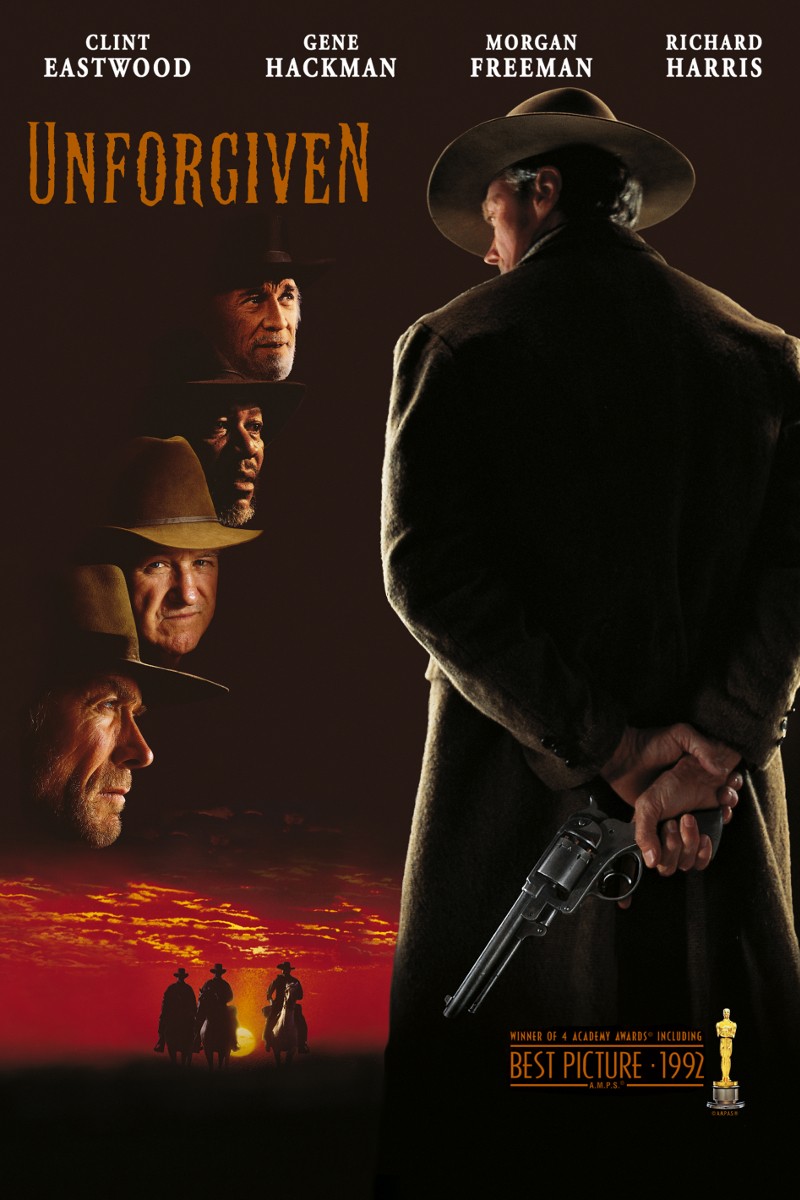
(No wonder. Clint Eastwood's guy-friendly western Unforgiven won four Oscars that year, including Best Picture, Best Director, Best Supporting Actor, and Best Revival Of A Macho Genre Previously Considered Stone Dead.

The most talked-about female role of the year was actually played by a man—Jaye Davidson in The Crying Game.)

It's taken 26 years for Hollywood to catch up — even though it's had to be dragged kicking and screaming toward enlightenment by a sisterhood of industry professionals who have launched the #MeToo and Time's Up movements.

What might this unexpected and organic movement portend for this year's Oscars? Let's take a look at what's been going on in the awards season so far.

Black Power: Hollywood celebs and their social justice activist dates at the Globes

The flow tide of black gowns and black-on-black tuxes on the red carpet at this year's Golden Globes were worn in solidarity with the above mentioned movements.

(Although I wonder if black was  the best color choice to associate with the group announcing the end of the culture of sexual harassment and gender inequality. If Time's Up (at last!) for the old boys club that perpetrated it for generations, why should people dress in mourning?)

McDormand: Year of the Rampaging Woman
(Still, everybody was rocking the look, and many of the black gowns and tuxes will be auctioned off on eBay this month to raise money for the Time's Up Legal Defense Fund.)

Meanwhile, it was a bad night for movies about men. Odds-on favorite, The Post (directed by Steven Spielberg, with Meryl Streep's Katharine Graham playing den mother to a bunch of male reporters) got shut out, along with Christopher Nolan's Dunkirk, and the boy-meets-boy coming of age love story, Call Me By Your Name.

Frances McDormand as a rampaging working-class mom demanding justice for her raped and murdered daughter won the Best (Dramatic) Actress award, as expected, but it was a surprise that the movie devoted to her character, Three Billboards Outside of Ebbing, Missouri, also won for Best Picture/Drama.

Gerwig (with Ronan) directs herself to a DGA nomination
The other big winner was Lady Bird, about a loving, if volatile, mother-daughter relationship, which scored a Best Actress /Comedy nod for star Saoirse Ronan, and Best Picture in the Musical-or-Comedy category — ensuring a trip to the podium for producer Greta Gerwig, who also wrote and directed.

Not that this is quite yet a juggernaut, but it is interesting that the recently announced Directors Guild of America (DGA) Awards include first-timer Gerwig on its hallowed list of nominees. It's rare enough for a woman to get nominated, and a coup in itself — suggesting how many folks in the industry have taken the small, wry, femme-o-centric Lady Bird to their hearts.

But she shouldn't start clearing a place on her mantel just yet. She'll still have to go up against Guillermo del Toro for the DGA prize, who's already won both the Globe and Critic's Choice awards for his masterful The Shape of Water.

(The Oscars nominations will be announced January 23. The ceremony will be later than usual this year, broadcast March 4)

Monday, January 15, 2018

STAR SYSTEM

Okay, I know authors are expected to give their own books 5-star ratings over at the Republic of GoodReads, to bump up the average. But, I just can't make myself do it! What do you think of this strategy instead?

Also, interested to see the star-ratings piling up for Beast: A Tale of Love and Revenge — even though I know for a fact that only five of the raters have actually read the book, including me and Art Boy.

Three other legitimate reviewers received ARCs from the publisher, Candlewick, but the rest of the raters are no doubt responding to the peculiar GR algorithms that confer traction within the community depending on number of books a person rates — whether or not the raters have read them.

I dealt with this topic awhile ago, here on the blog. What do you think?

On the other hand, I'm delighted that over 4900 members have put Beast on their shelves, so thank you, GoodReaders!

Wednesday, January 10, 2018

CLASSIC BEAST

Hey, folks!

Exactly seven months from today — July 10, 2018 — my next novel, Beast: A Tale of Love and Revenge, is (finally) coming to a bookstore near you!

Let's celebrate by reviving my Beast of the Month countdown. Once a month, I'll share some of my favorite Beast images — from book illustrations to movies and stage design. Most will be riffs on the Beauty and the Beast story, but I'll throw in a few surprises too!

Let's start with a classic — this wonderful, vintage poster from Jean Cocteau's hypnotic 1946 film La Belle et la Bete.

This remains the best B&B movie. Ever! And this poster perfectly captures its mood — spooky, lush, and romantic.

It's said that when the movie ended, and this magnificent Beast had morphed back into the handsome prince, Greta Garbo cried from the audience, "Give me back my Beast!"

Who could blame her?

ICE BREAKER

The real Tonya Harding
Harding scandal revisited in wry, raucous I, Tonya 

She was famous for all the wrong reasons.

Figure skater Tonya Harding, a working-class girl from Oregon, had been a child prodigy on the ice who battled her way up the competition circuit to spots on the 1992 and 1994 American Olympic teams.

But it all came crashing down after a bizarre knee-bashing attack on her rival teammate, Nancy Kerrigan, in which Harding's husband and bodyguard were implicated. As Tonya (skillfully played by Margot Robbie) tells us in the faux-documentary, I Tonya, "I was loved. Then I was hated. Then I was a punchline."

Written by Steve Rogers and directed by Craig Gillespie, I, Tonya is an often raucously entertaining fact-based fiction film that purports to be a documentary detailing the tragi-comic incidents of Harding's early life and public career, punctuated by interviews with the key players after the fact.

The reel Tonya: Margot Robbie
This enables the filmmakers to tell the story from a variety of perspectives as the plucky competitor who was the first American woman ever to stick a triple axel in competition evolves into the most reviled woman in the world. Along the way, they generate a surprising amount of sympathy for the human being at the center of all that notoriety.

Robbie is terrific. So is Allison Janney, unrecognizable in a performance of icy waspishness as Tonya's mother, an embittered, hard-drinking, chain-smoking diner waitress with a violent temper and a vulgar mouth.

As wacky as the movie's tone often is, it delivers a scathing look at gender and class politics, and the hypocritical fantasyland of professional sports.

(Read more in this week's Good Times)

Saturday, January 6, 2018

HOOK SAILS ON


Surfing the Interwebs the other night, I was delighted to find this review of Alias Hook by modernlaureate on Instagram, from November, 2016.

In part:

"Dark and dangerous faeries, magnificent but terrifying mermaids, and fresh characterization of Pan and Hook all make this an outstanding Peter Pan retelling. Jensen deftly weaves faerie with fairy tale, mortality with hope, children’s games and bitter reality, all the while moving elegantly between the present events of Neverland and Hook’s past. An interesting and thought-provoking novel from start to finish."

Woot!

James Hooks voyage of world domination continues!


Thursday, January 4, 2018

BEASTY NEW YEAR!


Looky what arrived on my virtual desktop this week!

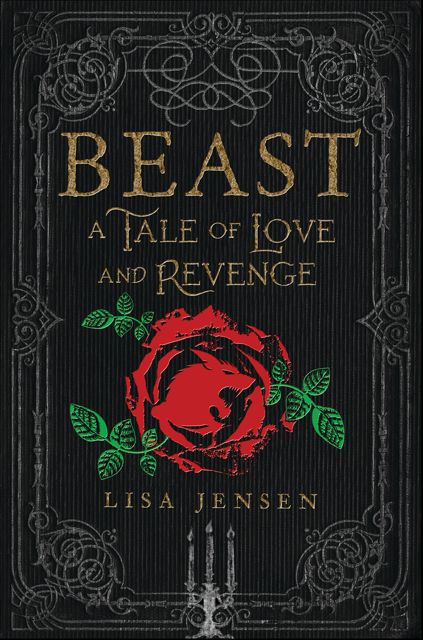
In the publishing biz, they call this a cover flat — the dust jacket of a hardcover book spread out flat. Pretty cool, huh?

My intrepid editor, Kaylan Adair, at Candlewick Pres, sent this out to me ASAP, the cover flat for Beast: A Tale of Love and Revenge, to get my Happy New Year off to a boffo start. It worked!

I'm very jazzed about the Gothic elegance of this artwork — dark and lovely — and how it suits the mood of my story. And I could NOT be more thrilled about how the gorgeousness of this concept extends beyond the front cover all the way to the spine and the flaps!

Pub date is July 10. Stay tuned!

(PS: And yes, the one typo I found in the jacket text will be corrected in the printed version. Can you spot it?)

Tuesday, January 2, 2018

OF BEASTS AND BEAUTIES

There's a funny moment in the sci-fi movie, Mimic, an early work by Guillermo del Toro: some creepy guy is trying to put the moves on the character played by Mira Sorvino, who is so not interested.

"I like to stick to my own species," she cracks.

Evidently, Del Toro has altered his own position on this point since then, judging from the rapturous love story at the heart of his beguiling new movie, The Shape of Water.

In this romantic pairing, the heroine is a mousy, spinsterish woman scrubbing floors at a secret government facility, and the hero is a man-sized amphibian, complete with gills, fish scales, and webbed digits.

Okay, what couple doesn't have their issues? But in the name of diversity, tolerance, and the right to fall in love with whoever you choose, their relationship blossoms into one the year's most poignant love stories.

Which got me thinking about the age-old Beauty and the Beast trope and how it continues to be updated through the generations.

Thoughts already much on my mind during the writing of my own B&B-inspired novel, Beast: A Tale of Love and Revenge. (Coming in July to a bookstore near you!)

After a few centuries on the old wives tale circuit, the story was first set down in print in the 18th Century, as an instructive tale for young ladies about to be married off by their families to scary older men. The point was to train timorous young brides to see beyond the ferocious-seeming exterior to the humanity within.

But the tale is always ripe for alternative interpretations and debate, around a few central questions: What constitutes beauty and beastliness? Does physical beauty make one beautiful? Does a a beastly face make one a monster, even if one has a human heart?

Does one have to be considered beautiful to be worthy of love?

Del Toro's heroine is not considered a beauty, and she's further marginalized by her inability to speak. Despite his monstrous appearance, the beast character here demonstrates empathy, intelligence, and compassion. The only real monsters in the story are human.

Julia Adams meets The Creature: blood-curdling
Linda Hamilton, Ron Perlman: Romantic

In pop fiction (the fairy tales of today), we've come a long way since the monstrous "Gill-Man" in The Creature From the Black Lagoon (to whom Del Toro pays such loving homage). Back then, the ferociousness of this "monster" elicited from co-star Julia Adams one of the juiciest, most blood-curdling screams in the history of movies.

We've seen the lion-faced Vincent as romantic hero in the old Beauty and the Beast TV series. We've seen a generation of sexy vampires and werewolves, to whom their human prey all too eagerly succumb. Del Toro intuits the time may be right for an unapologetic sort of "beast" who doesn't have to be revealed as a (yawn) handsome prince to earn his happy ending.

And here's the best part (SPOILER ALERT) — in Del Toro's movie, they find a way to be together. A lovely, poetic way.

Because, really, who doesn't root for the Beast to end up with the woman he's wooed and won?

Friday, December 29, 2017

RAPTURE OF THE DEEP

Offbeat love story simmers in bewitching Shape of Water

It would be glib to say The Shape of Water is like Beauty and the Beast meets The Creature From the Black Lagoon. It would be accurate, but it doesn't suggest the profound emotional pull and dramatic resonance of this bewitching new movie from Guillermo del Toro.

The master craftsman behind the amazing Pan's Labyrinth, Del Toro's career has taken some oddball turns since then, but he's back in top form with this evocative modern fairy-tale.

Co-scripted by Del Toro and Vanessa Taylor, the story begins at a secret government facility in Baltimore, ca 1962 — at the height of the Spy-vs-Spy tensions of the Cold War. Elisa (Sally Hawkins), and her friend, Zelda (Octavia Spencer), are maids, cleaning up the research labs.

An orphan, whose damaged vocal cords render her unable to speak, Elisa lives an orderly, solitary life in an apartment above a once-grand movie theater. Her only other friend, Giles (Richard Jenkins), down the hall, is a lonely, middle-aged gay artist whose magazine illustrations are going out of style.

Hawkins & Jones: Liquid Asset
One day, something strange is brought to the lab, accompanied by volatile government honcho, Strickland (Michael Shannon).

The staff is warned to keep their distance, but Elisa can't help peeking into the tank to find that what everyone refers to as "The Asset" is a man-sized, reptilian, aquatic creature with scales, webbed digits, and gills, captured from the jungles of South America — where "the natives consider him a god."

The scientists, however, are only interested in his dual breathing mechanisms (both water and air), which they plan to study for military purposes. But Elisa soon discovers he's a sentient being, able to communicate. It's agonizing enough whenever sadistic Strickland shows up with a cattle-prod to show "The Asset" who's boss. But when Elisa hears they plan to dissect him, she goes into action.

Hawkins & Jenkins: Allies for love
That's the plot, but Del Toro takes extraordinary time and care to develop Elisa's relationship with the "Amphibian Man." She brings him food and companionship; he learns her sign language (which no one else at the facility bothers to do), and responds to music she smuggles in to play for him.

In small deft strokes, theirs becomes one of the most compelling, fanciful, and satisfying love stories you'll see onscreen all year. As Elisa signs to Giles, "He doesn't see how I am incomplete." They recognize in each other something everyone else is missing.

Loud and clear: Elisa has a message for male authority
Hawkins is as marvelous as ever, full of smoldering fury at Strickland (the story's real "monster"), yet persuasively tender and giddy in love. But major kudos go to Doug Jones, as the creature. A frequent Del Toro collaborator, he's a skilled mime who specializes in otherworldly roles (he played the fearsome Fauno in Pan's Labyrinth, and Abe Sapien in the Hellboy movies).

The range of subtle sound effects by which the character communicates are brilliantly done, but it's Jones' soulful, expressive presence that gives the movie its heart.

Inspiration: the original "Amphibian Man"
And it's all done with make-up; you'd never feel so much humanity from a CGI effect.

Jenkins is also terrific as wry observer Giles; hopelessly crushed on the guy who serves pie at the diner, he becomes Elisa's staunchest ally. And Del Toro's sheer joy of filmmaking is contagious, from precision chase scenes, and glimpses of period TV shows like Mr. Ed and Dobie Gillis, cannily chosen to inform the story, to his gleeful homage to vintage Hollywood musicals in a nutty but irresistible fantasy dance routine shot in black-and-white, a la Fred and Ginger.

Cat lovers (like me) will find one incident distressing, but even that makes a valid point about letting what's wild stay wild. Overall, this offbeat love story could not be more timely, or effective.

It celebrates diversity with a "disabled" heroine, a woman of color, and a gay man teaming up to thwart the evil schemes of a government of monsters. It's about a woman who defies the perception that she is powerless against condescending male authority. It rebukes stark political and scientific agendas without compassion. And it stands up for the unalienable right to fall in love — period.

Wednesday, December 13, 2017

DECONSTRUCTED DICKENS

Jeff Garrett: Scrooge defiant
Condensed Carol delivers holiday spirit in lively, solo Scrooge

No matter how many versions of A Christmas Carol you've seen — and I've seen plenty —the new Jewel Theatre Company production, Scrooge: The Haunting of Ebenezer, is something completely different.

It's adapted and performed as a one-man-show by Jeff Garrett, in which the dauntless Garrett enacts 31 characters out of the beloved Charles Dickens classic.

Garrett delivers a Herculean solo performance playing all the parts — from Scrooge, Marley's Ghost, Mrs. Fezziwig, Tiny Tim — in a show that's as much a celebration of the acting craft as it is about the Yuletide season.

This is also the first ever holiday show to be mounted by JTC, now in its 13th season, and embarking on its third year in the Colligan Theater at The Tannery. With only nine scheduled performances over a seven-day period, it's a brisk injection of holiday spirit right when we need it the most.
Garrett: Scrooge redeemed

In addition to playing all the characters, Garrett also takes the role of narrator, telling us Dickens' famous Christmas Eve tale in the author's own words.

 (Well, not all of them; Garrett cherry-picks his scenes, characters, and incidents, streamlining and condensing the material into a fleet 80 minutes.)

But this isn't Dickens Lite; the emotional heart of the story is laser-focused throughout.

What I love about the novel is the economy of its storytelling, well-served in this unadorned, yet effective production. It only plays through next Sunday, so catch it quick, before it disappears like the foam off a glass of hot bishop. (Read more)

Tuesday, December 12, 2017

AMOK IN HOLLYWOOD

Crackpot dream spawns weird cult hit in funny Disaster Artist

The most delirious scriptwriter could never invent a character like Tommy Wiseau. With his eccentric speech and long, dyed-black hair, of indeterminate age, means or national origin, and pretty much devoid of any actual talent, he became one of the most renowned filmmakers of the new Millennium in 2003, as writer, producer, director, and star of The Room, universally acclaimed as the worst movie ever made. (Move over, Ed Wood.)

With that single act of abomination against the annals of cinema history, Wiseau has become the international poster boy for pursuing one's artistic vision — however crackpot it may be — in the face of all obstacles.

Wiseau is now such a legendary cult figure they've made a movie about him: The Disaster Artist, a giddy, lightly fictionalized adaptation of a non-fiction book about making The Room.

The book was co-written by Greg Sestero, Wiseau's friend and real-life co-star of The Room. The Disaster Artist is directed by James Franco, who also stars as Wiseau, in a performance of fascinating weirdness.
Truth is weirder than fiction

If the real Wiseau wasn't up there in the spotlight for all to see, Franco might be accused of excessive eccentricity, swanning around with a lazy, affected drawl, looking like a cross between Tiny Tim and Vlad the Impaler. But Franco also manages to expose the occasional raw nerve of a lost soul yearning to fit in.

In a San Francisco acting class, 1998, shy young student Greg Sesteros (nicely played by the director's brother, Dave Franco), is mesmerized by the chutzpah of fellow student Tommy Wiseau. Doing the "Stella!" scene from A Streetcar Named Desire, Tommy shrieks, rolls around on the floor, and literally climbs the walls. The rest of the class is stunned into horrified silence, but Greg has found a mentor.

When Tommy suggests they move together to L. A. to break into Hollywood, Greg is thrilled. Soon enough, they decide to make their own movie, Tommy hammering out a bunch of loosely-connected melodramatic crescendos disguised as a script.

Foreknowledge of The Room is not essential, but viewers interested in backstage Hollywood will get the most out of this cheery look at outsiders amok in the Hollywood dream factory.
(Read more in this week's Good Times)

Thursday, December 7, 2017

A LEAGUE OF HER OWN

Forget about your kick-ass super-heroines. Mildred, the middle-aged mother at the center of Three Billboards Outside Ebbing Missouri, doesn't have magic, bullet-repelling bracelets or jiu-jitsu training.

All she's got is a spectacularly vulgar mouth, a fearless take-no-prisoners attitude, and a relentless drive to see justice done — whatever the cost to her family, her community, or her own shaky reputation.

As portrayed with steely grit by the superb Frances McDormand, Mildred is a one-woman Justice League out to avenge the murder of her teenage daughter. That she has a few demons of her own to exorcise along the way deepens her character and the story in this third layered and complex morality play from Anglo-Irish playwright-turned-filmmaker Martin McDonagh.

As in his previous films (the extraordinary In Bruges, and Seven Psychopaths), McDonagh mixes raucously funny dialogue and irreverent observation of human nature and foibles with an uncompromising (and often surprising) sense of morality.

He also likes to keep us guessing about who are the bad guys, who are the good guys, and what — if anything — separates them.

It's been long months since her daughter was raped and murdered in the rural town of Ebbing, and Mildred (McDormand) is still incensed that no suspects have ever been found and the case has gone cold. When she notices three dilapidated billboards along what was once the main road into town, she pays to have signage put up demanding action from the town police chief, Willoughby (a terrific Woody Harrelson).


This has a divisive effect on the townsfolk: everyone sympathizes with Mildred's loss, but nobody agrees with her confrontational tactic of blaming the hard-working Willoughby.

Another actress might choose to chomp on the scenery with extra relish and hot sauce, given such extravagant material. But McDormand commands the material, instead, by playing Mildred small and close. Her volatility — and her vulnerability — are always right below the surface, but she rarely even has to raise her voice.

The rest of the cast is just as impressive, including Sam Rockwell as a dimbulb, yet hothead deputy, Lucas Hedges as Mildred's loyal, but embarrassed son, and Peter Dinklage as a sympathetic local with a crush on Mildred.


McDormand vs Harrelson and Rockwell: Justice League
 A more conventional filmmaker might also try to frame this story as more of a traditional mystery thriller, or a subversive black comedy — or possibly both. But throw your expectations out the window, because McDonagh isn't interested in making a typical genre movie.

Nothing get tied up with a neat bow, here. However marginal his characters, or dire their circumstances, what interests him above all else is the universal quest for redemption — in whatever oddball form it might take. (Read more)

Tuesday, November 28, 2017

DICKENSIAN FEAST

Here's the thing: I'm a Charles Dickens geek. A Christmas Carol is probably my favorite novel, for both the economy of its storytelling, and the scope of its story. I have an insatiable appetite for the Carol, and I've seen every version, good, bad, and ugly — from Alistair Sim and Bill Murray to Mr. Magoo and The Muppets.

Still, glutton that I am for this Dickensian feast, you have to wonder how anyone could possibly find anything new to bring to the story.
   
The answer is The Man Who Invented Christmas, a delightful fantasia on the writing of A Christmas Carol at a pivotal moment in the life of its author. It's based on Les Standiford's non-fiction book on how Dickens, beset by financial and family worries, set out to write and publish a Christmas book in only six weeks.

But dry facts are transformed into delicious fiction by scriptwriter Susan Coyne, who combines Dickens' real life with the volatility of his active imagination — whose impudent characters keep overflowing into every other aspect of his life.

Dickens vs Scrooge: who's in charge of this story?
Directed by Bharat Nalluri, the movie begins in 1842, where Dickens (Dan Stevens) is treated like a rock star on a speaking tour of America. A year later, after three poor-selling "flops," he promises his anxious publishers he'll produce a Christmas story in time for the approaching holiday — although he hasn't an idea in his head.

With a new house to furnish and an ever-burgeoning family, Dickens roams the London streets in search of inspiration — an elderly waiter at the Garrick Club; beggars in the street.

But it's not until he overhears the young Irish nanny, Tara (winsome Anna Murphy), telling a spooky story to his children, that Dickens gets the idea for a ghost story set on Christmas Eve — as experienced by a greedy, covetous old sinner named Scrooge (Christopher Plummer), who calls the season "Humbug!"

Marly may be dead as a doornail, but he keeps popping up.
As the story takes shape in his head, Dickens' characters come alive onscreen, haunting him like Scrooge's ghosts, occupying his study to egg him on, or criticize his story.

(They're like actors backstage, clamoring for their script.)

Meanwhile, in the real world, his publishers reject the first stave of his story; Dickens angrily returns their check, and pays to publish the installments and hire illustrator, Leech (Simon Callow), out of his own pocket — while desperately trying to finish the book.

The arrival of his perpetually impecunious father (Jonathan Pryce), the role-model for Mr. Micawber, further complicates things.   

Coyne is the ideal translator of this material, well-versed in acting, writing, and theater. (She created the hilarious, cult Canadian TV series Slings and Arrows, about the tension between art and commerce in a modern Shakespearean theater company.)

Coyne as Anna, Slings and Arrows: harried
(She also co-starred as harried, but unfailingly efficient receptionist, Anna.)

Her scenes of Dickens at work ring especially true. Every writer has experienced that moment: the idea has come, you're just starting to commune with your characters, and boom! Somebody knocks on the door. The phone rings.

Your story dissolves and you're back in the real world.

Stevens is a master of the eye-rolling slow burn as Dickens, reacting to every interruption with teeth-gritting cordiality.

He's great as the physical embodiment of the writing process (which is generally not a spectator sport), stalking around his study, having animated conversations with characters only he (and we) can see.


But what's most interesting about Coyne's interpretation — and it sneaks up on you amid the fun and frivolity — is the way Dickens himself is shown to have a dark side that also informs his work.

Beneath his unfailingly polite and jovial exterior, he too has begun to forge a chain; it's not yet as long as Scrooge's, but redemption must be sought before he can move on.

You don't have to be an expert on the Carol, or Dickens' ouvre, to appreciate the sly gusto with which Coyne and company weave references to Dickens' world and his work into the fabric of their film.

Yet this is a highly original work of holiday cheer: witty, bracingly unsentimental (yet honestly moving), and hugely entertaining.

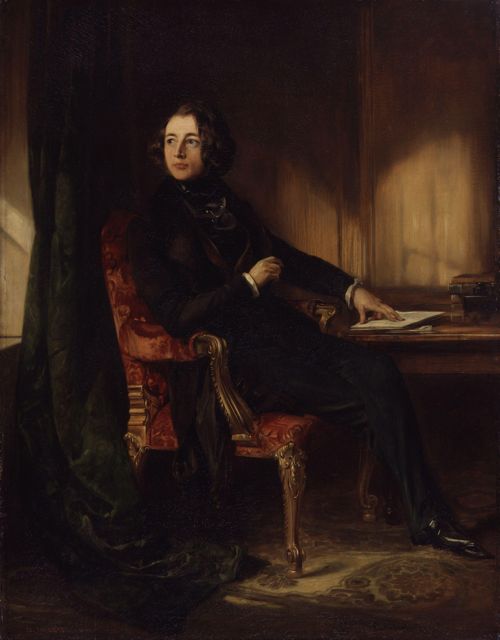
(Charles Dickens, painted by Daniel Maclise, 1839 (age 27). He was 31 when the events of this movie take place!)
Thursday, November 23, 2017

FLIGHT PLAN

Teen yearns to spread her wings in wry, warm-hearted Lady Bird

Okay, I didn't have high hopes for Lady Bird. From the trailer, it looked like it was going to feature one of those indie heroines who's supposed to be adorably quirky, but is really just tiresome — the kind of character so often played by Greta Gerwig (in movies like Damsel In Distress, or Frances Ha).

Knowing that Gerwig wrote and directed this movie only intensified my dread.

But, surprise! With Lady Bird, Gerwig delivers a wry but warm-hearted portrait of family, home, and dreams in modern America. The family in question is not dysfunctional in any clichéd movie comedy way, but Gerwig captures the gulf of potential calamity in the fractious relationship between a high-school senior (Saoirse Ronan) and her loving, but harried mom (Laurie Metcalf).

As in most mother-daughter relationships, one false move or the wrong word might set either one of them off as they try to navigate the mine field of what they think or feel, and their ability (or not) to express it.

Ronan and Metcalf: Driving through the minefield
The movie begins with a quote from Joan Didion: "Anyone who talks about California hedonism has never spent Christmas in Sacramento."

Ronan plays Christine, who calls herself "Lady Bird," and is facing her senior year at a Catholic girls school in the suburbs of the state capital.

She has few scholastic ambitions, but she's eager to leave the nest and fledge, preferably to a college on the East Coast "where culture is." Unlike Sacramento, which she calls "the Midwest of California."

The plot is episodic as the school year scrolls by. But Gerwig's most trenchant observations concern issues as eternal a time itself — the elliptical orbits of friendship; separating the reality of sex from its romantic mythology; the often fraught, but fiercely devoted relations between parents and children.
(Read more)

Monday, November 20, 2017

FREAKY FRIDAY

Nothing curdles my pre-holiday spirit faster than the spectre of Black Friday.

I mean, seriously? When it comes to ushering in the Yuletide, the annual smackdown at the mall is a poor substitue for those angels we have heard on high.

It was bad enough when the season began on November 1st, when the pumpkins and ghosts were whisked off drugstore shelves to be replaced by Santas and snowmen. Then the fact that the Friday after Thanksgiving was (cue the echo chamber) The Biggest Shopping Day of the Year sort of morphed into its own holiday.

How long before we get Black Friday songs and TV specials?

(Note: that's a rhetorical question. If you know of any such crimes against humanity, please don't tell me.)

In recent years, the race to the line at the mall keeps starting earlier and earlier, from 8 am on the Friday after Thanksgiving, to dawn, to 8 pm on Thanksgiving night itself. (Hey, nothing aids digestion better than a donnybrook at the electronics store an hour after dinner.)

Now, stores barely close for Thanksgiving at all. It's business as usual from about noon on, as retailers give thanks for your money.

Disembark from the Lemming Express!
But there's no actual law that says you have to march like a lemming into the marketing melee. Don't you have better things to do with your precious time?

Here's what I suggest:

Plan your baking. If, like me, your favorite food groups include sugar, carbs, and butter, there are probably Christmas cookies in your future.

This is a perfect chance to cull your favorite recipes, or even whip up a pound or two of dough to bake later.

Move! Treat yourself to a hike, a run, a bike ride, or an hour of yoga. Physical stimulation without the stress of shopping! Get those endorphins up and running — you're going to need them as the season unfurls.

Don't you have better ways to spend your time?
Write some holiday cards. Okay, you prefer to text, fine. But if you like to communicate the old-fashioned way — with actual words —use this quality time to send a note to far-flung loved ones. (With or without a card.)

Advocate. Bypass the mall and donate your time to a cause or a group you believe in — the environment, animal rescue,  a food bank, the arts.

You may not come home with a flat-screen TV at an insane discount, but you'll feel better. Trust me.

And finally, whatever you do this Friday, DO NOT BUY YOUR CHRISTMAS TREE!

It's still another month to Christmas, and by then it'll be as dead as Marley's Ghost.

Tuesday, November 14, 2017

NOISES OFF

Deafness and silent movies converge in lyrical Wonderstruck

Filmmaker Todd Haynes is a master visual stylist. Just look at his swoony period aesthetic in Far From Heaven, or Carol.

He has plenty to visualize and to style for the screen in his new movie, Wonderstruck.

With its parallel storylines set in the 1920s and the 1970s, child protagonists, and kids-eye-view of the world, this rare PG-rated experiment from Haynes may be less filling, plotwise, than his grown-up movies, but it still looks great.

It's adapted from his own novel by Brian Selznick, whose very first book was made into the rapturous movie Hugo.

Selznick's books are a genre unto themselves, combining a certain amount of prose storytelling with extravagantly detailed pencil illustrations that sprawl across the pages.
She loves New York: Millicent Simmonds in Wonderstruck

Presenting his stories in visual terms must come naturally to the author related through his grandfather to Hollywood Golden Age producer David O. Selznick.

So it's no wonder that Selznick's stories so often reference movie lore and history. The life and exuberantly eccentric work of silent movie pioneer Georges Melies was the inspiration for the book that became Hugo.

The silent movie era also figures in this plot: the industry facing the advent of sound film provides a counterpoint to the story of two deaf children on separate quests coping with a hearing world.

Cabinet of Curiosities: Selznick version

Oakes Fegley and the newcomer Millicent Simmonds (a wonderful young deaf actress making her feature debut) play the kids in search of family, love, and tolerance, whose stories finally converge in New York City.

The Museum of Natural History figures prominently in both stories. But the most interesting set, a 19th Century Cabinet of Curiosities preserved at the museum, is underused.

It's gorgeously rendered in an old book that Ben finds (an illustration straight out of Selznick's novel), but the big reveal of how it relates to the modern story lacks, well, a sense of wonder — and then we never see it again.

Still, Haynes rocks the scenes set in 1927, shooting in black-and-white, without dialogue (just as Simmonds' character perceives the world), like a silent movie.

But this movie is far from silent, percolating along with a marvelously inventive, often percussive score by Carter Burwell that informs and reflects the action in every frame.

Cabinet of Curiosities onscreen: Let's spend more time here!
In honor of the non-hearing community that inspires it, Wonderstruck features open-caption subtitles throughout.

It's a thoughtful touch for a lyrical movie whose message of family, friendship, and tolerance strikes a particular chord these days.
(Read more in this week's Good Times)

Monday, November 13, 2017

SUCH A DEAL


Oh, and did I happen to mention that Beast: A Tale of Love and Revenge is (finally!) available again at a decent pre-order discount on Amazon?

Take a look!

Sunday, November 12, 2017

PRE-HOLIDAY CHEER

Who's ready for a little pre-holiday spirit?

If your answer was a resounding "Gah!" stop reading right now. Otherwise, stick around.

Okay, full disclosure: I'm kind of a Charles Dickens geek.

His unparalleled view of Victorian-era England (London, especially) — upstairs and downstairs, comic and tragic, darkness and light, good, bad, ugly, and everything in between — is endlessly fascinating to me. I eat it up like a Christmas pudding.

So imagine my delight when this trailer appeared before the feature over at the Nick a couple of days ago. Coming this Thanksgiving weekend: The Man Who Invented Christmas. It stars Dan Stevens as you-know-who, caught in the act of creating one of his most beloved works, A Christmas Carol.

Whenever I'm asked to name my favorite book of all time, this is it. It's astonishing at how polished this simple-seeming tale is: it obeys the so-called "classical unities" of time, place, and action, occurring in the space of a single night, and yet it encompasses one man's entire lifetime, while painting an indelible portrait of an age and culture at its most human, and inhumane extremes.

All wrapped up in an eerie Gothic ghost story.

Really, it's a master class in how to write fiction!

As the screen went dark on the Dickens trailer, Art Boy whispered to me, "I know you're going to want to see that one!" And how. I wanted to stay sitting right there for the next two weeks until the movie itself came onscreen. He practically had to chisel me out of the seat!

This movie might well be silly. It might be trash. But my appetite is inexhaustible! Opening day is November 22, Thanksgiving Eve, at the Nick. We'll see you there!

Monday, November 6, 2017

NORSING AROUND

Gods just wanna have fun in entertaining Thor: Ragnarok

Okay, so it's less about the gods of classical Norse Mythology than the Marvel Comics pantheon, but only a real killjoy would fail to get a kick out of this third installment of the Thor series, Thor: Ragnarok.

As Norse geeks know, Ragnarok is like Armageddon — the long-prophesied doom of Asgard, where the Norse gods live.

Yes, the destruction of the world is serious stuff, but what's most engaging about this episode is the way Chris Hemsworth and Tom Hiddleston continue to have way too much fun developing the prickly relationship between heroic Thor, God of Thunder, and sly, acerbic half-brother Loki, the Trickster God.


(Established with such brio in the last installment, Thor: The Dark World, my Guilty Pleasure of 2013.)

Hemsworth, Hiddleston: Wait, who's the straight man here?
 But — surprise! This time Hemsworth gets most of the laughs, beginning with the opening prologue, where, wrapped in chains and caged, he cheerily explains The Story So Far, to clue in both the viewer and the gigantic fire demon that thinks it's about to destroy him.

Who knew Thor could be funny?

It's all directed with a surprisingly droll, light touch by New Zealander Taika Waititi, who give his adroit cast plenty of room to maneuever.

Goldblum: priceless
Jeff Goldblum brings his priceless, eccentric delivery to the role of the Grandmaster, presiding over a gladiatorial combat arena in some distant world or other.

(In the Thor universe, gods and mortals rocket around the galaxies at will.)

That's Cate Blanchett in a black Vampyra wig as Hela, Goddess of Death (a previously undocumented lost daughter of Odin), whose evil schemes to conquer Asgard and unleash Ragnarok set everything off.

New to the series, Tessa Thompson struts around with brio as the last survivor of the Valkyrie sisterhood, nursing a grudge against Hela.

The ever-wonderful Idris Elba has more to do this time as Heimdall, keeper of the portal of Asgard, who becomes a leader of the resistance after Hela takes over.

Thompson: Happy Hulk Day
And Mark Ruffalo proves himself the best screen Hulk ever in the comic timidity he brings to brainy science nerd Bruce Banner before hulking out into his colossal alter-ego.

(He's also extra poignant in his CGI Hulk suit, when he's not bashing people about.) It's also pretty funny when spectators take to the streets in green masks to celebrate Hulk Day, in honor of their favorite combatant.

Benedict Cumberbatch pops up for one pretty cool scene as Dr. Strange. (I told you, these characters jet all over the place.)

And keep your eyes peeled for a cameo by Matt Damon playing an actor playing the part of Loki in a recreation of the last scene of the last Thor movie onstage in Asgard.

But don't worry, fanboys, there's a whole lot of action, too, dire peril, shifty alliances, and ginormous special effects — including gladiatorial combat between Thor and the Hulk.

Of course, there's also another yawner of an aerial dogfight above Asgard. (Don't even ask.)

(And in one disturbing scene, a character goes on a two-fisted rampage, firing two automatic assault rifles into a crowd of Hela's army. Sure, his targets are inhuman demons with green glowing eyes, but it still looks like a serial killer-empowering moment.)

Thor also loses his mighty magic hammer in this one. (Although he mostly retains a tactical advantage, since he is, you know, a god.) More traumatizing to fangirls is the scene when he's shorn of his long blond locks. Loki too gets a new do, less limp and Snape-like, with a little bounce around the edges.

Hulk, Thor, Valkyrie and Loki: Let's get the band back together!
Oh, and that Ragnarok thing? Fear not — the post-credit teaser suggests this franchise, like the gods, is immortal.

Wednesday, November 1, 2017

ONE STEP CLOSER!

OMG!

My beloved Beast is in the Candlewick catalogue!

Imagine my delight today to open my mailbox and find the Spring-Summer catalogue 2018 from my new publisher, Candlewick.

Couldn't resist posting my Beast page, in all its gorgeouness!

Here's a screen-shot of the page from the online catalogue, including just enough of the plot outline to give you a little tease. Hope you're intrigued!

At long last, Beast is finally heading toward a bookstore near you! 

(Not right away, of course; pub date is still July 10, 2018.)

But he's on his way!