Thursday, March 3, 2011

FRIDAY FRESH


Lion or lamb, March has snuck in while we weren't looking, and that means it's already time for another First Friday Art Tour. As always, there are venues as far afield as Harvey West (the Michaelangelo Gallery, featuring printmaker Robynn Smith), UCSC ( a closing night reception for the retrospective of the work of painter/printmaker Geoff Morten at the Porter Faculty Gallery, and Chip Lord's "Public Spaces" exhibit at the Sesnon), and the Davenport Gallery (the collective, mixed-media show, "Our Oceans").

But now that the days are getting perceptively longer (she says hopefully), FFAT is a great opportunity for local artists, art lovers, and schmoozers to reconnect with our downtown and see what's new. Local favorites showing downtown this month include James Aschbacher (aka Art Boy), showing his folk art-inspired mixed media on wood paintings at Artisans Gallery (above), Jane Gregorius, with a series of mixed-media monoprints from her "Church Series" at Lulu Carpenter, and Coeleen Kiebert's expressive clay sculpture at Felix Kulpa. This is also the last week to catch the excellent Clay and Glass show at the MAH.


What's extra fresh for this month? How about local childrens' art on view at two downtown locations. Over at L'Atelier Salon, on the corner of Pearl Alley, check out mixed media artwork from the students at Westlake Elementary K-12. The piece above is uncredited, but boy, do I love it! There's nothing like a kid with a paintbrush (or some torn colored paper) to capture the pure joy of self expression.

Then take a short stroll down to Louden Nelson Center to see work from the students at Mission Hill Middle School. Teacher, artist, activist, and one-woman dynamo Kathleen Crocetti presides over the art department at Mission Hill, and she's always dreaming up exciting new things for her students to do. This show is called Machines of Memory Boxes, featuring student artwork inspired by the work of Joseph Zirker, which was shown at the MAH last fall.

Finally, the new downtown offices of Cruzio (in the building formerly known as the Sentinel) is open for business and participating in FFAT for the first time. Five artists affiliated with the UCSC Digital Arts and New Media MFA program are staging a tech-based installation (sound, light, video and sculpture) in the Cruzio workshop for a First Night "interactive artistic experience." Okay, fine, but if you're like me, you just want to know what's been going on in that space for the last two years. Will some vestigial spirit of the old Sentinel printing press come thrumming through the fiberoptics into the new media? Drop in 5-9 pm Friday night and pick up the vibe.

Wednesday, March 2, 2011

POST OSCAR POST


Due to popular demand (thanks, Annie!), here's a peek at my 2011 Oscar Barbies. It was such an uninspiring group of nominees, costume-wise (all modern women in contemporary clothes, yawn...) that I almost didn't bother. But I decided to do Natalie Portman in Black Swan because I just happen to have a 50-year-old Barbie ballerina outfit in my possession, and when will I ever have another chance to use it?


Once I got into the spirit of the thing, I didn't want to be rude and leave anyone out, so here's the rest of the Best Actress lineup. Most of them anyway; I opted not to do Nicole Kidman, since I didn't see Rabbit Hole. Instead, I added Melissa Leo in The Fighter, in all her trampy glory. (Clutching a pair of boxing gloves that I happened to have left over from an old Hilary Swank, Million Dollar Baby Barbie.)


To the far side of the "Oscar," that's Annette Bening in The Kids Are All Right, Jennifer Lawrence's mountain girl in the frigid Ozarks in Winter's Bone, and Michelle Williams as the embittered young wife in Blue Valentine. Like I said, not much to work with this year, but, hey, it keeps me off the streets and out of trouble.


My favorite real-life, grown-up outfit at the Oscars this year? Annette Bening's beaded, Art Deco-patterned metallic number in shades of black and silver. Okay, she missed out on the Oscar she deserved, but she gets my vote for the coolest dress—sort of a cross between slinky Fortuny glam and Robot Maria (from Metropolis). And this is absolutely the last thing I have to say about the Oscars for the rest of the year. Promise.

Friday, February 25, 2011

FEARLESS OR CLUELESS?


Speaking of the Oscars, if you have any serious money riding on the outcome, check out my fearless predictions in this week's Good Times. In the meantime, here's the no-frills version:


BEST PICTURE: The King's Speech. This is fine with me, impeccable as it is in every way, although I'd love to see Toy Story 3 win.


BEST DIRECTOR: Tom Hooper, The King's Speech.


BEST ACTOR: Colin Firth, The King's Speech. And good for him; he's always great. My favorite? Javier Bardem, Biutiful.


BEST ACTRESS: Natalie Portman, Black Swan. No power of earth can stop her in this category, but damn if I can figure out why. My favorite? Annette Bening, The Kids Are All Right.


BEST SUPPORTING ACTOR: Christian Bale, The Fighter, well-deserved in a very strong field.


BEST SUPPORTING ACTRESS: Melissa Leo, The Fighter. Oscar loves a lady who transforms into a tramp. My favorite? Helena Bonham Carter, The King's Speech.


Fearless or clueless? Find out Sunday night. As usual, should these prognostications fail to pan out, I'll be here next week to deny I ever made them.

Tuesday, February 22, 2011

IN STITCHES


In Oscar season, it's all about the clothes

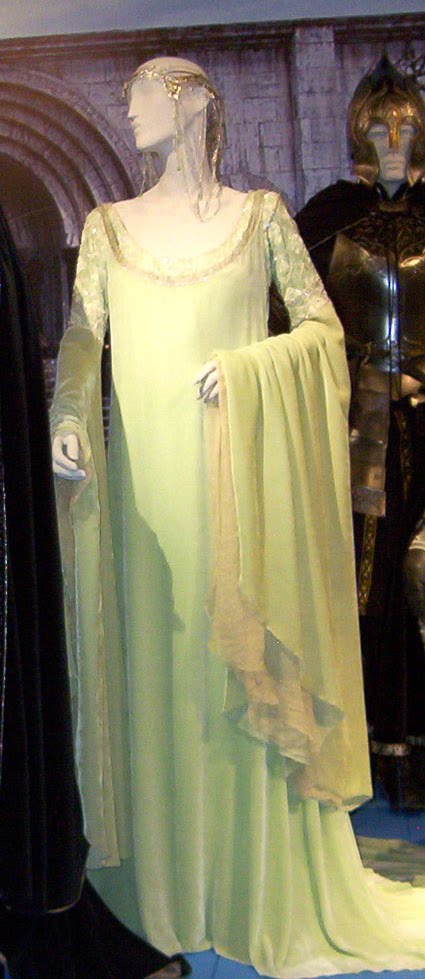
Look at this cool website I just discovered! For the last 17 years, the Fashion Institute of Design and Merchandising (FIDM) in Los Angeles has hosted an annual exhibit of the year's best movie costumes during Oscar season (February-April). The exhibit is not limited to the year's Best Costume nominees (although they are included), but covers films of all genres and budgets for an annual look at the most interesting onscreen clothes. (That's Arwen's coronation gown, designed by Oscar winner Ngila Dickson, and worn by Liv Tyler in The Lord of the Ring: The Return of the King, in situ at the FIDM exhibit from 2004.)

This years exhibit (costumes from 20+ movies from 2010, including all five Oscar nominees, up close and personal) runs through April 30. But for those of us not heading south anytime soon, the FIDM website provides a virtual online archive of its movie costume exhibitions. Not all of them; this year's and last year's exhibits are not yet online. Exhibits from 1997 and 1998 are represented only by a few fuzzy still photos. But from 1999 through 2009, the online collections expand to numerous photos images (many in drool-worthy detail) of an astonishing variety of films—the Elizabeth movies; the Lord of the Rings and Pirates of the Caribbean trilogies; Julie Taymor movies (Titus and Frida); Tim Burton movies; Austin Powers movies; Crouching Tiger, Hidden Dragon; Moulin Rouge; The Girl With the Pearl Earring; Chicago; Shakespeare In Love, and, well, the list goes on and on.

My only complaint is the lack of consistency on the site. In some featured years, only costumes from the five nominated films are online, while another year might feature costumes from 20 films or more. And no two of these online exhibits are organized exactly the same way; you have to do a lot of scrolling around and searching for appropriate buttons to access all the displays. Some have drop-down menus, others pop-up windows (the 2008 exhibit is only represented by a video featurette, where you can hardly see the clothes at all), but in most cases, if you can find and follow the prompt arrows, or the words "Enter" or "View," you'll probably see it all eventually. And it's worth seeing, especially the 2000 gallery, which features a side exhibit of costumes and accessories from the previous 100 years of film, from Fred Astaire's elegant dancing shoes to Sharon Stone's rude little white dress from Basic Instinct.

And let's face it, at Oscar time, it's all about the clothes. Me, I'm as much a sucker for the clothes worn to the ceremony as the clothes worn onscreen, so at this Sunday's Oscarcast (ABC, 5 p.m.), I'll brave the inevitable blithering of the TV interviewers to catch the red carpet fashion parade during the pre-game show. After all, by the time the actual ceremony rolls around, there aren't going to be that many surprises onstage, so we depend on the red carpet to deliver the drama.

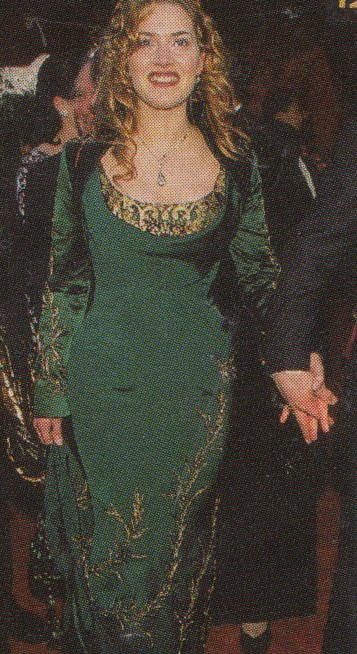
My all-time favorite Oscar dress? Probably that luscious, faux-Edwardian teal green number that Kate Winslet wore the year she didn't win the Oscar for Titanic. To my amazement, this dress churned up a lot of controversy; self-appointed fashion Nazis lambasted it as too weird or matronly or something (this no doubt from the same pundits who used to complain that Kate Winslet—Kate Winslet, fer crying out loud!— was fat). But I just thought it was stunning, in a funky-chic retro way. After all, it's not like she showed up with a dead swan draped around her neck. (Which reminds me: I wonder what Natalie Portman will wear this year?)

You want to know how demented I am about the Oscars? For years, I've paid my own homage to the art of movie costuming by dressing up my vintage Barbie dolls as the Best Actress nominees. It began as something I did as a lark to spruce up the place back when Art Boy and I used to throw lavish Oscar Night parties, but then I started getting into the challenge of the thing. (You try transforming a Barbie doll into Kathy Bates in Misery. I dare you!) We don't throw those big parties any more, but I still find it therapeutic now and then, in a non-verbal, Zen sort of way, to costume the occasional doll.

Nominees in big, juicy, historical epics are the most fun to dress, of course; I was delirious the year both Gwyneth Paltrow in Shakespeare In Love, and Cate Blanchett in Elizabeth were in the running.


Not that the 20th Century can't be interesting too. This was my tribute to the nominees from the lurid '50s melodrama of Far From Heaven, the sassy, Depression-era '30s of Chicago, and the bohemian '20s and '30s of Frida.


And sometimes, it's all about the props, like the year Susan Sarandon and Geena Davis were both nominated for Thelma and Louise.


The Best Actor costumes are rarely as much fun, but I made an exception for Captain Jack Sparrow. I had to go to Goodwill and pop two bucks for a recycled Ken doll, but seriously, Ken never looked better.


So kids, in the spirit of this year's Best Picture nominee, Toy Story 3, the moral is, never throw your toys away. Recycle them to the Goodwill instead. You never know what sort of swashbuckling afterlife is waiting for them there!

Friday, February 18, 2011

CAT TALES


This just in from Julian Soler at the Santa Cruz Film Festival. A new film sure to be dear to the hearts of anyone who's lived in Santa Cruz for longer than about four minutes will have its World Premiere at this year's fest (May 5 to 14). The Catalyst is a feature-length documentary devoted to the life and times—and, of course, the music—of that most venerated and enduring local nightclub, put together by two local folks who probably know the subject better than anyone. Producer Dean Newbury was the Catalyst booking agent for years, during the proprietorship of the late Randall Kane (whom Newbury refers to as his "father figure"). Director Michèle Benson is herself something of a Santa Cruz institution as longtime court photographer/historian/archivist at the Cat, as well as my colleague at Good Times for many years.


Ten years in the making, the film is dedicated to preserving the funky/hip spirit of the Cat, as envisioned by Kane, who shepherded the place from bohemian '60s coffeehouse/hangout to A-list music venue. Interviews with the always-quotable Kane and various staff alumnae will be combined with rare, painstakingly-unearthed concert footage of such Catalyst headliners as Neil Young, Patti Smith, Nirvana, The Doobie Brothers, Greg Kihn, Tina Turner, The Tubes—well, the list goes on and on. Since basically everybody has played the Cat, from Alanis Morissette to The Zutons, my mind is literally boggling as we speak just imagining what sort of musical treasures Benson and Newbury might have turned up. Check out the film's tasty trailer and get the vibe.


According to my friend Mary Offermann, you know you're a real Santa Cruz old-timer when you can remember all the previous businesses that used to be in this or that downtown retail space. (Remember when Kianti's was the original Pretty Mama's? Remember when the Walnut Avenue Cafe was The Old Theatre Cafe? Remember when the Gap building housed Woolworth's?) Those of us who have been here forever still think of the club's current Pacific Avenue location as "the new Catalyst." When I first arrived as a dewy coed in the early '70s, we used to hang out at the "old" Catalyst under the St.George Hotel. The main entrance was on Front Street, or you could take the scenic route, a surreal stroll from Pacific Avenue through the St. George lobby and into the atrium, with its skylights and burbling fountain (pictured above). The bar was sandwiched in there somewhere, en route to the erm, intimate stage and dance floor over on the Front Street side of the floor plan. There, my best friend, Jan, and I frittered away many happy hours. Among my most cherished Cat memories? Dancing the night away to Oganookie, Annie Steinhart on fiddle, gearing up for the last raucous crescendo of "The Orange Blossom Special." Go visit The Catalyst movie website and jump-start your own!


(All images © 2010 All Access Productions, LLC.)


And btw, speaking of SCFF, they will still be accepting film submissions for this year's fest through next Friday, February 25. Click here to read all the details, or find out about Festival Passes.


Tuesday, February 15, 2011

SPELLBOUND


Good news for fans of the esoteric: one of my all-time favorite movies is coming this weekend to the Aptos Weekend Matinee Classics series!


Maybe you had to be an impressionable teenager, like I was, when the movie Black Orpheus (Orfeu Negro) first cast its simmering spell over me. I seem to remember watching it in a classroom, probably in 16mm, on one of those rickety, square pop-up screens, so it was probably with the after-hours movie club I joined in high school. But I've never forgotten the impact of this moody, romantic 1959 update of the Greek myth of Orpheus and Eurydice with the pulsing samba beat.


Set in vibrant Rio de Janeiro during Carnaval, it's about a guitar-strumming young bus conductor, Orfeu (Breno Mello) who falls in love with Eurydice (the beauteous Marpessa Dawn), newly arrived in Rio. But her past catches up to her in the lurid figure of Death during the riotous Carnaval parade, and Orfeu must literally descend into a kind of hellish underworld to reclaim the woman he loves.


Shot in Portuguese by French filmmaker Marcel Camus, the story is set to a propulsive score by Luis Bonfa and Antonio Carlos Jobim, introducing their hip samba fusion music to the world. The haunting "Manha de Carnaval," soon to spark the entire bossa nova craze of the early '60s, was the theme song from Black Orpheus. An international hit, it won the Palme d'Or at Cannes, and both an Oscar and a Golden Globe for Best Foreign Language Picture. None of which made any difference to me; all I knew was I absolutely loved this movie to pieces when I saw it back in my misspent youth. Will it hold up after all these years? Let's find out this weekend, Saturday and Sunday, 10:45 a.m. at Aptos. Prepare to be swept away!


(Breno Mello and Marpessa Dawn in Black Orpheus, and, yes, the movie is in color.)


CRITICAL MASS


Just remember, if you go see Black Orpheus on Saturday, you can also come see Bruce Bratton, Wallace Baine and moi at the Nickelodeon on Sunday for our annual slugfest, oops, I mean discussion of the movies of 2010. Back in the day, when Morton Marcus was leading his bi-monthly film discussion group at the Nick, we all used to convene for a year-end wrap-up of our favorite (and otherwise) films of the year in January, followed by a pre-Oscars discussion the week, before the Academy Awards.


Nowadays, we streamline the event into a single, annual mash-up of opinions. Yes, we'll cover what the three of us predict will win the Oscars (along with what SHOULD win, often two entirely different things) when the Academy Awards are handed out next Sunday, February 27. But Wallace, Bruce, and I also reveal what our personal favorite films of the year were and tell you why we liked them. (Handouts of our respective Top Ten titles will be provided, in case you want to rush home and enter them in your queue.) But it's not all about us; we also want to hear about the films you liked (or not) this year. Here's your chance to tell the critics what YOU think! So hie thee down to the Nick, this Sunday (Feb 20), 11 a.m. Turn off your cell phone and join the conversation!

Tuesday, February 8, 2011

WHAT'S THE STORY?


Okay, it took us a couple of months to catch up with the clay and glass show at the MAH, but, boy, is it worth seeing. Presented upstairs in the Solari Gallery, this selection of work from members of the Association of Clay and Glass Artists of California (ACGA) offers a compelling and inspirational assortment of pieces from both statewide and local artists. Work on view ranges from vessels and vases to totems and installations, with every conceivable kind of abstract, figurative, functional, and sculptural artwork in between.


Me, I'm drawn to the figurative, as you probably know by now if you read my posts on Zimbabwe sculpture and other recent art shows. Maybe it's the storyteller in me, but in 3D art as well as painting, I like threading my way through the implied narrative when figures take center stage. So pardon my bias, but the most exciting discovery for me at the ACGA show is Bay Area ceramicist Fred Yokel. His sly, whimsical sculptural vignette, "The Build," is the highlight of the show for both Art Boy and me. It was love at first sight; one look, and our eyes were bugging out of our heads like a Tex Avery cartoon.


In this piece, a monumental human form is being constructed out of stone blocks by four or five small worker drones; they're still bustling about the litter of blocks at its feet, trying to fill in the last couple of open spaces in the form. Are they constructing a man-shaped temple to their god? A ceremonial effigy? A Trojan Man? It's all in the perspective. I like to think of these little guys as a person's various inner selves, caught in the act of assembling the complete individual, the sum of all their parts. Or not. That's the cool thing about art, it's open to endless interpretations. Feel free to make up your own.


Evidently, Yokel is well known for a series he calls "Jestures," playful figures of monumental-seeming proportions, yet small format (the central character in "The Build" is only about two feet tall) in expressive poses. Yokel's other piece in the MAH show, the delightful "Woody: Ancient Artifact," captures this spirit, a breezy little character brilliantly textured and painted to resemble carved wood.


I've rhapsodized about local clay artists Coeleen Kiebert and Peggy Snider before; both of them have dynamic pieces in the show. So does Tom Wolver, whose "Contemplation" features a brooding "Thinker"-like character with a typically Wolverian, jackal-headed demon laughing over his shoulder.


Among other intriguing out-of-town artists I "discovered" at this show is Natasha Dikareva. I love her "Shell Dweller" (above) with its poignant little human face emerging from the organic cocoon of the shell. I was also drawn to Vicki Gunter's "The Reading Chair," an evocative ceramic representation of a stuffed, saggy old armchair covered in flowered chintz. The object itself is one thing, but the story that goes with it (written out in the artist's attached note), about memories of the old family chair she crawled into as a child to hear stories, completes the narrative in the most fitting way—with the written word. Another piece I found weirdly haunting was "Legerdemain," by Charlene Doiron Reinhart, which celebrates the idea of sleight-of-hand with four tiers of digits unfolding from each other like the petals of a rose. (Don't forget to peek around at the back of this piece for the punch line.)


This is just a teeny, tiny sampling of the work on view at the MAH show. (And by the way, I think it's great that the MAH now regularly features local artists in its exhibits, after so many years as mainly a venue for traveling art shows from elsewhere. Big kudos to Susan Hillhouse and her staff for finding ways to bring both local artwork and traveling shows to the party.) No matter what your personal bias, there's much to inspire you here. The ACGA show runs through March 13, so there's still plenty of time to go get the story.

Thursday, February 3, 2011

TIME'S WINGÉD CHARIOT


Heads up, kids! Here come two great movies you need to go see right away. As usual, some of the best films of the old year are just now trickling down onto local screens, and opening tomorrow are two of the best of 2010, either one (or both) of which I might have put on my personal Top Ten if only I'd seen them in time. Very different kinds of films, each deals with the passage of time with compassion and urgency.


How long is long enough to save the world? Even the miniscule portion of your immediate world where you might actually be able to make an impact? This is the dilemma faced by the hard-luck protagonist played with furious grace by the great Javier Bardem in Biutiful, a man clawing a living out of the urban underbelly of Barcelona who discovers he has only a short time left to straighten out his messy life for the sake of his beloved children. Brooding and heartfelt, it's a dark, yet tender vision of life on the fringe from the always provocative Alejandro González Iñárritu. (Read more.)


(High Hopes)


Here's the thing about Mike Leigh. From the very first of his films that I saw, the irrepressible High Hopes, in 1988, I knew that he and I were on the same wavelength. This most passionate bard of Britain's working class has always been a champion of the disenfranchised, with a dry, often scathing wit coupled with a huge heart for the human condition.


High Hopes is a blisteringly funny look at class warfare and family ties in Margaret Thatcher's England. At its heart is a scruffy young, leftist couple in the Kings Cross district of London; she's a nurturing earth-mother, he's a disappointed Marxist always railing scornfully (in unprintable but hilarious terms) about the evils of government by the corporate rich. Sadly, not much has changed in the world since then, except that the corporate stranglehold is even more severe and the plight of the lower classes even more desperate.


Leigh's absolutely wonderful new film, Another Year, could be about the same couple, 25 years later. Indeed, the same marvelous actress, Ruth Sheen, plays the wife in both films, and in both cases, she is the wry, good-humored, compassionate soul of the story. This time out, she's paired with the great Jim Broadbent; he's Tom, a geologist bursting with sly wit and bonhomie who does not suffer fools gladly, but most of the time just manages to keep a lid on his snarky opinions. Sheen plays his wife, Gerri, a caring mental health counselor at the local hospital. They live in a comfy brick flat north of London, but spend most of their free time at the neighborhood "allotment," an open plot of land where they tend their garden of vegetables and herbs. Their marriage has been long and happy, produced one droll and loving son (Oliver Maltman), and they still spend all their free time together, cooking, gardening, laughing, and hanging out.


Things have not worked out so well for their friends, most of them alone or unhappily wed, miserable in their jobs, dissatisfied with themselves, and no longer able to ignore the grim fact that life is passing them by. Time, not politics, is the enemy this time around, and the film takes place over the seasonal cycles of one year, from spring through winter, as time's wingéd chariot inevitably whooshes onward. (When Gerri comments on the book he's reading in bed, Tom dryly observes, "I never liked history in school, but the older I get, the more relevant it seems.")


But Tom and Gerri have faced life's challenges and made something of their lives together. The delicate tension wrought by Leigh in the film comes from the desperation with which their misfortunate friends are lured to the nurturing flame of their happiness and stability. Chief among these is Lesley Manville in a fearless and devastating performance as Mary, a lonely, long-divorced secretary at Gerri's hospital clinging to the memory of youth with her too-revealing clothes and too-brittle perkiness, who keeps pushing the boundaries, desperately trying to upgrade from work mate to surrogate family status. Peter Wight plays Tom's old school chum, also divorced, compulsively gorging himself on food, drink, and cigarettes to fill up the emptiness inside. (His neighborhood pubs are now "full of young people, talking about nothing!" he complains.) Tom's elderly old codger of a brother, Ronnie (David Bradley, best known as sinister Hogwarts groundskeeper Filch in the Harry Potter movies), is a new widower reduced to near catatonia, with an explosively angry son.


(David Bradley and Lesley Manville)


Leigh famously workshops his story ideas with his cast to arrive at a script, and there's not a false syllable in the entire movie. Every conversation, however fragmented, has the ache and vitality of real life, as well as every potent glance, and all the things that remain unspoken as these characters face up to life's disappointments. And the movie teems with sudden, breathtaking insights; when Mary talks to Ronnie about the music they loved as kids—The Beatles and Elvis—we realize this is what's become of the generation that was going to change the world back in 1968.


Working with his longtime cinematographer Dick Pope to replicate the changing seasons within a rigorous eight-week shooting schedule, Leigh also masters the look of the film as the year and his dramatic themes evolve. As vibrant as their kitchen is, with its warm, curry-colored walls and vivid tiles, the same interior looks washed out and cold in a later, winter scene when Tom and Gerri are not in it.


Despite the wistful melancholy of its theme, this is a delicious, savvy, and resonant film, peppered with irreverent wit and real feeling. Do not miss it.


(Trivia note: look out for Phil Davis—Sheen's co-star in High Hopes, pictured above—in a cameo in Another Year as a guest at a backyard BBQ.)

Tuesday, February 1, 2011

SINS OF OMISSION


Sorry, but I'm not one of those people who gets all worked up about Oscar's sins of omission. I know my personal taste in movies is way off in the outer limits of mainstream Hollywood culture, so I never expect the movies I like best in any given year to even be in the running, let alone win gold. Imagine my shock in 2009 when my second-favorite film of the previous year, Slumdog Millionaire, actually won the Academy Award for Best Picture. I figured either the Academy was getting smarter or I was getting more lenient in my dotage. Or Door Number Three: the Academy had been taken over by aliens, still the most logical explanation.


(What beat out Slumdog for my favorite movie of 2008? It was the magnificent The Fall, which went on to rank #3 in my Top Ten Movies of the Decade, although—surprise!—it received zero recognition from Academy voters.)


So I have to say that this year's Oscar nominations are at least (and at best) par for the course. This year's safe, "Masterpiece Theatre" entry, The King's Speech, cleans up in nominations—as well it might, excellent as it is in every department. Expanding the Best Picture category to 10 titles gives the Academy a chance to recognize some smaller, dark horse contenders that might formerly have slipped through the cracks at awards time (like the equally excellent—in its own, weird way—Winter's Bone), although we all know the five serious contenders are those whose directors are also nominated in their category. With the addition of Toy Story 3D, that places three of my personal 10 favorite movies of the year on Oscar's list—a pretty remarkable average, all things considered. (Hmmm ... maybe the Academy IS getting smarter...)


(Btw: conventional wisdom says that TS3D won't win because it's also up for Best Animated Feature, which it IS sure to win. Apropos of which, don't miss Wallace Baine's impassioned article calling on the Academy to disband the Animated Feature category and let the worthy animated films duke it out with the live action features. Good point, sez I. It's the message, not the medium; a beguiling film like TS3D (like the utterly wonderful Up last year, also nominated for Best Picture) is equal in emotional resonance, wit, and heart to any other film on the list—and superior to most.)


By now, we all know how often Oscar accolades are cumulative, honoring a body of work (think of John Wayne in Rooster Cogburn, or Paul Newman in The Color of Money, or Martin Scorsese for, erm, The Departed?). Or at least retroactive. Don't get me wrong, Heath Ledger deserved every inch of Oscar gold he won for his breathtaking Joker in The Dark Knight, but you know the Academy was suffering a collective case of (posthumous) bestowers' remorse over not having awarded him the Best Actor Oscar he so richly deserved for Brokeback Mountain a couple of years earlier. The retroactive factor is the primary reason we can expect to see Colin Firth claim the gold this year for The King's Speech, after his fine performance last year in A Single Man lost out to Jeff Bridges—who was winning HIS well-deserved cumulative award for Crazy Heart. (How Bridges himself managed to evade Oscar recognition for so long in such incredible performances as Fearless, and Starman remains one of the great mysteries of the age. Not to mention his criminally un-nominated performance as the scruffy, disorderly children's book author/artist in The Door in the Floor in 2004. He even did his own artwork!)


(Jeff Bridges in The Door in the Floor. Go stream it this minute!)


I'm convinced the main reason Johnny Depp was getting all those nominations for awhile (Finding Neverland; Sweeney Todd) was because Oscar voters neglected to hand him the gold after nominating him for Best Actor in the first Pirates of the Caribbean movie. I'm serious! Nothing against Sean Penn (who won that year for Mystic River), but any great actor can act. What Depp did was create a classic and enduring movie icon, virtually out of whole cloth. Captain Jack Sparrow as we know him was not conceived in the script or out of the director's vision; he sprang as fully-formed as Athena out of the fervid, goofball imagination of Johnny Depp.


But I digress. Despite my habitually lowered expectations, there is one especially glaring omission among this year's Oscar nominees that can neither be ignored nor rationalized away. The category is Best Actress, and, Academy voters, I have two little words to say to you: Noomi Rapace. She is, of course, the woman who played Lisbeth Salander in all three of the "Millenium Trilogy" movies released this year: The Girl With the Dragon Tattoo, The Girl Who Played with Fire, and The Girl Who Kicked the Hornet's Nest. Yes, the films and the performance are in Swedish, but that doesn't stop the incendiary Rapace from giving the iconic female movie performance of the year. It might be argued that the part itself is so iconic, half the actress' work is done for her, but an actress with one iota less of Rapace's guts, sass, vulnerability and smoldering righteousness could never have brought it off. Oscar voters, what were you thinking?


On the other hand, it's nice to see Christian Bale moving into the frontrunner's position in the Supporting Actor race. Although his career trajectory put him on the fast track for leading man roles early on, he's always been a character actor at heart, with a taste for the edgy. (How about his self-imploding insomniac in The Machinist, or downed Air Force pilot Dieter Dengler in Rescue Dawn? And what other actor would even consider American Psycho?) He's paid his Hollywood superhero dues as well, but he's savvy enough to know you don't win Oscars for playing Batman; you win them for playing The Joker. Bale gets his juicy Joker role in The Fighter, as a jittery, crack-addled ex-boxer running on the fumes of a once-promising life (and career), and he makes something pretty amazing out of it.


Finally, in the Heath Ledger Memorial "What's A Guy Gotta Do To Get An Oscar Around Here?" category, consider Christopher Nolan. It's one thing that he's not nominated for directing Inception, one of the year's most intriguing thrill rides (although the film itself made it on to Oscar's Top 10). But neither Nolan nor his phenomenal Memento was even nominated back in 2002. In both cases, Nolan at least snagged a screenwriting nomination (impossibly, he didn't win for the intricate and audacious Memento, losing to the safe bet, Gosford Park), but come on, kids, these movies don't direct themselves.


PS: If you want to see where the next generation of Christopher Nolans is coming from, drop by Open Projector Night on Thursday (Feb 3), 5-8 pm at the Vino Tabi Winery in the Swift Street Courtyard out on the West Side. Presented under the auspices of the Santa Cruz Film Festival, it's a chance for budding filmmakers to bring their short films (10 minutes or less) to show on a big screen before an appreciative audience. No entrance fee; first come, first screened. There'll be wine, munchies, and camaraderie; here's the lowdown.

Saturday, January 29, 2011

MOLTO BENE


After the success of their fall film series on Italian Neo-Realism, the Dante Alighieri Society of Santa Cruz is back with a new winter season of Italian cinema. Screening one Sunday a month for the next three months, the new series is devoted to "Italian Directors of the '60s," a molto bene area of study if ever there was one.

First up this weekend is the provocatively titled Sedotta e Abbandonata (Seduced and Abandoned). Director Pietro Germi followed up his huge international hit, Divorce, Italian Style, with this 1964 satirical comedy about the dubious results when an old-school father demands that the cad who got his teenage daughter pregnant marry her. No Marcello or Sophia in this one, but a dewy young Stefania Sandrelli stars as the plucky bride/ mother-to-be. Screens this Sunday, January 30.

Other directors spotlighted in the series are Michelangelo Antonioni (The Eclipse, screening February 13) and the one and only Federico Fellini (8 1/2, screening March 20). Dr. William Park, Faculty Emeritus, Sarah Lawrence College, will introduce each film, and lead a discussion with the audience afterwareds.

Films screen at Cabrillo College, VAPA At History Forum Room 1001, 7 pm. Admission is free. For more info (and cool poster art) click here.


Tuesday, January 25, 2011

HERE COME THE GAILIES


Get ready for the biggest party in the Santa Cruz arts community since the demise of the old Hearts for the Arts. That would be the Gail Rich Awards, celebrating its 15th anniversary this Wednesday, January 26, at the Rio Theater, where six new inductees will be initiated into the tribe and presented to a grateful public.

Don't expect suspense. Recipients are announced in advance; Price-Waterhouse is not involved. There are no winners or losers, because it's not a contest, just a chance for the community to come together and celebrate some of the folks who make this the kind of place we all want to live in.

Under the auspices of the Cultural Council of Santa Cruz County Associates, the idea behind "the Gailies" was hatched at the Sentinel by arts reporter Wallace Baine and photographer Shmuel Thaler. They were looking for a way to honor the abundance of creative artists—dancers, craftspeople, musicians, writers, artists, actors, entrepreneurs, teachers, clowns, exhibitors, purveyors—who make our home town so culturally rich. The award, "recognizing people in the arts who inspire our community," is named for the late and still beloved Gail Rich, onetime Sentinel arts correspondent and member of CCSCC Associates, who was a tireless champion of the local arts scene.

The original plan was to recognize each year's new honorees with a lavish photo spread in the Sentinel, featuring Shmuel's dynamic black-and-white portraits and Wallace's adroit commentary. Then someone got the idea to stage an awards ceremony in the beckoning intimacy of the Kuumbwa, an event that quickly took on a life of its own. These annual Kuumbwa events (always in January, when it's usually pouring outside) became the place to schmooze and be schmoozed with all strata of our thriving arts community. Wine was poured by the ever-gracious Robert Kelley of Santa Cruz Ballet Theatre (who went on to receive his own Gailie with co-founder Diane Cypher), and there was always a spread of fabulous local treats after the ceremony. Peter McGettigan (also a future Gailie recipient) started filming the event for rebroadcast on Community TV. After a few years, there were so many folks lined up outside in the rain, hoping to get in, that last year they switched to a new venue at the Rio.

While we all miss the intimacy of Kuumbwa, the sheer capacity of the Rio ensures that no one has to resort to Machiavellian ploys just to get a seat. Master of ceremonies Wallace's jokes are just as funny and the montage of Shmuel's photos just as impressive in a larger auditorium. Of course, the Rio is an alcohol-free venue, but that didn't dampen the spirit one iota at last year's event.

We're even looking forward to clear skies this year. So come in a party mood to celebrate this year's honorees: photographer Bob Barber, singer Lori Rivera, musician Bryn Loosley, artist Rose Sellery, Rick "Ukelele Dick" McKee, and artist/writer T. Mike Walker. Doors open at 7:10 pm sharp; showtime is 7:30 pm. Admission is free. Read all about it at the CCSCC website. And to really get in the groove, check out this cool slideshow of all 84 of Shmuel's fabulous photos of Gailie honorees.


Speaking of people who are an asset to our community, did you see the exhibit, "Transfigurations" by local photographer Jana Marcus? Begun as a thesis project at San Jose State University, this important show documents a handful of transgendering men and women who allowed Jana to photograph the stages of their progress and record their unique stories. From the initial showing at SJSU in 2004, various reinventions and updates of the exhibit have been seen in New York, Seattle, Illinois State University, Stanford University and San Francisco, as well as local showings at the Attic in 2006 and at Cabrillo College last fall.

As a pioneering work in the still marginalized field of LGBT studies, the exhibit has garnered many awards and citations. For years, fans have been pestering Jana to bring it out as a book, but no such luck in today's belt-tightening, play-it-safe publishing environment. So this month, Jana decided to get a grip on her destiny and posted the "Transfigurations" book project on Kickstarter.com, the website that functions as a kind of creativity matchmaker, presenting artistic projects in need of funding to a cyber-pool of potential donors. Response so far has been tremendous. Donations accepted until February 23, but the project looks like a go. Click here to see how she's doing and cheer her on.

(Above: Jana hangs her exhibit at the Attic, May, 2006.)

Monday, January 24, 2011

CRIX PICK SLICK FLIX


Coming soon to a TV screen near you, six critics, two shows, and lots of ideas about cool movies to put in your Netflix queue. A few of us whose job it is to go to the movies so you don't have to convened on a soundstage at Community TV yesterday (at an ungodly hour of the morning) to discuss our favorite films of 2010.

The occasion was a special edition of the Cinema Scene TV show, and our genial host was Richard von Busack, longtime film critic for the Santa Cruz Weekly and Metro newspapers. Going tete a tete with Richard over our faves of the year were Wallace Baine of the Sentinel, Greg Archer of Good Times, Bruce Bratton of Bratton Online, filmmaker Aleandro Adams, and me.

No, there were no knock-down, drag-out brawls this time out. With barely enough time for each of us to squeeze in our top five picks, there was no chance to challenge each other over them, so the gloves were definitely on. (If you're looking for a fight, come see Bruce, Wallace, and me when we debate the best and worst films of the year at our pre-Oscar discussion at the Nickelodeon, Sunday, February 20.) But the Cinema Scene show may surprise you with the diversity of titles offered up by our humble selves, some of which you may have never even heard of. These are movies we think you should run out and rent (or stream, or channel; whatever) right now, so check it out.

Community TV veteran Peter McGettigan produced the two-part show (aided and abetted by one-man film crew Emory Hudson), which should begin airing soon on CTV Channel 27/Charter 73, possibly in the old Cinema Scene time slot, Sundays and Thursdays at 8:30 pm. Or maybe not, so keep an eye on the CTV schedule. I'll let you know when it airs as soon as I find out.

(Not so obscure movie reference: apologies to the classic Yankee Doodle Dandy, in which Jimmy Cagney (as showman George M. Cohan) reads an issue of "Variety" with the headline: "Hicks Nix Sticks Pix.")

(Btw, Greg was kidding about his pick for Best Movie of the year. Seriously.)

Tuesday, January 18, 2011

FOOD NOT FADS


Western women are at war with their bodies. We're obsessed with our weight; it's sort of a mass psychosis fueled by the media with its slinky supermodels, and undernourished, heroin-chic pop divas and movie stars. Back when the first Bridget Jones movie came out, a male colleague of mine complained that Bridget "only wants to get married." He was missing the big picture. The majority of women in Western culture, whatever their ethnicity, sexual persuasion, or actual body type, believe absolutely in two things: that they are too fat, and that no one will ever love them because of it. Bridget's attempt to find love by reshaping her body is a seminal experience millions of women share.

Like most females, I was on some fad diet or other from about age 13 up into my early 30s: high protein, no carbs; all carbs, no protein; the grapefruit diet, the cube steak diet, the Scarsdale Diet, you name it. But the trouble with dieting is as soon as you start depriving yourself of foods you like, you suddenly can't stop thinking about them. (Pizza! Pasta! Popcorn!) When you divide your eating life into two separate entities— on or off the diet—you're liable to eat twice as much as normal when you're off the diet, and endure twice as much self-loathing when you grudgingly go back on it.

Of course, on none of these half-wit regimes did I ever alter my weight on any dramatic level. But the tyranny of the scales used to dictate my mood for the rest of the day, and since I somehow never seemed to wake up in the morning 30 pounds lighter than I'd been the day before, my moods tended to be pretty foul.

So what's the solution? Here's what worked for me: throw away your bathroom scale. Ours broke years ago, and it's extraordinary how liberated I've felt ever since. It may sound like killing the messenger, but as soon as we got rid of the scale, my unhealthy obsession with my weight went with it. Which is not to say I started chowing down like a stevedore: just the opposite. As soon as formerly forbidden foods were no longer off limits, I stopped craving them so much, and started eating more sensibly. I found out you can eat whatever you want, as long as you pay attention to how much you're eating. It also helps to start moving. Most days, Art Boy and I take a walk around the harbor here in Live Oak, to see what the otters and sea lions are up to, and soak up some rays (if there are any). It's not drudgery; it's fun. It's not a diet; it's a lifestyle. "We eat therefore we walk," that's our motto.

True, we live in a slothful, overfed society, and anyone whose health is threatened by serious obesity owes it to herself to control her weight. But for the vast percentage of us hovering somewhere between anorexia and full-tilt obesity, it's much more effective to give up the useless and unhealthy cycle of dieting, learn to accept who we are, and get on with our lives, already.

All this occurred to me leafing through a copy of "Shut Up, Skinny Bitches," the new anti-diet book co-written by my friend and Good Times editor Greg Archer. Okay, the title is a tad flippant, but Greg and co-author Maria Rago, PhD. delve into the psychology behind women vs weight, explore eating disorders, and address the inner hungers that we try to satisfy with mere food. Having just picked up the book, I'm heartened to find entire chapters devoted to "Shut Up About Hating Your Body," and "The Scale Is Not Your God." Here-here!

Me, I'm the proof of the pudding. Once I gave myself permission to stop worrying about my weight, I discovered I had better things to think about than food. When I accepted that Nature did not intend me to be willowy, when I was able to make peace with my body and stop blaming it for all my perceived problems, I was free to go out and live my life with a lot more gusto. This body has served me well, in good times and bad, and I find I'm no longer interested in pummeling it into submission. And as soon as I stopped denying myself those so-called forbidden foods, I was no longer haunted by unattainable visions of, say, bittersweet chocolate, or Gayle's ciabatta. Every now and then, I eat some. And guess what? Life goes on.

Greg will be debunking diet myths and reading from "Shut Up, Skinny Bitches" at Bookshop Santa Cruz Thursday night, at 7 pm. Forbidden foods are promised, so get there early for a ringside seat!

Saturday, January 15, 2011

HEARTS FOR THE ARTS—THEN & NOW


Not to out anybody, age-wise, but hands up, everyone who remembers the original Hearts for the Arts. For 20 years, it was the second-most important event of the year to the local art community (after Open Studios), an annual art auction staged at the Civic Auditorium on the Saturday closest to Valentine's Day as a fundraiser for the Santa Cruz County Cultural Council. Hundreds of artists donated original pieces of art (often, but not exclusively, with a hearts/love/romance motif) in return for tickets for self and spouse to the event. The rest of the tix were snapped up by eager art patrons, some of whom saved up all year (as Art Boy's collectors often told him) to be able to finance their Hearts addiction on the big night.

It was always a mob scene. With doors opening at 4 pm, the Civic was jam-packed by dark, with eager attendees jostling each other between the dozen or more Silent Auction tables set up on the floor, or thronging together at the central feeding trough where the hors d'ourvres were laid out. (In later years, they sensibly removed the food to a spacious tent outside.) You could buy drink tickets for local wines at libation stations strategically placed around the perimeter, but Art Boy and I soon figured out it was easier to pack in our own repast (Tupperware dishes of pasta; baguettes and cheese, a bottle of champagne, flute glasses), and set up camp in the first row of the bleachers, literally a front-row seat for the festivities.

There might be anywhere from 2-300 paintings, photographs, ceramics, jewelry, or other smaller objets d'art available for bidding on the Silent Auction tables. After they were all sold off, the decks were cleared and the tables replaced by rows of folding chairs for the Live Auction, where another 50-60 pieces of art were presented. Bidding was always spirited from both the floor and the bleachers, enhanced in no small part by the many servers roving up and down the aisles dispensing free bubbly and chocolate. There's nothing like sugar and alcohol (my two favorite food groups) to get the crowd in a party mood!

Hearts was always a festive event, full of balloons and whimsy. Attendees could be as dressy (or not) as they wanted (as you can see by the photo of Art Boy and moi at Hearts, 1993); tuxes, ball gowns, and spats mingled with jeans and Birkinstocks. Artists loved it. Anyone could donate and everybody did; it was the one night a year we could expect to see every other artist in town and hang out together. It was also a great opportunity for art lovers to discover the work of new artists, and for artists and collectors to meet each other. Best of all, proceeds went to CCSCC, which funds Open Studios and the SPECTRA program for teaching art in the schools.


(Barbara and Kent Perry, Dan May, Carrie Jacobsen, d.hooker, Faye Augustine, and Art Boy, Hearts, 1994)

In these belt-tightening times, no one has the wherewithall to stage an art auction on a masive scale like Hearts any more. These days, the principal Spring fundraiser for CCSCC is Primavera, a gala event that combines an auction of select artwork, services, and other goodies with dinner, entertainment, and a theme party up at Chaminade.


But in the meantime, the folks at Artisans Gallery downtown are staging a mini-Hearts for the Arts revival. For one month, now through February 14, pieces of artwork donated by many local artists will be on view in the gallery as part of an ongoing silent auction. Proceeds will go directly to SPECTRA, so drop by now and leave a bid. Then come to the reception for artists and public alike, next First Friday, February 4, 6-8 pm, and see how you're doing.

We all miss the original Hearts like an old friend, but the spirit of supporting the arts lives on at Artisans.

Tuesday, January 11, 2011

AROUND THE WORLD BY VW BUS


If there was a Santa Cruz Hall of Fame, Bill Raney would deserve a seat of honor. Most of us know him as founder, original owner emeritus, and all-around Grand Poohbah of the beloved Nickelodeon Theatre. Less well known is the fact that, just before moving to Santa Cruz, Bill was embroiled in an adventure as brimming with drama, action, comedy, and pathos as any epic movie.

In 1967, just after he and his first wife, JoAnne, sold their first movie theater in North Beach, they packed up their 10-month-old son, Xerxes ("Zerky"), and a Dachsund named Tarzan, flew to Munich to pick up a new VW bus, and embarked on an intended European vacation that evolved into an extraordinary 13-month journey around the world. On the road, Bill wrote letters about the days' events for his toddler son, hoping to capture the flavor of the journey that Zerky was probably too young to remember on his own. These letters, rediscovered and re-edited some 42 years later, make up the backbone of Bill's recent memoir, "Letters to Zerky: A Fathers Legacy to a Lost Son, and a Road Trip Around the World."

It's an amazing story. I had the opportunity to read several early drafts, and I was always sucked in by the immensity of the journey, and the twists and turns along the way—from Western to Eastern Europe, Turkey to Iran, Afghanistan, and Pakistan (at a distant time, as Bill writes, "when people in the Islamic world admired America"), from India to China, and finally back to San Francisco—oh, the intrepitude!—by freighter.

If you have any interest at all in travel, travel diaries, or world affairs, come relive Bill's incredible journey tonight at Bookshop Santa Cruz, during their Locally & Independently Published Authors Night. Joining Bill will be nutritionist Rebecca Rovay-Hazleton, reading from her book, "Choosing Health," local surf veteran Thomas Hickenbottom, reading from his surf novel, "Local Tribes," and Julie Anne Morley, reading from her novel, "Cole Creek." Come out and support BSC in their tireless efforts to support local wordsmiths!

In other news—stay tuned for my next post, where Ill get all nostalgic over another beloved Santa Cruz arts institution, Hearts for the Arts, and tell you all about how it's being reinvented by the folks at Artisans Gallery.

Friday, January 7, 2011

FIRST FIRST FRIDAY


Looks like clear skies for the first First Friday Art Tour of the new year. In honor of the (slowly) returning sun (hey, technically the days ARE getting longer, although you'd never know it at about 5:30 on a pitch-black January evening), why not take a stroll around town for a sunny afternoon of art in unexpected places. Or head out this evening and hit the receptions, where many venues are sure to offer wine, live music, and/or little nibbly things.

Joining traditional venues like the Santa Cruz Art League (its current show is "This Is Santa Cruz: local artists interpret what Santa Cruz means to them," where I got this uncredited image), the Felix Kulpa Gallery (15 neon artists), and the MAH (exhibits include work from the Association of Clay and Glass Artists of California, photographer Lawrie Brown, and miniature trains), you'll find art shows in banks, cafes, shops and boutiques all over the place, from the Eastside to the Westside to Davenport. From "The Masculine Series" of photographs by Midori at Pure Pleasure, to Neno V. Villamor's "Cycles of the Feminine Self," relief sculptures in handmade paper at Camouflage. Get all the info here.

And don't forget to drop by the R. Blitzer Gallery in the old Wrigley building for the closing night reception for the Art For Art exhibit. Remember, 20% of art sales from this show go to benefit the Santa Cruz Artists' Assistance and Relief Fund (SCAARF) to aid local artists experiencing a career-threatening emergency. Get there early to really appreciate the size and scope of this epic new gallery space. Maybe I'll see you there!

Wednesday, January 5, 2011

READERS, WRITERS, & HIRED GUNS


I'm concerned about the state of writing here in the new millennium. Not only my own writing, which obsesses me quite enough, thank you, or the scary prospects for the future of writing and reading in the text-and-tweet society. I'm mostly worried about the ways writers and readers are and are no longer being served by traditional publishing, once the principal venue for getting the written word into the hands of the reading public.

Over on the writers' website, Red Room, their book editor-in-residence, Alan Rinzler, recently posted an informative blog advising new writers how to find and choose a freelance editor-for-hire. It reads a lot like the advice writers used to be given for finding an agent to rep their work to a publisher: check out references (if any) and credentials, talk to other authors who have worked with the potential editor, try to find out if his or her work habits and creative vision mesh with your own. Rinzler goes on to invoke the sainted memory of Maxwell Perkins, the editor at Charles Scribner's Sons publishing house in the early 20th Century whose dedication and expertise helped to midwife the work of F. Scott Fitzgerald, Ernest Hemingway, and Thomas Wolfe (in particular, the mighty behemoth that would become Look Homeward Angel) into literary classics.

But it seems to me the crucial difference between the Maxwell Perkins era and our own is that Perkins was actually employed by Scribner's to nurture its authors. This was back in the day when a publisher would take on a promising new writer and team him or her up with a simpatico in-house editor to develop the writer's career.

These days, new writers who are still learning their craft are also expected to somehow locate and purchase the services of a freelance editor (and just trust to the Force thy can find a good, or even competent one, judging from the experiences of other writers responding to Rinzler's post) before they've made one dime off their writing. And all this before they've even landed an agent—let alone a publisher. A hired-gun of an editor who may or may not be invested in developing the writer's career over the long haul.

Would Perkins and Wolfe have had such a prolonged, profound, and productive relationship if Perkins had been an editor-for-hire paid for out of Wolfe's own (threadbare) pocket?

Here's my other question: if books are pre-edited before they even get to the agent, and arrive at a publishing house camera-ready, as it were, what is it that editors at publishing houses do all day, if they're not editing books? I'm just asking.