Strap on your goggles and lace for the Steampunk exhibit at the new Santa Cruz Institute for Contemporary Arts Gallery at the Tannery.
Long a gleam in arts entrepreneur Kirby Scudder's eye, the SCICA has been a floating world of artistic ideas, a cyclone of creative energy that finally has a permanent place to touch down, a brand new gallery in the Tannery studio complex. Kirby has partnered with Co-Director, artist and arts administrator Ann Hazels in the new SCICA venture, which also includes office space and a gift shop adjoining the spacious gallery.
The inaugural exhibit, Steampunk, launched earlier this month and runs through the end of December. It's a back-to-the-future, retro fantasy exhibition of sculpture, prints, painting, photography, and wearable art celebrating the merger of Victorian/Edwardian sensibilities (Machine Age clockwork, gears and cogs; top hats and corsets) with futuristic fantasy. (The shorthand definition of "steampunk" is Victorian sci-fi.)
The alcove at the gallery entrance gets you in the mood with these two displays of fantasy headgear from an artist calling himself killbuck. What I found especially cool about the piece on the left is that it contains no real metal (except, possibly, those eyepiece dials); it's constructed entirely out of found and recycled objects like plastic and foam.
The diverse pieces inside include fanciful photography and found-object sculpture from Robbie Schoen, and woodwork gear box wall pieces by Michael Zelver.
I loved metal sculptor Thomas Ramey's "Piston Bat," a wall piece made of recycled metal. In Ramey's elegant 3D sculpture, "Drilling," a globe of the world is suspended in a man-made cage; the piece is made out of recycled auto parts.
(Recycled materials is also a running theme throughout the show, from Jack Howe's found object-studded bedspring piece, "At the Gates of Redemption," to Geoffrey Nelson's life-sized "Steampunk Starfighter" outfit.)
Some pieces have only a tenuous connection to the theme. Diego Rios' graphic angel prints in muted colors are beautiful, but don't necessarily convey a steampunk ethic. Outside of a few corsets, neither do Nelson's "Storyville Series" of contemporary photos of women posed in the style of the notorious turn-of-the-century New Orleans red-light district.
Jenny Markowitz's painting on a recycled door, "The Visionary,"doesn't really mesh with the theme either.
But her companion painted door, "The Lovers," is spot-on with its image on an embracing couple in full regalia; it could easily be the Tarot card of that name in a steampunk deck!
The SCICA Gallery is located at #127 in The Tannery, the front corner space in the commercial studio building across from the live-work artists lofts. The Steampunk show runs through December 30. Gallery hours are Wednesday-Sunday, 11 am to 6 pm.
And if you like what you see, consider signing up for an inaugural membership in the SCICA.
Adventures in writing with Lisa Jensen, Author, Columnist and Film Critic
Wednesday, November 28, 2012
Tuesday, November 27, 2012
ANIMAL MAGNETISM
Boy and tiger share fantastic voyage in gorgeous 'Life of Pi'
It's a story too incredible to believe. But choosing what to believe—along with the sheer power of storytelling—is exactly the point of Life of Pi, Yann Martel's bestselling novel of faith, destiny, courage and survival, now made into a magnificent-looking film by director Ang Lee. Martel's 2002 novel of a teenage boy and a Bengal tiger shipwrecked together in a small lifeboat in the middle of the vast Pacific was long considered unfilmable (at least, as a live-action movie)—until Lee came on board.
A craftsman who never makes the same film twice, Lee is renowned for his sensitive handling of diverse, often daunting material, from Crouching Tiger, Hidden Dragon, to Brokeback Mountain. With careful attention to Martel's core theme—the search for God (in whatever guise) through astounding adversity—Lee turns the material into a visually rapturous and ecstatic spiritual journey that's also a breathtaking adventure saga. Kudos to cinematographer Claudio Miranda (TRON: Legacy; The Curious Case of Benjamin Button) for providing such stunning visuals to go with Lee's delicate narrative of loss and redemption.
Life of Pi is rated PG, which basically means no sex or naughty words, but that doesn't mean it's a kids' movie. Besides brief scenes of animals attacking and/or eating other animals, a bigger problem for very young children is all the talking, which will bore them silly. The verbosity of the bracketing story gets a bit wearisome for adults, too. Pondering the quest for (or death of) spirituality may have resonated more on the printed page, but onscreen, all we care about is getting back out on the water and the delirious fever dream at the heart of Lee's hypnotic film. (Read more)
Friday, November 23, 2012
PRELUDE to ALIAS HOOK
-->
Wow, this is exciting!
My publisher, Emma Barnes, at Snowbooks, in the UK, just put up a blog about my upcoming novel, Alias Hook.
"Now, I don't like to brag. But. Next year we have a book coming out which is going to knock your socks off," she writes. "Alias Hook is really special."
Aw, shucks!
Then she posts the opening chapter, or "Prelude," in its entirety, just to whet your whistle, inviting you to "have a read and tell me it's not the most compelling thing ever."
But wait. There's more! She's also launching a contest to give away a bound proof copy of the book—something so new, even I don't have one yet!
Initial publication, now slated for May, 2013, will be UK only (unless a deal is brokered with a US publisher between now an then, she says, hopefully). But this contest is open to anyone with an email account, anywhere in the world.
Surf on over to Snowbooks and see what you think!
Wednesday, November 21, 2012
HONESTLY ABE
Day-Lewis' extraordinary performance powers Spielberg's Lincoln
It's probably counter-productive to try to shoehorn Steven Spielberg's massive historical epic, Lincoln, into the realm of allegory. Yes, this tale of political maneuvering at the close of the American Civil War portrays a House literally divided against itself, one party trying to reconcile the conservative and "radical" elements within itself, two parties so ideologically diverse they can't engage in debate on the floor without hurling invective at each other, and a recently re-elected president struggling to balance his personal principles with his need to heal the nation.
But the beauty, and genius, of Spielberg's film is the way it defies analogy to any specific statesman, party, or era. Instead, it provides a cogent glimpse into the American political process itself, the very democracy that Americans of all persuasions believe they support, although few of us understand exactly how it works. In this respect, Spielberg's view of the contentious state of American politics, then as now, is as timeless as it is fascinating.
But what gives this film its touch of greatness is very specific, indeed. Abraham Lincoln, was no ordinary statesman, but a moral visionary who risked everything to end the institution of slavery. Extraordinary, too, is the performance of Daniel Day-Lewis in the role. From his unruly, tufted hair and scruffy beard, to the hint of windswept prairie in his light-pitched voice, from his gentle, self-deprecating laughter, to the careworn curve of his shoulders, to the deliberate way he folds or unfolds his long limbs in sitting or standing, Day-Lewis inhabits the role with every fiber of his being.
This is a Lincoln savvy enough to wield great power, but who never loses the common touch, and Spielberg and company impress us with what a rare and laudable gift that is. When Day-Lewis collects his third Best Actor Oscar next February, he will SO have earned it. (Read more)
Monday, November 19, 2012
MY NEXT BIG THING
Today, it's my very great pleasure to join a Blog Chain called My Next Big Thing, in which we writers answer interview questions about a current or future project.
But first, many thanks to Vinnie Hansen for inviting me to join this thread. Vinnie is the author of the Carol Sabala mystery series, in which an intrepid pastry chef-turned-sleuth heroine solves murders—with recipes!—in and around Santa Cruz County. Her latest, Art, Wine & Bullets, is in stores now. Thanks, Vinnie!
Okay, here goes:
What is the working title of your book?
Alias Hook
Where did the idea come from for this book?
We don't like to say it in mixed company, but most writers hear voices in their heads. I was writing a review of a live-action Peter Pan movie in January, 2004; of the actor playing Captain Hook, I wrote that he captured "the tragedy of a grown-up Hook trapped forever in Peter's eternal childhood." Instantly, a caustic voice popped into my head observing the Neverland from Hook's point of view. I hit 'Save,' clicked open a new doc and hastily typed in what is now the opening paragraph of the book. I was off and running!
What genre does your book fall under?
I call it historical fantasy. Yes, it takes place in the Neverland (that's the fantasy part), but in the flashbacks, I've tried to give James Hook a solid historical grounding as an early 18th Century English privateer/pirate.
How long did it take to write the first draft?
About one year.
What actors would you use for a movie rendition of your book?
Well, Hugh Jackman has the height advantage, and the musicality. (My Hook is an accomplished musician, so losing his hand is extra horrific). But Gerard Butler has the blue eyes! I like Rachel Weisz for Stella Parrish, the grown woman who dreams herself to the Neverland in defiance of all the boy's rules, who may be the key to Hook's redemption.
What is a one sentence synopsis of your book?
The flip-side of Peter Pan, Alias Hook is a time-traveling love story about male and female, love and war, and the delicate art of growing up.
Will it be self published or represented by an agency?
I didn't have an agent for this one; I sold it to Snowbooks, a small, but intrepid independent publisher in the UK, who will bring it out in May, 2013.
Who or what inspired you to write this book?
I've always liked Captain Hook better than Peter Pan; for one thing, he has much funnier lines! (See my History of Hook on stage, page, and screen.) Here's a guy stuck playing villain to a pack of malicious little boys in a pointless war that never ends.
Also, Peter and Wendy, James M. Barrie's 1911 novelization of his famous play, is much darker and more subversive than the play. But it seemed to me that Barrie hardly even scratched the surface of the Neverland he created, with all its complex enchantments, so I thought I'd give it a shot.
What other books would you compare this story to within your genre?
The reimagined Oz books, especially Wicked, by Gregory Maguire.
What else about your book might pique the reader's interest?
Alias Hook goes where Barrie feared to tread—delving deep into the Sisterhood of the guardian fairies and their erotic Revels, the secret ceremonies of the First Tribes, and the society of the merfolk in their mysterious temple beneath the Mermaid Lagoon.
Here are some other writers with cool new projects you might be interested in:
Broos Campbell, author of the Matty Graves series, writes ripping nautical fiction that's funny, irreverent, heartfelt and action-packed.
Heather McDougal, longtime proprietess of the popular Cabinet of Wonders blog, has just launched her first steampunk/clockpunk fantasy novel, Songs for a Machine Age.
Lynna Banning is a veteran author of historical romance who's been writing Western and Medieval fiction since 1996.
Visit their sites, and check their blog posts next week to see what they're working on!
(Above, right, Capture of the Pirate, Blackbeard, 1718, by Jean Leon Gerome Ferris, 1920.)
But first, many thanks to Vinnie Hansen for inviting me to join this thread. Vinnie is the author of the Carol Sabala mystery series, in which an intrepid pastry chef-turned-sleuth heroine solves murders—with recipes!—in and around Santa Cruz County. Her latest, Art, Wine & Bullets, is in stores now. Thanks, Vinnie!
Okay, here goes:
What is the working title of your book?
Alias Hook
Where did the idea come from for this book?
We don't like to say it in mixed company, but most writers hear voices in their heads. I was writing a review of a live-action Peter Pan movie in January, 2004; of the actor playing Captain Hook, I wrote that he captured "the tragedy of a grown-up Hook trapped forever in Peter's eternal childhood." Instantly, a caustic voice popped into my head observing the Neverland from Hook's point of view. I hit 'Save,' clicked open a new doc and hastily typed in what is now the opening paragraph of the book. I was off and running!
What genre does your book fall under?
I call it historical fantasy. Yes, it takes place in the Neverland (that's the fantasy part), but in the flashbacks, I've tried to give James Hook a solid historical grounding as an early 18th Century English privateer/pirate.
![]() |
| Edward Teach, aka Blackbeard, contemporary of James Hook |
How long did it take to write the first draft?
About one year.
What actors would you use for a movie rendition of your book?
Well, Hugh Jackman has the height advantage, and the musicality. (My Hook is an accomplished musician, so losing his hand is extra horrific). But Gerard Butler has the blue eyes! I like Rachel Weisz for Stella Parrish, the grown woman who dreams herself to the Neverland in defiance of all the boy's rules, who may be the key to Hook's redemption.
What is a one sentence synopsis of your book?
The flip-side of Peter Pan, Alias Hook is a time-traveling love story about male and female, love and war, and the delicate art of growing up.
Will it be self published or represented by an agency?
I didn't have an agent for this one; I sold it to Snowbooks, a small, but intrepid independent publisher in the UK, who will bring it out in May, 2013.
Who or what inspired you to write this book?
I've always liked Captain Hook better than Peter Pan; for one thing, he has much funnier lines! (See my History of Hook on stage, page, and screen.) Here's a guy stuck playing villain to a pack of malicious little boys in a pointless war that never ends.
Also, Peter and Wendy, James M. Barrie's 1911 novelization of his famous play, is much darker and more subversive than the play. But it seemed to me that Barrie hardly even scratched the surface of the Neverland he created, with all its complex enchantments, so I thought I'd give it a shot.
What other books would you compare this story to within your genre?
The reimagined Oz books, especially Wicked, by Gregory Maguire.
What else about your book might pique the reader's interest?
Alias Hook goes where Barrie feared to tread—delving deep into the Sisterhood of the guardian fairies and their erotic Revels, the secret ceremonies of the First Tribes, and the society of the merfolk in their mysterious temple beneath the Mermaid Lagoon.
![]() |
| The secret entrance to the Mermaid Lagoon |
Broos Campbell, author of the Matty Graves series, writes ripping nautical fiction that's funny, irreverent, heartfelt and action-packed.
Heather McDougal, longtime proprietess of the popular Cabinet of Wonders blog, has just launched her first steampunk/clockpunk fantasy novel, Songs for a Machine Age.
Lynna Banning is a veteran author of historical romance who's been writing Western and Medieval fiction since 1996.
Visit their sites, and check their blog posts next week to see what they're working on!
(Above, right, Capture of the Pirate, Blackbeard, 1718, by Jean Leon Gerome Ferris, 1920.)
Thursday, November 15, 2012
AAA BOND RATING
Craig's 007 shaken, yet stirring, in Skyfall
What does Skyfall, the title of the new 007 movie, actually mean? Suffice it to say that "Skyfall" is James Bond's "Rosebud," an element from his deeply shrouded past revealed here for the first time—one of many "firsts" that make this 23rd outing for the legendary uber-op so interesting.
For once, we see a more vulnerable Bond, a man who has himself been shaken and stirred a few too many times and is no longer in peak condition, a man who's begun to question if its all worthwhile. This Bond even spends several scenes in rumpled clothes and a beard. Most heretical of all, this is a Bond on the verge of becoming "irrelevant."
All these factors, a dynamic performance from Daniel Craig, and sterling work from incoming director Sam Mendes (a filmmaker not generally known for action movies) conspire to make Skyfall one of the best Bond films ever. In this 50th year of the franchise that has itself often been deemed irrelevant (remember the punning innuendo and bloated fx of the Roger Moore era?), Craig's and Mendes' reinvented, revitalized Bond puts the series right back in the game.
It's great to see Dame Judi Dench's formidable spymaster, M, as the principle "Bond girl," in the thick of the action from the very start. The ever-watchable Ben Whishaw (last seen in Cloud Atlas) is terrific as the new Q, a ridiculously young techno-geek whose droll manner and skill earn Bond's grudging respect.
Factor in a mesmerizing performance of grinning dementia from the great Javier Bardem as the chief villain, and you've got a ripping E-Ticket of a movie that pretty much never lets up. (Read more)
Wednesday, November 14, 2012
MAPPING NEVERLAND
Here's a cool thing!
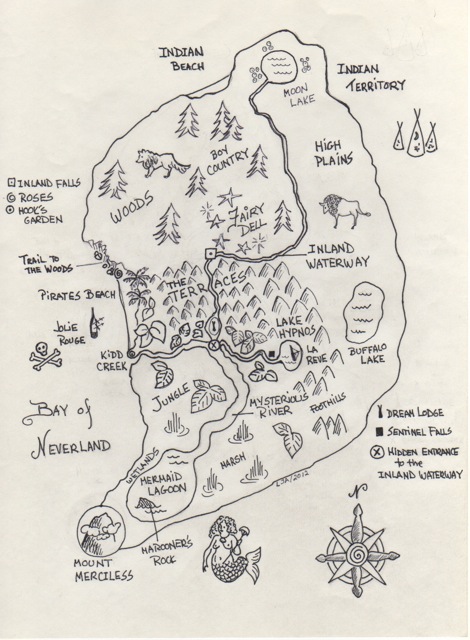
My editor at Snowbooks just sent me the typeset ms of my upcoming novel, Alias Hook, for the final proofreading. It's starting to look like a real book!
Meanwhile, it looks like the map of the Neverland that I sketched once upon a time will now be included in the published book! Well, not exactly my map, but my talented book designer's interpretation of it.
It's probably some dire infringement of copyright to publish the official map before the book comes out. But here's the original that I drew for myself, as a means of keeping track of where everything is in the Neverland. Yes, it's an enchanted place, full of diverse micro-climates and eco-systems that would not coexist in so-called "real" life. But the island of Neverland is still on Planet Earth in my story, so I had to know in which direction the sun and moon rise and set, for instance, from one scene to the next.
Anyway, here's a sneak preview of my original map. The one that will appear in the book is much like this one, but with sexier fonts, and it's much easier to read!
And just for fun, I dug this photo out of the archive: here I am in August of 2004, under the shade of our beloved green fig tree, actually drawing my first version of this map. I'd been working on the story for almost a year, but on my birthday, I decided to take the day off from writing and make the map I'd promised myself.
Interesting historical footnote: within about three years, the fig tree went kaput; termites got into the wood and it stopped producing fruit. We were devastated, but Art Boy and our friend, Isaiah, a woodworker, chopped it down to the ground and carted it away, leaving only an underground root too massive to dig out.
And guess what: the tree came back! First it was just a couple of leaves, than a nubby branch, but this summer we have three sturdy new limbs as tall as me; we've also had two tiny but delicious crops of figs!
All of which I consider a good omen, since Alias Hook is all about redemption, rebirth, and second chances!
Sunday, November 11, 2012
WIT and WHIMSY
Big fun was had yesterday at the opening reception for the new Wit & Whimsy art show at the Scotts Valley Library. It may seem like an odd venue for art, but there's a lot of wall space in the vast and bustling SV Library, and coordinator Valri Peyser is committed to filling it with the work of local artists in rotating 2-month shows.
The Wit & Whimsy show features 14 local artists in various media, including John McKinley, the beloved Aptos illustrator whose insouciant animal portraits have earned him legions of fans. (These are his arty cats.) Victoria Kerr crafts fanciful sci-fi critters out of recycled materials sculpted over with air-drying clay, and painted in rainbow colors. Brian Iles also uses found and repurposed objects to build his small, imaginative birdhouses.
Graphic artist Mott Jordan contributes witty print collages. Stephanie Schriver shows an assortment of her ceramic animal sculptures. In her "Forest of Fabled Creatures" series, Elspeth Inglett writes and illustrates original fables and mounts them on planks of recycled wood.
Myra Eastman presents a series of droll rat paintings, and Chris Miroyan offers fun paintings of imaginary cakes, as well as a series of masked heads that look like refugees from a Morgani costume. And James Aschbacher ("whimsical" is his middle name) shows a selection of new and vintage mixed-media paintings celebrating life in the Aschbacher universe.
The Wit & Whimsy show is up through January 19. Visit the SV Library website for directions, and a complete list of participating artists.
And don't forget, the SV Library is also the permanent home to a dozen life-sized endangered wild animals sculpted in papier maché by the gifted Beth Allison Gripenstraw. So don't forget to look up on top of the bookshelves at the cheetahs, tiger, lynx, crocodile, and other friendly fauna gazing down on the scene.
The Wit & Whimsy show features 14 local artists in various media, including John McKinley, the beloved Aptos illustrator whose insouciant animal portraits have earned him legions of fans. (These are his arty cats.) Victoria Kerr crafts fanciful sci-fi critters out of recycled materials sculpted over with air-drying clay, and painted in rainbow colors. Brian Iles also uses found and repurposed objects to build his small, imaginative birdhouses.
Graphic artist Mott Jordan contributes witty print collages. Stephanie Schriver shows an assortment of her ceramic animal sculptures. In her "Forest of Fabled Creatures" series, Elspeth Inglett writes and illustrates original fables and mounts them on planks of recycled wood.
![]() |
| "I'd Rather Be Sailing," James Aschbacher |
Myra Eastman presents a series of droll rat paintings, and Chris Miroyan offers fun paintings of imaginary cakes, as well as a series of masked heads that look like refugees from a Morgani costume. And James Aschbacher ("whimsical" is his middle name) shows a selection of new and vintage mixed-media paintings celebrating life in the Aschbacher universe.
The Wit & Whimsy show is up through January 19. Visit the SV Library website for directions, and a complete list of participating artists.
And don't forget, the SV Library is also the permanent home to a dozen life-sized endangered wild animals sculpted in papier maché by the gifted Beth Allison Gripenstraw. So don't forget to look up on top of the bookshelves at the cheetahs, tiger, lynx, crocodile, and other friendly fauna gazing down on the scene.
Wednesday, November 7, 2012
REMEMBERING MORTY
It's been three years since Santa Cruz lost one of its literary treasures—poet, raconteur, and bon vivant, Morton Marcus. But his memory lives on, not only in the hearts of those of us who knew him, but more tangibly in the Morton Marcus Memorial Poetry Reading, the third installment of which is coming up this Saturday, November 10, at Cabrillo College.
In this annual event, a world-class poet from out of town (previous guests have been Robert Hass and the delightful Kay Ryan) shares the stage with local poets in a program presented free to the public.
This year's distinguished guest poet is Arthur Sze, chancellor of the Academy of American Poets, and winner of the American Book Award.
This year's event also includes a reading by the winner of the Morton Marcus Poetry Contest, sponsored earlier this year by the Santa Cruz Writes collective and phren-Z, the group's online literary magazine. David Sullivan will read an excerpt from his contest-winning poem, "Take Wing."
As in years past, Gary Young, Santa Cruz County Poet Laureate (2010-11), will serve as master of ceremonies. You can be sure Mort's spirit of bonhommie will be there as well!
Also, in keeping with the tradition of alternating venues between co-sponsors UCSC and Cabrillo, this year's event will be held at the Samper Recital Hall in the new Cabrillo Collage Arts Complex. Other event co-sponsors are Poetry Santa Cruz, Ow Family Properties, and Bookshop Santa Cruz.
Admission is free, but seating is limited, so be sure you get there early. The program begins at 7 pm. Visit Morton Marcus.com for more details.
Monday, November 5, 2012
GUYS & DAMES
JTC's Gunmetal Blues a sharp, funny musical homage to film noir
Say, pal, you got a yen for film noir? (And I mean everything from The Maltese Falcon to Detour, to Chinatown.) Then you should beat it over to Gunmetal Blues, the Jewel Theatre Company's fast, frisky, and funny musical homage to the genre, playing for two more weeks at the Center Stage in downtown Santa Cruz.
It's a simple story about a world-weary gumshoe, a mysterious dame, and, um, a guy in a tux playing piano throughout, a one-man Greek chorus commenting on the action. The private eye investigates a murder case involving a veritable sea of blondes, in a milieu bursting with deliciously crisp tough-guy dialogue and dynamic songs—jazzy, blues, anthems—that keep the story percolating along.
It's a three-person show, and the performers are terrific. Christopher Reber anchors the story as detective Sam Galahad, a rumpled knight in a trenchcoat with a pesky addiction to ferreting out the truth. Reber's Sam is a soulful Everyman who can sell a song as persuasively as he bites off a line like, "Suddenly the room smelled of stale perfume and shattered dreams."
Lee Ann Payne is excellent as the story's four blondes—an ingenue, a classy femme fatale, a nightclub floozy in a spangled red dress, and a bag lady. With her powerhouse singing voice, Payne makes the most of each incarnation, from the chanteuse's wry and clever "The Blonde Song," to the bag lady's poignant ballad.
But Brent Schindele is the real scene-stealer. As piano-playing lounge act, Buddy Toupee, not only does he provide onstage accompaniment for the show's entire song cycle, along with various incidental music cues throughout, he also springs off the piano bench to double for whatever other male characters the story requires—a half-bright doorman, an Irish cop, a gangster, a chauffeur—all with appropriate accents.
Did I mention that he also sings? Schindele has a big, confident voice, whether jauntily hawking his "Buddy Toupee—Live!" CD between acts, or harmonizing with the others in various intricate duets. The two big numbers where all three players sing together, "Don't Know What I Expected," and especially "Childhood Days," are show-stoppers.
Gunmetal Blues was written by Scott Wentworth (acclaimed for his recent work with Shakespeare Santa Cruz), with music by Craig Bohmler, and lyrics by Marion Adler; they put the project together back when all three were working with Stratford Shakespeare Company in Ontario, Canada, as a vehicle for themselves. It must be as much fun to perform as it is to watch. My favorite lines of hard-boiled dialogue (scribbled in the dark) are, "(She had) a mouth that would have sent Shakespeare thumbing through a Thesaurus," and the instant classic, "I checked into a hotel where the desk clerk is blind and you sign your name in invisible ink."
The JTC production, crisply paced by director Tom Gough, makes fluid use of Ron Gasparinetti's spare set—a grand piano in one corner, defining the Red Eye Lounge, and a table and a couple of chairs opposite, for Sam's office and every other interior space. And kudos to Mark Hopkins' lighting design, especially the kaleidoscope of pulsating colors when Sam gets sapped from behind, or someone slips him a mickey.
Gunmetal Blues only plays eight more performances, Thursdays—Sundays through November 18, so don't miss out! Click here for tickets and info.
Wednesday, October 31, 2012
HOOK-WINKED
Okay, I love Captain Hook so much I wrote a novel about him. (Alias Hook, coming soon to a bookstore near you.) But tossing the character into the chaotic mosh pit that the TV series Once Upon A Time has become hasn't done nearly enough to improve the gene pool in terms of story.
The Irish actor playing him, Colin O'Donoghue, is sexy enough. (Although if you've read your Barrie, you know that Mr. Smee, the bosun, is the Irishman; Hook is pure Etonian-bred English.) O'Donoghue would likely rise to the occasion if the writers gave him anything interesting to do.
But, no. After one brief episode that took place at least partially aboard ship, now Hook is landlocked on the Island of Lost Toys, or wherever it is where half the cast is segregated this season, wandering around with the rest of the superfluous characters—Sleeping Beauty, Mulan, Snow White, Lancelot (Lancelot? I thought these were fairy tale characters)—in search of a plot.
And—most egregiously of all—last week they introduced the Frankenstein monster, in the person (at least, the cadaver) of Regina's lost, reanimated stableboy lover. It must have been some kind of Halloween thing; the reanimation sequence was even in black-and-white, performed by a doctor called "Whale." (But if you want a truly clever homage to the classic James Whale movie, go see Frankenweenie).
The weirdest thing about the Hook subplot (and I use the term "plot" in the loosest possible sense) was the backstory establishing his enmity with Robert Carlyle's Mr. Gold. Each is responsible for depriving the other of the woman he loved, which suggests a tedious and prolonged grudge match of vengeance between the two of them if Hook ever gets out of Purgatory. And just so we get the point, Mr. Gold, in his sorcerous Dark Lord persona, is the one who cuts off Hook's hand, equating him in the storyline with—yes—the Crocodile. (They even call him "Crocodile" in the episode.)
Carlyle remains the best (possibly only) reason to watch the show. But, seriously, give a guy a break! They've already got him playing Rumplestiltskin, the Dark Lord, Beast (in the Beauty and the Beast subplot), and now the Crocodile. How long can he be expected to carry the show all by himself? Talk about the hardest-working man in showbiz!
Tuesday, October 30, 2012
INSISTENT KARMA
Who will win the Best Makeup award at next year's Oscar festivities? You can bet on the talented team from Cloud Atlas, the ambitious, visionary saga of love, loss, greed, slavery, and redemption through the ages, co-written and directed by Lana and Andy Wachowski and Tom Tykwer.
Not only does this intrepid crew remake recognizable actors into various characters in various timelines, it often radically alters an actors' age, ethnicity and gender into the bargain.
The ease with which Asian and Caucasian, male and female, black and white switch roles throughout the film puts Cloud Atlas at risk of becoming a stunt movie, an elaborate game of spot-the-actor. OMG, it's Tom Hanks as that foul-mouthed skinhead British author. There's Halle Berry as a futuristic (male) lab tech with a gearshift for an eye. And isn't that Hugh Grant in tribal war paint? But the movie is rich (some might say dense) enough in ideas, plot, characters, and themes to keep us engaged.
Adapted from the 2004 novel by David Mitchell, the film presents six interwoven stories in different styles and settings (Victorian-era seafaring adventure, neo-noir thriller, industrialized future, post-apocalyptic tribalism, etc). Some civil rights groups are blasting the film for putting non-Asian actors in "yellowface" in a segment set in futuristic Korea (although Asian actresses Doona Bae, Xun Zhou, and Zhu Zhu also turn up in non-Asian roles in other segments).
But having the same actors play diverse roles across five centuries of civilization also enhances the central motif of humanity facing the same moral, romantic and political issues, over and over again, in every era, where, as one character says, "the smallest crime or kindness" can have unknowable repercussions throughout the ages.
Transitions back and forth between the stories are often ingenious, and overall, the filmmaking is dynamic, despite a few too many vehicle chases and shootouts. And I would have liked more genuine emotional resonance amid all the flash and dazzle.
But here's the, er, bottom line for me: at nearly three hours in length, does the movie pass the butt test? It did for me. No squirming, no checking my watch, I was interested in the stories throughout. And how often do you see a movie any more that you can talk about for hours later? (Read more)
SOUNDS of SILENTS
New Music Works launched its 34th Season last week with another live music program built around vintage silent films. This is a great idea pioneered last year with the NMW presentation of the beautifully restored 1926 Art Deco classic, Metropolis, accompanied by a terrific new score written for the film and conducted by NMW Artistic Director Phil Collins
This year, the film of choice was the weirdly haunting 1919 German Expressionist masterpiece, The Cabinet of Dr. Caligari. It's a wildly inventive piece of filmmaking for its day, with its surreal, hand-painted sets, and cadaverous, yet sympathetic "somnambulist" forced to do the bidding of the evil "Herr Doktor," who belatedly discovers a will and conscience of his own. And it's always a treat to see it on a big screen.
It was also a treat to have composer Richard Marriott in the house, whose original 1987 score for Caligari was performed live by NMW at this screening. Maestro Collins introduced Marriott from the stage, who spoke about his work with The Club Foot Orchestra (a Bay Area ensemble highly esteemed for composing and performing live scores to accompany vintage silent films), and how he came to write the Caligari score, after channel-hopping upon the movie one night on Channel 9.
Also on the program was the surreal 1927 short film Ghosts Before Breakfast, by DaDaist Hans Richter, accompanied by the largely percussive and playful 1982 piece, "Revenge Before Breakfast," by Henry Bryant.
The experimental 1944 silent short, At Land, directed by and featuring Maya Deren, rounded out the bill, an evocative piece in which a female (nymph? spirit?) appears to crawl out of the sea and slither into a swanky dinner party. Despite the composer credit for John Cage in the program, the 15-minute film was accompanied by dead silence. Lucky for me, Art Boy knows something about 20th Century music and explained it was an homage to a famous Cage composition, "4:33," which consists of four-and-a-half minutes of silence. But I wonder how many other audience members didn't get the joke, which was never alluded to from the stage.
In fact, there could be more acknowledgement of the audience in general from the stage. It would be nice if Collins or someone else from NMW came out to welcome the audience and thank them for their support at the start of the program. It could even be an amplified voice from offstage, just a little touch of showmanship to let people know the show is about to begin.
Pairing up avant garde film and music is a productive idea I hope NMW continues to explore in the future. With a little tightening up in the presentation department, consider the possibilities!
Thursday, October 25, 2012
NUTRAGEOUS
Funny script, extreme blood, in genre satire 'Seven Psychopaths'
Irish playwright Martin McDonagh made quite a splash—albeit a bloody one—with his first feature, the brilliant, brutal, scathingly funny, fiercely moral In Bruges.
The good news is he's back with more boys behaving badly in Seven Psychopths. The bad news is, it's no In Bruges.
Still, even almost-there McDonagh is better, smarter, and funnier than your average bear. This time, the story concerns an Irish filmmaker named Martin in Hollywood, trying to write a new screenplay. It's not exactly McDonagh's 8 1/2; it's more like his Alex In Wonderland, a well-intentioned and often entertaining sophomore effort that doesn't always hit all its marks.
As self-referential to its genre as a Scream movie, its film-within-a-film format allows McDonagh to deconstruct the crime/buddy/gangster thriller, and point out all its clichés and weaknesses, while trading on them shamelessly. The degree of bloodletting is utterly absurdist, but the character comedy is still funny, even if it lacks the cohesion and moral force of its predecessor.
Colin Farrell plays the blocked screenwriter as a wary, wide-eyed Everyman. (His eyebrows alone deserve their own Oscar.) His job is to play straight man to a looney-tunes cast that includes Sam Rockwell, Woody Harrelson, Tom Waits, and Christopher Walken, who is extra terrific as the movie's weary, tattered soul. (Read more)
Tuesday, October 23, 2012
CREEP SHOW
Silent movie fans, unite!
One of the most spellbinding, eeriest, and earliest proto-horror films ever, The Cabinet Of Dr. Caligari, is coming to town this week. Here's your chance to see it on a big, big screen at the Rio, Friday night, at the kickoff event for New Music Works' 34th season, The Cabinet of Dr. Caligari: A Live Soundtrack Experience.
Robert Weine's 1919 German Expressionistic masterpiece concerns a demented carnival fortune-teller who keeps a sleepwalking somnambulist in a permanent trance-like state to do his evil bidding. Breathtakingly bizarre visuals include moody chiaroscuro lighting, and menacing forced-perspective interiors and exteriors, which add to the sense of haunting weirdness.
Conrad Veidt (later to play suave Nazi villains in American films like Casablanca) is strangely poignant as the fragile, reed-thin, hollow-eyed somnambulist, Cesare. Not a monster himself, he's manipulated in monstrous ways by his keeper, sinister Dr. Caligari (the scenery-chewing Werner Krauss).
Still, the shots of Cesare, all in black, creeping like a shadowy spider along the walls of Walter Reimann's surreal dreamscape of a set are among the most indelible images in all of horror cinema. I get chills just thinking about it!
At Friday's event, the 51-minute film is accompanied by an original music score by contemporary Bay Area composer Richard Marriot, performed live by the NMW Ensemble under the baton of Artistic Director Phil Collins.
Also on the bill is Ghosts Before Breakfast, a surreal 1927 short by Dadaist filmmaker/artist Hans Richter, accompanied by the composition "Revenge Before Breakfast" (1982) by Henry Brant, and At Land (1944), an experimental short by Maya Deren, featuring Deren and John Cage, accompanied by the composition "John Cage, 4:33" (1952). The NMW ensemble will also perform Erik Satie's 1920 composition, "Furniture Music." Complete program begins at 8 pm.
If you remember last year's NMW presentation of another silent, classic, Metropolis, as fondly as I do, you know you're in for a treat! Yes, there will be a costume contest Friday night, so dress up as a character from Caligari, or your favorite piece of furniture, to compete for the Best Costume prizes. Click here for ticket info, or visit the NMW website.
Friday, October 19, 2012
DISENCHANTED
I don't know about you, but it seems to me they can't bring on the Captain Hook character soon enough in the second season of TV's Once Upon A Time.
The curse was broken at the end of last season, and the suddenly un-enchanted denizens of Storybrook remember their fairy tale lives, although for some reason that escapes me at the moment, they can't go home to their fairy tale realm. But now, the scriptwriters have no idea what to do next; like the proverbial spaghetti noodle test, they're throwing everything at the wall to see if something, anything sticks.
Evil queen Regina (Lana Parrilla) is under some kind of house arrest in her mayor's mansion, out of the action. There are early indications that the writers are trying to soften her character up this season by re-introducing an even more dastardly wicked queen, the mother who made her what she is, previously seen only in flashback. This would be fatal to the show; Regina's ruthlessness is one of the series' few constant pleasures.
The other one is the great Robert Carlyle as Rumplestiltskin/Mr. Gold. You never know from one week to the next if he'll prove to be a good guy or a bad guy, but he always has a private agenda, some angle of self-interest, and that's what makes him so interesting. (Along with Carlyle's deliciously acrobatic and insinuating voice.) But we haven't seen enough of Mr. Gold this season, either.
Instead, the bulk of the narrative action so far falls to the designated "heroes" in the cast, and you've never seen so many shades of vanilla. At the moment, storylines are unfolding on three fronts, none of them interesting: the folks in Storybrook are trying to figure out how to get home, under the dubious leadership of Prince (yawn) Charming; angsty Emma and virtuous Snow (as in White) have tumbled though a mystic portal into some other enchanted plane, where they team up with another couple of personality-challenged females—Sleeping Beauty, and the so-far-underwhelming warrior Mulan—to battle ogres and elude Regina's poisonous mommie dearest; meanwhile, everyone's backstories continue to play out in flashbacks to the original fairy tale kingdom.
The mystery of how these stories fit together may be more trouble than it's worth solving for an increasingly disenchanted audience. (Okay, for me.) The writers must know it; the end of last week's episode teased a shot of a sailing ship, with a promise to introduce "one of the most despicable villains of all time." Hmmm...that's a bit harsh, especially if you've read my History of Captain Hook on stage, page, and screen.
Even if this Hook is still a villain, if he can hold his own against Gold and Regina, he'll be worth his weight in bullion in a show that desperately needs a breath of fresh sea air. It's promising that they have a sexy young Irishman playing the part, although the fatality rate for sexy young males on this show is pretty, er, grim.
Remember the hunky Huntsman/Sheriff? The queen squashed his heart like a bug. Mysterious stranger August/Pinocchio was last seen turning into wood (and I don't mean in a good way). And didn't Ruby/Riding Hood devour her own sweetheart during a werewolf interlude in her backstory?
If Hook is a hit on the show, I'll be waiting to see what kind of backstory they invent for him, and how it differs for the one I wrote for him in my upcoming novel, Alias Hook. That's the great thing about a character who's been around as long as Captain Hook (107 years and counting)—he's always ripe for a new interpretation.
Thursday, October 18, 2012
REEL CONNECTION
Pacific Rim Film Festival promotes cross-cultural understanding
The aloha spirit returns to Santa Cruz when the 24th Annual Pacific Rim Film Festival unspools this week. Originally inspired by the Hawaii International Film Festival, and dedicated to cross-cultural understanding around the theme, "When Strangers Meet," the six-day event runs October 19-24, offering twenty films from countries all around the Pacific Rim at five venues countywide. In addition to the Del Mar and the Rio, festival films will also screen at the Riverfront Twin, Watsonville Center, Cabrillo College, and the Crocker Theater at Cabrillo College. As always, all films are screened free of charge to the public, with the exception of the closing night benefit.
The biggest crowd-pleaser of the Festival may be the opening night offering, THE TOPP TWINS: UNTOUCHABLE GIRLS (New Zealand, 2009, 100 minutes) Leanne Pooley's delightful documentary introduces us to two of New Zealand's most beloved cultural icons: Jools and Lynda Topp. Farm-bred twin sisters who started out as street-corner buskers, singing, yodeling, and playing guitar, they are also cheerfully upbeat lesbians, and tireless anti-nuke, pro-civil rights activists.
As comediennes, the twins are like a two-woman Monty Python troupe with a rotating cast of comic characters of all ages, genders, and classes. As musicians, their songs are infectious, witty, and heartfelt, and as personalities, they are irresistible. So is the film. I guarantee you'll come out humming the tunes. (Plays at the Del Mar, Friday, 8:30 p.m., and at the Rio, Monday, 12 noon.)
Speaking of tunes, one of the most democratizing things about the humble ukulele is that everyone can play it. But not everyone can play the uke like Jake Shimabukuro. Takashi Nakamura's terrific documentary, JAKE SHIMABUKURO: LIFE ON FOUR STRINGS (USA, 2012, 60 minutes), explores the life and sudden, meteoric career of the awesomely gifted young Hawaiian-born uke virtuoso, who's carved out an international career as a solo concert artist playing everything from The Beatles, to classical, to jazz. If you can't even imagine Queen's "Bohemian Rhapsody" on the uke, wait till you hear Jake's full-blooded rendition! (Plays at the Del Mar, Saturday only, 8 p.m. O&A to follow with director Nakamura.) (Read more)
For more details, check out the PRFF website or visit their Facebook page.
WESTSIDE STORIES
Here's what we did on our Open Studios "vacation" (meaning—the one weekend that Art Boy & I have off from his own OS). These Westside artists will all be open for "Encore," this weekend, as well.
It's always fun to visit ceramic sculptor Peggy Snider, on Meder Street (on the way to UCSC). The rustic shelves of her workspace are loaded with lively clay creatures ready for a good home—winged angels, muses, sun-haloed wisewomen, human figures just about to take flight, and fanciful critters of indeterminate species. Don't miss the column of animated little faces made from bits of leftover clay that decorate her door jamb ("Nothing goes to waste around here!" Peggy laughed.)
More winsome pieces decorate the railing of her side deck; stroll along until you get to the steps leading down to her enchanting sculpture garden. This is a meditative space perfect for gazing at her larger, more formidable and hypnotic pieces.
Over on National Street, painter and mixed-media artist Glenn Carter is showing a range of work. Some are monumental works in progress destined for a gallery show early next year, but he also has walls full of small, intriguing framed pieces with an interesting history: they were created from large mixed-media on paper pieces that Carter felt were no longer working. So he cut them up into smaller bits, then ripped, repurposed and recombined the various elements into a completely new series with an energy and mystery all its own.
Carter works with all kinds of materials, from large steel monoliths and a giant, dried agave root, to wire, string, cheesecloth and wax. His wide-open two-room studio is a terrific display space for his work. And while you're there, take a moment to wander the brick pathways that wind through the fantastic succulent gardens he and his wife, Denise, have put in over the years. Who wouldn't feel creative in such a beautiful space?
The oil paintings of Westside artist and art teacher Isabell Fearnsby are moody and mysterious, especially her renderings of iconic local places like Shopper's Corner, the Boardwalk, and the Rio Theatre. I like how she imbues this image of the Del Mar with a haunting, otherworldly feel.
The plain pegboard display of unframed pieces on the lawn of her Sacramento Street home could use an upgrade, and her painting studio inside is tiny. But we enjoyed watching her at work at her easel.
While we were there, she was working on the underpainting of a new piece, and it was interesting to see how she gridded out the canvas and mapped out where the most compelling focal points would be. The chance to view the artistic process in action is a big part of the appeal of OS.
It's too bad paperwork artist Will Marino doesn't show more of his process for us conceptually-challenged types. The simple explanation is posted in his San Juan Avenue studio that his raw materials are used, vintage dartboards whose coiled paper interiors are deconstructed, refolded and rewound. But I still can't even imagine how he gets such extraordinary effects.
The color, texture and detail of his wall pieces are simply amazing. This one is called "Big Sur #2: After the Fire," combining wound paper with pieces of charred wood. He makes vivid use of greens in some landscape-themed pieces, but his monochromatic pieces are just as visually intense.
So are his sculptural pieces. A forest of proud, majestic cones dominate one area, while a variety of sinuously arching, leap-frogging, slinky shapes pop up on shelves and other surfaces. And don't miss the Steampunk-style, hand-cranked paper cone extruder in one corner. It's hands-on all the way with Marino's exceptional, one-of-a-kind work. Don't miss it!
Studios will be open for this final, Encore weekend from 11 am to 5 pm. Let's hope this gorgeous weather holds out!
Friday, October 12, 2012
PASSPORT TO PARIS
Hundreds of participating artists throw open their doors to the public during the Open Studios Art Tour. Beth Allison Gripenstraw throws a party—and you're invited!
This copiously creative ceramicist, watercolor painter and jewelry-maker doesn't just spruce up her workspace for OS; she creates an entire alternative universe that visitors are happy to get lost in. Every year at OS, her Westside house on Towne Terrace (off Mission) gets a makeover into some fantastic new environment. Two years ago, it was Alice's Wonderland. Last year, Beth staged an African safari, a trip she never took in real life, but imagined and recreated in a series of bold, fanciful paintings and animal print ceramic vessels and tableware.
This year, we're off to Paris to commune with the Bohemian art scene, ca 1920. I was lucky enough to get a sneak preview this week, and if you loved Midnight In Paris, you'll want to put Beth at the top of your OS to-do list this weekend.
The centerpiece is the transformation of her dining room into the Lapin Agile, the Montmartre cabaret where Picasso and his buddies hung out to smoke, drink, and argue about the meaning of art. And guess what—they're all still here!
Enlarging black-and-white photos on the computer, and with incredible attention to the details of vintage clothing and accessories, Beth recreates a dinner party for eight renowned artists. You'll see Frida Kahlo in her embroidered Mexican blouse, beads, and coronet of flowers, and Picasso peering out dubiously from beneath his beret.
Paul Gauguin arrives straight from the islands, in tropical whites, and sporting a lei, while Diego Rivera unbuttons his tailored waistcoat over his impressive girth.
Vincent Van Gogh wears his straw painting hat and a faraway look in his eyes. And I love Salvador Dali's dashing white silk aviator's scarf and old school tie.
Modigliani and Claude Monet are also in attendance, along with famed artist's model Kiki lounging on the banquette in back. Sure, not all these artists were alive at the same time in real life, but that's what artistic license is all about!
In addition to the period glassware, vintage cigarette packs, ashtrays, and cutlery with which Beth festoons the table, she's created plates, bowls, and saucers inspired by each artist's work. (Here's a dinner plate featuring her take on a Frida self-portrait.) I also love Beth's version of Van Gogh's "Starry Night."
To get you more in the mood, old black-and-white silent films will play on a nearby screen while an old record player will spin Edith Piaf and other French cabaret music. Oh, and did I mention there will be an absinthe bar in the corner?
And this is just one room. Beth promises a French bistro with wine and cheese on the balcony, a French farm market in the driveway, and an artist's atelier adjoining the dining room, complete with easel and model's couch, where various ceramic wares and jewelry will be on sale.
Meanwhile, her living room gallery space will display Beth's big, fun, colorful paintings of travels real and imagined: to Mexico, Hawaii, France, and Africa.
Beth is # 228 in your OS Guide. She'll only be open this weekend, so don't you dare miss her! Check out her website to see what she's been up to lately, and I'll see you there.
Thursday, October 11, 2012
DOG STAR
If you love dogs, you'll love Frankenweenie, Tim Burton's sweetly subversive story of a boy and his (recently deceased) dog. When loyal little Sparky gets hit by a car, heartbroken young Victor sews him up and reanimates him, Frankenstein-style, in his home-made attic lab.
Reinventing a short film he made almost 30 years ago, Burton crafts a black-and-white, 3D, stop-motion animated feature in loving homage to James Whale's horror classic, full of monster movie in-jokes and hilarious sight gags. The lab scene is deliriously fun, as Victor generates electricity using a spectacular lightning storm outside to drive every household appliance in the attic capable of rotation—electric fan, bike wheels, the reels of a film projector, a record-player turntable.
Victor's grade school science teacher is a Vincent Price lookalike with an unpronounceable Slavic name; his classmates are junior ghouls in the making, from eager young hunchback E(dgar) Gore to a pint-sized Karloff clone, to a budding mad Japanese scientist. The tombstones in the pet cemetery are shaped like crossed dog biscuits, a fishbowl, or a fire hydrant, with inscriptions like "Goodbye, Kitty."
Heroic little Sparky (an adorable little pooch of indeterminate breed—to say the least) gets to save the day when a herd of grotesquely reanimated pets invades the town, led by a giant Turtle-zilla (named "Shelley," natch).
Everyone should recognize the burning windmill finale from Whale's original Frankenstein, but only connoisseurs (like Art Boy) may get Burton's reference to vintage '50s sci-fi B-movie, Invasion of the Saucer Men, at the very end, when all the townsfolk gather their cars in a circle and turn on the headlights for one last energy burst.
Frankenweenie is loads of silly fun, but best of all, it offers plenty of genuine resonance about the bond between people and their beloved pets. You'll want to hug your own little guy the minute you get home!
Subscribe to:
Posts (Atom)