Tuesday, November 29, 2016

WATER WHIRLED

Action in the Pacific in Disney's girl-powered Polynesian adventure Moana

If Disney's gazillion-dollar-grossing Frozen was the perfect holiday animated feature of 2013, with its snowy Nordic landscape, and supporting cast that included a snowman and a reindeer, Disney's new cartoon feature, Moana, is the perfect holiday movie for the opposite reason — enveloped in the landscape and folklore of the Pacific Islands, it's a sunny, beachy, gorgeously animated antidote to winter.

Moana is directed by Disney veterans Ron Clements and John Musker and their creative team, the brain trust behind The Little Mermaid, Aladdin, and The Princess and the Frog, among others. The movie's story and look are steeped in Polynesian mythology, and it features a principal voice cast of mostly Pacfic Islander descent, along with a songwriting team that includes Broadway wunderkind Lin-Manuel Miranda, of Hamilton fame.

The result is a wonderful, girl-power tale of a young woman on a quest to find herself and fulfill her destiny.
Moana: Chosen by the Sea

Scripted by Jared Bush, from a story concocted by Clements, Musker, and their minions, Moana begins with an origin myth about the creation of life in the world, and a slumbering earth goddess in the shape of an island.

But a trickster demigod called Maui stole the sparkling green heart of the goddess, and now the seas are restless, and life in the islands is imperiled.

This tale is told by Gramma Tala (Rachel House) to an audience of rapt island children, and none are more thrilled than her own granddaughter, Moana.

In a brief, frisky montage, we see Moana as a toddler, child, and tween, repeatedly sneaking down to the beach to commune with the sea, only to be dragged back to the village by her father, the chieftan (Maori actor Temuera Morrison). The sea is dangerous, he keeps telling her, but life is beautiful in the village, where her destiny is to lead the people one day.

Moana discovers forbidden boats: love the design on that hull

But the sea herself disagrees. One day when little Moana protects a sea turtle hatchling from predator birds as it crawls into the sea, a wave rises up in a beautiful green spout and deposits a trail of conch shells leading into the ocean at the child's feet.

Her grandmother tells her the sea has chosen Moana to find Maui and return the heart to the sleeping island, far away across the ocean — even though her father forbids anyone from sailing their outrigger boats past the reef that surrounds their island.
Gramma Tala communes with the Sea

But by the time Moana is a young woman (now voiced by Auli'i Cravalho), a coconut blight, and a dwindling fish supply, put island life in jeopardy. The sea reveals the lost heart to Moana, and, at her grandmother's urging, she sets off past the reef, through stormy seas, to find Maui.

The relationship between girl and grandmother is very tender. When Moana is reluctant to leave her granny behind at the start of her quest, Gramma Tala tells her "There is nowhere you can go that I won't be with you."

Navigating by a constellation shaped like the Maui's fabled fish-hook, Moana finds the desolate salt island where the demigod has long been stranded for his crime. With a body full of tattoos, and plenty of attitude, Maui (voice of Dwayne Johnson; turns out he's part Samoan), doesn't care about Moana's quest, but he covets her boat.


When the sea prevents him from throwing Moana overboard, Maui reluctantly adopts a big brother attitude toward her, and they set out to fix the mess he's made.

After a bizarrely funny encounter with a few boatloads of ferocious pirates made out of coconuts, they visit a scavenger crab (Jemaine Clement provides its sleepy hipster voice) to retrieve the magic fish-hook that allows Maui to shape-shift. (Although, when he wants to soar like a raptor, he's just as likely to find himself transformed into a bug, instead, or an airborne shark.)

A pet chicken provides comedy relief, and the movie spoofs the whole Disney Princess brand. When Moana bristles at that designation, Maui cracks, "If you wear a dress and you have an animal sidekick, you're a princess."

Moana's determination to become a Wayfinder echoes another great girl-power movie, Whale Rider. And, most cool are Maui's tattoos, which not only move around and tell their own animated stories, but act as Maui's conscience.

Maui's animated tats: Every picture tells a story
 Like Brave before it, Moana is a newly-minted adventure that's not based on a classic fairy tale, and a Disney Princess movie that doesn't need a prince. It's also great to see the folks at Disney pursuing diversity with such a vengeance, after their first 60 years of all-white heroines. (Remember when it was a big deal that Belle in Beauty and the Beast had brown eyes, not blue?)

Bursting with color, music, beautiful seagoing vistas, and the mythology and folkways of the Pacific Islands, Moana is guaranteed to cure your winter blahs.

Sunday, November 27, 2016

FLAME ON

Santa Cruz media icon Christina Waters is a true Renaissance Woman.

A journalist whose newspaper stories on arts and culture have been entertaining readers for decades, she's been nominated for the James Beard Award for her food writing (Spirits, Wine and Beer category).

She's a classically trained musician who sings in the University Choir, an accomplished painter, an educator at UCSC with a PhD in Philosophy, and a world traveler always eager to jet off to Milan or Bayreuth for the opera, or London for the theatre.

Now Christina can add "Author" to her impressive list of credits. Her new book, Inside the Flame: The Joy of Treasuring What You Already Have, is out this month from Parallax Press, in Berkeley. Part memoir, part dispensation of accumulated tribal wisdom, it's a collection of punchy, short pieces that exhort us to live now, in the present moment, in the real world — and offers suggestions on how to make our sensual, intellectual and emotional experiences of life even richer.

Christina and I have known each other since the Late Pleistocene Age; we met in the lobby of the Nickelodeon when we were both reviewing movies for rival papers, and we've been friends ever since. But even I was surprised at the sheer variety of life experiences revealed in Inside the Flame, and the depth of her willingness to share them with her readers.

If you're looking for someone to give you tips on how to live life fully, Christina is the mentor for you!

Her thoughtful, often playful pieces have provocative titles, like "Perfume Tattoos," "Up High and Down Low," "Purposeful Wandering,", and "When the World Touches Back."  In "Freestyle Craftiness," she celebrates "the rule that you don't require rules," in the act of creation.

In praise of the rougher, less genteel surfaces found in nature, she writes, "Texture is the world's way of getting our attention." In the piece, "Swimming In the Rain," she turns a story about diving into a public pool in the middle of a summer thunderstorm into an erotic confession.

In these brief, potent vignettes, Christina Waters celebrates the deeper meanings lurking beneath everyday experience, and through a collection of memories and suggested activities, invites us to reimagine our own lives.

Christina will read from Inside the Flame, sign books, and supply witty answers to your questions Monday night, November 28, at Bookshop Santa Cruz. She's liable to have a pretty big cheering section, so get in line now!

Saturday, November 26, 2016

BIPOLAR EXPRESS

Mental disorder handled with heart, wit, in exuberant Next To Normal


One of the most interesting things about the Jewel Theatre Company is its choice of material. Sure, they produce their share of the classics — Pinter, Shepard, Athol Fugard, Noel Coward — but Artistic Director Julie James also has a sharp eye for innovative work less familiar to local audiences.

Case in point: Next To Normal, the exhilarating second production in JTC's  ongoing 12th season. This show also marks the company's first anniversary in its new space, the Colligan Theater at The Tannery (where they opened last November with Guys And Dolls).

Next To Normal is also a musical, but there's nothing old-school about it. Produced on Broadway in 2009, the show won a couple of Tonys, along with a  Pulitzer Prize, for its audacious depiction of a wife and mother with bipolar disorder whose struggles to cope with her husband, her family, and herself, are surprisingly universal.
Schmitto, with Payne: outstanding

With music by Tom Kitt and book and lyrics by Brian Yorkey, this is not the kind of musical that comes with show tunes and a chorus line.

It's more like a rock operetta, with almost non-stop music provided in this production by an onstage jazz-rock combo (ably led by keyboardist Katie Coleman) and a cast of six terrific singers.

The music ranges from lyrical to powerhouse, the lyrics are insightful, and the singers perform it in an endlessly inventive series of duets, quartets, and counterpoints.

The story revolves around Diana (Lee Ann Payne), a suburban housewife struggling to get a grip on herself in order to hold her family together. Husband Dan (Christopher Reber) has stuck with her through all the peaks and valleys of her illness.

Payne and Reber: getting a grip
Son Gabe (the outstanding Coleton Schmitto) is the apple of his mother's eye. Teenage daughter Natalie (a poignant, affecting Brittany Law), a scholastic overachiever, also plays keyboards, embracing the classical precision of Mozart as an antidote to the chaos at home.

Payne sings up a storm; she captures Diana's wry wit, and articulates the emotional terrain of each number. Reber's rumpled, loyal Dan, trying to do his best, partners her beautifully. Married in real life, they last appeared onstage together for JTC in the fabulous film noir musical, Gunmetal Blues. (He was the gumshoe; she was the blonde who popped up in all the female roles.)

James (who also directs this production) keeps the action brisk and the audience engaged. The exuberance of this production is what live theatre is all about.

Saturday, November 19, 2016

MIAMI VICE

Race, identity, love, explored in eloquent Moonlight

Black lives matter in Moonlight, filmmaker Barry Jenkins' eloquent coming-of-age drama that explores issues of race, culture, and love in unexpected ways.

Adapted by Jenkins from an unproduced play, In Moonlight Black Boys Look Blue, by Tarell Alvin McCraney, the story zeroes in on three key moments in the life of its protagonist as he experiences the world and searches for his place in it.

Beautifully acted, shot with visual intensity, and featuring a haunting soundtrack by Nicholas Britell, the movie begins in the recent past, in the suburbs of Miami.

A minor neighborhood drug kingpin, Juan (the charismatic Mahershala Ali), originally from Cuba, is making his rounds one day in his souped-up, vintage Impala, when he sees a pack of kids chasing a boy.
Ali and Hibbert; father figure

Tracking down the scared, silent boy to a boarded-up apartment house, Juan persuades him to come home with him. Over dinner with Juan's girlfriend, Teresa (Janelle Monáe), the boy reveals that his name is Chiron, but everybody calls him "Little" (Alex R. Hibbert).

Juan takes the boy home to his single mother, Paula (Naomie Harris). But Little starts spending more time with Juan and Teresa.

Juan becomes the boy's mentor and surrogate father; he teaches him to swim in the ocean, and offers thoughtful advice about finding his own identity, no matter what bullies, or his mother, say about him. "You gotta decide for yourself who you gonna be."

Holland and Rhodes: collision course
In the movie's middle section, we meet Chiron again as a 16-year-old high school student (now played by Ashton Sanders). And about ten years later, in the movie's final act, we catch up with Chiron (played as a pumped, hard-edged adult by Trevante Rhodes), whose life has taken a turn that's both unexpected, and yet, sadly, inevitable.

One night, he receives a phone call —out of the blue — from the one friend back home he'd had in grade school, easygoing Kevin (André Holland). So Chiron hits the road on a collision course with the past.

Moonlight gives us a new way to look at characters and situations that are only clichés on the fringes of most mainstream movies.

It's a slice of cinematic poetry with a vision all its own.

Thursday, November 17, 2016

SPACE CAPTAIN

Very sad this week to hear of the passing of the one and only Leon Russell, whose soulful, gospel-tinged boogie-woogie, rocking' piano provided much of the soundtrack for my misspent youth. He was an accomplished guitarist too, but I loved his piano best!

I saw him live at the Anaheim Convention Center ca 1970: Elton John was his opening act. They played separate sets, but their pianos were butt-to-butt onstage. It was a great night!

Saw him again at UCLA, with his own band. Guest star was former child evangelist Marjoe Gortner (who was experiencing a tiny window of celebrity at that moment because of a documentary about him).

Marjoe thought he knew a thing or two about revving up a crowd with his strutting, frenzied onstage antics. But all Leon had to do was lift one pinky and cast a glance: his band started cooking, and the crowd went nuts!

He was featured in two of the greatest rock events of the '70s (spawning two of the greatest rockumentaries, ever): Joe Cocker's Mad Dogs and Englishmen tour of the States (1970) (movie: 1971), and George Harrison's all-star Concert For Bangladesh (1971) (movie: 1972).

Leon was the musical director and onstage bandleader of the Cocker tour, assembling a knockout collective of studio and session musicians.

He also recruited some amazing vocalists (Rita Coolidge, Claudia Linnear, Jennifer Warnes, among others), not as mere "backup singers," but dubbed The Space Choir, whose contributions were heavenly indeed!

Seeing the Mad Dogs and Englishmen tour movie in 1971, I decided joining his choir would be my Plan B career option. So what if I couldn't sing? With all those people crowding the stage, who would ever know?


Here's the entire company rocking out to "Space Captain." (Split screen; very Seventies.) Keep an eye on Leon in the side panels, to appreciate his keyboard riffs, and see just how surely he's in control of the band!

For the Concert For Bangladesh, Leon brought the core of his own touring band to play onstage with Harrison, Eric Clapton, Bob Dylan, Ringo Starr, Billy Preston, and members of the group Badfinger.

Here's one of my favorite bits, Leon's medley of the Stone's "Jumpin' Jack Flash," and the Lieber-Stoller chestnut "Youngblood."

(It's kind of a buggy video; a random icon pops up onscreen now and then, and there's a commercial(!) in the middle of the clip. Still, you can see how cool these folks are in concert!)

Both of the soundtrack albums to these movies were at the top of my stereo default list for years!
Did I mention Leon Russell was also a songwriter? "Delta Lady," "Superstar," "Roll Away the Stone," and "A Song For You" are just the first ones that come to mind.

When my brothers and I were cleaning out my mom's house a few years ago, I found this stashed away somewhere. It's a full-page pic of Leon, ripped out of Rolling Stone magazine, in his trademark top hat, and cascading hair (already going silver in his late 20s). I'd taped it o a piece of cardboard, and had it posted in my room forever!

Singer, songwriter, guitarist, killer piano-player, and Master of Space and Time: rock on, Leon!

Monday, November 7, 2016

FULL SERVICE

Sex, lies, gender politics fuel twisty, edgy 'The Handmaiden'

It may seem like an odd collaboration: bad-boy Korean filmmaker Chan-wook Park, famed for the violent male revenge melodrama Oldboy, and British author Sarah Waters, whose erotic thrillers are set in the Dickensian underworld of Victorian London.

But it turns out to be a surprisingly happy match-up in The Handmaiden, Park's Asian riff on Waters' novel Fingersmith. Filmmaker and source material are both edgy in complementary ways.

Gorgeously shot and composed, audacious, and full of witty visual asides, The Handmaiden is a sly entertainment of sex, larceny, deception, double-crosses, and female liberation.

Park shifts the locale to Japanese-occupied Korea in the 1930s. Sook-Hee (bright and lively Kim Tae-ri) is a young woman who's grown up in a den of pickpockets and thieves, purchased from a "purveyor of stolen girls." One of the gang leaders, a smooth-talking Korean who calls himself Count Fujiwara (Jung-woo Ha), picks Sook-Hee as his accomplice in an elaborate swindle.
Maid to Order: Kim Tae-ri and Min-hee Kim

The mark is Kouzuki (Jin-woo Jo), a wealthy, middle-aged Japanese man living in splendor at a remote country estate. Kouzuki has been the guardian of his niece, Hideko — and her fortune — since she was five years old.

Now that Hideko (Min-hee Kim) is a poised young woman, the Count, a talented art forger, has secured himself a position as her drawing tutor. He's also arranged employment for Sook-Hee as Lady Hideko's handmaiden.

The plan is for Sook-Hee to assist the Count in persuading Hideko to run away with him. Once married, he'll shut her up in a madhouse and claim her fortune for himself.
Drawing conclusions:Jung-woo Ha and Min-hee Kim

Hoping to make her own fortune from her share of the take, Sook-Hee agrees. Street-smart, but not especially sophisticated (she can't read), she's awed by Kouzuki's grand home, his immense library of rare books that she's forbidden to enter, and the beauty of her new mistress — who's surprisingly close to her own age.

But this is just the jumping-off point for a plot that becomes more bold, twisty, and rewarding as it unfolds. (Park's film could be a subversive co-bill with Miss Hokusai: both deal with ukiyo-e erotica, including the famed print of a giant octopus pleasuring a swoony geisha, an image Park also references in one funny, fleeting visual gag.)

You might want to skip this one if onscreen sex makes you uncomfortable. But otherwise, this is a lavish, intricate puzzle-box of a movie that considers colonial, and gender politics with wicked aplomb. (Read more in this week's Good Times.)

Wednesday, November 2, 2016

ART HERSTORY

Three Women Playing Musical Instruments, by O-Ei Hokusai
Art, erotica, girl power, and parent-child relationships — Miss Hokusai ought to have everything going for it.

Set in the Japanese capital city of Edo (now Tokyo) in the early 19th Century, it depicts the life of famed painter, Katsushika Hokusai, and his daughter, O-Ei, also a talented artist, who spends her days completing deadlines for her unreliable father.

This would have been a fascinating story for a live-action film. But as an offering from the popular Japanese animation studio, Production I.G (Ghost In the Shell), it's an odd mix of gorgeous, painterly vistas and lovely glimpses of historical and cultural traditions, with jarring modern rock music, cornball dialogue, and inane slapstick comedy.

(To be fair, I saw a version dubbed into English. It's possible that the Japanese-language version, with English subtitles — both versions are playing at the Del Mar — might work better.)

Daughter of Dragons: Miss Hokusai
Directed by Keiichi Hara, inspired by Hinako Sugiura’s manga comic Sarusuberi, the movie revolves around O-Ei, who lives with her slovenly, obsessed father. He has no vices, she tells us, he doesn't drink or smoke— all he does is paint. She paints too, and when her dad can't complete a commission on time, she's expected to fill in for him — without credit.

This makes O-Ei perpetually fed up and rankled, so she's not a character we ever exactly warm up to. We see her smoking a pipe and sketching erotic drawings (the elder Hokusai was famed for his erotica as well as his iconic land- and seascapes), but neither of these pastimes gives her character much extra dimension.

Hokusai, the Elder's Great Wave

The plot goes off on a lot of weird tangents. There's Hokusai's apprentice, a drunken ex-Samurai used for tedious comic relief, and his buddy, another young apprentice, making painfully gauche attempts to ingratiate himself with the profoundly uninterested O-Ei. It's interesting that one if the brothel geishas turns out to be male, but not much is done with that character.

The movie is most impressive, visually, when its static —a giant wave that recreates the famous Hokusai image, The Great Wave Off Kanagawa; a white winter landscape dotted with touches of red. The supernatural elements are also well-done: a dragon that grows out of storm clouds; Hokusai's dream of his hands flying around the world; a courtesan's nightmares fueled by a painting of Heaven and Hell. (Read more in this week's Good Times.)
Cherry Blossoms In the Night

O-Ei was an actual historical person whose excellent work was almost entirely submerged in her father's career. In most bygone eras, only women who were the daughters, or wives, of artists were allowed into the old boy's club of the arts.

You'd never know it from this movie (where O-Ei seems to be a teenager), but O-Ei (daughter of her father's second wife) had already been married and divorced before she moved back in with her father in his old age, when he was stricken with palsy and needed her help with his work.

She was never credited with any of the painting they did together. Born around 1800, she did her most creative work between about 1830 to 1850. Only ten paintings have been attributed to her hand alone— but look how cool they are!

In the ukiyo-e style of this era, each painting was painstakingly copied by a master engraver, and the images were then published as hand-pressed woodblock prints. O-Ei's Three Women Playing Musical Instruments is remarkable not only for the rich detail of dress, but also for the audacity of that central figure with her back to the viewer.

And given the complicated printing technique, the intricacy of light and shadow is amazing in Cherry Blossoms In the Night. (Also variously titled A Beauty Reading (or Writing) Poetry by Cherry Blossoms In the Night.)

Attribution of this painting to O-Ei is sketchy. Two or three websites credit it to O-Ei, which references keep popping up on other sites. Wikipedia doesn't list this painting among its "selected works" for O-Ei, although that might be due to the confusion about the title.

However, O-Ei was renowned for her work in chirascuro (shadow and light). As a point of reference look at the luminous Night Scene in Yoshiwara, which is definitely attributed to O-Ei.

The movie Miss Hokusai has its ups and downs. But it's always exciting to discover an unsung woman artist!

Sketch of O-Ei and her father by Tsuyuki Kosho, ca. 1842

Thursday, October 27, 2016

FOR LOVE OF BOOKS

Break out the champagne!

This year, Bookshop Santa Cruz turns 50!

Celebrations have been going on all year, as befits such a momentous occasion. To thank the community, BSC has commissioned and installed three "Artful Reading Benches" in parks and playgrounds around the county. Poured by concrete meister Tom Ralston, each bench is designed and painted by a local artist. The store has also been celebrating all year with monthly giveaways and raffles.

Santa Cruz's own Wallace Baine has just hit the bookshelves with A Light In the Midst of Darkness, a history of BSC in our community. Published by Steve Kettner, founder of the Wellstone Center in the Redwoods, it's a non-fiction memoir as told to Wallace by the people at the epicenter of BSC history — former owner Neal Coonerty, his daughter Casey Coonerty Protti, current owner of the store, and dozens of local lights and ex-employees, working with and for the Coonertys, who helped shape BSC into the cultural hub it is today.

Wallace, Neal and Candy appeared before an SRO crowd of well-wishers at a book launch at the store last week, to tell their stories. It was more of a love-fest than a traditional book-signing. Wallace read some entertaining passages from the book, and Casey spoke about growing up in a world of books.

Neal and Wallace: Boyz n the Hub
Neal's talk was mostly a heartfelt tribute to his late wife, and original business partner, Candy Issenman Coonerty: how they met at a Yeats festival in Ireland, married, moved to Santa Cruz, and decided to pursue their love of books by opening a bookstore. Little did they suspect the impact their decision would have on the Santa Cruz cultural scene.

Long ago, in a galaxy far, far away (okay, it was 1966, on Pacific Avenue), on November 6, the first incarnation of Bookshop Santa Cruz opened at 1520 Pacific Avenue — more or less where it now stands — on the site of an old post-beatnik, pre-hippie hangout called The Hip Pocket Bookstore.

In 1969, the store moved across the street and down the block to 1547, Pacific Avenue, where it stood for the next 20 years. In 1973, Neal and Candy bought the business from owners Ron and Sharon Lau.

Sharon continued to work at the store for years. Ron could often be found outside, on the deck of the first incarnation of Caffe Pergolessi (built in the courtyard behind BSC in 1974), holding forth on a variety of inflammatory topics.

Bookshop basement: way, way back in the day
The Coonerty family weathered the quake of 1989 — and were blown away by the subsequent show of community support when 400 volunteers showed up to move boxes of books out of the rubble to help the business relocate to a tent. The store faced down challenges from mighty chains like Crown Books, and Borders — and prevailed! But you can read all about it in Wallace's book!

Me, I've always had a soft spot in my heart for BSC. I worked in the textbook room, in the basement, from 1974 to 1976. (It was sheer nepotism; my brother, Steve, was the manager.) It was my second job out of college, after a 6-month stint selling popcorn at the former UA Cinemas (now the Riverfront) on Front Street.

Books and movies: two obsessions I never got over!

Artful Reading Bench by Terra Dawson, San Lorenzo Park

I loved it! There was no dress code — I got to wear my embroidered overalls and Monty Python T-shirt to work. (Hey, it was the '70s!) And we got to borrow books.

As long as we weren't too grubby, and left the pristine dust jackets in the safety of the storeroom, we could take books home to read! (Well, I don't know if we "could," but we did!) It was all good!

BSC will be throwing its own birthday bash in the store on Friday, November 4, starting at 8 pm. And you're invited! Music, cake, raffle prizes, and a proclamation from the mayor are on the program, and who knows what other surprises?

If you've ever bought a book, browsed through a magazine, or attended an event at Bookshop Santa Cruz — or you just want to say "Thank You!" — come join the celebration.

Wednesday, October 19, 2016

THE BEAST GOES ON

Look out, folks! Here comes another installment in the saga of getting Beast: A Tale of Love and Revenge into print!

Due to publisher Candlewick reshuffling its release schedule, and some last-minute editorial decisions, my poor Beast has fallen off the Spring, 2017 publication schedule.

But fear not: as of this moment, he's set to come roaring back — bigger, bolder, and stronger than ever — on the Fall, 2017 list. Expected pub date is now September 12.

Stay tuned . . .

In the meantime, treat your orbs to this lovely Beauty and the Beast painting by Jynette Tigner, over at Deviant Art, which I just discovered and posted to my Pinterest page.

I love everything about this image — the romantic mood, the impressive Beast, and the woman smart enough to appreciate him as he is. (Did I mention that Beast, himself, not the "handsome prince," is the hero of my story?)

This is definitely my favorite Beast image of the month!

Find more of Jynette Tigner's fairy tale-inspired work here!

Sunday, October 16, 2016

THE TOXIC AVENGER

Okay, friends, under normal circumstances, I prefer to blog about movies, book news, occasional travels, and other fun stuff. But these circumstances are so not normal.

The clown show that is the Donald Trump presidential campaign is so surreal, so much like a bad movie, it just screams for commentary. Who am I to resist?

I'll leave the jokes for the pros. (Besides, this campaign is such a joke already, it defies the job of satire to make it seem even more ridiculous.) I'm more interested in how we've come to this truly bizarro point in our collective public life.

Um, I have an idea.

For about the last 30 years, and certainly the  last eight or ten — in an effort to defeat Obama (unsuccessful), and control Congress (successful) — the GOP has not only admitted, but actively courted every nutsquad out there with a grudge: Tea Party loonies, birthers, homophobes, xenophobes, anti-abortion terrorists, racists, religious right fanatics, climate change deniers, neo-Nazis — you name it.

There are plenty of people who are mad as hell and not going to take it any more. They're sure somebody is to blame for whatever's wrong in their lives, but they don't know who. All they need a target for their rage, and if there's one thing Trump actually does know how to do, it's incite unfocused minds to rage.

("What are you rebelling against?" biker Marlon Brando is asked in The Wild One. "Whattya got?" Brando drawls back. Trump is a master at serving up a bogeyman-du-jour from one speech to the next.)


 Add this bag of mixed nuts to the traditional, conservative GOP power elite of Wall Street, Big Pharma, predatory lenders, real estate scammers, and corporate America — that is, most of the folks responsible for their problems in the first place — and you get an unholy alliance of epic proportions.

Trump is like the Toxic Avenger, the goo that rises up out of this muck to overwhelm the mad scientist (or party) that created him. And now that he's finally beginning to self-destruct under the weight of his own bloated arrogance, Republican leaders are scrambling to save what's left of their party.

But it's too late for that. The damage is so done.

As soon as the GOP grudgingly named Trump to top their ticket, they've been willing to overlook his complete lack of policies, his woeful ignorance of foreign affairs, his inability to prep for a debate, his refusal to release his damning tax returns, and the outright lies and other random things that come out of his mouth on the stump.

He'll tell his cheering fans anything. He'll bring US business back from China (but that's where he sends all his own manufacturing). He'll get Americans to work again — he just won't pay them. (Look at his own record of stiffing contractors and other employees who worked for him.)

It's taken the almost daily allegations of repulsive sexual conduct in these last couple of weeks to alert even the most comatose of GOP stalwarts that something might be just a little off about their so-called candidate. (Not because they actually think there's anything wrong with his "locker-room banter," so much as the dim realization that over half the voting population is, you know, female. Trump's response? Repeal the 19th Amendment.)

This is not Reality TV; this is supposed to be Presidential politics.Those thundering hoofbeats you hear is the stampede of party leaders trying to distance themselves from the Trump debacle while they still can.

It's not news that their candidate is an unrepentant sleazebag, an "octopus" (albeit small-handed) who drools all over pretty women like Kujo. Why are party leaders and supporters surprised? Why didn't the GOP quit him months ago?

Because they kept hoping to sway his nutball "base" back to their own agenda. Ha! As if Trump cared about anyone's agenda but his own. He wants to promote himself as a rich "celebrity," because then he can "get away with" groping unwilling women and paying off debts with lawsuits. All he wants to do is win this horse race, a goal that grows more laughable every hour.

The GOP is the horse he rode in on. The disastrous Trump campaign is going down in flames, and now it threatens to take the whole party with it. And it couldn't happen to a more deserving bunch of folks.


Saturday, September 24, 2016

SEE 'THE LIGHT'


You guys!


Okay, I was too late to review The Light Between Oceans (I was out of town when it opened) but you should still run out and see it. Like, now!


I never read the M. L. Stedman novel, but I was completely entranced by the sophisticated storytelling of Derek Cianfrance's film adaptation. Cianfrance takes his time to tell the story with all the depth of feeling he needs to make an impact.


Michael Fassbender is terrific as Tom, a stoic WWI vet with no family ties who takes a job as lighthouse keeper on a lonely rock off the Australian coast where two oceans meet. After the horrors of war, he's looking forward to the solitude.

Fassbender and Vikander: back to life.

The remarkable Alicia Vikander is Isabel, the spirited daughter of Tom's new boss, head of the Commonwealth that employs him. She eases past Tom's defenses and changes his plans; they marry, and she moves into his cottage on the island.


Gradually, we see all the ways that loving her brings Tom back to life.


And the always excellent Rachel Weisz co-stars as Hannah, a woman of the town with sorrows of her own to contend with, whose life and destiny becomes inexorably knotted up with Tom and Isabel's.

Fassbender and Vikander: to the lighthouse.
Any further detailing of the plot might make it sound schmaltzy. But trust me, it's not. This emotional story is told without an ounce of sentimentality.

It all revolves around what Art Boy and I call "the film noir moment," when characters make that one regrettable choice that will have wrenching repercussions throughout the rest of the movie, and their lives.

And the pivotal moment here when that choice is made is utterly persuasive. Even as the viewer thinks, "No, no! Don't do it!," we can see exactly what it means to the character advocating so desperately for it, and exactly why the co-conspirator is powerless to say no.

This is movie-making for grown-ups, thoughtfully conceived and beautifully shot.

Why are you still sitting there?


Monday, September 19, 2016

BURIED TREASURE

A vintage fairy tale book can be as enchanting as the ageless stories that inspire it. Imagine our deight to find this one squirreled away in our stuff!

First, some backstory: Once upon a time, Art Boy used to go to the flea market every Sunday to buy old books.

Most were fantasy/sci-fi paperbacks, picked up for a dime to re-sell in his comic shop (preferably with gorgeous covers by Frazetta or Boris)— an outgrowth of his previous business selling books to collectors through the mail.

Untold cartons of these old books had been taking up space in the rafters of our garage for eons. But last year, when he decided to start recycling them back into circulation, we discovered two things.

One: eBay and its ilk have taken a huge bite out of the collectible book biz; you can get anything you want online. So there's not the same thrill Art Boy used to get from finding that one weird book he knew was on some collector's wish-list.

And two: a dwindling sector of people consider books worth collecting at all. People read on the run, on devices (like they do everything else), or listen to audiotapes. Who wants to clutter up their busy lives with actual, physical books?

Oh, but look what you miss out on!

While preparing a box of old hardcovers for Logos, Art Boy found this lovely volume: Wonder Tales Retold, a collection of folk and fary tales from around the world.

It was written and illustrated by Katharine Pyle (1863-1938), sister of legendary artist Howard Pyle.

Although she is lesser-known today, Katharine Pyle was a prolific and a successful illustrator in her own right.  Besides poems and magazine stories, she wrote, illustrated, compiled, edited, and/or adapted more than 50 books for children.


Wonder Tales Retold features stories from the French, German, Russian, Norse, and English, to Bohemian, French Creole, Persian, "Hindoo," Korean, and American Indian. Some are familiar, like Baba Yaga, or Tam Lin (here called "Tamlane"), but most were new to me.

The minute we flipped open the book, I knew we had to keep it!

It may not the most elaborate fairy tale book ever, by modern standards. But even though it's only a four-color printing process, look how lovely and sinuous these illustrations are! They were done in the Golden Age of Illustration, that decorative era right around the turn of the last century that I love so much.

A lot more women have made their living as artists or illustrators than history records, especially around this era of artistic and social ferment. I'm always thrilled to discover a new one!

What else is serendipitous about finding this buried treasure of a book? It was published in September, 1916 — making it 100 years old this month!

Sunday, September 11, 2016

ALL ABOARD

Jewel Theatre Company on-track with season opener 'Streetcar Named Desire'

These days, Tennessee Williams' groundbreaking drama, A Streetcar Named Desire could seem as quaint and mannered as the fading, delusional Southern belle at its center.

But the old girl holds up surprisingly well in the smart new production of Streetcar that launches the twelfth season of Jewel Theatre Company.

First produced onstage in 1947, the play was controversial for daring to whisper (obliquely) about taboo subjects like homosexuality, sexual promiscuity, and rape. It examines the erosion of Southern gentility, in the hothouse flower that is Blanche DuBois, exposed in the merciless glare of the postwar modern world represented by her rough-hewn working-class brother-in-law, Stanley Kowalski.

But Williams knew that the perceived elegance of the Old South — built on generations of slavery and repression — was as much an illusion as Blanche's fragile image of herself as a genteel lady.

Schindele and James: culture clash
These are no longer considered scandalous, or particularly new ideas. But director Susan Myer Silton sets them up vividly in her JTC production. The story is set in the French quarter of New Orleans, and one of Silton's coolest innovations is to place a three-man jazz combo on a wrought-iron balcony overlooking the stage; they play the actors in and out of scenes, subtly punctuating the action, but never overwhelming it.

Stanley Kowalski is played by Brent Schindele, previously seen in a dinner jacket, tinkling the ivories as the lounge pianist in JTC's delightful film noir musical, Gunmetal Blues. His performance here is a pretty nifty about-face. Erika Schindele (she and Brent are married in real life) plays his wife, Stella, with strength and compassion. The Kowalskis  enjoy a strong physical, if sometimes volatile, relationship.

Stanley and Stella: volatile
But their marriage is strained when Stella's older sister, Blanche (Julie James), arrives. A spinsterish onetime high school English teacher, Blanche spins a tale of woe about how the family home (a Mississippi plantation called Belle Reve), has been "lost," as the elder generation died out.

Alternately reproaching Stella for "abandoning" the family that Blanche had to care for, and buttering her up as her "precious baby sister," Blanche has nowhere to go, and her travel plans are indefinite.

Blanche deplores what she considers the Kowalski's miserable living conditions in their two-room apartment, and finds Stanley crude and common. Stanley suspects her of cheating Stella out of the family inheritance; he loathes her superior attitude, her interference in his marriage, and her pretense to gentility, which he considers a phony act.

And the clash of wills between them only intensifies. (Read more)

All photos ©2016 Steve DiBartolomeo-Westside Studio Images

Thursday, September 8, 2016

THANKS A MILLES

The Inconstant Traveler goes to Sweden!

The next time you're in Sweden visit Millesgarden, a fabulous home, art environment, terraced sculpture garden, and gallery space overlooking Stockhom Harbor.

It was created by and for sculptor Carl Milles (who studied with Rodin) and his wife, Austrian-born painter Olga Granner Milles, in the artistically simmering early decades of the last century.

This object to the left is a actually a (very thin) sponge, purchased in the gift shop, but I won't be mopping up spilled champagne with it anytime soon. I love the way its Wiener Werkstatte-inspired design and colors look on my aqua-green kitchen wall!

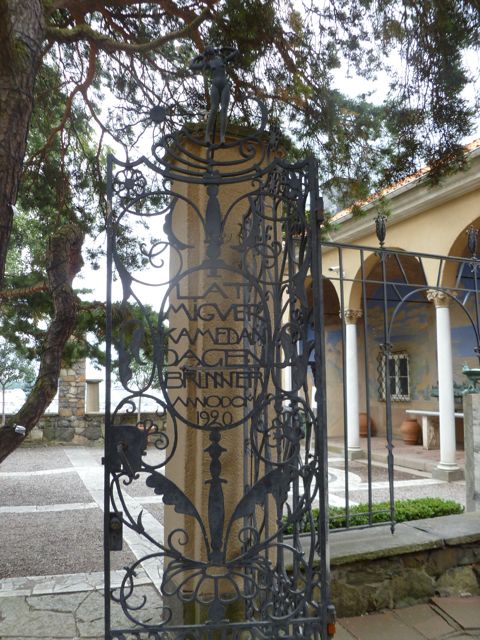
The graphic in the upper corner of the sponge replicates the design of this wrought-iron gate on the grounds. My Swedish is too rusty (okay; nonexistent) to translate the words, but I can read the date well enough: 1920.

This was right around the time the intricate, floral Art Nouveau aesthetic was starting to segue into the clean, machine-made design motifs of Art Deco.

Milles' bronze sculptures are monumental, mostly figures taken from Greek, Roman, and Christian mythology. On the grounds of Millesgarden, they are made even more imposing by their gravity-defying placement on tall, thin pedestals.

(For scale, see the tiny figures huddled at the low wall to the left, between the huge statue in the foreground, and the little spritz of water bubbling out of the fountain to its right? Those are actual people; that's how gigantic these sculptures are!)

Carl Milles' sculpture garden: monumental.
Each irregular paving stone in the terraces was placed by hand. Construction lasted for decades!

Austrian-born architect and textile designer, Josef Frank, who relocated to Sweden in the second half of his life, had a hand in some of the building on the Millesgarden grounds.

When we were there, the Millesgarden gallery was hosting an exhibition of Frank textiles, created by the Swedish design group,  Svenskt Tenn, with which Frank had a long association.

These are modern textiles based on Frank designs, shown alongside Franks' original watercolor sketches of each pattern. The colors are bold, the attitude playful, and the images abstract and amorphous, or wonderfully curvy, inspired by the fecund shapes of flowers, fruits, and leaves in nature.

Josef Frank: "Terrazzo."

Wall tapestries of Frank's designs were hung amid pieces of furniture  upholstered in these same patterns, ebulliently padded and poofy sofas, pillows, and chairs.

(Frank's dislike of hard, sharp corners is thought to have inspired Apple designer Jonathan Ive, a Frank fan, in his creation of the original blue iMac.)

I loved the designs for "Terrazzo," inspired by Italian mosaics. I also liked the starry, cloudlike silhouettes of "Zodiac," and a design based on images of historical sailing ships.

But for me, Best in Show was this whimsical riff on the classic bearskin rug (displayed only a couple of inches off the floor). The best thing about this life-sized accent piece is that it doesn't require the death of an actual animal to produce!

Oh, and the title of this piece? "Beast."


Saturday, August 20, 2016

AFTERGLOW

Okay, my opinion is not exactly impartial. But even I didn't expect to have so much fun at the premiere of Alias Hook last night at Louden Nelson Center!

I wasn't sure how I'd feel about Santa Cruz Parks & Rec Teen Theatre leaders Sara Jo Czarnecki and Darwin Garrett fooling around with my grown-up story for a cast of 12-17-year-olds.

But I was very impressed with the way they managed to telescope the book's action and themes in an early draft of the script they showed me.

And last night onstage, it came together with much more pizzazz than I could ever have hoped for!

There's a real thrill in seeing my characters brought to life before my eyes, not to mention hearing my jokes get laughs from the audience!  (Although, some of the biggest laughs were for funny lines that Sara and Darwin added.)

Sure, compromises were made. There's no flying, and no underwater merfolk community. The sexy Fairy Revels are replaced by a crew of cute flapper fairies doing the Charleston.

The racier aspects of James and Stella's relationship are eliminated (no doubt to the cheers of my readers over at the Republic of Goodreads, who are often shocked to find this is an adult fantasy, not written for kids). But Stella still indulges her fondness for wine!

And while James Hook's backstory is mostly cut out, the character of Proserpina, the voudon priestess who cursed him to eternal life in the Neverland, weaves in and out of the action, haunting him with his lifetime of mistakes.

There were other clever additions. I especially liked the moment when James, no longer able to play his beloved piano one-handed, rises from the bench, hand and hook moving over imaginary keys in the air, while the music playing in his head fills the auditorium.

Proud author with Aidan Brekka as Hook!
Most importantly, the heart of the story comes through intact — James Hook learning to give up the endless war games with Pan and extricate himself from the Neverland by finally growing up.

Much credit for this goes to Aidan Brekka for his brisk, commanding performance as James. He strikes just the right notes of sarcasm and despair. Sophia Alexander-Sidhom is poised and funny as Stella.

In the role of Pan (ironically played by a girl), Seyla Manzo is just as brash and bratty as she should be. And kudos to every single cast member, playing various pirates, fairies, Lost Boys and Indians, for making this show such a success.

After the show, Sara and Darwin presented me with this copy of the production's poster, signed by everyone in the cast! That was very, very cool, and I was also thrilled to meet a lot of the young actors down in front, afterwards. I said they were all great, and I meant it.

"Thank you for writing us!" They responded.

Seriously, I couldn't have had more fun!