"We could've written this!"
This refrain was often heard in our kitchen (usually over a glass of bubbly) when James and I came home after a movie and started analyzing where it had gone wrong.
Maybe there was a specific turning point in the narrative that shifted the whole story in the wrong direction. Maybe a character did something so inexplicably out-of-character that the whole thing lost its credibility.
But sometimes, as we went over plot points, themes and epiphanies, it seemed like the scriptwriter simply had not made the best use of all the elements that had already been set up and established in the storyline.
If this character had done this or that in the first quarter of the movie, we reasoned, then this exposition in the third quarter would make a lot more sense. Or this action that feels completely arbitrary might have been salvaged if it was done by a different character or from a different motivation. We often found everything needed to make the story work right there in its narrative bones, but it just hadn't been put together correctly.
After we'd figured out where it had gone wrong, and worked out the fix that could have saved it, it was time to clink those glasses. "Hey, we could've written this!"
I miss those critical download sessions, especially now that I'm grappling with my own busy fictional narrative that needs to be shaped into a coherent story. After my 187 years in journalism, I can still pretty much figure out what does or doesn't work in a movie. But I'm all at sea confronted with the unwieldy text of my own next book.
Among so many other metaphorical hats that my Art Boy wore around here, he was also my most trusted beta reader. If he didn't understand a plot point, even after the long-winded explanation in Chapter 21, or he questioned why a character said or did something peculiar, and my only defense was "because the author said so," I knew it was time to go back to the keyboard.
It was also at his urging that I started reading early drafts of my manuscripts out loud to him. Okay, he just didn't want to have to slog through all those pages in a box, himself, but it turned out to be great for me. If a word or sentence or passage felt clumsy in the mouth, or sounded tinny out loud, even to me, then out it went. Or, at least, it had to be finessed.
We were partners in my literary adventures, just like we were partners in everything else. Flying solo into new terrain still feels weird to me, but I just have to start viewing my own work through the lens of James' logical common sense and healthy skepticism.
Think of all those movies we saved, I tell myself.
We can write this!
(Top: A Book Is a Wondrous Thing, by James Aschbacher)
Adventures in writing with Lisa Jensen, Author, Columnist and Film Critic
Friday, May 29, 2020
Thursday, May 7, 2020
MAIN STREAM MOVIES
Regular readers will note that I prefer watching movies on a gigantic screen, the way God intended. In the future, no doubt, movies will be digitally implanted directly into our lobes, but at this historical moment, we are somewhere in-between. Move theaters are closed thanks to COVID-19, so we're stuck watching movies on our home screens. With a zillion options, some are more worthy than others, but here are a few titles I've notice popping up on streaming platforms that might be worth your time!
THE ASSISTANT Her new job as office assistant to a famous movie mogul ought to be a dream come true for a bright young college graduate with ambitions to produce her own movies. But it's a nightmare for the conflicted protagonist who discovers enabling her boss's sexual conquests is the unspoken part of her job description in this taut, claustrophobic and entirely effective drama from filmmaker Kitty Green. The focus of her story is not on predators or their victims, but on the system of silence and complicity that allows such misconduct to happen. Julia Garner has the pale, porcelain face of a Renaissance angel, darkening with visceral anxiety over the course of her workday. (R) 87 minutes. (***) (2020) (Amazon Prime)
THE HANDMAIDEN It may seem like an odd collaboration: bad-boy Korean filmmaker Chan-wook Park, famed for the violent male revenge melodrama Oldboy, and British author Sarah Waters, whose femme-centric erotic thrillers are set in the Dickensian underworld of Victorian London. But it turns out to be a surprisingly happy match-up in Park's Asian riff on Waters' novel Fingersmith. Filmmaker and source material are both edgy in complementary ways. Gorgeously shot and composed, audacious, and full of witty visual asides, it's a sly entertainment of sex, larceny, deception, double-crosses, and female liberation. (R) 144 minutes. In Korean and Japanese with English subtitles. (***1/2) (2016) (Amazon Prime)
THE LAST BLACK MAN IN SAN FRANCISCO This first feature from director Joe Talbot is remarkably assured and absorbing meditation on the mythology of the city's fabled past while its characters — two young black men born and raised in the city — reckon with the uncertainty of its present. As a semi-autobiographical version of himself, Jimmie Fails' character is obsessed with a stately Victorian-style house built by his grandfather that his family no longer possesses. Jonathan Majors offers poignant support as his best friend in this dreamy, splendidly composed mood piece about the search for home and identity in the rapidly evolving city they love. (R) 120 minutes. (***1/2) (2019) (Amazon Prime)
MILLIONS Money doesn't grow on trees, but it does fall out of the sky in this wonderful film from the ever-surprising Danny Boyle, about the comic misadventures of two young brothers in the working-class north of England when they find a mysterious suitcase stuffed with cold cash. Little Alex Eitel is terrific as the boy whose superheroes are the Catholic saints; he's up on all their biographical stats (birth, death, martyrdom), and they keep popping up in the story to help him figure out how to use the money to do good. Boyle's fresh, kinetic filmmaking style complements a touching story that's acute, funny, sophisticated, and full of imagination. Not a kids' film per se, this is a story told from a child's perspective that beguiles viewers of all ages (****) (PG) 97 minutes. (2005) (Disney Plus)
![]() |
| St. Peter (Alun Armstrong) (note keys and halo) instructs Alex Eitel in Millions |
Sunday, April 26, 2020
FREE BOOK!
![]() |
Here's my response to the global coronavirus shutdown; my "lost" second novel available in its entirety online — for free!
Now that we're all sheltering in place with time to spare, it's the perfect opportunity to revisit Tory Lightfoot and Jack Dance, protagonists of my first published novel The Witch From The Sea.
(Pirates! History! Romance! No Zombies!)
I always envisioned their story as a trilogy, and although the next two novels were never published in book form, they do exist.
So I've decided to bring Tory and Jack and their further post-pirate adventures in the tropical West Indies back into the public eye.
Borrowing a leaf from the Charles Dickens playbook, I posted the entire second novel in the trilogy, Runaways: A Tale of Jonkanoo, in serial chapters online.
![]() |
| Jonkanoo parade, Jamaica, 1838 |
Just doing my bit to provide a little escapism in these anxious times.
Nothing to join, nothing to buy, no passwords required. Just follow the links and enjoy!
Here's the Introduction to the story. (Find out just what the heck "Jonkanoo" means, anyway!)
PS: The entire novel is already up, as regular readers of this blog probably know (if you've ever scrolled all the way down to the murkiest depths of the right-hand menu). So feel free to binge away if you don't want to wait for my prompts!
(Above L: Runaways Frontispiece by moi.)
(Above R: Belisario 08, as shown on www.slaveryimages.org, sponsored by the Virginia Foundation for the Humanities and the University of Virginia Library)
Sunday, April 19, 2020
HOLD THAT (DEAD)LINE
After 40-odd years in journalism (some of them damned odd), I respect deadlines.
It's not that I grudgingly obey them, or that I've had to coach myself to accept them. I need them. I cling to them. They are the dangling carrot that propels my life forward.
Obviously, deadlines determine when I go see a movie (remember going to the movies?) in order to get my review in the paper. Sometimes, they influence which movie I see, depending on which showtimes are more favorable to making my deadline.
My entire week is orchestrated around seeing a movie on Friday, writing my review on Saturday, and sending the finished piece to my editor by Sunday afternoon — all to make my Monday morning deadline.
The entire book-publishing industry also runs on deadlines. They exist for turning in that first draft, for each new revision, for providing front and back matter, author photos, Q&A guidelines, PR material — everything depends on each successive deadline being met in a timely manner. Miss one, and the entire infrastructure stutters to a halt.
The habit has spread to every other part of my life. I pay bills according to which due date is looming next, and plan meals around which item in the fridge is most likely to rot if ignored much longer. I'm inspired to clean house when I know visitors are coming, and dress according to whatever events are going to take me out into the public eye.
But now all that's changed. The coronavirus pandemic has claimed yet another casualty: the deadline.
Five weeks into lockdown, and my schedule is completely out the window. Movie theaters are closed and I'm taking my yoga classes on Zoom, so I'm liberated from the task of having to actually go out in public. I don't drive any more, so I'm not even shopping; kind-hearted friends are picking up my groceries and bringing them to me. Some are intrepid enough to come in the house; others do a porch drop. Most days, the only one I interact with is my cat.
Did I say "liberated?" I'm in freefall. Without deadlines, where's my motivation?
The decline was gradual. First, I stopped strapping on what I call my ID bracelets every morning, vintage Celebracelets by Faye Augustine with my book titles spelled out in tiny silver alphabet-block beads. I never used to appear in public without them, but now . . .
Then, I stopped washing my hair every single morning, a big adjustment for someone as psycho about her hair as me. Maybe once or twice a week, if it doesn't look too hideous, I dare to let it go. Who's going to see me?
Some routines are still inviolate, in the absence of actual deadlines. I have to get dinner on the table by 7 pm in time for Jeopardy, and cleared away at least by 8:30 to have time to read before bed. Monday night is still Pizza Night, without fail — but the rest of the week, all the days tend to run together.
I don't go out, so the clothes I wear in public (you know, the ones that are still intact) stay in the closet, while my comfort outfits (sweatshirts, jeans, pom-pom slippers) get worn all day. I still wash my clothes every Saturday — even though the loads are smaller — but I'm down to washing my sheets only every other week.
I used to make jokes about Miss Havisham — until she popped up in my mirror.
Meanwhile, my living space is showing signs of — let's call it benign neglect. If those discarded slippers are littering the stairs all day, or a cobweb the size of a volleyball net is hanging from the hallway ceiling, who's going to know?
I'm starting to feel like that tree that falls in the forest. Am I still a sloth if there's no one to see me?
(Cartoon by Mick Stevens)
(Helena Bonham-Carter as Miss Havisham, Great Expectatons, 2012)
It's not that I grudgingly obey them, or that I've had to coach myself to accept them. I need them. I cling to them. They are the dangling carrot that propels my life forward.
Obviously, deadlines determine when I go see a movie (remember going to the movies?) in order to get my review in the paper. Sometimes, they influence which movie I see, depending on which showtimes are more favorable to making my deadline.
My entire week is orchestrated around seeing a movie on Friday, writing my review on Saturday, and sending the finished piece to my editor by Sunday afternoon — all to make my Monday morning deadline.
The entire book-publishing industry also runs on deadlines. They exist for turning in that first draft, for each new revision, for providing front and back matter, author photos, Q&A guidelines, PR material — everything depends on each successive deadline being met in a timely manner. Miss one, and the entire infrastructure stutters to a halt.
The habit has spread to every other part of my life. I pay bills according to which due date is looming next, and plan meals around which item in the fridge is most likely to rot if ignored much longer. I'm inspired to clean house when I know visitors are coming, and dress according to whatever events are going to take me out into the public eye.
But now all that's changed. The coronavirus pandemic has claimed yet another casualty: the deadline.
Did I say "liberated?" I'm in freefall. Without deadlines, where's my motivation?
The decline was gradual. First, I stopped strapping on what I call my ID bracelets every morning, vintage Celebracelets by Faye Augustine with my book titles spelled out in tiny silver alphabet-block beads. I never used to appear in public without them, but now . . .
Then, I stopped washing my hair every single morning, a big adjustment for someone as psycho about her hair as me. Maybe once or twice a week, if it doesn't look too hideous, I dare to let it go. Who's going to see me?
Some routines are still inviolate, in the absence of actual deadlines. I have to get dinner on the table by 7 pm in time for Jeopardy, and cleared away at least by 8:30 to have time to read before bed. Monday night is still Pizza Night, without fail — but the rest of the week, all the days tend to run together.
I don't go out, so the clothes I wear in public (you know, the ones that are still intact) stay in the closet, while my comfort outfits (sweatshirts, jeans, pom-pom slippers) get worn all day. I still wash my clothes every Saturday — even though the loads are smaller — but I'm down to washing my sheets only every other week.
I used to make jokes about Miss Havisham — until she popped up in my mirror.
Meanwhile, my living space is showing signs of — let's call it benign neglect. If those discarded slippers are littering the stairs all day, or a cobweb the size of a volleyball net is hanging from the hallway ceiling, who's going to know?
I'm starting to feel like that tree that falls in the forest. Am I still a sloth if there's no one to see me?
(Cartoon by Mick Stevens)
(Helena Bonham-Carter as Miss Havisham, Great Expectatons, 2012)
Labels:
books,
coronavirus,
Good Times,
movies,
pizza,
Writing
Monday, April 6, 2020
THE IMPOSSIBLE MEME
Okay, we've all seen that meme: William Shakespeare wrote King Lear while under quarantine in London during the Bubonic plague.
The intention of circulating this (probably relatively true-ish) factoid, of course, is to make us all feel like a bunch of whining slackers. Want to feel even worse? Remember that Anne Frank wrote her famous Diary while hiding from the Nazis in a cramped attic in Amsterdam with her family of four and three other people. For two years.
The fruits of these labors, composed under impossibly stressful conditions, are inarguably masterpieces, Frank's Diary for its honesty, optimism and compassion, and Lear for its brilliant and enduring insights into the human condition.
So what are the rest of us waiting for? Now that we're all under house arrest, we have nothing but time.
But consider too that Lear is one of Shakespeare's darkest plays, in every respect. It's full of howling storms and furious rages, delusion, betrayal, calamity, madness, folly, treachery and despair. Hard not to see at least a psychological parallel between the work itself and the temper of the times in which it was written.
So, if I wanted to write something gloomy and despondent, this would be the perfect time to do it! Indeed, there would be no excuse not to spend these grey, wet, solitary days hammering away at the keyboard, grappling angst and uncertainty into something (hopefully) brilliant.
But, no. Me, I'm trying to cobble together a lighthearted romantic comedy, full of magic and music, for Young Adult readers.
It's the second book (although not a sequel) stipulated in my contract for Beast: A Tale of Love and Revenge, which was already too dark and perverse for the general YA readership, according to my Goodreads reviews. This new one is supposed to be fun and upbeat.
Hah.
Not that it couldn't be done. When the Nazis marched in to occupy France, the celebrated novelist Colette was 67 (the same age I am now), and nearly bedridden. Yet, holed up in her Paris apartment for the duration, she produced Gigi. Harking back to France's golden age of the Belle Epoque, it told the sunny tale of a spirited teenage girl raised to be a courtesan who defies expectations by charming her designated client into marriage.
And I have no doubt that if my Art Boy was still here to shelter in place with me, he would have turned out three or four of his magical paintings by now, and sketches for many more.
His work was always blissfully untarnished by everyday reality; his ideas bubbled up directly out of the teeming wellspring of his own imagination — flying fish, joyous dancing figures, pink bunnies and all. How he would have relished the excuse to stay home and paint all day!
I'm trying to view this temporary (we hope) dystopian sojourn as an opportunity to be relished. That's what James would do! And who knows? If the present coronavirus lockdown stretches on for another eternity, a deep plunge into the imagination might be just the escape I need.
(Above: Act of Creation, James Aschbacher)
The intention of circulating this (probably relatively true-ish) factoid, of course, is to make us all feel like a bunch of whining slackers. Want to feel even worse? Remember that Anne Frank wrote her famous Diary while hiding from the Nazis in a cramped attic in Amsterdam with her family of four and three other people. For two years.
The fruits of these labors, composed under impossibly stressful conditions, are inarguably masterpieces, Frank's Diary for its honesty, optimism and compassion, and Lear for its brilliant and enduring insights into the human condition.
So what are the rest of us waiting for? Now that we're all under house arrest, we have nothing but time.
But consider too that Lear is one of Shakespeare's darkest plays, in every respect. It's full of howling storms and furious rages, delusion, betrayal, calamity, madness, folly, treachery and despair. Hard not to see at least a psychological parallel between the work itself and the temper of the times in which it was written.
![]() |
| Colette: Holed up like a Parisienne |
So, if I wanted to write something gloomy and despondent, this would be the perfect time to do it! Indeed, there would be no excuse not to spend these grey, wet, solitary days hammering away at the keyboard, grappling angst and uncertainty into something (hopefully) brilliant.
But, no. Me, I'm trying to cobble together a lighthearted romantic comedy, full of magic and music, for Young Adult readers.
It's the second book (although not a sequel) stipulated in my contract for Beast: A Tale of Love and Revenge, which was already too dark and perverse for the general YA readership, according to my Goodreads reviews. This new one is supposed to be fun and upbeat.
Hah.
![]() |
| Blissfully untarnished by reality |
And I have no doubt that if my Art Boy was still here to shelter in place with me, he would have turned out three or four of his magical paintings by now, and sketches for many more.
His work was always blissfully untarnished by everyday reality; his ideas bubbled up directly out of the teeming wellspring of his own imagination — flying fish, joyous dancing figures, pink bunnies and all. How he would have relished the excuse to stay home and paint all day!
I'm trying to view this temporary (we hope) dystopian sojourn as an opportunity to be relished. That's what James would do! And who knows? If the present coronavirus lockdown stretches on for another eternity, a deep plunge into the imagination might be just the escape I need.
(Above: Act of Creation, James Aschbacher)
Sunday, March 29, 2020
I WAKE UP STREAMING
It’s official — I’m superfluous!
With theaters shuttered (temporarily, we hope) due to the coronavirus, and no one going out to the movies, nobody needs to know my opinion of a movie they can stream from the privacy of their own couch.
It’s not like they have to pay to get in!
So my column in Good Times is suspended until further notice. If we, as a town/state/country/planet ever achieve normalcy again, I expect to be back on the job. But who knows how long that will take?
In the meantime, I encourage housebound film fans to boldly go into the archives of the product-delivery service of your choice — Netflix, Amazon, Hulu, You Tube, Viewmaster, whatever — and explore titles from over a century of vibrant cinema.
Silent films, for instance, are astonishingly creative! Check out anything from about the turn of the last century through the 1920s, back when the pictures were first learning to move, and they were making it all up as they went along. You’ll be amazed at their ingenuity!
Then there are Errol Flynn swashbucklers, Film Noir, MGM musicals, French New Wave, Hitchcock, Fellini, the Marx Brothers; they’re all out there, just waiting to be discovered.
Be adventurous! If something doesn’t grab you in the first 20 minutes, dial up something else. There won’t be a quiz, and there isn’t anywhere else you have to be.
Me, I’ve been catching up on movies I missed the first time around. Last night it was The Greatest Showman, an utterly berserk fantasia on the imagined life if P. T. Barnum, staged like a Hollywood musical.
Famed 19th Century opera diva Jenny Lind (Rebecca Ferguson) sings a power ballad. Keala Settle as the Bearded Lady leads a chorus of Barnum’s circus sideshow attractions in an empowering Millennial-style anthem.
But, hey, in the midst of it all, there’s Hugh Jackman in the top hat and ringmaster’s outfit, singing and dancing up a storm. I’m home alone — I have to have some fun!
Sure, I’d much rather be watching movies the way God intended, on a great big theater screen. And I fervently hope all this enforced home viewing doesn’t signal the end of the neighborhood movie house down the road, by giving viewers one more excuse not to interact with each other in public.
Still, there’s something to be said for watching a move with a cat on your lap — as long as she doesn’t mind the occasional popcorn kernel bouncing off her head.
Sunday, March 22, 2020
FEMME NOIR
Mayhem, matriarchy merge in entertaining Blow the Man Down
With movie theaters temporarily closed and everybody cocooning at home, the best way to see a movie right now is curled up on your own sofa. Okay, lots of us have already figured this out — there's no dress code and no assigned seating. Even better, with the rise of so many streaming platforms, there's plenty of new product out there too, just waiting to be discovered.
Just released last week on Amazon Prime, Blow The Man Down is an entertaining New England chowder of black comedy, femme-noir, and mood-making from co-writers and directors Bridget Savage Cole and Danielle Krudy. Set in a small fishing village on the rugged Maine seacoast (is there any other kind?), the story revolves around family legacies, deep, dark secrets, and fish — lots of fish, chopped, sliced, and pan-fried.
As the story begins, most of the denizens of Easter Cove are filling up the parlor of the Connelly sisters after the funeral of their beloved and respected mother, Mary Margaret. Now, responsible older sister, Priscilla (Sophie Lowe), and her more rebellious sibling, Mary Beth (Morgan Saylor) — who's had to postpone her freshman year at college — have to figure out how to maintain the family home and fish market on their own.
After the sisters' private spat away from their guests — Mary Beth is so done with Easter Cove and wants out — the younger sib stomps off to the local bar, just looking for trouble. She finds it. But when the chips are down, it turns out, a girl's best friend is her sister.
![]() |
| Saylor and Lowe: Bundle up |
This subtle tweaking of gender expectations gives the movie its own lively viewpoint. As the entwined dramas and dueling mysteries play out, one character notes, "Lotta people underestimate young women. That's why they get away with a lot." Women of all ages emerge as a collective force to be reckoned with in this diverting fish story of a movie.
(Read more)
Tuesday, March 17, 2020
KIDDING AROUND
Children vs, grown-ups in modern Peter Pan remix Wendy
Benh Zeitlin has very specific ideas about how a movie should look and feel, and what kind of story it tells. His first movie, the dreamy, impressionistic Beasts of the Southern Wild, explored themes of childhood resilience, the power of Nature, adult frailties, and community. All of which ideas resurface in his sophomore effort, Wendy.
As the title might imply, Wendy is the filmmaker's nod to the Peter Pan legend. It's a modern remix of the story of children who refuse to grow up, relocated to an uncharted island off the southern wild of America (it was shot largely in and around Louisiana bayou country), told not from the viewpoint of Peter, but from the little girl who, along with her two brothers, is caught up in his dream of eternal childhood.
Written by Zeitlin and his sister, Eliza Zeitlin, the movie stays grounded as much as possible in everyday reality — the kids' mom runs a diner at a whistle-stop on a freight train route; they hop a slow-moving train to "fly" away — kissed with a dash of magic realism. Their take on familiar Peter Pan tropes is often deftly done, from the fate of Lost Boys who outgrow Peter's tribe, to an eerie, unsettling origin story for Captain Hook.
But trying to shoehorn his unique sensibility into the existing structure of the Pan legend seems to dampen the audacious originality displayed in Zeitlin's earlier film. How well the story works may depend on whether or not you think the idea of never growing up is a good thing.
Young Wendy (Devin France) and her twin brothers, Douglas (Gage Naquin) and James (Gavin Naquin), have grown up in the diner run by their mama (Shay Walker). The train rattles by every night, and when they see a giggling figure scampering over the boxcar roofs one night, luring them to come away, they clamber on board.
He is Peter (Yashua Mack, a native of Antigua with a head of bouncy rasta dreads), who leads them to a mysterious volcanic island far out below the train trestle where he and his tribe of unsupervised children play all day long and never age.
(Read more)
Having tinkered so shamelessly with the dans macabre between Captain Hook and Peter Pan for my own purposes in Alias Hook, I'm always fascinated to see what others bring to the story. And it strikes me that, in the end, the Zeitlins make the same mistake as plenty of other recent Peter Pan retellers — promoting this half-baked notion that Hook should just let go of his grumpy adult perceptions and embrace the unalloyed joy of spending the rest of eternity playing pirates with a gang of mangy boys.
Hey, wouldn't that be fun?
Here's what my James Hook has to say about that:
It is my fate to be trapped here forever in a nightmare of childish fancy with that infernal, eternal boy.
Tuesday, March 10, 2020
COMEDY AND CONSEQUENCE
Austen's ferocious wit fuels savvy, stylish Emma
You never think of a Jane Austen novel as excoriating. Hers is a genteel world of flimsy, gossamer gowns, impeccable breeding, and humorous observation of delicate romantic complications, or so we believe.
But her fourth novel, Emma, while set in the same milieu of tasteful gentility, and written with Austen's familiar ironic asperity, also bristles with savage social satire on upper-class idleness and the damage their thoughtless antics inflict on the people in whose lives they meddle.
The new movie adaptation of Emma, combines a savvy script from Eleanor Catton with a scrupulously assembled visual narrative from music video director Autumn de Wilde, in her impressive feature debut.
It's a more overtly comic version of Austen than usual — a pack of boarding school girls march in and out of scenes like a flock of giggling birds; eyes dart from side to side, or pop wide open in elaborate double-takes; baleful servants perform increasing complex choreography in long-suffering silence on the periphery of the action.
But when the filmmakers zero in on the machinations of their heroine, Emma Woodhouse (Anya Taylor-Joy), they are unsparing in their critique of her folly.
The rich don't get much more idle than the Woodhouses, landed gentry with a country estate in the small village of Highbury. At 21, Emma has led a privileged life "with very little to vex her,” living with her widower father, Henry (the always welcome Bill Nighy).
Having just seen her former companion married off to an eligible widower to whom Emma had introduced her, Emma decides that arranging matches for others "is the greatest amusement in the world!" Although resistance to Emma's plans is never less than discreet (if utterly futile), we feel just how devastating the consequences can be for those unwillingly caught up in them.
Emma is not always likable in her wrong-headedness. But Taylor-Joy gradually earns our sympathy by giving Emma the grace to feel ashamed of her mistakes and outgrow them — especially after one of her attempted witticisms lands with such cruelty, it's as horrifying as any act of physical violence in Game Of Thrones.
Alexandra Byrne's outstanding costumes, male as well as female, are not only stunning to look at, their intricate layers — and the complicated ritual of getting in and out of them — also mirror the armor of social graces each character must assume every day in polite society. And Kave Quinn's lavish production design conveys just how well-heeled the Highbury 1% really is. Kudos all around for a very smart and stylish production.
(Read more)
You never think of a Jane Austen novel as excoriating. Hers is a genteel world of flimsy, gossamer gowns, impeccable breeding, and humorous observation of delicate romantic complications, or so we believe.
But her fourth novel, Emma, while set in the same milieu of tasteful gentility, and written with Austen's familiar ironic asperity, also bristles with savage social satire on upper-class idleness and the damage their thoughtless antics inflict on the people in whose lives they meddle.
The new movie adaptation of Emma, combines a savvy script from Eleanor Catton with a scrupulously assembled visual narrative from music video director Autumn de Wilde, in her impressive feature debut.
It's a more overtly comic version of Austen than usual — a pack of boarding school girls march in and out of scenes like a flock of giggling birds; eyes dart from side to side, or pop wide open in elaborate double-takes; baleful servants perform increasing complex choreography in long-suffering silence on the periphery of the action.
![]() |
| Taylor-Joy and Nighy: idle amusement |
The rich don't get much more idle than the Woodhouses, landed gentry with a country estate in the small village of Highbury. At 21, Emma has led a privileged life "with very little to vex her,” living with her widower father, Henry (the always welcome Bill Nighy).
Having just seen her former companion married off to an eligible widower to whom Emma had introduced her, Emma decides that arranging matches for others "is the greatest amusement in the world!" Although resistance to Emma's plans is never less than discreet (if utterly futile), we feel just how devastating the consequences can be for those unwillingly caught up in them.
Emma is not always likable in her wrong-headedness. But Taylor-Joy gradually earns our sympathy by giving Emma the grace to feel ashamed of her mistakes and outgrow them — especially after one of her attempted witticisms lands with such cruelty, it's as horrifying as any act of physical violence in Game Of Thrones.
![]() |
| De Wilde directs the well-heeled 1% |
(Read more)
Monday, March 2, 2020
THE LEGEND OF MONDAY NIGHT PIZZA
![]() |
| Pizza Boy to the rescue! |
When I first met James in his comic book store, back when dinosaurs roamed the earth, I had already been writing for Good Times for two years. Six months later when we moved in together, we only had one rule as we made up our freestyle new life: every Monday night, I had to do the (dreaded) Film Guide.
The Film Guide was the section in the paper that listed every movie theater in town, what new movies would be opening at each one that week, and all their showtimes. There was no iMDB in those days, so TV and newsprint ads were all I had to go on when it came to blurbing new titles.
But the gnarly part was getting those showtimes. Way before there were personal computers (certainly not in our house), let alone FAX machines, I had to call each theater manager on the phone and scribble down (usually in pencil) every single showtime for every single movie in the course of the week — daily schedule, weekend schedule, holiday matinees, midnight movies, the works. Then I typed them on a typewriter (look it up, kids) into my master list, three pages of hard copy I delivered by hand to the GT office first thing Tuesday morning, deadline day.
With me on the phone for hours, Mondays were a little hectic around our house, especially at dinner time. One theater manager in particular never decided what he was going to play on any given week, until he knew what everybody else had booked. Some nights, I wouldn't get off the damn phone before 8 pm — by which time, I was In. No. Mood.
![]() |
| The yeast goes on: why mess with a good thing? |
But trust my Sweetie to step into the breach! Even though he had not yet discovered the cooking gene within himself, he knew how to bake a frozen pizza. While I was stewing on the phone, he'd be in the kitchen chopping up real food — green onions, red peppers, black olives, mushrooms — and grating extra cheese.
His next move was to pop a tape into the VCR and record Jeopardy — my favorite way to chill — at 7 pm. As soon as I could finally hang up and finish typing, he would assemble his pizza, stick it in the oven, and pop a cork. (Okay, he usually didn't wait around for me for that part!)
Et Voila! Whenever I was finally ready to sit down and eat, we had hot pizza, cold bubbly, and Jeopardy! Pizza, champagne, and Jeopardy was our Monday night ritual for years — even after theaters started faxing their info to GT and I was liberated from the Film Guide. The tradition continued through the rest of our married life, and continues for me to this day. Why mess with a good thing?
It wasn't until years later that we started making our own pizzas from scratch. (Well, almost, thanks to Trader Joe's pizza dough balls.) I wouldn't have remembered how many years, except that I found the top photo above of our very first home-made pizza! It's dated November, 2003! Notice how shiny and silvery the pizza screen is. It's completely black now, untold thousands of pizzas later — and, yes, I still use it!
Sunday, February 23, 2020
TRIPLE TREAT
My love affair with Robin Hobb continues!
All three volumes in each of her trilogies are so closely linked with each other, I decided to stop reviewing the individual books, and wait until I finished all three. Reviewing one book at a time would be like writing a film review after only seeing one third of the movie!
So now, looking back with hindsight, I can say there are major changes for Fitz as the first book in the Tawny Man Trilogy, Fool’s Errand, begins, 15 years after the end of the Farseer Trilogy. At 35, Fitz is in retirement on a little plot of land, out of the limelight of Buckkeep, raising Hap, an orphan boy brought to him by itinerant minstrel and occasional bedmate, Starling. (I've never entirely trusted Starling!)
Soon enough, both former mentor, Chade, and the Fool, orbit back into his life, dragging Fitz into more courtly intrigue around the disappearance of Prince Dutiful — not Fitz's son, not exactly, but child of his body. (It's complicated.) Meanwhile, back in the realm, the entire Liveship Traders Trilogy has occurred in the intervening years, which will begin to impact the story of Fitz and Fool as this trilogy progresses.
Also of note, Fool is the tawny man in question, now passing himself off as the idle aristocrat Lord Golden, his coloring deepening, book by book, as his adventures are imprinted on his physical self and his ever-evolving psyche. Salted into the quest/adventure story arc is the wry comedy of Fitz (now calling himself Tom Badgerlock) passing himself off as Lord Golden's manservant as they surreptitiously search for Dutiful.
For all the political intrigue between the outcast Witted and the elite Skilled, and the lovely, heartbreaking exit of one of the series' most adored characters, it remains the evolution of Fitz's relationship with Fool that powers this endlessly compelling series.
Golden Fool is very much the second act in the Tawny Man Trilogy — all the plots are still simmering! And smack in the middle of it, a swirling eddy of characters and backstory from the Liveship Traders Trilogy begins to well up and seep into the story of Fitz and Fool. I was so excited! One suspicion confirmed, some questions answered, and even more intriguing questions raised. The dynamic between Fitz and Fool just keeps getting more intense —irresistibly so!
I read the Liveship books out of order, before I even started the first Fitz/Fool trilogy (Farseer), which I don't think was particularly detrimental to my enjoyment of either series. I was able to piece together a few key elements of the larger story as I went along.
But I am so glad I read the Liveship books before I started the Tawny Man Trilogy! It not only enriches the experience of reading each individual book, it sweeps the reader up in the thrilling scope of Hobb's imagination. Bit by tasty bit, the enormity of her Big Picture begins to take shape.
Okay, maybe Fool’s Fate, the third book in the Tawny Man Trilogy, is not the best book to read on a cold winter night, with our heroes slogging through impeccably rendered snow and ice across a glacier. Brrr . . .
But in the last two paragraphs of Chapter 29, you will find my favorite single scene of the whole series so far. I dare not provide any context, leaving it for intrepid readers to discover on their own.
Suffice it to say that from the depths of insurmountable despair, the reluctant Changer engineers the Best. Change. Ever. Damn the Prophecy. Damn Fate. Damn whatever may come next.
This is what love looks like. They are so pack!
Friday, February 14, 2020
SEA CHANGE
Heads up, Shakespeare fans! Our own Santa Cruz Shakespeare has announced its lineup for this year's summer festival season — and since it revolves around two of my favorite Shakespeare plays, I could not be more excited!
As in recent summers past, the season opener will be a non-Shakespearean offering, in this case A Flea In Her Ear, the classic French farce by Georges Feydeau, from the turn of the last century. This story of marital mistrust, miscommunication, mistaken identities and reconciliation gets a spanking new adaptation by David Ives (whose adaptation of Moliere's The Liar, back in 2015, was one of the funniest productions in the company's history).
Next up will be Twelfth Night, Shakespeare's lively comedy of romantic complications when a young woman shipwrecked on a foreign shore disguises herself as a young man to seek employment. Full of swift banter, unrequited passion, even a little swordplay, it's an adroit comedy of love, gender, and identity that never goes out of style.
![]() |
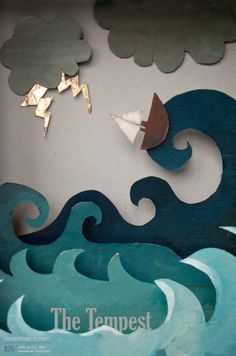
| Cut-out poster, Pratt Institute, 2012 |
The Tempest is categorized as a romance (what we might call in modern parlance magic realism), depending on magic, spells, and sorcery to advance the plot. With its scheming royals, drunken clowns, young lovers, antic, otherworldly spirits, disappearing banquets, and exuberant pageantry (as well as its undercurrent of slavery vs. freedom), its effects can be as subtle or spectacular as the playmakers can dream up.
One previous production of the play (in the company's former incarnation as Shakespeare Santa Cruz) used Balinese shadow puppets and masks to convey the magical elements. In another, director Danny Scheie riffed on Gilligan's Island, with uneven results, but also included a magnificent Ariel, Prospero's chief magical minion, soaring above the action on a trapeze.
![]() |
| The Tempest a la Balinese |
This will be the company's fourth production of The Tempest, and its first-ever helmed by Artistic Director Mike Ryan, making his debut in the director's chair. I can't wait! Especially since my next novel (under construction as we speak) imagines the further adventures of Prospero's daughter!
The recurring themes of shipwreck and redemption in this year's playlist prompts Ryan to adopt Sea Change as this season's unofficial title. As he explains it, “All of our 2020 plays center around someone (or someones) who are shipwrecked, sometimes physically, sometimes emotionally, and sometimes in both ways. These stories ask questions about how we find our way past disaster, impotence, and emotional stagnancy to find fertile ground in renewed joy, love, and hope.”
Finding our way past disaster through love and hope could not be more timely, in our current cultural climate. But, here, I'll let Mike tell you all about it himself!
Meanwhile — full steam ahead!
Tuesday, February 11, 2020
ADVENTURES IN DOLLYWOOD
Hey folks, it’s all over but the shouting (and the squeals of gobsmacked surprise) at this year’s Oscars.
Who knew that Parasite would sweep four of the six categories it was nominated in, including Best Director (okay, I knew that one!), Best Picture and Best International Film (quite a double-header), as well as Best Original Screenplay. (It only lost in the Production Design and Editing categories.)
Anyway, I’m awarding myself a half point for suggesting Parasite was the likeliest spoiler in the Original Screenplay category, bringing my total to 7 1/2 correct predictions out of 10.
But even though the hoopla has died down a bit, we all know it wouldn’t be the Oscars without — The Return of the (Dreaded) Oscar Barbies!
The Best Actress nominees in period costumes are always my favorites, so this year I decided not to even fool around with the nominees in boring modern dress. Renee Zellweger’s mid-60s Judy (as in Garland) is just retro enough to make the cut. Besides, I knew she was going to win, so I positioned her snuggling up to the man in gold himself.
She’s flanked by Saoirse Ronan, as budding writer, Jo, in Little Women, and Cynthia Erivo as intrepid Civil War slave liberator, Harriet.
And, yes, it’s all about the props!
Monday, February 3, 2020
ONCE UPON A TIME
Whose Hollywood fairy tales will come true at this year's Academy Awards?
You want Oscar predictions? How's this: when the Academy Awards are handed out this Sunday, winners in the top categories, excluding Actress nominees, will be white men.
Sure, some random female co-producers might swarm up in the production team accepting the Best Picture award. But (aside from Amy Pascal, solo producer of Little Women) you have to rappel down to the Screenplay categories before you even find another female nominee. And if not for this year's Korean phenom, Parasite, there would be few top nominees at all of any ethnicity other than Caucasian male.
(Just take a look at the posters for this year’s nine Best Picture nominees. Four feature only white men, two contain subordinate women alongside the men, and only two — Little Women (natch) and Marriage Story — feature women prominently. Only the Parasite poster bucks the trend, with three non-Caucasian men and two women — although one of the latter, appears to be, um, dead.)
Movies are being made from more diverse viewpoints — Us, Harriet, The Farewell, Hustlers, Waves — but the Academy has still hasn't gotten the memo. Can #OscarsSoWhiteMale be far off?
Of the movies that are anointed with Oscar nominations this year, the most hotly contested races are in the top two categories, Best Picture and Best Director. By contrast, all four acting winners are pretty much locked-in, after unanimous victories at all the other awards galas, so let's start with those.
SUPPORTING ACTRESS Laura Dern, Marriage Story. Dern has a lifetime of sterling film and TV credits, she plays a tough LA divorce lawyer (a character familiar to most Academy members), and is likely to score her first win with this, her third Oscar nomination.
SUPPORTING ACTOR Brad Pitt, Once Upon A Time . . . In Hollywood. Who doesn't want to see Pitt deliver another one of the droll acceptance speeches he's already given for this performance in this awards season?
BEST ACTRESS Renee Zellweger, Judy. Her gutsy performance is so close to the truth of Judy Garland's persona — wry wit, nervous mannerisms, and all — and Garland's effect on her fans, that we can forgive Zellweger doing her own singing. (Not bad, just not Judy.)
BEST ACTOR Joaquin Phoenix, Joker. He's already won everything else. It's chilling that Phoenix has tapped into some kind of grim cultural zeitgeist in this origin story of the pathetic failed comic fueled by psychosis to become the creepiest supervillain in the DC Comics universe. (Talk about art imitating life.) In a just, less traumatized world, the gold would go to Antonio Banderas in Pain And Glory, the performance of the year.
ORIGINAL SCREENPLAY Quentin Tarantino, Once Upon A Time . . . In Hollywood. Of the four nominees also contending for Best Picture, Hollywood has the snappiest dialogue, coupled with a typically nervy Tarantino wish-fulfillment plot. But don't rule out Parasite, whose savage satire on wealth and class makes it the likeliest spoiler of the evening.
ADAPTED SCREENPLAY Greta Gerwig, Little Women. In this notably guy-oriented field (The Irishman, The Two Popes, Joker, Jojo Rabbit), the Academy might offer Gerwig an olive branch after failing to nominate her for Best Director.
BEST DIRECTOR/BEST PICTURE These two categories used to be joined at the hip. But there have been recent upsets, now that there are so many more nominated films (nine, this year, each of which Academy voters are required to rate in order of preference), diffusing the likelihood of a clear front-runner. There are still only five directing nominees, however, encouraging more focused voting. (That's how Alfonso Cuaron won for directing Roma, last year, but the affable Green Book got more likes for Best Picture.)
So. Narrowing down the movies to the five with nominated directors, Todd Phillips' Joker is perceived as more of an actor's showcase, Hollywood will pick up its awards in other categories, and Martin Scorsese's The Irishman has lost its pre-season buzz. That leaves Sam Mendes' visually daring WWI epic, 1917 (constructed to look like it was shot in one, long take), and the upstart Parasite.
1917 is sure to win in the Best Cinematography category for veteran lensman Roger Deakins. Just as certainly, Parasite will clinch the prize for Best International (formerly Foreign Language) Feature. But here's my prediction for the main event:
BEST PICTURE 1917. BEST DIRECTOR Bong Joon Ho, Parasite.
(The 92nd Academy Awards will be broadcast live, Sunday, February 9, 5pm, on ABC. Tune in to find out just how wrong I can be!)
You want Oscar predictions? How's this: when the Academy Awards are handed out this Sunday, winners in the top categories, excluding Actress nominees, will be white men.
Sure, some random female co-producers might swarm up in the production team accepting the Best Picture award. But (aside from Amy Pascal, solo producer of Little Women) you have to rappel down to the Screenplay categories before you even find another female nominee. And if not for this year's Korean phenom, Parasite, there would be few top nominees at all of any ethnicity other than Caucasian male.
(Just take a look at the posters for this year’s nine Best Picture nominees. Four feature only white men, two contain subordinate women alongside the men, and only two — Little Women (natch) and Marriage Story — feature women prominently. Only the Parasite poster bucks the trend, with three non-Caucasian men and two women — although one of the latter, appears to be, um, dead.)
Movies are being made from more diverse viewpoints — Us, Harriet, The Farewell, Hustlers, Waves — but the Academy has still hasn't gotten the memo. Can #OscarsSoWhiteMale be far off?
Of the movies that are anointed with Oscar nominations this year, the most hotly contested races are in the top two categories, Best Picture and Best Director. By contrast, all four acting winners are pretty much locked-in, after unanimous victories at all the other awards galas, so let's start with those.
SUPPORTING ACTRESS Laura Dern, Marriage Story. Dern has a lifetime of sterling film and TV credits, she plays a tough LA divorce lawyer (a character familiar to most Academy members), and is likely to score her first win with this, her third Oscar nomination.
SUPPORTING ACTOR Brad Pitt, Once Upon A Time . . . In Hollywood. Who doesn't want to see Pitt deliver another one of the droll acceptance speeches he's already given for this performance in this awards season?
BEST ACTRESS Renee Zellweger, Judy. Her gutsy performance is so close to the truth of Judy Garland's persona — wry wit, nervous mannerisms, and all — and Garland's effect on her fans, that we can forgive Zellweger doing her own singing. (Not bad, just not Judy.)
BEST ACTOR Joaquin Phoenix, Joker. He's already won everything else. It's chilling that Phoenix has tapped into some kind of grim cultural zeitgeist in this origin story of the pathetic failed comic fueled by psychosis to become the creepiest supervillain in the DC Comics universe. (Talk about art imitating life.) In a just, less traumatized world, the gold would go to Antonio Banderas in Pain And Glory, the performance of the year.
ORIGINAL SCREENPLAY Quentin Tarantino, Once Upon A Time . . . In Hollywood. Of the four nominees also contending for Best Picture, Hollywood has the snappiest dialogue, coupled with a typically nervy Tarantino wish-fulfillment plot. But don't rule out Parasite, whose savage satire on wealth and class makes it the likeliest spoiler of the evening.
ADAPTED SCREENPLAY Greta Gerwig, Little Women. In this notably guy-oriented field (The Irishman, The Two Popes, Joker, Jojo Rabbit), the Academy might offer Gerwig an olive branch after failing to nominate her for Best Director.
BEST DIRECTOR/BEST PICTURE These two categories used to be joined at the hip. But there have been recent upsets, now that there are so many more nominated films (nine, this year, each of which Academy voters are required to rate in order of preference), diffusing the likelihood of a clear front-runner. There are still only five directing nominees, however, encouraging more focused voting. (That's how Alfonso Cuaron won for directing Roma, last year, but the affable Green Book got more likes for Best Picture.)
So. Narrowing down the movies to the five with nominated directors, Todd Phillips' Joker is perceived as more of an actor's showcase, Hollywood will pick up its awards in other categories, and Martin Scorsese's The Irishman has lost its pre-season buzz. That leaves Sam Mendes' visually daring WWI epic, 1917 (constructed to look like it was shot in one, long take), and the upstart Parasite.
![]() |
| All in the family: Parasite |
BEST PICTURE 1917. BEST DIRECTOR Bong Joon Ho, Parasite.
(The 92nd Academy Awards will be broadcast live, Sunday, February 9, 5pm, on ABC. Tune in to find out just how wrong I can be!)
Wednesday, January 22, 2020
ART TO GO
Calling all art fans!
You my be surprised to see the name James Aschbacher among the dozens of artists showing at Pajaro Valley Arts’ annual Take Aways: Art to Go show, opening this week. But when the gallery folks called me to ask if I had any of his work left that fit the criteria — small pieces priced at $300 or less — that I’d be willing to part with, I said yes!
James loved the whole idea of Take Aways. It was designed for people who had spent all of the previous month buying gifts for others, and might want to self-gift with some tasty little art item just for themselves. His work fit the bill, and he always made a few special pieces just for this show between the end of Open Studios in October and the year-end holidays.
I still have some of the last few pieces he made, and I am delighted that they are included in this year’s Take Aways exhibit. James made his work to be sold, to get their unique and joyful little spirits out into the world, and I am happy to spread the joy!
The exhibit opens Wednesday, January 22, and runs through March 8. Opening reception is Sunday, January 26, 2-4 pm.
(PS: This pic was taken at the 2018 Take Aways opening. A few of those paintings will be in the show, and I’m sure my Art Boy will be there in spirit!)
Sunday, January 12, 2020
IT'S A WRAP: MOVIES of 2019
For whatever reason, I fell behind on my movie viewing in 2019. I missed a lot of the most lauded mainstream movies, and I'm still too cranky to settle for watching big movies that barely appear in theaters at all on a home screen.
However, among the often small, weird and/or esoteric movies I did see, I have a few favorites. I wasn't quite able to stretch my list into the traditional Top Ten, and I certainly can't claim that these were in any way the Best of 2019. But if you're looking for something to stream on a cold winter's night, here are a few suggestions!
(FUN FACT: Five out of my eight favorites were directed by women! Wouldn't it be nice to see any of them appear among this year's Oscar nominees when they're announced tomorrow? If only. . . )
PAIN AND GLORY Pedro Almodovar directs this wonderful, semi-autobiographical movie about a Spanish filmmaker, looking back on his own life and career, and the people and events that shaped and inspired him. It's my favorite movie of the year! It may not look like much plot-wise, but the experience of watching this movie unfold onscreen is rapturous. And star Antonio Banderas is riveting in every single frame — you can’t take your eyes off him!
YESTERDAY In Danny Boyle's audacious what-if movie, The Beatles have disappeared from the collective memory of everyone except a struggling singer-songwriter named Jack (an engaging Himesh Patel) who finds himself poised to plunder their entire song catalogue. Detractors complain the movie misunderstands what made the Beatles popular, claiming as false “meritocracy” the notion that the songwriting would be hugely successful on its own, separated from the context of the band’s individual personalities and their era.
But here's why I (still) believe in Yesterday: It's not that the songs themselves are supposed to be the best ever written (although you could certainly make a case for some of them), but that there are so many of them, in so many diverse styles, that Jack is able to produce on the spot. The movie creates its own context for Jack’s popularity, a modest young person of color who produces song after song after song, seemingly out of the blue. That’s how he captures the public imagination — in much the same way the working-class lads from industrial Liverpool did with their cheeky attitude and funny haircuts, once upon a time. Boyle turns it into a sly morality play about fame, honor, and sacrifice, with a 4/4 beat and a larky sense of fun.
HARRIET Maybe the times have finally caught up to the amazing life of Harriet Tubman, a real-life superhero who fought for justice and won major victories in her lifelong battle to end slavery in the American South. An escaped slave herself, she led many others to freedom in the North, via the Underground Railroad, armed with little more than raw courage, and a flintlock pistol. Filmmaker Kasi Lemmons explores the woman behind the historical footnote, played with bristly moral conviction by Cynthia Erivo.
SWORD OF TRUST An aging hipster confronts the dark heart of extreme Southern yahooism in Lynn Shelton's very funny culture-clash comedy. Marc Maron is all dry wit and scruffy sarcasm as a pawn shop owner tasked to sell a Civil War sword that supposedly "proves" the Confederacy won the war. The twisty little surprises of the plot are delicious to discover along the way, and the sharp, funny conversations (largely improvised) had me laughing out loud.
THE MUSTANG Director Laure de Clermont-Tonnerre spins a tale of wild horses, regret, and redemption set in a high-security prison complex out in the middle of the Nevada desert. As part of their rehab, certain inmates are chosen to break and train wild mustangs for auction, and Matthias Schoenaerts delivers a towering, if taciturn performance (it's all in his eyes) as a prisoner who learns tenderness by bonding with his animal.
RAISE HELL: THE LIFE AND TIMES OF MOLLY IVINS Unusual enough as a progressive in Texas, smart, savagely funny political journalist Molly Ivins stood six feet tall. Not gifted with conventional proportions, she felt entitled to hold outsized opinions expressed with outsized gusto. There's plenty to laugh at — and get riled up over — in this Janice Engel documentary, celebrating all the hell Ivins raised as a pioneering woman in a world and profession run by good ole boys. Through documentary footage, Ivins tells much of her own story in her own words, and it's the particular zing of her voice that makes this movie so irresistible.
WAVES This gripping domestic drama from Trey Edward Shults encompasses euphoria, tragedy, and every conceivable emotion in between depicting a middle-class black family in South Florida sliding in and out of crisis. Some incidents seem torn from screaming headlines, yet Shults humanizes everything with careful attention to the personal relationships that guide our lives — between parents and children, between siblings, and between couples, both young and long-established.
LITTLE WOMEN In her entertaining, feminist update of the beloved novel, filmmaker Greta Gerwig combines the adventures of Louisa May Alcott's fictional March sisters with the journey of Alcott herself in getting her story published. Through Alcott's surrogate, Jo (Saoirse Ronan, who is absolutely wonderful), Gerwig inserts the author's early writing career and her tribulations with her patronizing male publisher. Timothée Chalamet is coltish, handsome, and mischievous as Laurie, and if the elliptical time frame becomes confusing toward the end, the movie exudes exuberant and heartfelt goodwill, building to a satisfying girl-power crescendo that surely would have pleased Alcott herself.
Labels:
Almodovar,
Antonio Banderas,
Cynthia Erivo,
Danny Boyle,
Greta Gerwig,
Harriet,
Kasi Lemmons,
Little Women,
Lynn Shelton,
Marc Maron,
Matthias Schoenaerts,
Molly Ivins,
movies,
Pain And Glory,
Saoirse Ronan
Sunday, December 29, 2019
MY LOST YEAR
![]() |
| "What's Next?" by James Aschbacher |
2019 was like that for me.
My five days at Dominican, and the aftermath, spread over the next two weeks (grab bars in the shower, walkers, rollators, PT, etc), petty much wiped out all my good intentions for the new year. After losing that first month, I feel like I was never able to catch up.
Each new season took me by surprise. Celebrations and holidays raced by, barely blips on my internal radar. By the time it finally stopped raining, it was summer. The next thing I knew, Halloween decorations were going up. Christmas? Hah! Despite the mailing list of 100 recipients that Art Boy and I honed over the years, I didn't send out one single card. If he had a grave, my sweetie would be spinning in it. This is not the way he would have done things!
Where did the time go? Where did I go? I still have no idea. This has been my lost year.
Since I haven't racked up anything in the way of accomplishments to point to over the last 12 months, I have to start looking at the old year from a new perspective. Let's not think of it as slacking. Let's say instead that I've been incubating. Temporarily diverted out of the mainstream of life, I've been in a holding pattern, taking take stock of where I am. And, what's more important, with the new year looming — what comes next?
It's like I've spent 2019 wrapped up in a chrysalis, waiting to see who or what will emerge on the other side.
![]() |
| What's incubating inside that chrysalis? |
It's clear that somebody has to take over the reins of this life, and, sadly, there's no one to do it but me, a daunting prospect without my co-pilot. Did I say co-pilot? Oh, please. James was not only the driver, he built the coach, groomed the horses, and paved the road. I was just the passenger. The idea of moving up into the driver's seat now, by myself, is one I greet with a resounding gulp.
So I have to hope that whoever is incubating inside this chrysalis is up to the task. I can't let another whole year slip through my grasp while I sit on the sidelines, fretting. The past is prologue, as Shakespeare says in The Tempest, and I'm looking forward to the next act. It's got to be an improvement over the last one!
Let's hope I can get a grip in 2020. No more excuses!
(Above right: Little Love Bugs, by James Aschbacher)
Friday, November 29, 2019
SOUVENIR
Looky what I found clearing off some bookshelves the other day. Fat Freddy’s Cat was a spinoff from one of the most fabled underground comix of the ’70s, The Fabulous Furry Freak Brothers.
Why am I hanging on to this relic of hippie nostalgia? It's a souvenir of the day I met my future.
One day in the spring of 1977, I walked into a comic book store with a couple of friends and a stack of silk-screened posters we’d made for the recent Spring Fair. I didn’t know from comics, but we wanted to sell our leftover posters on consignment, and the recently-opened Atlantis Fantasyworld had posters on its walls.
I can’t remember what came of that transaction; my friend, the comic collector, was handling the business end of the deal with one of the owners, Joe. But I didn’t want to look like a deadbeat, so I wandered around the shop and picked up this copy of Fat Freddy’s Cat, which I bought from the other owner — Jim.
We chatted for a few minutes over my big purchase, and that was the end of that — or so I thought.
Little did I know that a couple of months later, the Star Wars juggernaut was about to hit Santa Cruz. My publisher at Good Times told me if I could find a photo, he’d run my review as a cover story.
(Back then, GT was only 12 pages long, so a cover story meant the text of the review was actually printed on the cover! Not buried on page 6 with the ads for The Broken Egg, Cymbaline’s and The Good Fruit Company.)
The photo was the catch. It’s not like we could just dial up iMDB. (This was long before computers were invented; we were practically chiseling the paper onto slate tablets, like The Flintstones.) But I had seen some movie stills on the wall at — you guessed it — Atlantis Fantasyworld.
Joe was off at lunch the day I went back. But Jim was happy to stop filing comics for a few minutes to help me out. There was no one else in the store. We talked for an hour.
I never did get that still. (Turns out the only ones he had on the wall were from vintage ’50s monster movies.)
But I did get my cover story — my counterpart at the Sentinel took pity on a newbie and gave me one of his Star Wars stills — which gave me another excuse to visit Atlantis for another chat, the day the story was published, and then — well, you get the idea!
So when I happened upon Fat Freddy’s Cat, the discovery was bittersweet — but mostly sweet.
I notice it’s Book #1, and practically in mint condition (except for some fading on the spine), as it’s been mostly untouched by human hands all these yeas. I wonder if it’s worth anything — I’d have to ask Joe.
But it’s priceless to me.
Why am I hanging on to this relic of hippie nostalgia? It's a souvenir of the day I met my future.
One day in the spring of 1977, I walked into a comic book store with a couple of friends and a stack of silk-screened posters we’d made for the recent Spring Fair. I didn’t know from comics, but we wanted to sell our leftover posters on consignment, and the recently-opened Atlantis Fantasyworld had posters on its walls.
I can’t remember what came of that transaction; my friend, the comic collector, was handling the business end of the deal with one of the owners, Joe. But I didn’t want to look like a deadbeat, so I wandered around the shop and picked up this copy of Fat Freddy’s Cat, which I bought from the other owner — Jim.
![]() | ||
| She sells silk screens at the Spring Fair |
Little did I know that a couple of months later, the Star Wars juggernaut was about to hit Santa Cruz. My publisher at Good Times told me if I could find a photo, he’d run my review as a cover story.
(Back then, GT was only 12 pages long, so a cover story meant the text of the review was actually printed on the cover! Not buried on page 6 with the ads for The Broken Egg, Cymbaline’s and The Good Fruit Company.)
The photo was the catch. It’s not like we could just dial up iMDB. (This was long before computers were invented; we were practically chiseling the paper onto slate tablets, like The Flintstones.) But I had seen some movie stills on the wall at — you guessed it — Atlantis Fantasyworld.
![]() |
| Comics convert: me & my future |
I never did get that still. (Turns out the only ones he had on the wall were from vintage ’50s monster movies.)
But I did get my cover story — my counterpart at the Sentinel took pity on a newbie and gave me one of his Star Wars stills — which gave me another excuse to visit Atlantis for another chat, the day the story was published, and then — well, you get the idea!
So when I happened upon Fat Freddy’s Cat, the discovery was bittersweet — but mostly sweet.
I notice it’s Book #1, and practically in mint condition (except for some fading on the spine), as it’s been mostly untouched by human hands all these yeas. I wonder if it’s worth anything — I’d have to ask Joe.
But it’s priceless to me.
Subscribe to:
Posts (Atom)