Tuesday, April 23, 2013

GOOD IMPRESSIONS

Luscious Renoir is a painting come to life


For everyone who's ever wished they could stroll right into the middle of a lush, sun-drenched Impressionist painting by Pierre-Auguste Renoir, the French film Renoir is the next best thing.

Filmed on location in the south of France, where Renoir lived and painted in the last twenty years of his life, Gilles Bourdos' visually intoxicating film is alive with the extraordinary light and vibrant colors of both the natural world and the robust female forms that distinguish the painter's most beloved work.

True, the storyline rarely rises above Art Bio 101, but it doesn't have to, when every frame of film is such a living, breathing homage to the maestro's work.

 In 1915, the elderly Renoir (Michel Bouquet) has retired to a farmhouse in the verdant countryside above the French Riviera.

So arthritic, he needs gauze tied around his gnarled hands to support the paint brush, and assistants to mix the colors, he is attended by half a dozen competent women—maids who began as models, and vice-versa—who do all the heavy lifting. Literally, they carry the painter in his wheelchair from the farmhouse up the hill to his painting atelier every day; they also do all the cooking and housekeeping for "the Boss."

Along comes Andree (Christa Theret), a pert young redhead with a pearlescent complexion and a modern attitude, to pose for the Boss. Soon, the painter's son, Jean (Vincent Rottiers)—beloved by all the household women—comes home from World War I to convalesce after being wounded at the Front. As blasé as Jean usually is about his father's nude models, the provocative Andree gradually lights a fire under Renoir fils as well.

Father-son dynamics, the suppressed rivalries, resentments, and regrets of family life, erotic young love, and the eternal conflict between the beauty of life and the ugly insanity of warfare are all tossed into the simmering cassoulet of the plot.

Factor in some lovely life-sized women, exquisite fabrics, and voluptuous food, and you have a recipe for one tantalizing visual feast. (Read more in this week's Good Times)

Friday, April 19, 2013

IT'S A (BOOK) WRAP

File this one under Way Cool!

My wonderful book designer over at Snowbooks, Anna Torborg, just sent me this e-file of the wraparound front and back cover of my new novel, Alias Hook.

In the publishing biz, they call this a "full flat." And, as Anna reminds me, on the finished book (at the printer's, as we speak), the yellow bits will be shiny gold foil and the white script letters will be embossed.

I've already rhapsodized over the front cover design. But this is my first look at the back cover—complete with jacket quotes, for which I bow down in extreme gratitude to my intrepid blurbists, Laurie King, Broos Campbell, and C. C. Humphreys. (Ed. note: you folks rock!)


Pub date is May 1 in the UK. But you can pre-order a copy for $US online at The Book Depository (with free shipping worldwide).

Color me stoked!

Thursday, April 18, 2013

WONDER CON

You could never accuse filmmaker and master craftsman Terrence Malick of oversaturating the marketplace. There's never been any less than a five-year interval between the six films he's made in the last 40 years (and usually much longer)—until now. Hot on the sprockets of The Tree of Life, from 2011, comes Malick's latest, To The Wonder. And now we know once and for all why he should never, ever be rushed.

To the Wonder plays like a series of outtakes from the previous film. Once again, there is a young woman with lots of hair (Olga Kurylenko) given to twirling round and round bathed in sunlight, often with lengths of windblown sheer chiffon billowing across her face.

Once again, she is partnered by a stoic male presence (Ben Affleck), who, although less dangerous than Brad Pitt's father/husband in Tree of Life, gives every appearance of being quite the killjoy. Yet again, they are stranded together somewhere out on the lone prair-ee (in this case, suburban Oklahoma), trying and mostly failing to sync up with each other.

It's as if Malick didn't have time to invent new characters, so decided instead to recycle the same elemental female vs. uptight male dynamics from the last film. It's meant to be an impressionistic tone poem about the ebb and flow of love, I get it, but these cardboard figures in a landscape we know or care nothing about seem incapable of so strong an emotion.

(It's up to the stirring music of Henryk Gorecki and Arvo Part to provide any emotional context.) (Read more)

I still say Malick's 2005 film, The New World, was the best movie of its decade. But in that tale of English Puritan settlers and Native American tribal societies encountering each other for the first time in the first European colony in Virginia, the chaotic impressionism and interior monologue devices worked brilliantly. With two cultures unable to communicate with each other verbally, the viewer was plunged into the eerie strangeness of first contact, exactly as the people involved must have experienced it—sensory, frightening, rapturous and exalted.

In a modern context, like To the Wonder, when characters stubbornly refuse to talk to each other? Not so much. Such a disappointment.

Sunday, April 14, 2013

WRITE FIRST...

Once, I heard a very wise author dispense some sound advice about writing historical fiction: "Write the story first, and do the research later."

No, she wasn't advocating blissful ignorance. Of course, you don't want to set a story in a time and place you know absolutely nothing about, but if you didn't have at least a nodding acquaintance with your era, you wouldn't be inspired to write about it in the first place.

The gist of her argument was that you need to get your story down in a headlong rush—dramatic highlights, pivotal encounters, the shape and scope of the plot—before distracting yourself with the details. It won't be perfect; the first draft never is, but you can seed in the facts later. First you have to tell yourself the story.

But start out with the research, and chances are you'll be overwhelmed. Maybe diving into the history is so much fun, it eclipses everything else. Maybe events in the historical record don't play out quite the way you imagined, or contradict your ideas. Maybe the sheer enormity of research material starts to make your puny story seem insignificant by comparison, or the massive accumulation of detail starts to knead your tidy little idea into a gigantic, amorphous, Blob-like thing as you try to fit them all in.

In any case, your story as originally envisioned might get completely lost. Or you may become too paralyzed to write it at all.

My current WIP is the third installment of a trilogy, so I'm already familiar with the period, in a general way. And my characters are eager to jump on the page and start interacting. The writing goes pretty fast until I get bogged down in details about, say, the textile trade in Leeds, or the patent theatre system in Georgian London, things I don't seem to know off the top of my head. Things that may only be important for a scene or even a sentence or two.

So now, in the interest of progress, I leave a parenthetical note to myself in the text, along with a companion note in a separate doc of Stuff to Look Up. I write in the mornings, so if I have time in the afternoon, I might devote an hour to poring through info on these very particular subjects.

But if not, I'll get to them all later, after the first draft is done. The main thing now is to find out where the story is going; once that's done, making adjustments to accommodate the details will be far less daunting.

So when that first, elusive phantom of a story wavers into your brain, type first and ask questions later.

Tuesday, April 9, 2013

MEMORIAL DAY

This was the Santa Cruz Beach Bandstand, July, 1987.

And that's me interviewing the late Annette Funicello, along with Frankie Avalon, who were in town to promote their retro-beach party movie, Back To the Beach. They were both charming and professional, answering questions that they must have already answered a dozen times that day as if they'd never heard them before.

Annette was particularly kind when this young reporter's lips got stuck to her teeth in mid-sentence in the fierce, drying winds up on the Bandstand! (It may be sunny, but notice Annette's fur wrap, brrr…) She was a very gracious class act.

...And still more from the annals of Brenda Starr, Girl Reporter…

The great Les Blank was the subject of one of my very first (and almost last) interviews. He did not exactly regale a reporter with stories; serious and self-possessed, his answers tended to be one syllable or less and to-the-point. I was completely intimidated.

But that was his approach. He didn't tell you what to think or feel about his films, they just had to be experienced…and what an experience they were!

Burden of Dreams about Werner Herzog's obsessive quest to film Fitzcarraldo in the wilds of Peru may have been his highest-profile doc. But my favorite is probably Always For Pleasure in which the various crews from rival wards in New Orleans vie with each other to create the most extravagant Mardi Gras floats and costumes. It was shown around town at venues like the old Sash Mill Cinema & Cafe or The Good Fruit Company, where there was always a pot of red beans and rice simmering away in the kitchen, to get the audience in the proper mood.

Unlike his friend and cohort, Herzog, Les Blank never inserted himself into his docs; he let his subjects tell their own stories. He leaves a legacy of distinctive films that celebrate the intersection of food, music, and culture along the most fascinating back roads of Life.

Tuesday, April 2, 2013

OPPOSITES ATTRACT

Love vs. gravity in charming, but implausible sci-fi romance 'Upside Down'

If Upside Down were in print, it would be an outline, not a complete novel. The grand sweep of the story is there, the big, climactic scenes are all plotted out exactly where they should be, and marvelous, fanciful, poetic images decorate key passages.

What's missing from Juan Solanas' ambitious, interplanetary sci-fi romance are the details—the solid conceptual underpinning that would make it all plausible, and a final polish on the dialogue that would bring the characters and their unique story to life.

In an alternative solar system, two unnamed planets are locked in an eternal pas de deux. They are so close together, the landscape of each planet is visible hovering in the sky above the other, but the opposing gravitational forces keep the inhabitants of each planet firmly rooted to their home world. Although at certain high altitudes, the twin worlds almost touch, intermingling between those "Up top" and those "Below" is strictly verboten by law and custom.

A rigorous caste system has developed between the sophisticated, high-tech Up Worlders and their counterparts Below—which is basically a windswept slum.
But  Down World boy, Adam (Jim Sturgess), and Up World girl, Eden (Kirsten Dunst), are teenagers in love. They've figured out a system of ropes and weights allowing them to defy law and gravity to spend stolen time together.


(In one of many charming visual moments, Eden attaches herself to the underside of a jutting crag, like a bat, obeying the gravity of her own planet, to stay put long enough for Adam to kiss her.) (Read more)


I so wanted to give this movie an extra star for sheer audacity, but I just couldn't do it. It has so many lovely images and ideas, but the science is iffy, a best, and so much of the dialogue sounds made-up on the spot (and not in a good way). Still, sci-fi fans may want to check it out just for the cool visuals.

(Oh, and btw, if they every make a movie of Paul McCartney's life story, Jim Sturgess is ready for his close-up.)

Monday, April 1, 2013

ALIAS HOOK ALERT

Hey, kids, today begins the countdown to the publication of my new novel, Alias Hook, in the UK! One month from today, May 1st, my novel will be available from the intrepid small press, Snowbooks, at bookstores across the UK and online.

(Over at The Book Depository, you can pre-order it for $US, with free shipping worldwide.)

Alias Hook presents an alternative view of Peter Pan and the Neverland from the caustic perspective of Captain James Hook, it's prisoner. When a grown woman from a very different era dreams herself to the Neverland in defiance of the boy's rules, the stage is set for a time-traveling love story about male and female, love and war, and the delicate art of growing up.

Laurie King calls Alias Hook a "rich and darkly humorous tale of a man trapped in a child's nightmare. Jensen ably explores the power of storytelling, the cruelty of imagination, and the redemptive possibilities of love. A delicious and thought-provoking read."

Thanks, Laurie!

For the story so far, read about my inspiration for writing the novel, get a sneak preview of my map of Neverland, and catch up with my illustrated History of Captain Hook on stage, screen, and on the page.

I'm so excited about this book, I've even created an Alias Hook Facebook page. (Not easy for a card-carrying Luddite like moi.) For more info, cool illustrations, and updates, check it out!

Saturday, March 30, 2013

WELCOME QUEEN ALICE

"And what is the use of a book," thought Alice, "without pictures or conversations?"

I agree with Lewis Carroll's intrepid heroine. Over at Red Room, when writers were recently asked to name our favorite children's adventure, I found I was looking for lots of action, funny, interesting talk, and wonderful images—whether on the page or conjured in the mind's eye.

I suppose I'm expected to cite Peter Pan, since I've just written a novel about Captain Hook, but I've already written a blog about my longtime flirtation with Hook.

I'm also a big fan of The Wizard of Oz, but while I had well-thumbed copies of several Oz books, as a kid, I was more bedazzled by the MGM movie shown on TV every year. Indeed, I wrote a streamlined version of the movie script (in pencil, on lined Jiffy notebook paper) for my 6th Grade class, casting my classmates in all the roles. (Sadly, this epic was never produced, but when my teacher saw it, she promoted me to director of our class play, The Magic Fishbone.)

And I adore all the Harry Potter books, of course, although for this challenge I assumed they wanted us to write about books we read and loved as actual children.

Which brings me back to Alice, the plucky little English girl who enters the gaping maw of chaos and yet maintains her aplomb, eager for fun and adventure, yet ready to speak common sense to silliness at every turn.

Alice's Adventures in Wonderland is great fun, but my favorite Alice book is the sequel, Through the Looking Glass.

The narrative is a classic quest structure, a giant living chess game in which Alice begins as a lowly pawn and travels across many odd terrains in several moves to become a queen—encountering Humpty Dumpty (deluding himself that all the king's horses and men will protect him from any future mishap), the sweetly befuddled old White Knight, and the imperious Red Queen along the way. Not to mention the two epic poems, "The Walrus and the Carpenter," and the irresistible "Jabberwocky!"

Through it all, she is kind and helpful to those who are kind and helpful to her, thoughtful when given a variety of very weird things to ponder, and always ready for an argument when a thing makes no sense—which is most of the time.

We were so enamored of this book as kids that my brother and I used to travel all around our yard, acting out our favorite scenes. I even made this diorama of Alice climbing through a saran-wrap "looking glass" in the 5th Grade (borrowing some of the furniture from Barbie's Dream House.)

The text also provides me with two of my all-time favorite quotes, which I am eager to fling into any conversation to this day.

"It takes all the running you can do to keep in the same place," says the Red Queen. "If you want to get somewhere else, you must run twice as fast as that." What harried, modern multi-tasker can't identify with that?
And this from Humpty Dumpty, which his practically become my writing mantra: "When I use a word, it means just what I choose it to mean—neither more nor less." Amen!

Friday, March 29, 2013

WILD THINGS

Just in time for the end of Women's History Month comes Sally Potter's thoughtful and involving Ginger & Rosa. Very much a "woman's movie," with its emotional, relationship-driven storyline, it also has a distinct historical setting—London in 1962, during the Cuban Missile Crisis—as the backdrop before which its two teenage protagonists struggle to come of age. And while the plot may seem a bit far-fetched at times, there's something so touching about the authenticity of these young female voices and their nameless, formless yearning that will speak to anyone who has ever been a 17-year-old girl.

Potter is a highly original filmmaker who can be extremely great (her first feature was the brilliant Orlando) or pretty awful (her experimental Tango Lesson and Yes both self-destructed). With Ginger & Rosa, she is mostly great in getting to the heart of a simple, but potent story about teenage girlfriends, mothers and daughters, and fathers and daughters, and all the ways those delicate balances can be tipped, one way or another, during the perilous dance of growing up.


Ginger (the remarkable Elle Fanning) and Rosa (an affecting Alice Englert) have been best friends since their mothers gave birth to them at the same time in the same London hospital. They practice kissing and smoking together, shrink their jeans sitting in the same bathtub, make out with the occasional, anonymous boy, and do wild-girl things like hitchhike to the seaside for a day of illicit hanging out.

The unsupervised Rosa (her single mom cleans houses) is more advanced; aspiring poet Ginger gets more friction at home from her frustrated, stay-at-home mom, Natalie (Christina Hendricks), and her professor dad, Roland (Alessandro Nivola).

Invoking the Cuban Missile Crisis as a metaphor for the end of the world fits nicely into Potter's storytelling scheme. In fact, Ginger's world is about to end—the world of childhood, innocence, and absolute trust. (Read more in this week's Good Times)

Okay, so nobody wore this long, hippie hair in 1962—it was the era of the bouffant and the beehive. But otherwise, in emotional terms, this movie is right on!

Tuesday, March 26, 2013

GLEN TIDINGS

Get ready to pray for a fog-free summer this year, when Shakespeare Santa Cruz presents its first ever all-outdoor summer season.

Traditionally, one, if not more, of the SSC summer productions in repertoire is mounted indoors, in the Mainstage Theatre. But in this pared down, 2013 season, all three of the plays (including the Fringe offering) will be performed outside, under the redwoods, in the newly renovated Sinsheimer-Stanley Festival Glen.

Watching a live performance in the Glen has always been a high point of any SSC season, with the breeze whispering in the redwoods, above (or the moon and stars peeking through the foliage), and the "groundlings" sprawled at the foot of the stage, with their picnic baskets. Who doesn't have fond memories of the cast of Danny Scheie's original production of A Comedy of Errors  on their tandem bicycle pedaling down the aisles to the stage? Or Paul Whitworth in an earlier production of Henry IV Part I, arriving out of the forest on a motorcycle? Or J. Todd Adams as Puck back-flipping off the stage in A Midsummer Night's Dream?

It all harks back to Shakepeare's era, when going to the theatre was always an open-air experience. Elizabethan theatres were built in a round or octagonal shape (The Rose, sketched above, the Globe, The Curtain, The Swan), with thatched roofs over the tiers of boxes. But the stage in the middle and the groundling area before it were left uncovered; plays were performed in the daytime and they needed all the natural light they could get.

The SSC Festival Glen has living redwoods and banked seating instead of thatch and boxes. It also has a sophisticated electrical lighting system, which can make for some atmospheric, even spooky nighttime effects. (Remember the ghosts and witches popping up out of the foliage in an early production of Macbeth?)

And improvements are being made to the Glen as we speak. Scenic Designer Michael Ganio promises an expanded picnic area down front, and improved sightlines from all angles in the raked seating opposite the stage.

As to what's going on that stage this year, here's the scoop. This season's comedy will be The Taming Of the Shrew, Shakespeare's popular and funny, yet notoriously un-PC battle-of-the-sexes romp.

The drama will be Henry V, possibly the most heroic of Shakespeare's history plays; it's also the final installment of the "Henriad," the three-play cycle begun with Henry IV Part 1 in 2011, and Henry IV Part 2 last summer. Charles Pasternak will return to the role of Prince Hal/Henry.  Follow the links to catch up with the story so far!

Finally, this summer's Fringe production will be a new adaptation of Henry Fielding's 18th Century novel Tom Jones, the sexy coming-of-age tale of a good-hearted young foundling "born to be hanged," and a world of hungry women who have more creative ideas. The show will be staged in the Glen for two performances only by the entire cast of this year's SSC interns.

The SSC 2013 season plays July 23 to September 1. Tickets go on sale Tuesday, April 2. Visit the SSC website for ticket info, and watch a video where Artistic Director Marco Barricelli explains it all for you.

See you in the Glen!

Friday, March 22, 2013

FEMALE TROUBLE

Does it seem odd that women make up at least one half of the global population, yet we're given one measly month out of twelve to celebrate our contributions to history? You'll notice there's no designated Men's History Month. The rest of the year it's all about them.


There's nothing like getting assigned a special month of one's own to let you know just how marginalized you really are. Signaling out women, or African Americans, or gays, or any other alternative color, lifestyle, or nationality, to be recognized for one month suggests it's okay to forget about us the rest of the year. You got your month, what more do you want? Now let's pop a brewski and watch the damn game, already.


Attempts to designate special recognition, however well-intentioned, usually only serve to point out how far the designee still has to go to earn a little common respect. Once upon a time, the Academy Awards designated 1992 "The Year of the Woman" Batting clean-up at that year's ceremony was Clint Eastwood's grimly guy-friendly western Unforgiven, winner of four Oscars, including Best Picture, Best Director, Best Supporting Actor, and Best Revival Of A Macho Genre Previously Considered Stone Dead.

Its poster art features four craggy male faces and a large, prominent pistola clasped slightly below the Mendoza line. Nary a woman in sight.

Emma Thompson won the Best Actress award for Howard's End, beating out a fairly lackluster bunch of femmes, but the most talked-about female role of the year was actually played by a man—Jaye Davidson in The Crying Game. It's easy to fling about honorary designations, but the proof is in the pistola.


So while we're all busy celebrating Women's History—and getting all dewy-eyed over Susan B. Anthony, Clara Barton, and Amelia Earhart, all draped in nostalgia, now, like slightly mildewed lace, and safely tucked away in the past—let's spare a thought for a more sobering issue: Women's Present.


While so many women are running around trying to have it all, too many of our sisters at home and abroad are struggling to have any of it. A basic education. A living wage. The right to not get pregnant. (A tough one, since the new boss of the old church is—surprise!—same as the old boss when it comes to banning birth control.)

And this is a biggie—protection from rape, violence  and abuse. And freedom from the fear that a rape won't be considered "legitimate" enough to earn those protections.

At the recent UN Commission on the Status of Women, the Catholic Church played footsie with Iran & Russia in opposing tough global standards to prevent violence against women and children that didn't consider "religion, custom or tradition" a mitigating factor. (Tradition that does not recognize assault by a spouse or partner as "rape," for example.)

It took the US Congress a year and a half to grudgingly renew the Violence Against Women Act, protections that had already been in place for years and had been cited as reducing domestic violence  against women by as much as two-thirds. Meanwhile, an estimated 19,000 sexual assaults occur against women every year by their colleagues in the US military.

And even if a rape is considered legitimate enough to prosecute—even earn a conviction—that doesn't mean the rapist(s) won't earn more public sympathy than the victim. Last week, after two star players on the high school football team in Steubenville, OH, were convicted of raping an incapacitated teenage girl—repeatedly, while other teens recorded, tweeted, and texted the fun to share online—thinking people everywhere were outraged when a trio of CNN reporters, including two women, spent more air time maundering over the tragically blighted futures of these poor young men than on the fate of the girl whose life they had ruined.

The real tragedy is that none of these guys had any sort of internal moral compass—as men, as football players, as sons or brothers—that suggested that what they were doing was wrong at the time.

Here's a news flash: the mere fact of being female is not a legitimate excuse for getting raped, no mater how much you've drunk or what you are wearing.  Hey, she was walking around with a vagina—it's HER fault.

But what can you expect from a culture that considers Viagra a miracle drug and the Pill the work of Satan?


We may have a month to call our own, but we still have a long, long way to go, Baby.

Wednesday, March 20, 2013

DETOUR

Ideas vs melodrama in meandering beat odyssey 'On the Road'

There are about 45 minutes of a great movie in Walter Salles' adaptation of On the Road, the thinly fictionalized Jack Kerouac novel/memoir that helped define the beat generation of the early  1950s. These occur mainly at the beginning of the film, informed by the writer protagonist's narration, when the characters are first meeting up and hanging out, pinging ideas, dreams, and creative energy off of each other like random electrical charges, and in the final reflective scenes, when the writer lets go of his last illusions and starts hammering out Kerouac's spontaneous "bop" prose on the typewriter.

Which is to say the film is most effective when it sticks to Kerouac's voice, his thoughts and observations on the generation his book came to symbolize. In between these two poles of interest, however, lies the bulk of Salles' film, an increasingly frantic and pointless gallop back and forth across continental North America.

Yes, it successfully mimics the characters' headlong charge in pursuit of experience (i.e.: sex, drugs, jazz, and alcohol), but the more of the book's physical territory Salles covers—New York City, Nebraska, New Orleans, San Francisco, Denver, Mexico—the less focused the film's ideas become. Without the transformative power of Kerouac's words, we're stuck watching repetitive scenes of frenzied partying, which soon pales as a spectator sport.

Aspiring writer (and Kerouac alter-ego) Sal Paradise (Sam Riley) is living with his French-Canadian mother in New York City when mutual friends introduce him to wild man Dean Moriarty (Garrett Hedlund), a thinly-disguised version of Neal Cassady. Sam is quickly spellbound by Dean and his teenage bride, Marylou (Kristen Stewart), their freewheeling lifestyle of booze, dope, and sexual ménages. (Read complete review in this week's Good Times.)
The real-life Neal Cassady and children Jami, John and Cathy

Meanwhile, if you can't get enough of the beats, plan to attend the 7 pm show of On the Road at the Del Mar on opening night, this Friday night (March 22). After the show, there will be a Q&A with the real-life Neal Cassady's daughter and son, Jami Cassady Ratto and John Allen Cassady to discuss their father, the legacy of Kerouac's seminal book, and the influence of the Beat Generation on the Santa Cruz cultural landscape.

Check out the Nick/Del Mar website for the real lowdown.

Wednesday, March 13, 2013

WIZ-CRAFT

How did the Witch of the West get so wicked? If you know Gregory Maguire's novel, Wicked, or the stage musical, you know one version of the story of the magical land of Oz before Dorothy touched down in her flying house.

And now that the Disney corporation is buying up the rights to every fantasy property ever conceived (from the Pixar animation studio to the Star Wars universe), it's offering its own take on the material in the lavish Oz the Great and Powerful, which imagines the witches and the wizard of Oz in their heedless youth.

Directed by Sam Raimi from a script by Mitchell Kapner and David Lindsay-Abaire, the film is a prequel to L. Frank Baum's classic novel, and the beloved 1939 MGM movie. The mood and texture of Raimi's film, along with the extravagant production design by Robert Stromberg (Alice in Wonderland; Avatar) are heavily influenced by the earlier Oz film.

Despite some slow-going in the script, some dubious plotting, and an unresolved strain of moral ambiguity, the cheeky dash of Raimi's film, and its obvious affection for its source, makes for a mostly entertaining trip down the yellow brick road.

Once again, we begin in drab, black-and-white Kansas, ca. 1905. Oscar Diggs, called "Oz" (James Franco), is a stage magician in a cheesy traveling carnival. His tricks are all flash powder and illusion, but he delivers the thrills onstage; more fraudulent are his cavalier seductions of women, while his brusque treatment of his assistant (Zach Braff) suggests a mean streak. Being "good" doesn't interest Oz as much as his hopes to one day do something great.


Like Dorothy, he's swept up in a twister which deposits his hot air balloon in the vibrantly colored landscape of Oz. (Why does he have the same name as the magical place? Um, who knows, it's never explained.)

He's soon having close encounters with three sisters who are definitely not your father's witches: lovely Theodora (Mila Kunis), the equally ravishing Evanora (Rachel Weisz) and the radiant Glinda (Michelle Williams.)
Which witch becomes the woman scorned?
 The good vs great theme is hammered home a tad too often, and some long, talky stretches would require more than Franco's toothy grin to keep the audience invested. The various witches' powers tend to come and go at the whims of the plot (with Glinda often completely helpless).

And while it's interesting that a woman scorned by the feckless Oz becomes the heartless, green-skinned Fury we all know as the Wicked Witch, he never has to atone for it in any satisfying way. He may go over the rainbow, but his superficial character never takes enough of a journey.

Still, much is redeemed in the finale; instead of the expected bloody battle, Oz employs all the various non-warrior peoples of the land to build massive stage illusions to drive out the evildoers. There's a fun steampunk feel to the creation and manipulation of these devices. (Read complete review)

Tuesday, March 5, 2013

A GOOD BET

Aaron Walker and Jerry Lloyd
Performances highlight JTC Sam Shepard revival 'Horse Dreamer'

Now in its eighth season, Jewel Theatre Company continues to produce quality professional theatre right in the heart of downtown Santa Cruz. Spearheaded by Artistic Director Julie James, and making use of an ever-expanding gene pool of directors, performers and stage technicians, the company keeps local audiences intrigued with its lineup of often challenging, unexpected material.

Case in point is the new JTC production of Geography of a Horse Dreamer, a lesser-know drama by the iconic Sam Shepard that considers the plight of the artist in a world of commerce, the vagaries of luck, and (as usual, for Shepard) the spectacle of men behaving badly.

Geography of a Horse Dreamer was written in 1974, in the early middle of Shepard's long, prolific career, but still years before his most celebrated work like Buried Child and True West. It feels like a younger man's play, in that it's percolating with ideas, although its themes are not completely thought out or resolved. But it sparks with wit and energy, and offers opportunities for memorable performances and stagecraft, which this production exploits with JTC's usual panache. It's a short play staged with cohesion and clarity by director Nigel Sanders-Self, in which mobsters abduct a hapless young sheep rancher (Aaron Walker) with a "gift" for dreaming the winners of upcoming horse races.

In an excellent cast, Jerry Lloyd is flamboyantly great as the mob boss. But Jackson Wolffe steals the show as his enforcer, The Doctor, with his silky diction and malevolent aplomb. (Read more)

Monday, March 4, 2013

DANCE PARTY

Catch some serious aloha spirit at the Hula and Tahitian Dance Celebration this Sunday at Aptos High School Performing Arts Center. What's the occasion? It's the 15th anniversary of Santa Cruz's own, locally-grown Te Hau Nui School of Hawaiian and Tahitian Dance. (Te Hau Nui means "forever peaceful" in Tahitian.)

To celebrate, director and dance instructor Lorraine Kalei Kinnamon is staging an extravaganza of Polynesian culture and music. More than 50 dancers will perform traditional Hula, Tahitian and Maori dance. Live music will be provided by the Ho'omana Hawaiian Band, and beloved steel guitar virtuoso Patti Maxine, with traditional drumming by Kaili Francisco and friends jetting in from Kauai.

Kinnamon is promising "the biggest Polynesian event ever held in Santa Cruz" (except for the Outrigger canoe races, whose dance troupe, she points out, is not local). Her Te Hau Nui dancers, community members whose age range is roughly "5 to 55" have performed locally with the likes of Taj Mahal, and Kinnamon herself has toured the world performing Polynesian dance. Te Hau Nui classes are offered at the Santa Cruz Dance Company, Capitola Jade Street Community Center, UCSC, and the Tannery World Dance and Cultural Center.

There will be two complete performances on Sunday, March 10, 1-3 pm and again at 5-7 pm. Advance tickets are available at Pono Hawaiian Grill, Element Home Furnishings, and Island Home and Garden. Check out the Te Hau Nui website for more info, or visit their Facebook page.

Friday, March 1, 2013

MOVIES 4 WRITERS

In The Hours, there's a scene to gladden the heart of any writer. Nicole Kidman plays Virginia Woolf going into her study one morning in 1923 to begin a new novel. She snuggles into an armchair with her feet propped up on a footstool and a writing board across her lap, dips her pen in ink and begins scribbling in longhand on a sheet of paper—and the opening sentences of her landmark novel, Mrs. Dalloway, spring  complete onto the page, without false starts or corrections. Ah, we writers think, THIS is the way it's supposed to be!

I love movies about writers and writing, and since my friend Sally recently asked me what my favorite movies-about-writing were, now's my chance to share a few titles. There are enough of them out there to constitute a little movie sub-genre of their own—odd since the act of writing is one of the least cinematic activities you can imagine. Basically, you have a person staring a piece of paper (or a monitor) while all the action takes place inside the person's head. Not exactly what you'd call the money shot.   

Movies about writers fall into two categories: those based on novels or stories whose protagonists are thinly-disguised versions of the novelist, like My Brilliant Career, and those that purport to contain biographical information about real-life writers, like The Hours or Wilde. Of course, the more flamboyant a writer's personal life, the more likely it will be commemorated on film—and the less likely it is that the film will bother showing any actual writing. As Oscar Wilde in Wilde, Stephen Fry spends most of his screen time dallying with pretty boys and tossing off witticisms. We never catch him writing; we see him attending premieres of plays that are already a fait accompli.

We do see Joseph Fiennes' Will Shakespeare sit down to his writing desk in Shakespeare In Love. This charming bit of humbug is certainly no biography, but it contains a fanciful image of creative voodoo as Will rubs his palms together and spins around before sitting down to transform an unwieldy and much-rewritten, "Ethel, The Pirates Daughter" into "Romeo And Juliet." In the same spirit, that entertaining pastiche A Knight's Tale gives us Paul Bettany as Geoffrey Chaucer, not yet the mature author of The Canterbury Tales, but a young, vagabond huckster who proclaims, "I'm a writer. I give the truth…scope!"

But few writers will buy a ridiculous scene in Julia, in which 1930s playwright Lillian Hellman (Jane Fonda) is having such a bad day at the typewriter, she grabs the cumbersome machine and throws it out the window. Now, an old upright typewriter is no laptop; it takes a serious amount of strength and determination just to lift the damn thing up. In real life, a writer in a paroxysm of creative frustration might rip the page out of the machine and tear it into tiny pieces. But it's unlikely that a professional writer—in the middle of the Depression!—would throw the means of her livelihood out the window. It's a lame Hollywood ploy to make the boring craft of writing look exciting.

In my favorite writing movies reality and imagination merge in a fever of creative dementia. The fine Japanese film The Mystery Of Rampo imagines a story about real-life '30s mystery writer Edogawa Rampo. Obsessed by a woman whose life mirrors one of his thrillers, Rampo starts writing a new novel to shape her life, and the vibrant melodrama of his fiction plays off against his grey, repressive real life in eye-popping and spellbinding ways.

In adapting William S. Burroughs cult novel Naked Lunch, director David Cronenberg expands the delusional-junkie narrative into a wicked study of the nature of the creative urge: periodically, the writer protagonist's typewriters morph into large, wisecracking cockroaches with unholy appetites. (What writer can't identify with that?)

Probably my all-time favorite is the absorbing biographical memoir The Whole Wide World, about pulp writer Robert E. Howard, creator of Conan the Barbarian. In the film whenever Howard (played by Vincent D'Onofrio) is dreaming up one of his plots, or when anyone opens up a magazine to one of his stories, ambient noise fades out of the soundtrack replaced by the low grumble of distant prehistoric battle, the muted clank of swords, a fluting of ancient pipes and far-off screams. The viewer is lured to the very brink of chaos—the chaos of the unfettered imagination. For me, that's the closest the movies have ever come to portraying the authentic delirium of the writing life.

Tuesday, February 26, 2013

MUSE-WORTHY

Want to know what's going on in arts and entertainment in Santa Cruz County?

Time to consult The Muse.

No, not the fabulous British rock band, or some unsung Greek demi-goddess of Information. I'm talking about The Muse, the new website devoted to our very own simmering cultural scene. Operating under the aegis of the Santa Cruz Sentinel, it's sort of an upscale online version of that paper's weekly Guide, except that news, stories, interviews and images are posted a lot more often.

The Sentinel's crackerjack arts team is also the braintrust behind The Muse. Entertainment Editor, man about town, and Mr. First Nighter Wallace Baine certainly needs no introduction from me. Entertainment columnist and popular fashionista Christa Martin, and maverick visual arts champion Kirby Scudder round out the masthead.

If you want to catch up with a column of Wallace's, Christa's or Kirby's that you missed, they're all online at The Muse. If you want to know about art in local galleries, dance, music, and theater productions, great places to eat, or cool new books to read, this is a good place to look. New posts are going up daily, if not more often, so there's always something new on the site.

The get everyone in the mood for The Muse, the perpetrators are hosting a community launch party this Thursday, February 28, 6-9 pm at SCICA Gallery in the Tannery Arts Center. Scores of local arty types will be there, including Pipa Pinon and Rhan Wilson, Tammi Brown, Ukulele Dick and Jayme Kelly Curtis, Richard Stockton, Lori Rivera, Sven Davis, and, oh, just scads of others. All ready, willing and able to hang out with you, the arts-going public! Check it out!


(Above The Muse of Poetry, from the Beethoven Frieze, by Gustav Klimt.)

Saturday, February 23, 2013

THEY'RE BACK!

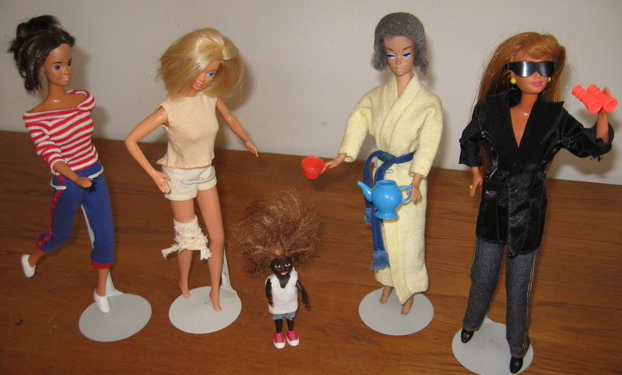
Academy Awards weekend can only mean one thing around my house: the Return of the (dreaded) Oscar Barbies! It's the time when I raid my eclectic collection of Barbie Dolls, vintage outfits, and scrap fabric to concoct my take on the Best Actress nominees.

But I can't say I'm much impressed by this year's nominees, Barbie-wise. None of them are in fantasy films or historical costumes dramas, so where's the fun in dressing them up? Jennifer Lawrence runs around in sweats most of the time in Silver Linings Playbook, Naomi Watts stumbles through the tropics in shorts and a bloody bandage in The Impossible, and Jessica Chastain searches the desert for Osama bin Laden in Zero Dark Thirty in a black fatigue jacket and black jeans. Bo-ring!

Of course, there are special challenges this year. Like 85-year-old Emmanuelle Riva in Amour. It's tough to de-glamorize a Barbie, since one of my rules is to never actually repaint a vintage doll, so this one's eye makeup remains intact. (Well, the character IS French.)

But she also has a molded head made for wearing wigs, so I borrowed some steel wool from Art Boy to give her sort of a grey pageboy, then I dressed her in a robe with a tea pot and cup to reference a key scene in the film at the breakfast table. (It's all about the props in Oscar Barbie World.)

But at least Ms. Riva is a full-size adult. What about vivacious little Quvenzhané Wallis in Beasts of the Southern Wild? (She was just 6 years old when the film was shot.)

Obviously, a regulation Barbie just wouldn't do. But the doll bin at the Thrift Center downtown yielded up this tiny little beauty—a steal at 31 cents!

Okay, she was originally white, but the no-painting rule doesn't apply to non-vintage dolls. She also has a gigantic mop of reddish hair that's sort of the correct color for the little girl in the film—I just had to lop off most of the length and tease up the rest.

Jennifer Lawrence/Barbie runs off with the gold


I crafted her tank top and cut-offs from fabric scraps and Scotch tape, but she came with her own sneakers!


Too bad there were no Best Actress nominees this year from Les Mis, or Lincoln, or Anna Karenina—or even The Hobbit! Those were costumes!

Oscar Barbie Heaven occurred for me back in 1999 when actresses from both Shakespeare In Love AND Elizabeth were nominated. For me it was a blessed orgy of Elizabethiana—puffed sleeves, hoop skirts and neck ruffs!


Oh, well, maybe next year...in the meantime, here's a flashback to some of my Oscar Barbies Past. Enjoy!

Friday, February 22, 2013

ANYTHING (STILL) GOES

I've already predicted Argo to win Best Picture, a film which (as Billy Crystal said about Driving Miss Daisy back in 1990), "apparently directed itself"—meaning director Ben Affleck wasn't nominated. (See my last Oscar post.)

So, who else is going to the Winner's Circle? Read on...

BEST DIRECTOR  Steven Spielberg, Lincoln. But anything goes in the biggest smackdown of the night, with DGA winner Affleck not even nominated. The only other DGA nominees in the race are Spielberg and Ang Lee (Life of Pi), and Spielberg's Americana epic seems likely to trump a tale of a boy and a tiger, however gorgeous. But it wouldn't be the first time Lee has snagged a directing Oscar for a film that didn't win Best Picture. (Remember the debacle of 2006, when Lee won for Brokeback Mountain, but the film lost to Crash?) Don't discount, Michael Haneke, whose Amour is nominated for both Best Foreign Film and Best Picture. But the strongest upset candidate may be David O. Russell, whose bipolar romantic comedy, Silver Linings Playbook, has also earned nominations in all four acting categories. Only Benh Zeitlin for his poetic and visionary Beasts of the Southern Wild lacks momentum.


BEST ACTOR Daniel Day-Lewis, Lincoln. The only sure thing this year is another win for Day-Lewis for his extraordinary alchemical transformation into Honest Abe. Bradley Cooper (Silver Linings Playbook), Hugh Jackman (Les Misérables), Denzel Washington (Flight) and Joaquin Phoenix (The Master) should all bask in the glory, but they shouldn't bother to write a speech.

BEST ACTRESS Jennifer Lawrence, Silver Linings Playbook. If Zero Dark Thirty had racked up more pre-season awards, or won Kathryn Bigelow a directing nomination, then it's star, Jessica Chastain, would be the favorite.

Chastain won a Golden Globe for Best Dramatic Actress, but the Globes are handed out in both comedy and drama categories, and the Globe winner for comedy, Lawrence, went on to snag the SAG award.

This category also includes the oldest and youngest acting nominees ever, 85-year-old Emmanuelle Riva (heartbreaking in Amour, and my favorite dark horse for an upset victory) and six-year-old Quvenzhané Wallis (Beasts of the Southern Wild), along with the excellent Naomi Watts in The Impossible.
BEST SUPPORTING ACTOR Tommy Lee Jones, Lincoln. He has strong competition from Golden Globe-winner Christoph Waltz (Django Unchained), the beloved Alan Arkin (Argo), and even Robert De Niro (Silver Linings Playbook). (Not so much Philip Seymour Hoffman in the overrated The Master.) But who doesn't love Jones as cantankerous anti-slavery advocate Thaddeus Stevens? He deserves an Oscar just for wearing that wig.


BEST SUPPORTING ACTRESS Anne Hathaway, Les Misérables. This one is virtually in the bag for Hathaway, who's cleaned up at the pre-Oscar awards, and is the only player in Les Miz who benefitted from the tricky device of shooting all the songs live, in one take. Sally Field (Lincoln), Jacki Weaver (Silver Linings), Helen Hunt (The Sessions), and Amy Adams (The Master) round out the category.

BEST of the REST Zero Dark Thirty may snag a Best Original Screenplay award for Mark Boal as it's biggest win of the night. Tony Kushner's script for Lincoln should edge out Chris Terrio (Argo) and Russell (Silver Linings) for Best Adapted Screenplay. I like Amour for Best Foreign Language Film (possible upset: Denmark's A Royal Affair), and Brave for Best Animated Feature. And expect the visually stunning Life of Pi to take home awards for Cinematography, Visual Effects and Production Design, while Anna Karenina sneaks off with the Costume prize.

Thursday, February 14, 2013

IDENTITY THEFT

Mood-altering pills power nifty Soderbergh thriller 'Side Effects'

Obfuscation is the name of the game in Steven Soderbergh's intricate new thriller Side Effects. The kind of tense drama for which the words "taut" and "twisty" are usually strung together in a sentence, this dark tale of sex, lies, and pharmaceutical skullduggery is a masterpiece of misdirection, artfully calibrated so that the viewer—like the film's overly medicated characters—often has no idea what may or may not be going on.

In retrospect, even the preview trailer (which has been playing around town for weeks) fools around with our expectations, so that the film itself is still full of nifty surprises.

Scripted by Scott Z. Burns (who also wrote Soderbergh's Contagion), the story revolves around Emily Taylor (Rooney Mara), a young woman battling depression. She was accustomed to living large back in Connecticut—parties, boat, mansion—until her yuppie stockbroker husband, Martin (Channing Tatum), went to prison for insider trading. Emily has gotten a job and moved to an apartment in New York City, but now that Martin is getting out again, she doesn't know how to cope.

Complaining that the anti-anxiety drugs she's been taking interfere with her work, her sleep, and her sex drive, she lands in a downtown hospital for observation when the car she's driving has a close encounter with a brick wall. Soderbergh is smart to use a supple actor like Jude Law in the pivotal role of Dr. Banks, the psychiatrist who happens to be making the rounds that day—who soon finds himself drawn into a sensational murder scandal that threatens his practice, his family, his career, and possibly even his own sanity. (Read more)

Tuesday, February 12, 2013

ANYTHING GOES

Taking another look at those Oscar nominees

Some years, predicting the Academy Awards winners is a sure thing; there's a clear front-runner that you just know is going to clean up, like The Artist last year, or The King's Speech the year before that.

But 2013 is not one of those years. Expect drama, when the stately odds-on favorite a month ago squares off against a plucky little upstart that's been raking in the pre-Oscar accolades. When an actress in a quirky comedy has a chance to edge out the female lead in a serious drama. In a directors' free-for-all where the winner of the prestigious Directors Guild of America award—who usually becomes the Oscar front-runner—wasn't even nominated by the Academy.

Needless to say, I've had to reconsider since I last popped off about this year's Oscar nominees.

So who do I think is the top contender for Best Picture? Argo. Serious.

A month ago, I'd have bet money on Steven Spielberg's Lincoln, a well-crafted drama about one of the most iconic figures in American history at the moment of his greatest triumph. But that was before Argo star-producer-director Ben Affleck and his fleet, witty real-life suspense caper started winning every other film award there is—Golden Globe, DGA, Producer's Guild, Screen Actor's Guild, even the British BAFTA.

Not once has Lincoln (or any other movie) wrested away the prize, and I see no reason to believe it will be any different at the Oscars. Indeed, since the Academy unaccountably failed to nominate DGA-winner Affleck in the Best Director category, Argo is liable to pull in even more of a sympathy vote. (As a co-producer, Affleck can still earn a statuette.)

To win without a directing nomination would be an epic upset in terms of Oscar history, but certainly not unprecedented. (Driving Miss Daisy managed this feat in 1989.) And don't forget, once upon a time, Affleck starred in Gigli, and there's nothing Hollywood loves more than a successfully rehabilitated image.

Meanwhile, since Affleck isn't nominated, any ideas on who WILL win Best Director???

Anyway, fasten your seatbelts for the Oscars, Sunday, February 24. It's going to be a bumpy night.

Sunday, February 10, 2013

ADVERBAL ABUSE

Maybe it's because I'm working on a novel about traveling theatrical players in post-Regency England, but I find myself struggling against the urge to stage-manage every move my characters make.

Of course, I'm writing all their dialogue; I'm the author, that's my job. (Although, as any writer will tell you, fictional characters often have their own ideas about what they'll say in any given situation. And they almost always know best!) But I'm getting very dictatorial about how those words should be delivered.

Most writing gurus will caution that adverbs are the work of Satan. But I spend a lot of time on these bon mots, and I want to make sure the reader hears the correct inflection for maximum impact. So I find my dialogue riddled with stage direction: my characters say things "wryly," "slyly," "stoically," "innocently," "eagerly," "miserably"...well, you get the idea.

Once in a while, an adverb hits the spot exactly right, but if I use them in every other sentence, it starts to look like a ping-pong match on the page. I don't advocate giving up adverbs altogether, but less is more; in the editing process, they are first up on the chopping block.

But even after I cut back on the dreaded adverbs, I find I still have a hard time letting my characters just, you know, speak. In early drafts, they rarely just "say" something. Instead, they "observe," "suggest," "echo," "falter," or—my personal favorite—"riposte."

I like to think I'm getting better, sifting through the chaff of these over-eager (over-anxious?) verbs to select those few that actually work. It's an uphill battle, but, luckily for me, cooler heads prevail. Most of the time, my characters let me know when they'll accept my micro-management, and when it's time for me to back off and trust the reader to get the point.