Thursday, March 23, 2017

FURRY TALE

How does Disney's new Beauty and the Beast shape up?

So, I went to see Disney's new Beauty and the Beast movie. Full disclosure: Disney's 1991 cartoon version, along with the dreamy 1946 Jean Cocteau black-and-white La Belle et la Bete, inspired me to write my own alternative take on the tale.

(Beast: A Tale of Love and Revenge, due out March 6, 2018. But you knew that!)

When it was first announced that Disney was doing a live-action remake, my first reaction was: why? They'd gotten everything so right the first time.

The obvious answer is the studio wants to wrest another megazillion bucks in profits out of tried-and-true properties to which the studio already owns the rights. (See other recent live-action remakes like Cinderella and Maleficent.)

But, the more pertinent question is: have they built a better Beast?

Belle and Gaston: no way, lout
Lavish, enormously-budgeted, gorgeously-produced, and directed by Bill Condon as a color-saturated movie musical extravaganza, the new version is much longer than the cartoon.

Additions have been made to the original script by Linda Woolverton (who does not get a credit this time around) by screenwriters Stephen Chbosky and Evan Spiliotopoulos.

There's some new backstory about the "Beauty" character, Belle (Emma Watson), her clockmaker father (Kevin Kline), and her absent mother. The pivotal moment when an insulted enchantress casts a spell to turn the spoiled, frivolous young prince into the fearsome Beast (Dan Stevens) is acted out as a prologue. And three new songs have been added to the Oscar-winning musical score by Alan Menken and the late Howard Ashman (new lyrics written by Tim Rice).

Otherwise, the story hews pretty closely to the (Disney) original. Belle is considered "odd" in her French country village because she reads books, dreams of adventure, and is in no hurry to get married — especially not to Gaston (Luke Evans), the narcissistic lout who means to make her his wife because "she's as pretty as me."

Beast and Belle: the way to a girl's heart
When her father is taken prisoner by a horrible Beast in a castle hidden in the woods, Belle demands to take her father's place. She doesn't know the fearsome Beast is a prince under a witch's curse. All his servants have been turned into household objects who befriend Belle, knowing that only a girl who falls in love with Beast and earns his love in return can break the curse on them all.

But there's a ticking clock: an enchanted rose preserved under a (ahem) bell jar. If Beast hasn't found love by the time the last petal drops, he and his people will be trapped in the curse for the rest of their lives.

Lumiere: candle power

Fractious with each other at first, Belle and Beast start to bond — especially when he invites her to visit his vast library. Meanwhile, the hateful Gaston makes plans to storm the castle, kill the beast, and "rescue" the girl.

There are many charming and funny interactions between Belle and the enchanted objects. I loved the staging of the song, "Be Our Guest," led by the irrepressible master-of-ceremonies, Lumiere, the candelabra (voice and motion-capture movements by Ewan McGregor), a show-stopping production number with its homages to Busby Berkeley-style overhead shots, and clever lyrics. ("No one's gloomy or complaining/When the flatware's entertaining").

I also found it rather touching toward the end when the enchanted objects gradually begin to lose the power to move and speak — ie: their human qualities —the more petals the rose drops.

Stevens aroar: don't mess with this Beast!
And this is a great-looking Beast, with his impressively long and upswept horns. (Although his mane looks a bit overly-groomed for my taste.) He's at his beastly best when he comes roaring out of the castle to fight off a pack of ravening wolves who attack Belle in the woods.

But it's hard to tell how much Stevens (late of Downton Abbey and currently on Legion) was able to contribute to the role. I experienced technical difficulties in some of his scenes with Belle. Long and medium shots, when the actors share the same physical space (Stevens in costume), are convincing enough. But at other times, Stevens doesn't get to use his own face to express the character's emotions because a decision was made to do Beast's face as a CGI effect.

Beast and Belle in the ballroom: sumptuous
Granted, it's a pretty amazing effect. But there are moments when Beast's expressions don't look as natural as Belle's when they are in close-up together. We sense a thin layer of physical and emotional disconnect between them — a problem when their relationship is meant to be the heart of the movie — so their romance never quite swept me up in its luscious grip, as it should have.

Another problem is that way to much of the story is devoted to the preening Gaston and his evil machinations. Don't get me wrong; I've loved Luke Evans ever since Tamara Drewe. But Gaston is a one-note character who sucks up too much precious screen time away from Belle and Beast — who could really use it to establish more rapport.

The showdown with Gaston in the finale is also a bit disappointing, with Beast leaping about like Spiderman from one castle spire to the next. Since when did his transformation into a beast come with web-slinging capabilities?

Still this is a sumptuous rendering of the classic fairy tale. But the essential question of why someone who falls in love with the noble Beast would be pleased when he suddenly turns into the standard-issue "handsome prince" in the end remains unresolved. What's so happily-ever-after about that?

This is the one thing that's always bugged me about this fairy tale. And it's an issue I'll be grappling with in my book!

Tuesday, March 21, 2017

KIDS TUFF

Dark side of childhood explored with humor, charm, in 'Zucchini'

Childhood is not for sissies.

Not all children are lucky enough to be raised by a loving family in a safe home. But marginalized kids get their own story in the eloquent and affecting animated feature, My Life as a Zucchini.

Directed by Claude Barras, this Oscar-nominated feature is a gently told tale that faces the dark side of childhood, yet offers the possibility of redemption through humor, friendship, and love.

A Swiss-born animation filmmaker who works in France, Barras based his story on an adult novel about kids in crisis written by Gilles Paris. Barras makes it more family-friendly by focusing on the solidarity of children together in a group home after the worst of their individual crises has passed.

The protagonist is a 9-year-old boy who prefers to be called "Zucchini," the nickname bestowed by his mother. She's an embittered single mom who drinks too much beer and neglects him, when she's not threatening to thrash him.

But she's the devil he knows, so when she is suddenly out of the picture (a surprisingly sobering event that happens in the first ten minutes), Zucchini is full of dread to suddenly be on his own.

A soft-hearted policeman named Raymond takes an interest in the boy and delivers him to a group home for kids who have lost their families. Their parents are drug addicts, or prison inmates, or mentally ill, or otherwise too incapacitated to care for them. One boy's mom has been deported. As another boy explains to Zucchini, "There's no one left to love us.

Plot complications include the arrival of a new girl, Camille, whose family history has been particularly awful. Yet her response is to treat the other kids with extra empathy, so she is soon beloved by all — especially the smitten Zucchini.

Despite its serious subtext, the film has a playful, often joyous tone as the kids explore their world and search for their places in it. Zucchini likes to draw, and his crayon portraits of the other kids, and their activities add an extra layer of humor and charm.


Other visual elements in the film are more subtle, but just as rich. The headmistress has paintings by Joan Miro and Paul Klee on the wall behind her desk. And it makes perfect sense that Camille — all too ready to escape the cocoon of her past — is shown reading Kafka's Metamorphosis.

Barras' technique is a sophisticated update of classic stop-motion clay animation. Each character is originally modeled in clay and painted, then an articulated puppet is made of each character, and coated in silicon, which is rendered to approximate the surface and texture of clay on camera. But expressive details like lips, eyelids, and eyebrows, in various positions, are molded in clay and painstakingly applied to be shot the old-fashioned way: one frame at a time.

It's a laborious process — especially for a small, independent studio like Barras' with only ten staff animators. But the result is obviously a labor of love.

Tuesday, March 7, 2017

BEAST(S) of the MONTH

In an alternate reality, my next novel, Beast: A Tale of Love and Revenge, would have been available at a bookstore near you as of today —March 7, 2017.

I'd be turning virtual cartwheels, and quaffing (actual) champagne!

But things don't always go according to plan. And nobody is more disappointed than me that my book has been delayed by one more year. We were on track for the original release date as recently as last August. But Circumstances intervened that (rather suddenly) required fundamental changes.

And now that those have been addressed, my new publication date is March 6 — 2018.

Yes, it seems like an eternity from now. (Especially for me, since I'm so eager for everyone to read it!) But to pass the time, I'm reviving my Beast of the Month countdown: for the next 12 months, I'll post images of some of my favorite Beasts from art, literature and the movies!

They won't be my Beast, exactly, but I hope they'll help get you in the mood!

First up: feast your eyes on this utterly gorgeous cover illustration for a 2014 children's book edition of La Belle et la Bete by French graphic artist David Sala. Pretty great, non?

The colors are clean and bold, the patterns are vivid, and I love the soft, almost Klimt-like details of the roses and faces. But best of all — what an impressive Beast!

See more of David Sala's La Belle et la Bete illustrations at his website.

And watch this space for future Beast updates!

Monday, March 6, 2017

WHO'S YOUR DADDY?

Hugh Jackman has been trapped in the Wolverine character since his star-making debut in the first X-Men movie back in 2000. The franchise has had its ups and downs since then, so when Jackman announced last year that the next Wolverine movie would be his last in the role, who could blame him?

The question was, could the filmmakers come up with an exit strategy for their indestructible mutant hero that obeyed the "rules" of the X-Men mythos and gave Jackman a satisfying send-off?

The answer, in Logan,  is yes and no. Yes, the storyline is plausible enough (well, as plausible as anything ever is in the X-Men universe). But satisfying? Not so much.

Previous franchise films have explored racism, xenophobia, intolerance, and whether or not social outsiders would choose to be "normal" if they could.

But Logan is one interrupted chase melodrama from first to last, with an endless parade of faceless bad guys to be dispatched in endlessly gruesome ways. (This is the first X-Men movie to get an 'R' rating, and it's not only for the F-bombs.)

Keen and Jackman: blood relations
Jackman is as watchable as ever. But in a film almost entirely unburdened by humor or emotional connections — two attributes at which he excels in other movies — his uber-brooding Logan (aka Wolverine) has nowhere to grow.

The movie was directed and co-scripted by James Mangold, who delivered a shot of adamantium to revive the series with The Wolverine in 2013 (after the fiasco of X-Men Origins: Wolverine).

This time out, Mangold seems to think he's keeping the focus on Logan's tormented psyche and (often inconvenient) moral decency, by introducing a new little mutant, Laura (Dafne Keen) — grown from Logan's own DNA, right down to the claws — for him to look after.

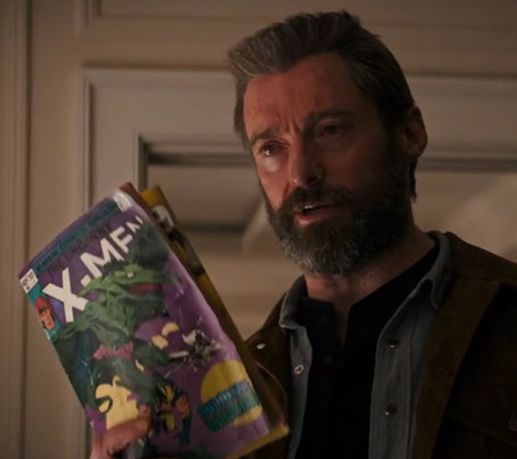
Art imitates Art imitating Life
They are soon besieged by an army of evildoers out to nab Laura before Logan can drive her cross-country to join her friends at a sanctuary for new mutant kids in Canada. In an interesting, self-referential twist, the place may only exist in the pages of the X-Men comics the kids all read.

But the constant, vicious fighting, as Logan faces off against carjackers, a lynch mob, convoys of sinister government ops, and his own genetically engineered doppelganger, leaves little time for further character development.

It would be helpful, story-wise, if father and daughter found another way to bond besides shredding bad guys. A moment when they compare nightmares (Laura dreams that "people hurt me," Logan, that "I hurt people") is a step in the right direction — but then, the script delivers another platoon of nasty adversaries to be decimated by the family that slays together.

Jackman is up to the task, as usual. But he, the character, and the fans might have wished for the saga to go out with a little less bang, and a lot more heart.

Sunday, March 5, 2017

HOORAY for DOLLYWOOD!


Just when you thought it was safe to open your browser . . .

It's all over but the shouting — and the blaming — after this year's Academy Awards kerfuffle over the wrong Best Picture envelope.  If it had been up to me after such a gauche faux pas, I'd have awarded co-Oscars to both Moonlight and La La Land.

Fortunately both movies won big in other categories. Damien Chazelle took the Best Director prize for La La Land, but writer-director Barry Jenkins also took home Oscar gold for the screenplay to Moonlight. And each movie picked up one of the four acting prizes. So all in all, a pretty even match-up (if you don't count all the production  and music awards La La Land racked up).

But even as confusion reigned at the podium on Oscar Night, there's one thing you can always count on at this time of year: I mean, of course, the Return of the Oscar Barbies — 2017 edition!

It was not a very inspiring group this year, but I did have fun making Emma Stone's tap shoes. And of course, vintage Barbie already looks like Jackie Kennedy with no help at all from me! She also comes complete with Jackie's wardrobe, right down to  the pillbox hat.

If only I'd seen Florence Foster Jenkins (I think I was in Sweden when it opened), I'd have known that the character — a would-be opera diva with a notoriously tin ear — dresses up like a Valkyrie and attempts to sing Wagner. Now THAT would have been a fun costume to make!

Meanewhile, visit  the full rogue's gallery of Oscar Barbies through the years!

Friday, February 24, 2017

THEN IS NOW

What reader hasn't wanted to live inside a book at some time or other? Joust with the Knights of the Round Table! Study magic at Hogwarts! Follow Alice down that rabbit hole! Wander the Highlands with Claire and Jamie *sigh*

But probably the one book nobody wants to actually live in is George Orwell's dystopian future classic 1984.  And yet, by some horrendous, impossible turn of events, that's the world we all find ourselves trapped in right now — especially in the last month.

Written in 1949,  Orwell's dark political satire was set in a totalitarian state of the future whose figurehead was Big Brother, but was really run by an elitist behind-the-scenes Party that was constantly rewriting history and reinventing language to conform with the party line.

From Orwell, we get the concept of "newspeak" (words rewritten to mean the opposite of their original intent), "thoughtcrimes" (individual thinking pursued and punished by the "Thought Police"), "doublethink" (unquestioning belief in two mutually exclusive ideas, also called "reality control"), and the "Ministry of Truth," whose entire function is to convince the people that lies are true.

It took a little longer than Orwell envisioned for his political prophecies to come true. But now that we're living in an Orwellian nightmare of "alternative facts," it all seems oh, so horribly relevant.

So relevant that the New York Times reports that sales of the novel have skyrocketed as of January of this year — and we all know what happened then.


But lucky Santa Cruzans won't have to go hunting down your dusty copies from sophomore English or trolling though used book shelves. Our very own Bookshop Santa Cruz is staging a reading of 1984, and you, the public, are invited.


Beginning at 10 am, Thursday, March 2, a rotating lineup of educators, activists, authors, and normal people from the community will read the novel aloud in 20-minute stretches. All of it. Cover to cover. Until the book is finished, whenever that may be.

Chairs will be set up in Bookshop's skylight room throughout the event; fall by and stay for a chapter or two, or stick around for the whole thing. It's up to you; this is a free country (so far).

While you're there, check out the table set up for people to write postcards with 1984 quotes to send to their elected officials.

This event is presented by Bookshop, the Wellstone Center in the Redwoods, and Wallace Baine. It's also the opening salvo in Bookshop's new Words To Act On program, to promote community, inspiration, critical thinking, and activism through books.

And, yes, yours truly will be one of the readers. I'm slotted for an evening shift, between 7 and 8 pm Thursday night. But whenever you drop in, it's sure to be a lively crowd, on either side of the mic!

(Top: 1984 cover art through the ages. From designKULTUR online.)

Tuesday, February 21, 2017

CINEMA SCOPE

Variety, diversity highlight this year's Oscar race

The Oscars are almost upon us; time for my yearly attempt to pretend I know anything about what Hollywood is thinking.

After last year's #OscarsSoWhite kerfuffle, every acting category this year features at least one person of color, and four out of the nine Best Picture nominees revolve around non-white bread protagonists. Let's hope it's not a temporary reaction, but a genuine trend toward equality and diversity. (Not to mention resistance to the current political climate.)

Meanwhile, let's take a look at who may (or may not) go home with the gold:

BEST PICTURE La La Land. Damien Chazelle's reinvented musical comedy is the one to beat, having already cleaned up at the pre-Oscar awards. Process out the four nominees that didn't win nods for their directors, and it's a five-movie race, including, Hacksaw Ridge, Arrival, Moonlight, and Manchester by the Sea. I'd be just as happy if either of these last two won, but I loved La La Land too.
And the nominees are . . .
BEST DIRECTOR Damien Chazelle, La La Land. He's already been anointed by the DGA, an almost sure-fire precursor to Oscar gold. If it were up to me, I'd split the award between Chazelle — for the sheer audacity of getting a movie musical made at all — and Barry Jenkins (Moonlight) for such a smart and precise look at contemporary black lives told in such an original, unexpected way.

Affleck: haunted
BEST ACTOR Casey Affleck, Manchester by the Sea. He doesn't say much, but he's the center of this haunting drama, and he's definitely got the buzz. Actors in comedies (much less musicals) are not taken as seriously as actors in dramas, so no gold for Ryan Gosling (La La Land) or the mighty Viggo Mortensen (Captain Fantastic).

Perennial contender and SAG  winner Denzel Washington (Fences) already has two Oscars; Andrew Garfield (Hacksaw Ridge) is the also-ran.

BEST ACTRESS Isabelle Huppert, Elle. Emma Stone (La La Land) may have some buzz, but she wasn't up against Huppert in any of the pre-season accolades she's won. (They split the Globes for Musical/Comedy and Drama).

Huppert: fearless
You don't find such gutsy roles for women of a certain age in US films, and Huppert's fearlessness onscreen and formidable career should sway Academy voters. (She'd get my vote.)

Natalie Portman (Jackie), Ruth Negga (Loving), and annual nominee Meryl Streep (Florence Foster Jenkins) round out the category.

BEST SUPPORTING ACTOR Mahershala Ali, Moonlight. This may be the Academy's one chance to honor this much-nominated film, and Ali (my favorite) grounds the movie with his solid, charismatic presence. Upset candidate might be Dev Patel (so appealing in Lion), or maybe even the much-beloved Jeff Bridges (Hell Or High Water), over Lucas Hedges (Manchester by the Sea) and Michael Shannon (Nocturnal Animals).

Ali: presence

BEST SUPPORTING ACTRESS Viola Davis, Fences. She's already won all other awards in this category, and she'll persist over a very strong field: Michelle Williams (Manchester by the Sea), Naomie Harris (Moonlight), Nicole Kidman (Lion), and Octavia Spencer (Hidden Figures).

BEST SCRIPT (ORIGINAL) Kenneth Lonergan, Manchester by the Sea. Lonergan so deserves it for his moving story, sophisticated storytelling, and unexpected humor. I think he'll edge out the scriptwriters for La La Land, 20th Century Women, Hell Or High Water, and The Lobster.

Washington and Davis: now it's HER turn

BEST SCRIPT (ADAPTED) Luke Davies, Lion. Just a hunch, but this is a popular movie based on an irresistible true story. It might just squeak by over the scripts for Moonlight, Arrival, Fences, and Hidden Figures.

MISC: While I don't perceive the popular La La Land as Oscar bait in the acting or script departments, I'd be very surprised if it didn't dance off with the gold in the music categories: Best Song (probably "City of Stars," because, Hollywood), and Best Original Score. (Although I'd give the latter to Nicholas Bitrell, for Moonlight — especially those edgy string interludes, as profound and immediate as a heartbeat.)

Also, look for La La Land to score for Production Design and Cinematography. But it might lose out in the Best Costume race to Madeline Fontaine's retro-chic  60s clothing in Jackie.

    The Academy Awards will be handed out Sunday, February 26. As usal, if my predictions don't pan out, I'll be available the following Monday to blame them on alternative facts.


Monday, February 20, 2017

LOOKING ROSY

What does it mean when a girl gets roses from her editor?

I like to think it means that my novel, Beast: A Tale of Love and Revenge is hovering on the brink of production — at long last!

It's been a very lengthy gestation. My editor, Kaylan Adair, and I have always been on the same page. But that culprit, Unforeseen Circumstances kept cropping up, delaying production and sending me back tp the keyboard again and again.

But last week, after I sent in my January edit, I got a note back from Kaylan, that the new revision "absolutely SINGS!"

The next day, I came home from yoga to find these beautiful, blood-red roses, with a lovely note from Kaylan! Roses loom very large in Beast's story, of course, so these were very appropriate — as well as gorgeous!

There was still some minor tweaking to do, but I think Beast is one pawprint closer to a bookstore near you!

Stay tuned . . .

Monday, February 13, 2017

HER FATHER, HERSELF

Family relationships are complicated. Especially the one depicted in the Oscar-nominated German film, Toni Erdmann. On the surface, it seems like a mild comedy about a fun-loving, prankster dad who makes life impossible for his workaholic businesswoman daughter.

But there's a lot more going on beneath the surface in this offbeat meditation on family, aging, the passage of time, and the meaning of happiness.

This is the third movie directed by German filmmaker Maren Ade, and her first to get wide distribution in the States. The story revolves around Winfried Conradi (the wonderful Peter Simonischek), a retired schoolteacher who confounds a deliveryman at the door by pretending to be twin brothers, likes to fool around with a set of fake buck teeth, and puts on zombie make-up to lead a chorus of kids at a school musical recital.

Amicably divorced from his ex-wife, Winfried attends a birthday party for their grown daughter, Ines (Sandra Huller). Briefly home from Bucharest, where the German corporation she works for is setting up business interests in Romania, Ines spends most of her time on the phone with her boss.

Concerned that his daughter is trapped in a joyless life, Winfried "spontaneously" follows her back to Bucharest and shows up at her workplace. His antics drive her nuts, but we begin to understand all the ways that her life is disappointing her, just as her father fears.

Father knows best: Huller and Simonischek
 At two hours and 42 minutes, the movie feels very long; boring business meetings in particular seem to go on forever. But what better way for director Ade to make us feel the crushing airlessness of the business world? Or suggest the complexity of feeling that connects father and daughter?

It's length, accumulation of detail, and humor, that allows Ade to craft her story with such emotional richness.

PS: Jack Nicholson and Kristen Wiig are poised to star in the English-language remake. You heard it here first!

Sunday, February 12, 2017

BACKLASH: THE MUSICAL

They had singing and dancing chops then
Now that La La Land has cleaned up at the Golden Globes and BAFTA (British Academy of Film and Television Awards), and director Damien Chazelle has been anointed with the DGA award, the inevitable backlash has begun — mostly by people saying, you know, it's not that great.

Much of the objections stem from Emma Stone and Ryan Gosling not being as adept at song and dance as movie musical stars of yore.

I would remind these critics that the star systems that produced the Judy Garlands and Gene Kellys of the Golden Age of movie musicals (like the Arthur Freed unit at M-G-M) no longer exists. Hell, movie musicals as a genre no longer exists!

Kelly came to the movies from the Broadway hit, Pal Joey. But he still had to work his way up through the studio system in innocuous fluff like For Me and My Gal, and DuBarry Was a Lady (along with a string of wartime dramas in the '40s) before he got a chance to start crafting his own classics like An American in Paris, and Singin' in the Rain.
Chakiris 1954: uncredited

Garland toiled away for a decade in musical shorts and revues before somebody at M-G-M got the bright idea to cast her in The Wizard of Oz.

And look at George Chakiris, an uncredited chorus boy dancing behind Rosemary Clooney in White Christmas in 1954 — one of many musicals, from a variety of studios, that he hoofed his way through during the 1950s.

Chakiris 1961: Oscar bait
(Another one was Gentleman Prefer Blondes, dancing in the chorus behind Marilyn Monroe in the number, "Diamonds Are A Girl's Best Friend.")

In 1961, after a decade of paying his dues, he was cast in West Side Story — and won a Supporting Actor Oscar as Bernardo, leader of the Sharks.

Sure, there are zillions of talented musical theatre performers out there at the regional theatre level, or even on Broadway. But they don't have the brand-name recognition by Hollywood standards that could get a crazed idea for a movie like La La Land financed these days.

Chazelle made the compromises he had to to get his movie made. But the result is something unexpectedly wonderful!

I admit, he had me at the opening dance number on the freeway! Seriously, haven't you always wanted to do this in the middle of an LA traffic jam?


Sunday, February 5, 2017

NINE IS ENOUGH

Only nine movies made it onto my "Top Ten" list of favorite movies this year. I don't think this means I'm getting any crankier (who, moi?), or even that the movies overall are getting any worse.

The problem is I only see about half the number of movies per year that I used to. This is largely due to space constraints in the paper, but also because the complicated technology of digital movies has pretty much ended the practice of advance film screenings for regional press.

All of which means there are less chances for me to discover those offbeat, unexpected gems (like, say, The Fall) that used to lead off my Top Ten lists.

Of the movies I did see this year, however, these are the most list-worthy!

How about you? Any unexpected gems you'd like to share?

LA LA LAND It takes a lot of audacity to mount an old-fashioned Hollywood musical in these cynical times. But Damien Chazelle's virtuoso production makes the movie musical sing again. And dance. And how! As dubious as you might find the idea of a modern musical starring actors — Ryan Gosling and Emma Stone — not previously known for their singing or dancing, this is one glorious joyride from start to finish.

Did I mention several scenes are shot in my home town of Hermosa Beach? Shots inside the venerable Lighthouse jazz club (top, left) were especially nostalgic!


THE EAGLE HUNTRESS The best girl-power stories are true. Aisholpan Nurgaiv, the 13-year-old heroine of this stunningly beautiful documentary, is a daughter of Mongolian nomads who defies tradition to master the ancient art of hunting with eagles. Directed by Otto Bell, and shot by Simon Niblett, with great sensitivity to the severe beauty of the vast, craggy steppes of the Kazakh region of Mongolia, and for the folkways of its people.

MOONLIGHT Black lives matter in filmmaker Barry Jenkins' eloquent coming-of-age drama that explores issues of race, culture, and love in unexpected ways. Three terrific actors play the lead character as child, teen, and adult, and Mahershala Ali (left) is wonderfully charismatic as the boy's surrogate father figure. A slice of cinematic poetry with a vision all its own.


MANCHESTER BY THE SEA Writer-director Kenneth Lonergan brings his playwright's instincts to this intimate story of love, loss, and family in a close-knit fishing community on the Massachusetts coast. These rugged folks don't articulate their feelings, but those feelings run deep, and Lonergan finds continually inventive ways to express them in this quietly moving film.

THE HANDMAIDEN It may seem like an odd collaboration: bad-boy Korean filmmaker Chan-wook Park, famed for the violent male revenge melodrama Oldboy, and British author Sarah Waters, whose erotic thrillers are set in the Dickensian underworld of Victorian London. But it turns out to be a surprisingly happy match-up in Park's Asian riff on Waters' novel Fingersmith. It's a sly entertainment of sex, larceny, deception, double-crosses, and female liberation.
Cristina Pato, Spanish bagpiper, The Music of Strangers


THE MUSIC OF STRANGERS: YO-YO MA AND THE SILK ROAD ENSEMBLE This beguiling and bittersweet documentary chronicles the efforts of the renowned cellist to found a performing group of international musicians from Europe, Asia, and the Middle East, whose existence is dedicated to cultural diversity, and common humanity. Filmmaker Morgan Neville (20 Feet From Stardom) knows a great music doc needs to feature not only wonderful music, but dynamic personalities to perform it, and this one is incredibly rich in both.

EMBRACE OF THE SERPENT The journey is the destination in Ciro Guerra's haunting meditation on culture, colonialism, and loss, shot in captivating black-and-white, on location in the remote jungles along the Amazon River. An indigenous shaman guides two separate scientific explorers down the Amazon, decades apart in the 20th Century; through his eyes, we see the disruptions of tribal culture before, during, and after exposure to the outsiders. Guerra's dreamlike pacing and sensuous imagery make this an absorbing piece of filmmaking with the power of myth in every frame.

THE LIGHT BETWEEN OCEANS I was completely entranced by the sophisticated storytelling of Derek Cianfrance's film adaptation on the M. L. Stedman novel. Michael Fassbender is terrific as a stoic WWI vet who takes a job as lighthouse keeper on a lonely rock off the Australian coast. Alicia Vikander is remarkable as a local woman who eases past his defenses and changes his life plan. This is movie-making for grown-ups, thoughtfully conceived and beautifully shot.

THE VVITCH Set in early colonial America, and meticulously researched by rookie writer-director Robert Eggers, this is not the cheesy horror movie you might expect, but an often squirmingly intense psychological drama of hysteria and religious fanaticism. Sure, it's still plenty scary (or at least creepy), but it's fearful anticipation that propels the narrative, not in-your-face violence.

Friday, February 3, 2017

BACK to the BEAST

Miss Havisham writes!
Did'ja miss me?

Here are 10 things I didn't have time to do while I was hammering out my last revision of Beast: A Tale of Love and Revenge during the entire month of January:

Update this blog. (Duh!)

Update my other social media/book pages.

Clean up my house and my workspace.

Get my hair cut.

Prune my roses.

Weed my yard. (Okay, the constant rain had a lot to do with that one.)

March against the Dictator-in-Chief.

Bake cookies. (Always necessary in desperate times.)

Start reading the book(s) I got from Santa.

Go back to work writing my own next book!

My Beast: SO ready for his close--up!
You known things are pretty dire when I'm looking forward to pulling weeds and housecleaning again! But that's how long I've been sitting at the keyboard, in full-on Miss Havisham mode — except in my case, I'm the one nearly covered in cobwebs (not a moldering wedding cake).

Three days a week, Art Boy unchained me from the keyboard and dragged me out for yoga (yay, yoga!), and once or twice a week (weather permitting) we walked in the harbor. Otherwise, here I sat, pounding away, until it was time to stumble downstairs for dinner, watch an hour of news for our daily dose of outrage, then stagger off to bed.

I've been working on Beast, one revision after another, since May of 2015. (A long story I'll tell you next time I see you, if you ply me with enough Merlot.) This end-of-January deadline was my last chance to get the book onto the Spring 2018 publication schedule, and I decided to kick out the jams and go for it!

I can't say it hasn't been a slog. But my Beast is worth it! I hope you'll think so too!

Friday, December 30, 2016

THE HAUNTING

Life-sized human dilemmas fuel poignant Manchester by the Sea

We think of the movies as a medium of action and image. So it's kind of audacious that most of the drama is internal in Manchester by the Sea. Writer-director Kenneth Lonergan brings his playwright's instincts to this intimate story of love, loss, and family in a close-knit fishing community on the Massachusetts coast.

These rugged folks don't articulate their feelings, but those feelings run deep, and Lonergan finds continually inventive ways to express them in this quietly moving film.   

Lonergan is best known for You Can Count On Me, another look at uneasy, but fierce family dynamics. Lee Chandler (Casey Affleck), the taciturn protagonist in Manchester by the Sea has no means of expressing his inner demons, not even to himself.

But Lonergan tells his story through judicious use of flashbacks, and in the ways he interacts with people around him, whether fighting, swearing, or joking around. (Indeed, for a movie whose plot turns on so many tragic elements, the dialogue can be surprisingly funny.)

Affleck and Hedges: new reality
Lee works as handyman and super at a small apartment building outside of Boston. He doesn't say much beyond what the job requires, and reacts with the same apparent indifference, whether he overhears a tenant telling her girlfriend on the phone she has a crush on him, or a tenant cusses him out over a plumbing malfunction.

But when his older brother, Joe, dies suddenly, Lee has to return to his home town of Manchester by the Sea, on Cape Ann. Joe (Kyle Chandler, in flashbacks) was a divorced commercial fisherman raising a son, Patrick, on his own.

Casey Affleck: stuck in Purgatory
Although the brothers were close, nothing breaks through Lee's tight-lipped impassivity — until he hears that Joe has named him the legal guardian of 16-year-old Patrick (Lucas Hedges).

As Lee and Patrick cope, Lee's memories play an ever more crucial role in the storytelling. The story of how Lee got stuck in his own haunted purgatory is revealed in small, heartbreaking increments, in counterpoint to the larger story of Lee and Patrick learning to navigate their strange new reality.

Affleck offers up shading in the smallest of gestures. His scenes with Hedges give the film its backbone. Michelle Williams provides fire and grace in her few scenes.

This is a life-sized story about recognizably human characters whose dilemmas stay with us.

Friday, December 23, 2016

PHONE TAGS

You've probably seen these two dueling phones ads by now. (Especially if you go to the Nickelodeon as often as I do.)

The first is unabashedly holiday-oriented, and because I'm such an easy mark, I always tear up. An old guy in shabby clothes with an aura of Frankenstein's monster about him shuffles into a village square populated by holiday revelers.

It's nighttime, and he pulls out two light bulbs, one red, one green, and screws them into the bolts in his neck.

When they light up, he hits a button on his iPhone to start the music, and begins to tentatively warble the first line of "There's No Place Like Home for the Holidays."

But then, one of the bulbs goes out, and he flounders to a halt with embarrassment.

Until — a small, delicate, utterly adorable little girl, a live-action Cindy Lou Who, stretches up to screw the errant bulb back in, and then sings the second line of  the song. Then the entire square full of people join in to complete the verse.

The old guy is not quite homeless; we see him receiving the bulbs in a mailbox at his remote shack in the snow. But it's understood he's some kind of outcast or at least an outsider; parents sweep up their kids and back away slightly at his approach. But when he gets there, he's not panhandling. He's just trying to share a little holiday spirit.

That they not only "let" him participate, but join in with such warmth and gusto sends a very affecting message — especially in these dark and cold political times. The tagline is "Open your heart to everyone."

The sponsor is the Apple iPhone, of course. But what they're really selling is a narrative about community and inclusiveness.

The other spot begins well, with an image of hats viewed from above. In the middle, a yellow beret with a black puff ball tilts up to reveal the face of the woman wearing it. She sings one note and lowers her face again; other hats tilt up to reveal other faces singing more notes in an intricate, a cappella pattern.

The image gradually expands into a phone-shaped rectangle, which tilts up on end, with the Google logo below it. Who's the sponsor? The Google Pixel phone. What are they singing? "Just The Two Of Us."

Wait, what? Although the tagline reads "Together by you." ("Phone by Google"), what they really seem to be selling is isolation and exclusiveness. Me and my phone, just the two of us. Who needs real-life interaction? It's us against the world.

Wednesday, December 21, 2016

THEY LOVE LA

Movie musical reborn in glorious joyride La La Land

It takes a lot of audacity to mount an old-fashioned Hollywood musical in these cynical times. Once a genre unto itself, usually a romantic story expressed in song and dance numbers ("All singing! All dancing!" the ads used to scream), the movie musical has been devalued in the age of irony.

Audiences who readily lap up zombies, vampires, and skyscraper-sized aliens are unable to suspend their disbelief for people breaking into song in the middle of their daily lives.

Only in Disney Princess cartoons do characters sing their hearts out onscreen (which is okay, because they're not, you know, real), or in the occasional film set in a musical milieu, like Once, where the characters bond through performing together.
Stone, Gosling: twilight

But Damien Chazelle's masterful La La Land makes the movie musical sing again. And dance. And how! As dubious as you might find the idea of a modern musical starring actors — Ryan Gosling and Emma Stone — not previously known for their singing or dancing chops, this is one glorious joyride from start to finish.

The stars are capable and appealing, the locations all around greater Los Angeles County (including my home town of Hermosa Beach) look as magical as any film set, and Chazelle finds exciting new ways to reinvent the genre at every turn.

Gosling: piano man
Chazelle was smart enough to commission an original musical score from composer Justin Hurwitz and lyricists Benj Pasek and Justin Paul, which gives the movie its own upbeat and modern identity.

Appropriately enough, for a movie set in LA, the story begins on a freeway during a traffic jam. As horns blare, and traffic slows to a halt, the overhead camera zeroes in on one woman driver who starts singing. She emerges from her car and starts dancing, with other motorists of all ages, shapes, and colors (just like the population of LA) climbing out of their cars and join in.

It's a massive production number ("Another Day of Sun") that not only makes brilliant use of the freeway structure and immobilized cars as dancing props, it shows us just how much fun this movie is going to be.

When traffic starts up again Mia (Stone) has a fleeting, rude encounter with Sebastian (Gosling). She's an aspiring actress on her way to work at a coffeeshop on a movie studio backlot, where she can be close to the auditions she's always running off to. She shares an apartment with three other hopeful actresses in an old Art Deco building; after they drag her off to a party, she's on her way home when she wanders into a piano bar where Seb is playing.

Dancing with the stars: Griffith Observatory

Now the movie switches over to Sebastian's story after the freeway incident. He's a jazz musician reduced to playing Christmas carols in the bar (it's winter, when the story begins) to fund his dream of opening his own jazz club one day. (J. K. Simmons — co-star of Chazelle's last film, Whiplash —cameos as Seb's deadpan boss.)

Mia is drawn to a particularly hypnotic refrain Seb is playing, that echoes throughout the story. But even though their second encounter does not go well, they begin circling into each other's orbits and their relationship blossoms.

The rest of the story is best left to the viewer to experience. The themes are universal—pursuing dreams; staying true to oneself — but the storytelling is fresh. Mandy Moore's choreography is outstanding, from that huge freeway number to Mia and Seb's lovely tap duet as they start to fall in love, on a ridge overlooking LA at twilight. In a fabulous fantasy duet, they rise up into the starmap of the interior dome of Griffith Park Observatory — literally dancing with the stars.


Stone and Gosling: to the Lighthouse
Both Stone and Gosling have musical experience — she starred in a Cabaret revival on Broadway a couple if years ago, and he played multiple instruments (including piano) in an indie rock band. Chazelle chose to shoot their duets the old-fashioned way — in Cinemascope, in one take — and both performers are up to the challenge; their dancing is fluid and relaxed.   

Using iconic LA landmarks and neighborhoods —the venerable Lighthouse jazz club in Hermosa (and the beachfront and pier); Watts Towers; The Grand Cenral Market; the vintage Rialto Theatre, the Angel's Flight cable car — Chazelle creates a visual reverie on the City of Dreams, an LA that may only exist in the imagination.

And while he stays true in spirit to classic musicals, Chazelle's wistful, and poignant finale gives the movie an unexpected edge. La La Land is a virtuoso production that gives us all something to sing (and dance) about.

Tuesday, December 6, 2016

BIRD MEETS GIRL

Girl defies tradition in soaring Eagle Huntress

The best girl-power stories are true. Fiction can inspire, but what better validation can there be for girls in the audience than a young woman who beats the odds in real life to excel at some traditionally male-dominated activity that she loves?

Someone like Aisholpan Nurgaiv, the 13-year-old heroine of the stunningly beautiful documentary The Eagle Huntress, a daughter of Mongolian nomads who defies tradition to master the ancient art of hunting with eagles.

Directed by first-timer Otto Bell, the film was shot by Simon Niblett, with great sensitivity to the severe beauty of the vast, craggy steppes of the Kazakh region of Mongolia, and for the folkways of its people. Nomadic families move out into the grasslands with their yurts to graze their sheep during the warm weather, but band together in their village of stone bunkers when winter comes.

Aisholpan's father is distinguished among the villagers as an eagle hunter, a skill learned from his own father. Indeed, the men in their family have been eagle hunters for twelve generations.

Like father, like daughter
Anyone bred into the brotherhood learns to capture his own baby eaglet from an untended nest, bond with the bird he trains to respond to his commands, and hunt the small game the nomads need to provide fur lining for their winter clothes. At the end of seven years of service, the hunter returns his bird to the wild with a ceremony of thanks.

It's always been a skill handed down from father to son, but Aisholpan has been fascinated by her father's birds from a very young age. He's taught her to feed and handle the bird, and to wear the forearm cuff on which the eagle perches.

Eagle hunting is "a calling," he says, "it has to be in your blood." So when his daughter wants to train to be an eagle hunter, he encourages her — and the filmmakers are there every step of the way.

Aisholpan and her eagle: bonded
Her father takes Aisholpan out into the mountains where she must "earn an eagle of her own," by scrambling down a cliff to snatch a female eaglet out of a nest. We see her feeding and cuddling with her eagle (a juvenile, yes, but still an enormous bird), and teaching her bird to respond to her particular voice commands.

Aisholpan is the youngest and the first-ever female to compete at a festival for eagle hunters from around the region. But the real test comes when she and her father take their shaggy ponies and their birds out into the mountains in deep winter to hunt for real.


The movie came about after Niblett heard about an eagle hunter teaching his craft to his daughter and took a series of still photographs of them. Director Bell signed on to make their story into a film, with Niblett as cinematographer, and when they showed their early footage to Star Wars franchise heroine Daisy Ridley, she begged to be involved, as both narrator and co-producer.

 Aisholpan's story in this soaring film inspires that kind of devotion.