Good Grief, I seem to be all over the blogosphere this week, ranting on about villains, villainy, fairy tales, and Alias Hook.
The Hugo Award-winning sci-fi blogsite, SF Signal, invited me to weigh in on its "Mind Meld" feature of the week. And forget about redemption; this time the topic is Villains We Love to Hate!
A selection of genre authors contribute their ideas on Worst. Villain(s). Ever. Me, I tried to steer clear of the heavy hitters—your Voldemort, your Sauron.
Because in books, as is so often the case in real life, the worst, most egregious villainy is often perpetrated not by the designated evildoers, but by more or less ordinary folks behaving very badly. That's the kind of life-sized villainy that gets me steamed.
Then, just another click away—look, Ma, I'm on Huff Post! Here's a piece I wrote on the fashion for rewriting fairy tales, listing some of my favorites in the genre.
Why do these ancient tales (in which I also include mythology, folklore, even Shakespeare) endure? Because each new generation of bards and storytellers reinvents those tales to keep them vital and current. Times change. Tastes change. One woman's Beast is another woman's Prince.
In this piece, I salute some writers who have dared to retell an old tale from the villain's side of the story. Like Tad Williams' Caliban's Hour. In one fleet, revisionist tale, Williams creates one of the most soulful of modern Beast-heroes!
Adventures in writing with Lisa Jensen, Author, Columnist and Film Critic
Friday, June 27, 2014
Tuesday, June 24, 2014
REDEEMABLE VILLAINS
It's my very great pleasure today to have a guest post up on the excellent speculative fiction blog, Layers of Thought.
My topic is "Top 5 (Redeemable) Villains." Since I've already revealed my soft spot for Captain Hook, I was asked to come up with some other designated villains from fantasy fiction, characters who I think may have gotten a raw deal. Characters who might deserve a chance to tell their side of the story!
Case in point: Circe. Okay, she turned Odysseus' men into pigs. But remember, they were a shipload of strange men of unknown provenance invading her island. And it's not like she killed or enslaved them; they were free to roam around her island in peace, enjoying the fruits of the land.
All they had to give up was the man-like shape that made them war-like. (Get rid of those pesky opposable thumbs, and no more weapons can be grasped!) Besides, she only turned them into swine after they spent a night of gluttony feasting at her table.
Click here to read the rest of the story. Then let me know what villains you would like to see redeemed!
Thursday, June 19, 2014
STOKED!
Hey kids, check it out!
It's a real book!
My first copy of the US edition of Alias Hook arrived yesterday (in hardcover, yet), and, seriously, could a person get any more stoked?
This is only the second time I've ever had a book published in hardcover. And the first one just wasn't the same, since it was only published in German, and I couldn't read it.
But I can read this one. And let me tell you, seeing my words in print—well, it's just indescribable. (Obviously, or else I'd be doing a better job of it!)
And right now, for a limited time only, you have a chance to read Alias Hook too—for free! From now through July 4, there are 10 copies up for grabs via a giveaway on Goodreads. Nothing to buy, no hoops to jump through, just follow this link, sign up and try your luck.
Meanwhile, I'll be reading from Alias Hook, signing books, and generally flailing about at Bookshop Santa Cruz on Wednesday, July 16, 7:30 pm.
I would love to see you there!
Tuesday, June 10, 2014
LOST and FOUND
Family and history collide in intimate, yet powerful 'Ida'
Who says size matters? At a mere 80 minutes, the Polish film Ida is a small miracle of economic storytelling, emotional complexity and astonishing scope. Co-written and directed by Pawel Pawlikowski, it is both an intimate, mostly two-character drama, and an unsparing and unsentimentalized look back on two tumultuous decades of Polish history as told over the course of a few days in the life of a young woman.
It's everything we want a film to be—focused, beautifully composed, surprising, and powerful.
Shot in expressive black-and-white by cinematographers Ryszard Lenczewski and Lukasz Zal, the film begins within the fortress-like walls of a rural convent. It's about 1962, and Anna (lovely and luminous Agata Trzebuchowska), an 18-year-old novice, is an orphan raised in the convent. She has never known anything else than the orderly routines and obedience of convent life; meals are taken in silence, discipline is strict, and the young novices regularly prostrate themselves on the stone floor of the chapel before their wooden Christ.
Anna is about to take her vows. But before she can, the Mother Superior tells her she must visit her only remaining relative, an aunt she never knew she had who lives in the city.
Aunt Wanda (a superb Agata Kulesza) is a tough, chain-smoking, hard-drinking, middle-aged court judge who sleeps with random men and has little interest in bonding with her niece. But she shows Anna an old photograph of her mother (Wanda's sister), tells the girl that her birth name was Ida—and drops the bombshell that their family was Jewish.
Their family history proves to be a harrowing tale, dating back to the Nazi invasion of Poland, and continuing into the severity of the Communist era. But director Pawlikowski reveals it only in small, potent bits, as the two women set off on an impromptu odyssey, first to the farmhouse where Anna's family once lived, and then on a quest to find her parents' unmarked grave.
Along the way, their fragile alliance is shattered and reformed, painful secrets are told, and a subtle portrait emerges of the troubled legacy left to a younger generation born out of chaos. (Read more)
![]() |
| Every beautifully composed frame film tells its own story. |
Monday, June 9, 2014
PIRATES LITE
Hey, I like a good pirate yarn as much as the next girl—and considerably more than most. And a successful pirate series could only bode well for Alias Hook.
But NBC's much ballyhooed Crossbones is sinking fast.
First the good news: it's not aimed at kids. And it doesn't have zombies, which has become distressingly de riguer in the genre since the Pirates of the Caribbean franchise.
But it doesn't have much in the way of, you know, pirates either. In the opening five minutes or so of the first episodes, pirates board and plunder a ship at sea, but the rest of the action so far has been confined to an island. Sure, plots and counter-plots unfold, but where's the swashbuckling? Where's the yo-ho-ho-ing? Where's the adventure on the high seas?
The show's main pirate is Blackbeard, but this is the old rogue in retirement, his trademark mane snowy and neatly coifed and trimmed. (Although he keeps his original moniker, "White Goatee" lacking a little something in oomph.)
I even kind of like the idea that Blackbeard has faked his own death and gone underground to rule his own little pirate island kingdom, unmolested by the Royal Navy.
But anyone who knows her pirate history knows that the real Blackbeard, Edward Teach, died spectacularly in front of numerous witnesses, on board his own ship in a pitched battle with Lt. Robert Maynard. Like Rasputin, he was hard to kill; five pistol balls and twenty sword cuts were found in his body after he finally keeled over, and, for good measure, his head was chopped off and hung from a yard on Maynard's ship.
So, not the kind of mystery-shrouded demise from which he might have rolled over with a nod and a wink when no one was looking and slunk away. Even if you go in for the imposter theory, who else but the maniacal Teach could have lasted that long in combat?
Then there’s Blackbeard himself, as played by John Malkovich. He can be a marvelous actor, and he has a swell time gobbling the scenery here, but I don’t think Malkovich would be anybody’s first choice for a swashbuckling pirate—especially not with whatever strange accent he uses here. And especially not the way he spends all his time swanning around the island in a white djellaba instead of out there on the deck of a pirate ship. He has moments of loony menace, but he lacks a certain robustness.
(As a point of comparison, here's Hugh Jackman in sword training to portray Blackbeard in a new live-action Peter Pan movie coming out next year. (What's Blackbeard doing in a Peter Pan movie? Well, that's another blog.) He looks more piratical in sweats than Malkovich has managed in two hours of screen time so far.)
The wheezy plot revolves around a fancy ship's chronometer en route to London that the pirates steal. The nominal hero is ship's doctor, Tom Lowe (Richard Coyle), who's really a British spy trying to keep the device out of the pirates' clutches, and who becomes Teach's prisoner.
Coyle works hard and lands the occasional deadpan wisecrack, but—hello!—he's NOT A PIRATE! He's the enemy of the pirates, so what fun is that?
The island is home to the usual scurvy dogs and a surprising collection of nubile women. (Borrowing a page from Game of Thrones, the community boasts its own brothel, but, unlike GoT, everyone keeps their clothes on even in mid-clinch. This is network TV, after all.) But there's not really anyone in the cast worth caring about.
No, wait, I did like one character, the black woman pirate (Tracy Ifeachor) who’s the first to board the king’s ship at the beginning. But she’s quickly relegated to the status of bit player, with only a few lines of dialogue. Too bad. I wish they’d write a story about HER!
Years and years ago, there was a TV show in syndication called Queen of Swords. It was like a female Zorro in old California, an aristocrat’s daughter by day, but a crusading swordswoman for the downtrodden at night.
It was all a load of hooey, but cheeky enough in its silliness to be entertaining. It had a level of pizzazz I fear Crossbones will never attain.
But NBC's much ballyhooed Crossbones is sinking fast.
First the good news: it's not aimed at kids. And it doesn't have zombies, which has become distressingly de riguer in the genre since the Pirates of the Caribbean franchise.
But it doesn't have much in the way of, you know, pirates either. In the opening five minutes or so of the first episodes, pirates board and plunder a ship at sea, but the rest of the action so far has been confined to an island. Sure, plots and counter-plots unfold, but where's the swashbuckling? Where's the yo-ho-ho-ing? Where's the adventure on the high seas?
![]() |
| A tough death to fake |
The show's main pirate is Blackbeard, but this is the old rogue in retirement, his trademark mane snowy and neatly coifed and trimmed. (Although he keeps his original moniker, "White Goatee" lacking a little something in oomph.)
I even kind of like the idea that Blackbeard has faked his own death and gone underground to rule his own little pirate island kingdom, unmolested by the Royal Navy.
But anyone who knows her pirate history knows that the real Blackbeard, Edward Teach, died spectacularly in front of numerous witnesses, on board his own ship in a pitched battle with Lt. Robert Maynard. Like Rasputin, he was hard to kill; five pistol balls and twenty sword cuts were found in his body after he finally keeled over, and, for good measure, his head was chopped off and hung from a yard on Maynard's ship.
![]() |
| Dueling Blackbeards: Malkovich |
So, not the kind of mystery-shrouded demise from which he might have rolled over with a nod and a wink when no one was looking and slunk away. Even if you go in for the imposter theory, who else but the maniacal Teach could have lasted that long in combat?
Then there’s Blackbeard himself, as played by John Malkovich. He can be a marvelous actor, and he has a swell time gobbling the scenery here, but I don’t think Malkovich would be anybody’s first choice for a swashbuckling pirate—especially not with whatever strange accent he uses here. And especially not the way he spends all his time swanning around the island in a white djellaba instead of out there on the deck of a pirate ship. He has moments of loony menace, but he lacks a certain robustness.
![]() |
| Dueling Blackbeards: Jackman |
(As a point of comparison, here's Hugh Jackman in sword training to portray Blackbeard in a new live-action Peter Pan movie coming out next year. (What's Blackbeard doing in a Peter Pan movie? Well, that's another blog.) He looks more piratical in sweats than Malkovich has managed in two hours of screen time so far.)
The wheezy plot revolves around a fancy ship's chronometer en route to London that the pirates steal. The nominal hero is ship's doctor, Tom Lowe (Richard Coyle), who's really a British spy trying to keep the device out of the pirates' clutches, and who becomes Teach's prisoner.
Coyle works hard and lands the occasional deadpan wisecrack, but—hello!—he's NOT A PIRATE! He's the enemy of the pirates, so what fun is that?
The island is home to the usual scurvy dogs and a surprising collection of nubile women. (Borrowing a page from Game of Thrones, the community boasts its own brothel, but, unlike GoT, everyone keeps their clothes on even in mid-clinch. This is network TV, after all.) But there's not really anyone in the cast worth caring about.
No, wait, I did like one character, the black woman pirate (Tracy Ifeachor) who’s the first to board the king’s ship at the beginning. But she’s quickly relegated to the status of bit player, with only a few lines of dialogue. Too bad. I wish they’d write a story about HER!
Years and years ago, there was a TV show in syndication called Queen of Swords. It was like a female Zorro in old California, an aristocrat’s daughter by day, but a crusading swordswoman for the downtrodden at night.
It was all a load of hooey, but cheeky enough in its silliness to be entertaining. It had a level of pizzazz I fear Crossbones will never attain.
Monday, June 2, 2014
BOOKADAY 1 & 2
I've just discovered the month-long "bookaday" conversation currently rocketing around the blogosphere. Every day in June, us bibliophiles (or "fetishists," as we are known to Kindle devotees) are invited to tell a story about the books in our lives. Who could resist?
Today's topic is Best Bargains. I have an unfair advantage in this category since I reviewed books for the SF Chronicle for 13 years, so I got lots of free stuff. (And they paid me too—what a racket!)
One of my biggest scores was a hardcover, first edition (with dust jacket) of Charles Palliser's debut historical novel, The Quincunx. I knew nothing about Palliser or the book at the time (let alone had I any clue what a "quincunx" is), and no doubt I grumbled lustily about its girth: 781 pages, not counting maps, charts, and family trees. But it turned out to be one of my Favorite. Books. Ever. (Here's my review on Goodreads.)
Also for review purposes, I once received a massive paperbound galley of Edward Rutherford's first historical novel, Sarum, which I also loved. (My review was so positive, it was quoted—with my name!—in an ad for the book that ran in The New Yorker.)
A couple of years later, when Rutherford came to the Capitola Book Cafe, I showed him the ad. (Of course I kept it; it's my only chance to say I've been published in The New Yorker!) And he was gracious enough to sign my well-worn dog-eared galley.
I made out like a bandit the year I went to a Historical Novel Society conference and swapped one of my little paperbacks of The Witch for a spanking new hardcover of Broos Campbell's robust seafaring adventure, The War of Knives.
But one of my best bargains ever came out of the Edward R. Hamilton book catalogue, from which I used to feed my fiction habit way back in the day before I had online access.
This catalogue offered thousands of mostly remaindered books at cheapo prices—but with only a scant sentence or two of description, it was always a crapshoot what you'd get!
But some sort of guardian book angel must have been at work the day I ordered a remaindered hardcover historical novel called Playing The Jack, by an author I'd never heard of, Mary Brown. I wouldn't have spent more than about three or four bucks on it, and probably less, but I took a chance—and fell madly in love.
To this day, I will rhapsodize about this book to ANYONE not speedy enough to get away!
(PS: Since I came in a day late to this conversation, I missed yesterday's topic, Favorite Book(s) from Childhood. But, aha! Here's a blog I recently posted on that very subject!)
Sunday, June 1, 2014
FAIRY EXCHANGE
Sleeping Beauty villainess tells her side of the story in Maleficent
For 40 years, feminists have complained about the sanitized fairy tales force-fed to little girls in Disney cartoons—the ones that promise a handsome prince and true love's kiss. And over the last couple of years, the Mouse House seems to be getting a clue. (Well, better late than never...) Brave featured an independent-minded princess who didn't get (or need) a prince. In last year's mega-hit Frozen, an ironic plot reversal was built around the (mistaken) notion of true love's kiss.
Times and tastes change, of course. Kick-ass heroines (the very phrase is already a cliche), in the Katniss Everdeen mode, are all the rage in the YA fantasy market—to which all little pink Disney Princess fans graduate soon enough. And it probably made a difference that the above Disney films were largely conceived, as well as co-written and co-directed, by women—Brenda Chapman and Jennifer Lee, respectively.
For Maleficent, the studio turns over scriptwriting duties to one of its most accomplished players, Linda Woolverton, who wrote (among other things) Disney's fabulous Beauty and the Beast, and its live-action Alice In Wonderland. It's Woolverton's task to blithely rewrite the vintage Disney Princess cartoon, Sleeping Beauty—or at least provide a bracketing story around events in the earlier movie that pretty much changes everything.
This time, the story is told from the viewpoint of the so-called evil fairy, Maleficent, formerly the designated villain. It's an audacious idea, and a nod to the trend for rehabilitated villains, a la Wicked (not to mention Alias Hook).
And while the narrative stumbles now and then, Maleficent is often a savvy and entertaining live-action revision. With the formidable Angelina Jolie in the title role, we get a character who is both deliciously wicked (when she needs to be) and surprisingly, believably tender as her side of the story plays out.
In this version, we meet Maleficent as a young fairy (Isobelle Molloy) growing up blissfully happy in the moors, a verdant haven for all manner of magical CGI critters adjacent to a kingdom of humans. For some reason never explained, Maleficent is blessed with majestic hawk-like wings as tall as she is, which enable her to tumble around joyously in the sky, but also to swoop down on anyone or anything that threatens her precious moors.
As a child, she befriends a human boy, Stefan, who strays into the Moors one day. They become close friends—until the day, years later, that he betrays her. It's not simply that his love isn't true enough, but as a grown man (now played by Sharlto Copley), driven by ambition to inherit the kingdom, he commits an act so heinous and horrifying against Maleficent, it hardens her heart and sets her on the road to villainy.
The symbolic weight of this action for female viewers cannot be overestimated, and it ground's Maleficent's psyche in something much deeper and more primal than an unhappy romance.
When her former friend becomes King Stefan, and he and his queen celebrate the birth of their daughter, Aurora, Maleficent crashes the party and delivers her famous curse: on her sixteenth birthday, Aurora will prick her finger on a spinning wheel and fall into a trance-like sleep from which she will never waken.
This is the "familiar" part of the story, except things don't play out the way we expect in Woolverton's clever script. Not to give away the best surprises, but Aurora, raised in secret by three fairies in a cottage in the wood, grows up a wild child, beloved by all the woodland creatures. Including, gradually, Maleficent herself—whom Aurora calls her fairy godmother.
When Aurora (now played by the dewy Elle Fanning) nears her sixteenth birthday, Maleficent actually tries to revoke her curse, but can't. Ironically, the only possible escape clause is "true love's kiss"—which Maleficent believes does not exist.
The film marks the directing debut of visual effects wizard and production designer Robert Stromberg (Oscar-winning art director on Avatar and Alice In Wonderland). The effects are sophisticated, especially the transformations of Maleficent's shape-shifting crow familiar (nicely played by Sam Riley in human form). Also cunning is the way the faces of actresses Imelda Staunton, Lesley Manville, and Juno Temple are morphed onto tiny winged bodies as the guardian fairies—although too much time is wasted on their slapstick Three Stoogettes routines when they switch to human size.
In an earlier scene, there's something ugly, gratuitous, and out-of-character in the savage way winged Maleficent keeps diving into the fray when an invading army attacks the moors—especially since giant bog creatures of trees, rock, and mud seem perfectly capable of defending themselves.
Short shrift is also given to the story's central motif, the death-like sleep into which Aurora falls when the curse is fulfilled. Her sleep is usually shown to cast a pall of tragedy over the realm; in some versions of the tale, the entire kingdom likewise falls asleep for a hundred years.
Here, she's only asleep for about five minutes of screen time before the apparent rescuer(s) start parading in. I love how the notion of what does (and does not) constitute "true love" is handled in this sequence; still, waking the princess from a nap doesn't have quite the same dramatic urgency.
But despite these missteps, the film's fresh ideas (including its notion of who the real Sleeping Beauty is) help this radical retake cast a certain spell.
For 40 years, feminists have complained about the sanitized fairy tales force-fed to little girls in Disney cartoons—the ones that promise a handsome prince and true love's kiss. And over the last couple of years, the Mouse House seems to be getting a clue. (Well, better late than never...) Brave featured an independent-minded princess who didn't get (or need) a prince. In last year's mega-hit Frozen, an ironic plot reversal was built around the (mistaken) notion of true love's kiss.
Times and tastes change, of course. Kick-ass heroines (the very phrase is already a cliche), in the Katniss Everdeen mode, are all the rage in the YA fantasy market—to which all little pink Disney Princess fans graduate soon enough. And it probably made a difference that the above Disney films were largely conceived, as well as co-written and co-directed, by women—Brenda Chapman and Jennifer Lee, respectively.
For Maleficent, the studio turns over scriptwriting duties to one of its most accomplished players, Linda Woolverton, who wrote (among other things) Disney's fabulous Beauty and the Beast, and its live-action Alice In Wonderland. It's Woolverton's task to blithely rewrite the vintage Disney Princess cartoon, Sleeping Beauty—or at least provide a bracketing story around events in the earlier movie that pretty much changes everything.
![]() |
| Not your ordinary fairy wings. |
This time, the story is told from the viewpoint of the so-called evil fairy, Maleficent, formerly the designated villain. It's an audacious idea, and a nod to the trend for rehabilitated villains, a la Wicked (not to mention Alias Hook).
And while the narrative stumbles now and then, Maleficent is often a savvy and entertaining live-action revision. With the formidable Angelina Jolie in the title role, we get a character who is both deliciously wicked (when she needs to be) and surprisingly, believably tender as her side of the story plays out.
![]() |
| Disney's original, in all her wicked glory. |
In this version, we meet Maleficent as a young fairy (Isobelle Molloy) growing up blissfully happy in the moors, a verdant haven for all manner of magical CGI critters adjacent to a kingdom of humans. For some reason never explained, Maleficent is blessed with majestic hawk-like wings as tall as she is, which enable her to tumble around joyously in the sky, but also to swoop down on anyone or anything that threatens her precious moors.
As a child, she befriends a human boy, Stefan, who strays into the Moors one day. They become close friends—until the day, years later, that he betrays her. It's not simply that his love isn't true enough, but as a grown man (now played by Sharlto Copley), driven by ambition to inherit the kingdom, he commits an act so heinous and horrifying against Maleficent, it hardens her heart and sets her on the road to villainy.
The symbolic weight of this action for female viewers cannot be overestimated, and it ground's Maleficent's psyche in something much deeper and more primal than an unhappy romance.
When her former friend becomes King Stefan, and he and his queen celebrate the birth of their daughter, Aurora, Maleficent crashes the party and delivers her famous curse: on her sixteenth birthday, Aurora will prick her finger on a spinning wheel and fall into a trance-like sleep from which she will never waken.
This is the "familiar" part of the story, except things don't play out the way we expect in Woolverton's clever script. Not to give away the best surprises, but Aurora, raised in secret by three fairies in a cottage in the wood, grows up a wild child, beloved by all the woodland creatures. Including, gradually, Maleficent herself—whom Aurora calls her fairy godmother.
When Aurora (now played by the dewy Elle Fanning) nears her sixteenth birthday, Maleficent actually tries to revoke her curse, but can't. Ironically, the only possible escape clause is "true love's kiss"—which Maleficent believes does not exist.
The film marks the directing debut of visual effects wizard and production designer Robert Stromberg (Oscar-winning art director on Avatar and Alice In Wonderland). The effects are sophisticated, especially the transformations of Maleficent's shape-shifting crow familiar (nicely played by Sam Riley in human form). Also cunning is the way the faces of actresses Imelda Staunton, Lesley Manville, and Juno Temple are morphed onto tiny winged bodies as the guardian fairies—although too much time is wasted on their slapstick Three Stoogettes routines when they switch to human size.
![]() |
| Something to crow about: Sam Riley and Jolie. |
Short shrift is also given to the story's central motif, the death-like sleep into which Aurora falls when the curse is fulfilled. Her sleep is usually shown to cast a pall of tragedy over the realm; in some versions of the tale, the entire kingdom likewise falls asleep for a hundred years.
Here, she's only asleep for about five minutes of screen time before the apparent rescuer(s) start parading in. I love how the notion of what does (and does not) constitute "true love" is handled in this sequence; still, waking the princess from a nap doesn't have quite the same dramatic urgency.
But despite these missteps, the film's fresh ideas (including its notion of who the real Sleeping Beauty is) help this radical retake cast a certain spell.
Wednesday, May 28, 2014
THEY GOT ME COVERED
Ahoy, me hearties! Feast your eyes on the new Alias Hook book cover:
Special delivery from UPS last night, and, boy, was I excited to get it. Is this beyond cool, or what? I've always loved the rose thicket on the front cover, but I can't tell you how crazy I am about those giant woodcut waves on the back cover, with the ship sailing off into the stars. (A central image from the story, btw.)
Big thanks to Lisa Marie Pompilio at Thomas Dunne Books for this splendid design!
And, as always, thanks to intrepid readers Laurie King, Paula Brackston, Elizabeth Blackwell, and C. C. Humphreys for the jacket quotes—you people rock!
This is all starting to get very real. Just imagine what this will look like with a book inside it!!!
Friday, May 23, 2014
DARK VICTORY
Mixed-race gentlewoman inspires anti-slavery politics in 'Belle'
The history of slavery in the Americas did not begin and end with the American South. For centuries, the economy of the lucrative Caribbean sugar islands colonized by European powers depended on imported African slaves.
Yet slavery was abolished in the British islands 30 years before the American Civil War—in the courts, not on the battlefield. One possible reason for which is explored in Belle, an engaging, handsomely-mounted drawing room drama about a real-life young woman of color who may have had an impact on the legal campaign to end slavery in England.
Belle is the love child of two determined Anglo-African women filmmakers, scriptwriter Misan Sagay and director Amma Asante, who labored for seven years to bring the story to the screen.
Their subject is Dido Elizabeth Belle, daughter of English Naval officer Captain Sir John Lindsay, and a black slave woman, whose father had her raised in gentility by his aristocratic uncle, Lord Mansfield—the Lord Chief Justice of England.
The film begins in 1769 with the child, Dido, delivered to her new home. Matthew Goode brings his usual panache and conviction to his few brief minutes of screen time as Lindsay. Tom Wilkerson and Emily Watson are the initially uncertain Lord and Lady Mansfield.
But as Dido grows into a lovely young woman (played with grace and spirit by the beauteous Gugu Mbatha-Raw), they love her as devotedly as they do the other great-niece they are raising, fair, blonde Elizabeth (Sarah Gadon), who becomes Dido's best friend.
(The cousins' real-life friendship is well documented in this lively 1779 portrait of the two young women together. The painting of this portrait figures in many of Asante's scenes.
Notice how Dido is dressed like an "exotic" in the popular style of the day, but also see how much affection the girls have for each other.)
The great Miranda Richardson (below) is on board as a scheming dowager who comes sniffing about with her two eligible sons (Tom Felton and James Norton).
Sam Reid plays a clergyman's son with legal aspirations who awakens Dido to the abolitionists' cause.
What keeps the tale from becoming too fluffy is the juxtaposition of Dido's coming-of-age with a celebrated legal case involving slavery, on which Lord Mansfield's ruling was an important legal step on the road to abolition.
While Reid's character is based on a real person, most of the film's romantic entanglements are entirely fabricated.
Yet, despite (or more likely because of) these fabrications, Belle succeeds as an effective portrait of a singular young woman understanding her own identity, and of a political era in which men of principle still dared to confront the moral issues of the day. (Read more)
The history of slavery in the Americas did not begin and end with the American South. For centuries, the economy of the lucrative Caribbean sugar islands colonized by European powers depended on imported African slaves.
Yet slavery was abolished in the British islands 30 years before the American Civil War—in the courts, not on the battlefield. One possible reason for which is explored in Belle, an engaging, handsomely-mounted drawing room drama about a real-life young woman of color who may have had an impact on the legal campaign to end slavery in England.
Belle is the love child of two determined Anglo-African women filmmakers, scriptwriter Misan Sagay and director Amma Asante, who labored for seven years to bring the story to the screen.
![]() |
| Tom Wilkerson and Gugu Mbatha-Raw |
Their subject is Dido Elizabeth Belle, daughter of English Naval officer Captain Sir John Lindsay, and a black slave woman, whose father had her raised in gentility by his aristocratic uncle, Lord Mansfield—the Lord Chief Justice of England.
The film begins in 1769 with the child, Dido, delivered to her new home. Matthew Goode brings his usual panache and conviction to his few brief minutes of screen time as Lindsay. Tom Wilkerson and Emily Watson are the initially uncertain Lord and Lady Mansfield.
But as Dido grows into a lovely young woman (played with grace and spirit by the beauteous Gugu Mbatha-Raw), they love her as devotedly as they do the other great-niece they are raising, fair, blonde Elizabeth (Sarah Gadon), who becomes Dido's best friend.
![]() |
| The real-life Dido and Elizabeth |
(The cousins' real-life friendship is well documented in this lively 1779 portrait of the two young women together. The painting of this portrait figures in many of Asante's scenes.
Notice how Dido is dressed like an "exotic" in the popular style of the day, but also see how much affection the girls have for each other.)
The great Miranda Richardson (below) is on board as a scheming dowager who comes sniffing about with her two eligible sons (Tom Felton and James Norton).
Sam Reid plays a clergyman's son with legal aspirations who awakens Dido to the abolitionists' cause.
![]() |
| Romance is doomed when one of your suitors is Draco Malfoy |
What keeps the tale from becoming too fluffy is the juxtaposition of Dido's coming-of-age with a celebrated legal case involving slavery, on which Lord Mansfield's ruling was an important legal step on the road to abolition.
While Reid's character is based on a real person, most of the film's romantic entanglements are entirely fabricated.
Yet, despite (or more likely because of) these fabrications, Belle succeeds as an effective portrait of a singular young woman understanding her own identity, and of a political era in which men of principle still dared to confront the moral issues of the day. (Read more)
Monday, May 19, 2014
MY WRITING PROCESS
Big thanks to Persia Woolley for tagging me in the ongoing My Writing Process blog hop tour thingy. She is the author of the splendid Guinevere trilogy (Child of the Northern Spring, Queen of the Summer Stars, Guinevere: The Legend in Autumn), which imagines the court of King Arthur with enough historical context to make it all deliciously plausible.
Thanks, Persia!
Here's how it works: I answer four questions about my work and (wait for it...) my writing process, and then I pass the metaphorical baton on to two more writers, who will blog about same next week. Seems harmless enough! Let's go...
What am I working on?
At the moment, I'm in the final publicity and promotion phase* for my novel, Alias Hook, coming out from Thomas Dunne Books in July, 2014. (*Translation: I'm posting to my Pinterest boards and trying not to check my Goodreads ranking every fifteen seconds!)
Alias Hook is a different take on the world of Peter Pan. It's not a rehash of the familiar play, but a somewhat subversive look at life in the Neverland as viewed from the caustic perspective of Captain James Benjamin Hook, its prisoner and victim. There is no Wendy or Tiger Lily, and Tinker Bell is, by this time, in retirement. There's only James Hook and Peter Pan, and the eternal enmity that keeps them locked forever in a pointless war that Hook can neither win, nor end.
The wild card in their power struggle is Stella Parrish, a grown woman from the other world who dreams her way to the Neverland in spite of Pan's prohibition against grown-up "ladies." In search of a fantasy of perfect childhood innocence she quickly realizes does not exist, Stella opens herself up to the diverse forces of the Neverland—the fairies at their Revels in the Fairy Dell, the secret temple of merwives beneath the Mermaid Lagoon, the society of the First Tribes—in a way Hook has never dared to. And in the pirate captain himself, she begins to see someone far more complex than the storybook villain.
Stella may be his last chance for redemption and release—if he can give up the game and grow up.
How does my work differ from others of its genre?
I'm not interested in retelling the same old story over again, from a slightly different viewpoint. It's more fun for me to take a setting and characters we think we know—in this case, J. M. Barrie's Neverland—explore the hidden undercurrents, reshuffle the dynamics between the characters, toss in something or someone totally outrageous, and then imagine a whole new story.
I thought the Neverland could benefit from the proverbial woman's touch—and I don't mean a dewy little Wendy, in thrall to Peter. What would a grown woman from, say, 1950 think of the place? A woman who had survived war and turmoil and heartbreak with her humor and spirit intact, who longed to regain a sense of wonder about the world, who was perhaps overly fond of fine, vintage port? How would she get on with Captain Hook? What on earth would he make of her? I wanted to find out!
In my next novel, I reimagine the Beauty and the Beast tale from the viewpoint of a third party, a young woman who falls in love with Beast as he is, and desperately tries to prevent Beauty from turning him back into a handsome prince. But that's another blog!
Why do I write what I do?
As a baby-boomer, I belong to one of the most over-analyzed, over-written-about generations in the history of media. I have no interest in contributing to the vast literary navel-gazing of my g-g-g-generation; there are plenty of others telling that story.
I started out writing historical fiction because I was interested in other eras, other circumstances, other sets of rules. I wasn't writing about the movers and shakers of history—the Tudors and Borgias—but of ordinary people who might have plausibly lived in those times, who might have fallen through the cracks of the historical record, but still had extraordinary adventures.
More recently, I've been writing fantasy, which is even more liberating in terms of creating new rules, settings, and circumstances for the story a writer wants to tell. When you think about it, fantasy is a lot like historical fiction: in both genres, you're taking readers some place they have never been and where they can never actually go, perhaps with its own specific language, inhabitants, dress code, and cultural dynamics. What gives fantasy a slight edge is you can make ALL of it up!
How does my writing process work?
Sporadically. Okay, let's be serious. In the early days, I had no process; I just blathered on and on all over the page (with a #2.5 pencil, on Jiffy notebook paper) in hopes that I would eventually get somewhere. Which explains why the first draft of my first completed manuscript was 900 pages long.
Thankfully, my process has evolved since then. It all begins with that one nagging idea that takes up residence in the nether regions of my brain and won't be dislodged. (In the case of Alias Hook, it was James Hook's acerbic voice telling me in no uncertain terms what he thought about everyone and everything in the Neverland.)
Once I've resigned myself to the fact that I'm in for a long, novel-length slog, I start a Word doc, into which I start writing random scenes as they occur to me—meetings, climaxes, love scenes, comic relief. As these scenes accrue, I try to arrange them in some sort of chronology. In the meantime, I've started another doc for characters (names, who they are, what they do, how they function in the story) and plot—where I start explaining to myself the trajectory of the story. This is where I hope to discover and work through potential dramatic problems that stand between me and the finish line.
By now, I know myself well enough to realize that if I don't have the storyline pretty much figured out beforehand in the plot doc—right down to the closing scenes—I'll find myself flailing around mid-book with no clue where I'm going. Of course, it's going to take a lot more work, and a lot more docs (with names like "Inserts," "Outtakes," "Weird Stuff," "Orphan Scenes" ) before I get the narrative into some coherent shape.
But once the shape starts to make sense, I start a "Timeline" doc, where I dope out the arrangement of scenes within chapters—and get to work.
And here's the thing: it's all going to change during the actual writing, anyway. Writing is not an exact science, at least not the way I do it! But I have to have a pretty solid idea of where I'm going before I can figure out the best way to get there.
And that's about all there is to My Writing Process. Next Monday, please do stop in and visit my two tagees and read all about their writing processes.
Sailor, editor, guitarist, and Renaissance man Broos Campbell, author of the rousing Matty Graves series of seafaring historical fiction, is transitioning as we speak into the paranormal with a spooky new ghost story.
M. D. Waters lives with her family in Maryland. Her dystopian, near-future, romantic science fiction debut, Archetype, is such a sensation, it will be followed this summer by a sequel, Prototype, and a novella prequel, Antitype.
Thanks, Persia!
Here's how it works: I answer four questions about my work and (wait for it...) my writing process, and then I pass the metaphorical baton on to two more writers, who will blog about same next week. Seems harmless enough! Let's go...
What am I working on?
At the moment, I'm in the final publicity and promotion phase* for my novel, Alias Hook, coming out from Thomas Dunne Books in July, 2014. (*Translation: I'm posting to my Pinterest boards and trying not to check my Goodreads ranking every fifteen seconds!)
Alias Hook is a different take on the world of Peter Pan. It's not a rehash of the familiar play, but a somewhat subversive look at life in the Neverland as viewed from the caustic perspective of Captain James Benjamin Hook, its prisoner and victim. There is no Wendy or Tiger Lily, and Tinker Bell is, by this time, in retirement. There's only James Hook and Peter Pan, and the eternal enmity that keeps them locked forever in a pointless war that Hook can neither win, nor end.
The wild card in their power struggle is Stella Parrish, a grown woman from the other world who dreams her way to the Neverland in spite of Pan's prohibition against grown-up "ladies." In search of a fantasy of perfect childhood innocence she quickly realizes does not exist, Stella opens herself up to the diverse forces of the Neverland—the fairies at their Revels in the Fairy Dell, the secret temple of merwives beneath the Mermaid Lagoon, the society of the First Tribes—in a way Hook has never dared to. And in the pirate captain himself, she begins to see someone far more complex than the storybook villain.
Stella may be his last chance for redemption and release—if he can give up the game and grow up.
How does my work differ from others of its genre?
I'm not interested in retelling the same old story over again, from a slightly different viewpoint. It's more fun for me to take a setting and characters we think we know—in this case, J. M. Barrie's Neverland—explore the hidden undercurrents, reshuffle the dynamics between the characters, toss in something or someone totally outrageous, and then imagine a whole new story.
I thought the Neverland could benefit from the proverbial woman's touch—and I don't mean a dewy little Wendy, in thrall to Peter. What would a grown woman from, say, 1950 think of the place? A woman who had survived war and turmoil and heartbreak with her humor and spirit intact, who longed to regain a sense of wonder about the world, who was perhaps overly fond of fine, vintage port? How would she get on with Captain Hook? What on earth would he make of her? I wanted to find out!
In my next novel, I reimagine the Beauty and the Beast tale from the viewpoint of a third party, a young woman who falls in love with Beast as he is, and desperately tries to prevent Beauty from turning him back into a handsome prince. But that's another blog!
![]() |
| My workspace, where genius burns—or at least flails around... |
Why do I write what I do?
As a baby-boomer, I belong to one of the most over-analyzed, over-written-about generations in the history of media. I have no interest in contributing to the vast literary navel-gazing of my g-g-g-generation; there are plenty of others telling that story.
I started out writing historical fiction because I was interested in other eras, other circumstances, other sets of rules. I wasn't writing about the movers and shakers of history—the Tudors and Borgias—but of ordinary people who might have plausibly lived in those times, who might have fallen through the cracks of the historical record, but still had extraordinary adventures.
More recently, I've been writing fantasy, which is even more liberating in terms of creating new rules, settings, and circumstances for the story a writer wants to tell. When you think about it, fantasy is a lot like historical fiction: in both genres, you're taking readers some place they have never been and where they can never actually go, perhaps with its own specific language, inhabitants, dress code, and cultural dynamics. What gives fantasy a slight edge is you can make ALL of it up!
How does my writing process work?
![]() |
| Vintage me, vintage Mac, transcribing those 900 pages |
Sporadically. Okay, let's be serious. In the early days, I had no process; I just blathered on and on all over the page (with a #2.5 pencil, on Jiffy notebook paper) in hopes that I would eventually get somewhere. Which explains why the first draft of my first completed manuscript was 900 pages long.
Thankfully, my process has evolved since then. It all begins with that one nagging idea that takes up residence in the nether regions of my brain and won't be dislodged. (In the case of Alias Hook, it was James Hook's acerbic voice telling me in no uncertain terms what he thought about everyone and everything in the Neverland.)
Once I've resigned myself to the fact that I'm in for a long, novel-length slog, I start a Word doc, into which I start writing random scenes as they occur to me—meetings, climaxes, love scenes, comic relief. As these scenes accrue, I try to arrange them in some sort of chronology. In the meantime, I've started another doc for characters (names, who they are, what they do, how they function in the story) and plot—where I start explaining to myself the trajectory of the story. This is where I hope to discover and work through potential dramatic problems that stand between me and the finish line.
By now, I know myself well enough to realize that if I don't have the storyline pretty much figured out beforehand in the plot doc—right down to the closing scenes—I'll find myself flailing around mid-book with no clue where I'm going. Of course, it's going to take a lot more work, and a lot more docs (with names like "Inserts," "Outtakes," "Weird Stuff," "Orphan Scenes" ) before I get the narrative into some coherent shape.
But once the shape starts to make sense, I start a "Timeline" doc, where I dope out the arrangement of scenes within chapters—and get to work.
And here's the thing: it's all going to change during the actual writing, anyway. Writing is not an exact science, at least not the way I do it! But I have to have a pretty solid idea of where I'm going before I can figure out the best way to get there.
And that's about all there is to My Writing Process. Next Monday, please do stop in and visit my two tagees and read all about their writing processes.
Sailor, editor, guitarist, and Renaissance man Broos Campbell, author of the rousing Matty Graves series of seafaring historical fiction, is transitioning as we speak into the paranormal with a spooky new ghost story.
M. D. Waters lives with her family in Maryland. Her dystopian, near-future, romantic science fiction debut, Archetype, is such a sensation, it will be followed this summer by a sequel, Prototype, and a novella prequel, Antitype.
Thursday, May 15, 2014
LISTEN UP!
It's official: Captain James Hook now has a voice—and a face!
Meet Ralph Lister, who will be reading the Alias Hook audiobook for Blackstone Audio. An accomplished British stage and film actor, audiobook narrator, and voice-over artist, Lister has read Darren Shan's entire Cirque du Freak series for Blackstone, the immense Gorean Saga by John Norman for Audible, and the Malazan Book of the Fallen series by Steven Erickson for Brilliance—along with many, many other credits.
Release date for the Alias Hook audiobook is July 8, 2014, same as the hardcover, ebook and Kindle editions. The recording will clock in at 12 hours—unabridged!
I'm excited that they're producing the audiobook so speedily, and with such an accomplished reader. I found this sample of his voice work, reading something a bit smaller and intimate in scope, a passage from the Anne Perry mystery, Acceptable Loss.
He also looks more than ready for his close-up, should there ever be a movie version. I'm just sayin'...
Friday, May 9, 2014
TASTY
As we all know, life goes better with art. And everything goes better with chocolate!
This weekend, why not combine the two? get ready for the 7th Annual Art & Chocolate art studio tour in beautiful mid-town Live Oak.
At this popular Mother's Day Weekend event, a dozen artists in the Live Oak area throw open their doors to you, The Public, and invite you in to see what's new and exciting in their creative lives.
To sweeten the deal, free chocolate will be available at every stop on the self-guided tour!
Equally tasty artwork on display ranges from the watercolors of Amy Stark and the pastel landscapes of Lou Renner and Paul Rodrigues to the oil paintings of Maggie Renner Hellman, Aaron Johnson, and Janet Ferraro.
From abstract stone sculpture by Mike McClellan and whimsical clay work from Carol DePalma to black-and-white, infrared photography by Kevin Osborn.
Andy Orsini is showing hand-crafted fine wood furniture. And new to the event this year, Ron Cook is showing his hand-carved, medieval-inspired folk instruments and furniture.
In fact, we're lucky enough to be hosting Ron this year at our Live Oak studio, where Art Boy (aka James Aschbacher) will have some fun new mixed-media paintings on display
(That's his New Power Spot above. What does the title mean? Ask any cat lover!)
Studios are open this weekend, May 10 and 11, from 11 am to 5 pm. Admission is free! For a map and a preview of the artists involved, drop by the Art & Chocolate website.
Then grab your mom, or the art lover of your choice, and enjoy!
This weekend, why not combine the two? get ready for the 7th Annual Art & Chocolate art studio tour in beautiful mid-town Live Oak.
At this popular Mother's Day Weekend event, a dozen artists in the Live Oak area throw open their doors to you, The Public, and invite you in to see what's new and exciting in their creative lives.
To sweeten the deal, free chocolate will be available at every stop on the self-guided tour!
Equally tasty artwork on display ranges from the watercolors of Amy Stark and the pastel landscapes of Lou Renner and Paul Rodrigues to the oil paintings of Maggie Renner Hellman, Aaron Johnson, and Janet Ferraro.
![]() |
| Germanic rote (Lyre) by Ron Cook |
From abstract stone sculpture by Mike McClellan and whimsical clay work from Carol DePalma to black-and-white, infrared photography by Kevin Osborn.
Andy Orsini is showing hand-crafted fine wood furniture. And new to the event this year, Ron Cook is showing his hand-carved, medieval-inspired folk instruments and furniture.
In fact, we're lucky enough to be hosting Ron this year at our Live Oak studio, where Art Boy (aka James Aschbacher) will have some fun new mixed-media paintings on display
(That's his New Power Spot above. What does the title mean? Ask any cat lover!)
Studios are open this weekend, May 10 and 11, from 11 am to 5 pm. Admission is free! For a map and a preview of the artists involved, drop by the Art & Chocolate website.
Then grab your mom, or the art lover of your choice, and enjoy!
![]() |
| Did I mention there'll be chocolate??? |
Wednesday, May 7, 2014
RANDOM ACTS OF LUNACY
![]() |
| Julie James and Danny Scheie: frenzied plots |
Orton's crazed spirit
lives in JTC's hilarious 'What the Butler Saw'
Spoiler alert: there is no butler in What the Butler Saw. But there's plenty to see and enjoy in Joe
Orton's scabrously funny 1967 comedy as performed by the Jewel Theatre Company.
It's a slamming-door farce in which the set's four doors repeatedly slam,
identities are mistaken, switched, disguised and deconstructed, thwarted
sexuality drives the plot, and anarchy runs riot over all.
In other words,
business as usual for Orton, the working-class Brit whose subversively witty
comedies blazed across the London theatre scene during his brief mid-1960s
career.
Yes, this production references the '60s, from the British
Invasion soundtrack that greets audiences on the way to their seats, to B.
Modern's mod-influenced costumes. But Orton's comic style is timeless; his
tweaking of authority and cheeky disdain for hallowed traditions and bourgeois
propriety would be equally at home on a 16th-Century Commedia dell'arte stage
or last night's cable TV comedy series. And the excellent JTC team mines the
material for every possible laugh.
![]() |
| Josh Saleh, Mike Ryan, Audrey Rumsby: gender-switched |
This production continues JTC's fertile association with
Shakespeare Santa Cruz alumni. Director Art Manke (whose credits include the
wonderful The Three Musketeers)
stages the piece with verve and clarity.
Mike Ryan notches up another
entertaining performance as the head of a tony private psychiatric clinic,
whose aborted attempt to seduce his dewy new secretary, and his increasingly
frazzled attempts to conceal this fact from his virago wife (expertly played by
Julie James), lead to mayhem in Orton's frisky plot.
![]() |
| Ryan and Saleh: anarchy vs. propriety |
Also on board is the hilarious Danny Scheie as another
shrink, visiting the clinic on behalf of the British government. As the
principal authority figure, it's his function to misinterpret
evidence, misconstrue motives, and misdiagnose everyone else as a raving
lunatic—and Scheie wrings the most out of every syllable of caustic observation
and gleeful epiphany.
Audrey Rumsby, as the secretary, and Josh Saleh as a bellhop
roped into the action are delightful as the young innocents caught up in the
crazed lies and schemes of their elders; they are the ones most often stripped
down to their skivvies and forced to switch clothes and genders to suit the
others' frenzied plotting.
The message here is that no amount of personal aplomb or
official prestige can save you from random acts of lunacy in the Orton
universe. (Read more)
(The JTC production of
What the Butler Saw plays through May 25
at Center Stage in Sant Cruz. Visit the JTC website for ticket info.)
Photos by Steve DiBartolomeo, WestsideStudio Image.
Monday, May 5, 2014
TRAVELS WITH HOOK
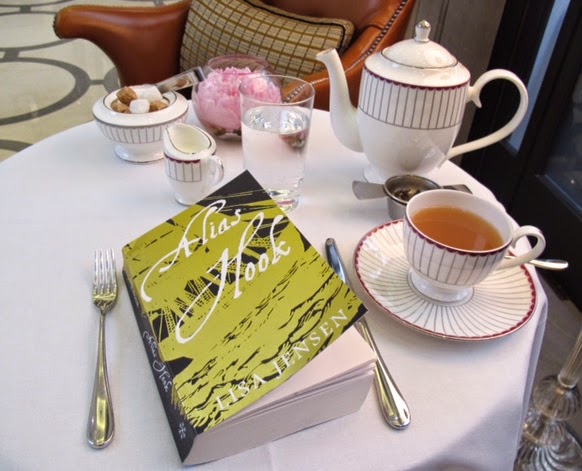
I don't know about you, but I never travel anywhere without a book. Fortunately for me, intrepid reader Kate Underwood feels the same way.
On a recent trip to London, she took along a copy of Alias Hook. (Fittingly enough, she brought the UK edition with the gold foil cover.)
And this morning, she sent me these cool pics from her excursion!
That's Kate standing next to the famous statue of Peter Pan in Hyde Park, next to the Kensington Gardens. According to her guidebook, this is the "most photographed statue in Hyde Park."
Of course, in my book, James Hook has a slightly different opinion:
He is partial to London. They have erected a statue to him there. Fancy, a public statue of Pan, the boy tyrant in his motley of leaves, like a king or a hero. While Hook is reviled, the evil pirate, the villain. There is no statue to me.
This other lovely photo speaks for itself. Afternoon tea and a good book in the Lobby Lounge a the Corinth Hotel. What could be better?
Kate also writes: "I love love love Alias Hook. I can't wait to see it on Broadway!"
From your lips to the ears of the Universe!
Wednesday, April 30, 2014
LOVE YOUR LOCAL BOOKSTORE
Despite what you may have read (probably online), the printed book is not dead. To prove it, booksellers across the state—those intrepid folks in the trenches, hand-selling books directly to you, the reading public—will throw open their doors this Saturday, May 3, for the first ever California Bookstore Day.
Event organizers have come up with lots of exclusive goodies to entice folks through the mystic portals of our favorite bookselling emporiums. For one day only, bookstores statewide are offering such limited edition items as an illustrated Neil Gaiman short story, The Sleeper and the Spindle, a signed lithograph of an illustration from Brian Selznick's The Invention of Hugo Cabret (which inspired the film Hugo), a Literary Map of California, and a signed and numbered collection of cartoonist Lisa Brown's Depressed. Repressed. Obsessed., a collection of her delicious 3-Panel Book Reviews.
(Here's Brown's take on the Twilight series. If her work looks familiar, her 3-Panel zingers appear periodically in the SF Chronicle Sunday Book Review section.)
All of these goodies and more will be available all day Saturday at Bookshop Santa Cruz—or at least until supplies run out. Festivities begin at 9 am. with free coffee from Verve for all browsers and book lovers.
In addition, BSC will offer an exclusive, hand-printed broadside featuring a previously unpublished passage about Santa Cruz written, numbered and signed by Jonathan Franzen. A very limited number of these broadsides will be given out to anyone who buys a California Bookstore Day item, or any BSC Reader's Club member making a book purchase of $20 or more.
From 1-3 pm, there will; be face-painting, balloons and storytelling for young readers. And get ready for Literary Trivia Night, beginning at 7 pm—especially if you know the only NFL team named for a character in a poem, or can name the Patronus of every wizard in the Harry Potter series. Teams can compete for cool book prizes, with refreshments provided by Santa Cruz Mountain Brewing.
Visit the BSC website for more details.
Me, I have fond memories of working at BSC back in the '70s as an infant, straight out of UCSC. (And wondering what the heck I was gong to do with a BA in Aesthetic Studies. Answer: Nothing. I ended up going to the movies for a living instead.)
I worked in the airless, frigid textbook department in the basement, where daylight never penetrated. (Note the quaint florescent bulbs.) Sure, it was kind of like working in a mine shaft, but the precious ore we were excavating was books and ideas, in all their messy, infinite variety.
In this digital age, those of us who still love ink-and-paper books are labelled fetishists—a name I wear proudly! How can you wander among the deep stacks of shelves in a bookstore or library and not feel that primordial rustling, the heart and soul of civilization waiting to be reawakened in the pages of a book?
Monday, April 28, 2014
LOOK WHO'S DANCING
Here's one for the ladies (and gentlemen of an enlightened nature).
Three words:
Sherlock.
Loki.
Dance-off.
There I was, trolling around the Internets the other day, when I found this tasty tidbit on Tor.com. Benedict Cumberbatch (beloved as Sherlock on PBS) and Tom Hiddleston (the delicious and sardonic Loki from the Thor films) in a video mash-up in which each busts some serious dance moves on chat shows, dance floors, sound stages, and a few other impromptu venues.
It's not like they're actually having a competition, you understand. Just a couple of guys letting off steam the way any of us might—by totally rocking out!
Here's the link.
Who wins?
Who loses?
Who cares?
Or, I should say, everyone's a winner with access to this irresistible video dance-off. Take 3 minutes out of your life and check it out. I guarantee, you'll be grinning like the Cheshire cat!
Sunday, April 27, 2014
BEACHED
Art loses out in irresistible doc on unmade sci-fi epic 'Jodorowsky's Dune'
They call it "the greatest science fiction movie never made." The source material is one of the most iconic, influential, and beloved of modern sci-fi novels.
The production would have teamed up an extraordinary brain trust of creative young geniuses—designers, graphic artists, and special effects wizards destined to become cinema A-listers in subsequent projects like Star Wars, Alien, and Blade Runner—along with a couple of maverick old-school geniuses. And it would have cemented the reputation of one of the most engaging nutball visionaries ever to emerge in the annals of cinema.
If only Alejandro Jodorowsky's dazzling adaptation of Frank Herbert's Dune had been made.
But now we get the next best thing in Jodorowksky's Dune, an irresistible documentary by Frank Pavich that celebrates the movie that might have been. Pavich structures his film around a series of interviews with Jodorowsky himself, the Chilean-born iconoclast with roots in avant garde theater in Mexico City and Paris, whose trippy 1970 experimental film, El Topo, became the godfather of the midnight movie.
Now a dapper 84, the cosmopolitan Jodorowsky ("Jodo" to his friends) recounts his vision for Dune with exuberant relish, and a passion undimmed by time.
As charming as Jodo is, however, Pavich's film is more than talking heads. During two years of pre-production on Dune, the director amassed a vast archive of images—paintings, sketches, costume designs, storyboards—eventually bound into an enormous volume the size of several metropolitan phone books.
This treasure trove of visual material (featuring amazing work by comic book artist Jean "Moebius" Giraud, H. R. Giger, and Chris Foss, among others), its images occasionally animated onscreen, is the centerpiece of Pavich's doc.
Ultimately, the projected budget of $15 million was enough to scare off potential backers in 1975. Maybe Jodo could never have translated his passion for Dune to the screen intact, given the primitive tools of the day. In which case, Pavich's film may be the greatest version of Jodorowsky's Dune that could ever possibly be. (Read more)
They call it "the greatest science fiction movie never made." The source material is one of the most iconic, influential, and beloved of modern sci-fi novels.
The production would have teamed up an extraordinary brain trust of creative young geniuses—designers, graphic artists, and special effects wizards destined to become cinema A-listers in subsequent projects like Star Wars, Alien, and Blade Runner—along with a couple of maverick old-school geniuses. And it would have cemented the reputation of one of the most engaging nutball visionaries ever to emerge in the annals of cinema.
If only Alejandro Jodorowsky's dazzling adaptation of Frank Herbert's Dune had been made.
![]() |
| H. R. Giger with concept sketches. |
But now we get the next best thing in Jodorowksky's Dune, an irresistible documentary by Frank Pavich that celebrates the movie that might have been. Pavich structures his film around a series of interviews with Jodorowsky himself, the Chilean-born iconoclast with roots in avant garde theater in Mexico City and Paris, whose trippy 1970 experimental film, El Topo, became the godfather of the midnight movie.
Now a dapper 84, the cosmopolitan Jodorowsky ("Jodo" to his friends) recounts his vision for Dune with exuberant relish, and a passion undimmed by time.
As charming as Jodo is, however, Pavich's film is more than talking heads. During two years of pre-production on Dune, the director amassed a vast archive of images—paintings, sketches, costume designs, storyboards—eventually bound into an enormous volume the size of several metropolitan phone books.
This treasure trove of visual material (featuring amazing work by comic book artist Jean "Moebius" Giraud, H. R. Giger, and Chris Foss, among others), its images occasionally animated onscreen, is the centerpiece of Pavich's doc.
![]() |
| Character and costume sketches by Moebius. |
Thursday, April 17, 2014
BREATHLESS
Well, so much for the hurry-up-and-wait phase of my career as a Real Author. This week has been nothing if not action-packed! As the Red Queen tells Alice, it takes all the running you can do to stay in the same place. if you want to get somewhere else, you must run twice as fast!
So what has me all breathless and excited this week? On Sunday morning, I heard from my editor at Thoms Dunne Books that the audiobook rights to Alias Hook had been sold to Blackstone Audio. Yippee!
That was great! But I also found in my inbox a note from the very high-profile and respected NYC literary agent Irene Goodman. She had just finished reading an ARC of Alias Hook, loved it, and said although she was sure I must be ably represented by now, if not, might I please keep her in mind?
Anyone who has had to suffer through my endless monologues on my attempts to interest literary agents in any of my various projects can imagine what a shock it was to have an agent of this caliber querying me!
And I thought I never got any interesting email on the weekends!
On Tuesday, the team at TDB forwarded me a very nice review of Alias Hook from Library Journal, which read, in part:
"Scintillating description and deep characterization make Jensen's Neverland a psychologically intriguing place to visit. Jensen offers a humanized take on Captain Hook that will be sure to entertain fans of the fairy tale-retelling genre."
On Wednesday, my editor sent me a fabulous jacket blurb written for Alias Hook by author Elizabeth Blackwell. Her new novel, While Beauty Slept, is a re-imagined retelling of the Sleeping Beauty fairy tale. (See, I'm not the only one who comes up with these crack-brained ideas!)
Here's her blurb:
"A captivating blend of fantasy, adventure and historical fiction, Alias Hook is a fresh, utterly convincing reinterpretation of the Peter Pan story. Lisa Jensen takes a classic villain and transforms him into someone we care about and root for all the way to the emotionally stirring end. You will never look at Captain Hook the same way again!"
Thanks, Elizabeth!
And this morning, I awoke to find my mug shot grinning out at me from the cover of the SC Sentinel (okay, I was below the fold, but still...), teasing a story Wallace Baine wrote on me in his excellent new book-related column Read Or Die in The Guide.
All I would add is that my upcoming reading/signing at Bookshop Santa Cruz has been rescheduled to Wednesday, July 16. (My bad for giving Wallace outdated info.) Also, this photo of me, used in the story, was taken by the fabulous and talented Jana Marcus.
Oh, and did I mention that on Monday, the inestimable Irene Goodman called me up to offer me representation? Of course, I said "yes" in about 2.8 seconds. Sure, most authors find an agent first and THEN get a book deal, but, hey, I'm not complaining. And she's already reading my next book!
Calloo! Callay!
Subscribe to:
Posts (Atom)